
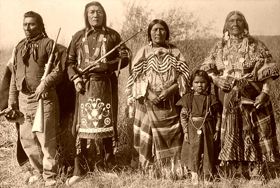
Bannock Indians.
In 1869, the Fort Hall Reservation in Idaho was set apart for 600 Bannock Indians and many Shoshone. The Indians were moved to the reservation under military escort. Almost immediately, life on the reservation was difficult for the tribes, as the promised food supplies meant to sustain them as they transitioned from a hunting-and-gathering way of life to a more settled agricultural lifestyle were insufficient to feed them. Many of them left the reservation, while others stayed but continued to travel to the Camas Prairie, where they harvested the camas to prepare for the coming winter. They also traveled off the reservation to hunt, but found the game, especially the buffalo, dwindling at an alarming rate.
With tension already mounting, a drunken Indian shot and wounded two teamsters in August 1877, and another white settler was killed by the Indians in November. When soldiers attempted to arrest the Indian, the tribes refused to turn him over, and Colonel John Smith seized 53 Bannock warriors and took away their weapons and horses. Though the situation was desperate and tempers were high during the winter, no outbreak occurred. However, in the spring of 1878, when the Bannock and Shoshone traveled to the nearby Great Camas Prairie to harvest camas roots, they discovered that white settlers were grazing their livestock on the land, and most of the camas tubers had been eaten. The chiefs then traveled peacefully to Boise to meet with the governor, again explaining the importance of the Camas Prairie. At this time, many Americans feared that the Bannock and Shoshone might join the non-treaty bands of Nez Perce in their war against the United States. At the meeting with the governor, the chief assured him that they did not intend to join the Nez Perce, and though grateful for the news, the governor did nothing about the Camas Prairie situation.
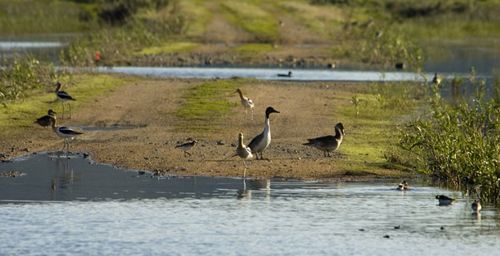
Camus Prairie.
Further fuelling hostilities among the Indians, a Bannock man shot and killed two white men on May 30, 1878. While many of the Indians remained on the reservation, others banded together under Chief Buffalo Horn and decided that they would launch a large-scale raiding offensive to drive out the white man. With a warrior force numbering about 200, the Northern Paiute warriors joined the Bannock and began to raid white settlements in search of food.
A vigorous campaign under General Otis Howard resulted in the capture of about 1,000 of them in August. The outbreak came to an end after a fight on September 5, 1878, at Charles’ Ford, Wyoming, where 20 Bannock lodges were attacked, and some 140 Bannock men, women, and children were killed. Afterward, the remaining Indians gave up and returned to the reservation.
Looking back at the causes of the Bannock War, the territorial governor explained that the Camas Prairie was the Indians’ garden and provided them with an abundant food supply. He also admitted that the government had failed to follow through on the treaty stipulation to assign the prairie as part of the Bannock tribe’s reservation. He recommended that immediate action be taken to assign it to the Fort Hall reservation or to compensate the Indians in some other way.
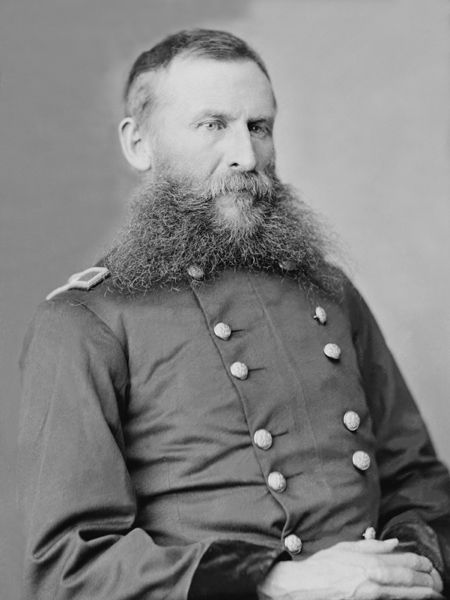
General George Crook, about 1870.
General George Crook would say that the cause of the Bannock War was hunger, stating:
“It cannot be expected that they will stay on reservations where there is no possible way to get food and see their wives and children starve and die around them. We have taken their lands, deprived them of every means of living.” Crook later wrote: “Our Indian policy has resolved itself into a question of warpath or starvation; and, merely being human, many of them will choose the former alternative where death shall be at least glorious.” The Idaho Statesman disagreed with General Crook, and the editor wrote: “It was not the want of food which started them upon the warpath, but their savage thirst for blood, which had not been restrained and prevented by proper discipline and Governmental supervision.”
©Kathy Alexander/Legends of America, updated April 2026.
Also See:
The Bannock Tribe – Roaming the Great Basin
Battles and Massacres of the Indian Wars
See Sources.