
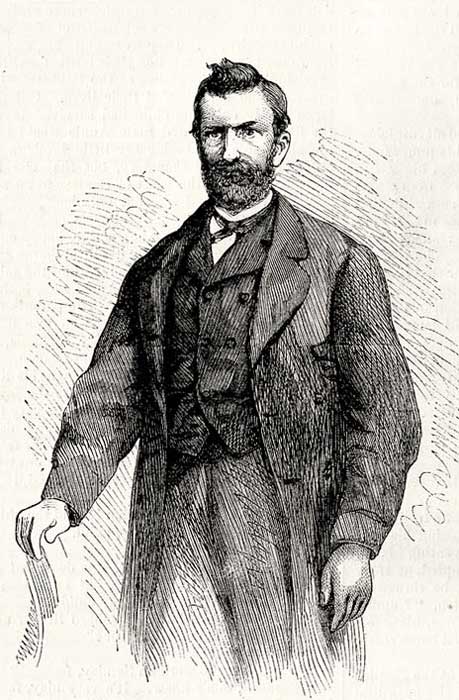
Stephen Venard.
Stephen Venard was one of the most fearless lawmen during the California Goldrush.
Venard was born on a farm near Lebanon, Ohio, in 1824. He received a good education as a child, attended Waynesville Academy, and, when he grew up, moved to Fountain City, Indiana, where he worked as a teacher. A man of strong morals, Venard soon became involved in the Underground Railroad, and his life was threatened when slave owners put a price on his head.
When gold fever swept the country during the California Gold Rush, Venard headed West in 1850. After prospecting on his own for several months with little success, he finally settled in Nevada City, California, where he worked for wages on another miner’s claim.
Over the next several years, he tried his hand at several ventures, including a grocery store and a freight business, and continued mining. However, none of these brought the financial success he hoped for, and in 1855, he took a job as a deputy under Nevada County Sheriff W.W. Wright.
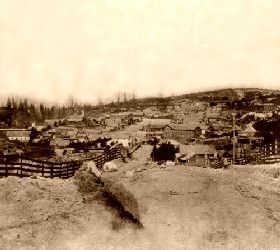
Nevada City, California, 1866.
The following year, Sheriff Wright was killed, and when a new sheriff, William Butterfield, temporarily replaced him, Venard resigned, not having been on good terms with the other officer. That same year, the infamous Henry Plummer (who would later be hanged as an outlaw in Montana in 1864) became city marshal. In 1857, Venard ran against Plummer for the position but lost in what was said to have been a rigged election.
Meanwhile, Venard continued to work in the area mines while sometimes serving as a Nevada City police officer. After Henry Plummer had moved on, Venard became the Nevada City Marshal in May 1864 and was regarded with respect, especially for his proficiency with his 16-shot Henry rifle.
On May 15, 1866, a Wells Fargo stagecoach was robbed near Nevada City by outlaws George Shanks, Robert Finn, and George Moore, who made off with nearly $8,000 in gold dust. A posse comprised of county sheriffs and Nevada City officers was quickly formed to pursue the bandits. The posse split up to look for the desperadoes, with Venard and Deputy Sheriff Lee searching near the headwaters of Myer’s Creek. The two law officers soon came upon the fugitives, and Venard killed all three with four shots when gunplay erupted.
Upon returning the gold bullion, Venard found that Wells Fargo had offered a $3,000 reward for the bandits. However, Venard refused to accept the full amount, insisting it be split among the posse members. In the end, he accepted half the reward and became an area celebrity for his bravery. Governor Frederick Low appointed Venard to his staff as lieutenant colonel in the National Guard, and Wells Fargo presented him with a new gold-mounted Henry Rifle.

Venard Gunfight.
In June 1866, Venard became a deputy sheriff in the nearby boomtown of Meadow Lake City. However, the gold soon played out, and Venard went to work as a shotgun messenger for Wells Fargo. During the construction of the transcontinental railroad in 1869, he guarded the express coaches and served in the Mountain Division for two years.
By 1871, however, he was back in Nevada City, working as a police officer. That same year, he played an important role in capturing the John Houx Gang. Soon after, Wells Fargo asked him to return as a detective as stagecoach robberies became rampant in Sonoma and Mendocino Counties.
After serving for many years at Wells Fargo, Venard died of complications from a kidney ailment on May 20, 1891. Described as a “man of modest demeanor, thoroughly temperate, of the strictest probity and not afraid of anything,” he, unfortunately, died so poor that his friends had to take up a collection to pay for his burial in Nevada City.
©Kathy Alexander/Legends of America, updated October 2026.
Also See:
See Sources.