
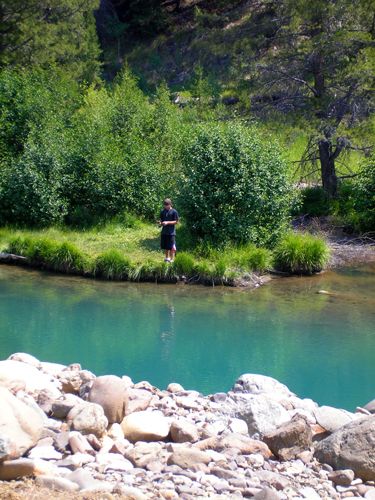
Traveling up Yankee Fork Road, the sides of the trail are piled with rocks from the dredging operation, but the river still provides numerous recreation opportunities by Kathy Alexander.
Around 1866, a group of Montana prospectors led by Joel Richardson came to what would become known as the North Fork area, searching for placer mining opportunities. When they came to a large tributary of the upper Salmon River, they set up camp and prospected for several weeks but unfortunately did not find gold. However, before returning to Montana, they named the creek “Yankee Fork” because everyone in the party was a Yankee.
Prospectors continued to comb the area, and in 1870 gold was found on a tributary of the Yankee Fork near Jordon Creek. Soon after the discovery, the Yankee Fork Mining District was organized. The first significant find was made by William Norton in July 1875, which produced as much as $20,000 in ore dug by hand by Norton and his partner, John Rohrer.
After the discovery of the General Custer Mine in August 1876 by James Baxter, E. K. Dodge, and Morton McKeim, the area began to flood with miners.
However, the three founding members of the mine realized they didn’t have the resources to develop the mine and soon sold out to an English firm.
Bonanza
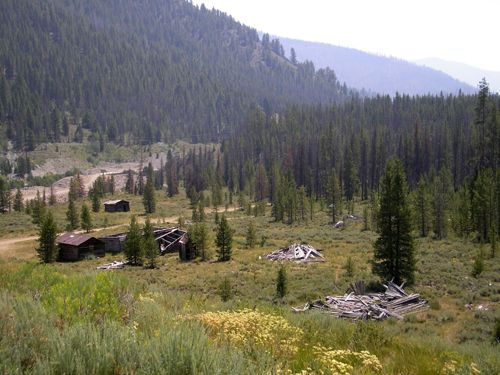
Bonanza today has a few tumbling buildings, Kathy Alexander.
With prospectors camped out all over the area, Bonanza City was laid out in 1877 by Charles Franklin, some eight miles up the Yankee Fork of the Salmon River. Generally called Bonanza, Spanish for “prosperity,” lots were first sold, ranging from $40 to $300. In the beginning, machinery and supplies had to be brought in by mule packers along a rugged 84-mile trail from Ketchum.
The settlements’ first buildings were crude log buildings that were gradually improved over time. The miners celebrated when the first saloon was built, and soon sawmills were constructed; more miners poured into the area, and plans were made to build a toll road between Challis and Bonanza in 1879.
Once it was complete, freight haulers required 5-7 pairs of oxen, mules, or horses to pull their loads on trips that would take four days to cover the 35-mile wagon trail. A daily stage was running over the toll road the following year, costing passengers $5.00 for the 8-9 hour one-way trip.
Though Bonanza never had a mine or a mill, it quickly became the hub of the area, and by 1881 it boasted some 600 people and numerous businesses, including Custer County’s first newspaper, The Yankee Fork Herald; a post office, a school, the Dodge Hotel, a blacksmith, a cafe and dance hall called the Charles Franklin House, a hardware store, grocery and variety stores, a dentist, a watchmaker, and several other businesses. The settlement also sported numerous entertainment venues, including a croquet field, a baseball field, and a small racetrack. Bonanza’s wide main street was lined with trees and several two-story buildings fronted by boardwalks or wooden sidewalks so customers wouldn’t have to walk through the mud or the snow. The town also sported a public well and a water system, providing water for its residents and fire protection.
In the meantime, Custer City had also sprung up about two miles upstream from Bonanza. However, during Bonanza’s peak in 1881, the town outnumbered Custer City two-to-one in population and sported a greater number of businesses.
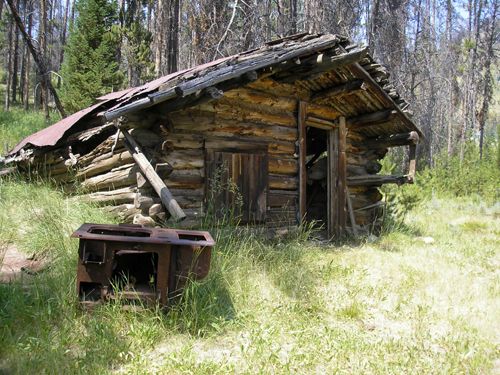
The old iron stoves always seem to sit outside these old miner’s cabins, Kathy Alexander.
Bonanza suffered its first setback when a fire raged through the town in 1889; however, it continued to survive until a second fire destroyed an entire block in May 1897. Most of the remaining merchants moved to nearby Custer instead of rebuilding. By this time, the waterworks had fallen into disrepair, and firefighters could not save the buildings.
By the turn of the century, Bonanza’s only remaining businesses were a boarding house, a saloon, a slaughterhouse, a few stables, and several cabins, as most all its population had either moved out of the area or moved upstream to nearby Custer.
Today, Bonanza has only about seven tumbling structures in various states of decay. A Forest Service Guard Station, built by the Works Progress Administration in the 1930s, is located on a hill above the old townsite, which is responsible for the care and maintenance of all the recreation facilities in the area.
Traveling westward up the hill and beyond the guard station are two cemeteries, the first of which served both the people of Bonanza and Custer, and the other, a bit further down the road and referred to as Boothill, holds only three marked graves.
The story of these three unmarked graves remains a bit of a mystery, but what is known is that a couple named Richard and Agnes Elizabeth “Lizzie” King, both natives of London, England, moved into Bonanza from Bodie, California, in the summer of 1878. The pair soon set up businesses, with Richard selling real estate and Lizzie, described as a “golden-haired beauty,” opening the Arcade Billiard Saloon and the Yankee Fork Dance Hall. The couple became good friends with Bonanza’s founder, Charles Franklin, who owned The Franklin House. However, Lizzie tended to spend the most time with Franklin, most often without her husband.
In the meantime, Richard and his real estate partner, William Dillon, weren’t getting along and dissolved the partnership. A short time later, when Dillon allegedly sold some land that belonged to King, an argument erupted, and Dillon shot and killed him on July 14, 1879. Dillon was sent to prison for ten years, and Lizzie was picking out a burial plot for her husband.
Charles Franklin, who, by this time, had become infatuated with Lizzie, was right at her side, helping her to pick out a site on the hillside that had been recently been designated as Bonanza’s new cemetery. Richard King was to be its first occupant.
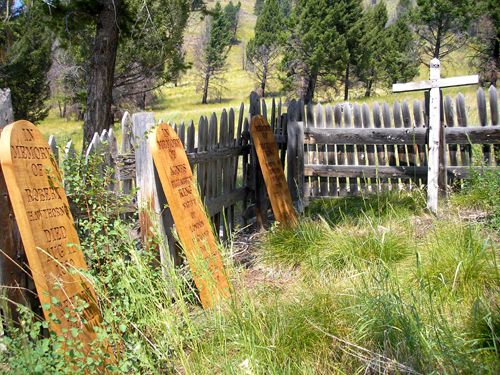
Bonanza Boot Hill by Kathy Alexander.
Franklin, who had hopes of winning Lizzie for himself, also bought two more plots, one for himself and one for Lizzie. Almost immediately after her husband was buried, Franklin began to court Lizzie openly, and rumors abounded that they would soon marry. However, Franklin’s plans were foiled when another man named Robert Hawthorne came to town and went to work for Lizzie as a dealer in her saloon. He swept the beautiful blonde off her feet because the two married on August 11, 1880. Just six days later, Robert Hawthorne and Agnes Elizabeth “Lizzie” King Hawthorne were found dead in their home.
Charles Franklin buried the newlyweds next to Richard King and, interestingly, did not include her married name on her marker. Instead of putting the date she died on the marker, he put the date of their marriage on both her and Hawthorne’s grave markers. Though suspensions were high that Franklin had killed the pair, he was never arrested. A short time later, Franklin packed up his belongings and moved to a placer claim near Stanley. A few years later, he was found dead in his lonely cabin, clutching Lizzie’s photo in a gold locket. His body was buried next to his cabin, miles away from the tiny cemetery where his love, Lizzie, lay between her two husbands.
Bonanza is about eight miles north of Sunbeam on Idaho State Road 75 (Yankee Fork Road.)
Yankee Fork Gold Dredge
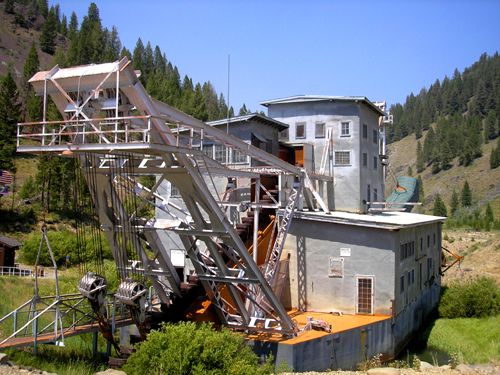
Yankee Fork, ID – Dredge by Kathy Alexander.
The Yankee Fork Dredge is just about ½ mile down the road from Bonanza. Once placer mining was exhausted and the major mines ceased operations, the Yankee Fork claims owners knew that there was still “gold in them thar hills,” or river and tailings, in this case. In the early 1930s, many placer miners who knew that valuable gold still existed on the Yankee Fork joined to see if they could find a company interested in dredging the river.
By 1938, they had interested the Silas Mason Company of Shreveport, Louisiana, whose initial tests indicated that as much as $16,000,000 worth of gold was recoverable.
They soon formed a subsidiary called the Snake River Mining Company, and the following year, the dredge began operations in October 1939. The 988-ton dredge, which was 112 feet long, 54 feet wide, and 64 feet high, went to work recovering the remaining gold. Requiring 11 feet of water to float, the dredge could dig to a depth of 35 feet and included 72 buckets, each of which was eight cubic feet in size to haul up the gravel ore.
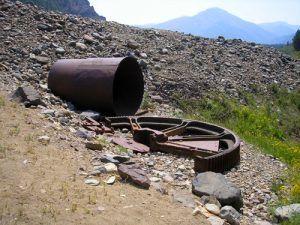
Yankee Fork, ID – Gold Dredge Tailings by Kathy Alexander.
Constantly dredging out rock and recovering the precious mineral by washing and separating the rock and dirt from the gold, the dredge operated continuously until 1942. Operations ceased briefly until 1944, when they continued again until the dredge reached a rock dike below Bonanza in 1949.
At that time, the Snake River Mining Company sold the dredge to J.R. Simplot and Mr. Baumhoff, who operated the dredge until 1951. Baumhoff then sold his interest to Simplot, who continued to operate the dredge for another year when he ran out of mining claims on which to work. In 1952, the dredge ceased production forever. One of the most efficient dredges ever in production, it recovered about $11 in ore over the years.
J.R. Simplot, the last owner, donated the dredge to the U.S. Forest Service, but there were no funds to develop it as a museum. However, in 1979, the Yankee Fork Gold Dredge Association was formed by former employees and their families, who worked hard to restore the dredge, and today it is open for tours during the summer.
Custer
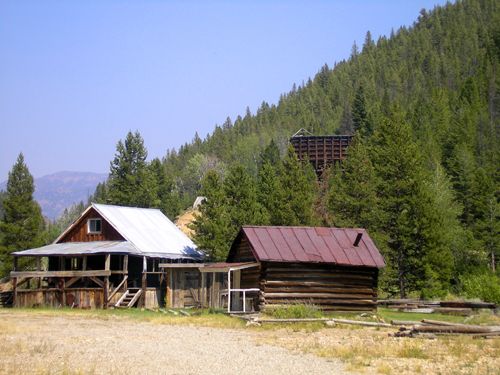
Cabins in Custer, Idaho, with a mine peeking up in the background, by Kathy Alexander.
Just two miles north of Bonanza is the more intact ghost town of Custer, which was founded in early 1879 right below the General Custer mill site. The settlement was founded by Sam Holman, a transplanted Harvard Law School graduate who had headed west and worked as a prospector rather than pursuing his law career. Coming to Yankee Fork in 1878, he became the first justice of the peace in Bonanza. He also staked a large claim two miles north of Bonanza, but rather than working the claim, he divided and sold his property as lots for building a new mill. When the Custer Mill was completed in December 1880, Custer began to grow in importance. In the 1880s, both cities flourished, as Custer grew to a population of about 300.
By the 1890s, the cities had virtually grown together, supported by the operations of the Lucky Boy and Black Mines, and were operated by common authorities. During this decade, Custer grew larger than Bonanza, especially after two fires wiped out some of Bonanza’s buildings, and the merchants moved to Custer. The town reached its peak population of 600 in 1896. In its heydays, the town boasted a post office, a general store, a boarding house, several restaurants, the Nevada House Hotel, a school, and the ever-popular numerous saloons. However, it never had a church.
At this time, town residents also passed a law forbidding any Chinese to live within the town limits, so a small Chinatown developed just southwest of Custer. The immigrants worked as launderers, cooks, and miners on low-grade properties.
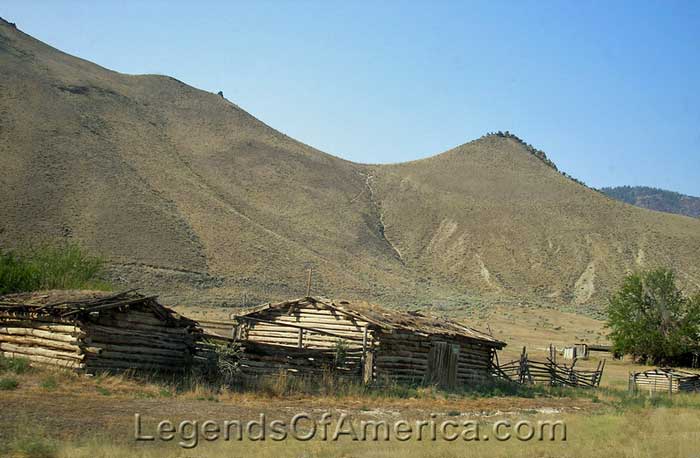
Near the Yankee Fork Mining District. Photo by Kathy Alexander.
But, by the turn of the century, the end was in sight for both communities, and in 1904, the Lucky Boy Mine and General Custer Mill closed. A few businesses continued to survive by supplying new mines near Sunbeam and the Loon Creek district, but most people began to leave. By 1910, only about 12 families were living in Custer, and when the Sunbeam Mine closed in April 1911, it spelled the end of the mining camp, and Custer became a ghost town.
However, the settlement has been restored and preserved by the Yankee Fork Historical Association, the Idaho Department of Parks and Recreation, and the Salmon-Challis National Forest.
A walking tour begins at the historic schoolhouse now serving as the Custer Museum. The tour looks at over a dozen buildings, including several cabins and homes, the Empire Saloon, the assay office, a transportation building, mining equipment, and the sites of several long-lost buildings.
More Information:
Challis – Yankee Fork Ranger District
HC 63 Box 1669
Challis, Idaho 83226
Phone: 208-879-4100
© Kathy Alexander/Legends of America, updated March 2023.
See our Yankee Fork Mining District Photo Gallery HERE
Also See: