

Asotin County – Situated in the southeastern corner of Washington in a remote mountainous area, the ghost town of Rogersburg has fewer than 25 residents today. A river boomtown stimulated by gold discoveries, the town was once accessible only by horse or boat. It wasn’t until 1938 that a road from Asotin finally reached the small village. The lost Shovel Creek Mine is thought to be on or near Shovel Creek, off the Snake River. Also near Rogersburg is said to be the Trio Lost Mine, as well as a hidden cache left by a long-ago prospector. Yet another cache is said to have been buried near Rogersburg by outlaw Charley Maguire after he robbed a stagecoach.
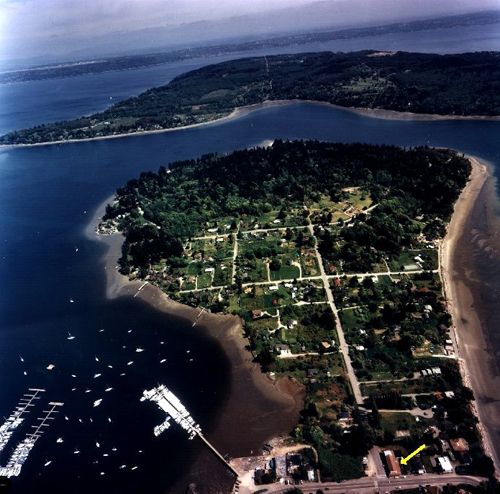
Vashon Island.
Bloom County – Vashon Island, located in the heart of Puget Sound, is where a successful lumberman named Lars Hanson lived in the 1870s. On the banks of Judd Creek, near Burton, he was said to have hidden more than $200,00 in gold coins.
Clark County – For over a century, rumors have abounded that a rich mine is hidden in the Cascade Mountains. Said to have been located near the headwaters of the Lewis River somewhere in the wilderness between Mt. St. Helens and Mt. Adams, an old Spaniard worked the mine in the 1880s. The miner often journeyed South to The Dalles, Oregon, to bank his gold at the French & Company Bank. On several occasions, other prospectors would attempt to follow him as he returned to the mine. Still, the old Spaniard was clever and always eluded them, using several tricks, including putting the shoes on his mule backward. Suddenly, the old Spaniard stopped appearing to bank his gold, and local miners began to wonder what had happened to him. About a year later, numerous Yakama Indians began showing up in several stores in Washington, paying for goods with gold nuggets. When asked where they had obtained the gold, the Indians refused to answer. Soon, rumors began circulating that the Indians had found the Spaniard’s mine. Later, a man’s and a mule’s skeletons were discovered near Spirit Lake by Mt. St. Helens. It was thought to have been the old Spaniard who the Indians had killed. The mine, which some say is hidden behind a waterfall in a cavern, has never been found.
Grant County – Outlaws are said to have buried some $30,000 in gold in a cave on Sentinel Mountain in the Saddle Mountain Range, about three miles Southeast of Beverly.
Pacific County – Captain James Scarborough was the first white settler North of the Columbia River and built a frontier cabin in 1843. He allegedly buried a treasure near his cabin on what is now Fort Columbia. If a treasure is buried there, it must stay hidden, as the historic fort is now a Washington State Park.
Stevens County – The Lost Doukhober Mine, discovered in 1929, is said to be located in the northern part of Stevens County. Ore from this mine assayed at 1,000 oz of silver per ton. Another lost cache is said to be buried at Robbers’ Roost near Fruitland.
Stevens County – Located near the town of Colville, a treasure known as The Highgrader’s Poor Farm treasure is said to be hidden. Poor Farm treasure refers to “Matte” – a crude mixture of sulfides produced when smelting gold. It is thought to be buried near an old brickyard.
Walla Walla County – According to the legend, bandits stole several gold bars in a train robbery near Wallula in the late 19th Century.
Intending to catch a boat for Portland, they missed it and buried their stolen cache near old Fort Walla Walla. Later, the bandits were shot before they could tell where the loot was hiding. Today, the old fort is gone, and the site is now Fort Walla Walla Park, on the western edge of Walla Walla, Washington.
Yakima County – Pierre Rabado’s Lost Mine is thought to be located near Mt. Adams, but it could also be in Skamania County.
©Kathy Alexander/Legends of America, updated September 2026.
Back to: Treasure Tales of Washington
Also See:
The Infamous Victor Smith & a Tale of Three Lost Treasures
John Tornow – The Wild Man of the Wynoochee
Washington – The Evergreen State
See Sources.