
By William Daugherty for the Reno Evening Gazette in 1891
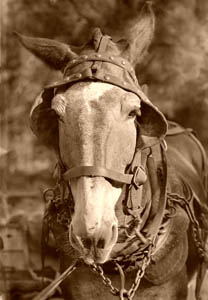
Mule by Walker Evans.
Among the pioneers of the stage business in Nevada and on this coast was Frank Cluggage, well known to the early traveling public and noted for his quiet, unobtrusive ways and his thorough financial stability. Reports said Frank became rich early in life and was never known to make a loss. Hence, his financial standing gave him prestige, which enabled him to choose good, reliable employees and thus contributed to his continued success. He was, however, equally well known for his parsimonious habits, which led him to adopt economical ways that sometimes caused him personal inconvenience.
On one occasion, desiring to save time on his mail route from Columbus in Esmeralda County to San Antonio in Nye County, which was only tri-weekly, he decided to ride the hurricane deck of a mule on one of the off days. He set out from Columbus in the early morning with no companion but his long-eared transport and had an excellent time during the first part of the journey. It was then a lonesome route, as it is yet, and he met no travelers on the way. Hence, he smoked his cigar and talked to the mule for company, thinking he had established kindly relations with the brute who had cunning light heels. The mule seemed to enjoy Frank’s talk and jogged along in a docile and becoming manner without exhibiting “any tricks that are vain.” Frank permitted his confidence to get the better of his mature judgment.
The road passes over stretches of dreary alkali deserts, with watering places far apart and no habitation within sight or reach. When Frank had accomplished most of the distance but was about 25 miles from San Antonio, he reached the last watering place. It was a shallow well amid the desert and without a well rope. This had caused travelers to cut a sloping path down to the water, and the stage company kept a bucket there for watering the stock. When Frank reached it at noon, he and the mule were thirsty. He dismounted and, as there was nothing to hitch the mule to, he left it standing at the head of the incline and descending; he first quenched his own thirst and then brought up a bucketful.
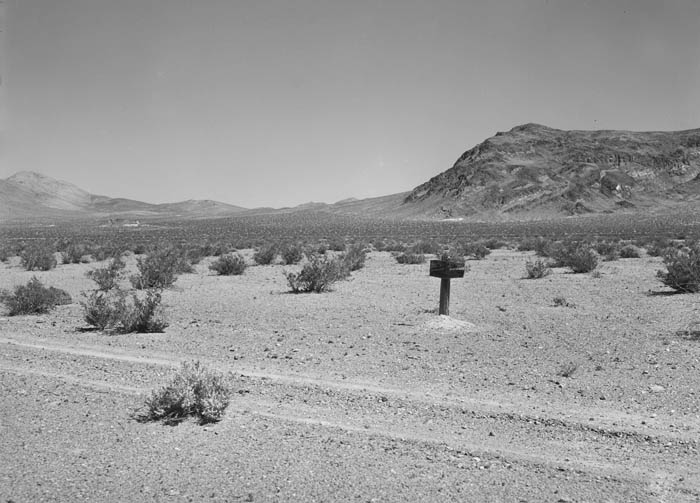
Trail in Nye County, Nevada.
For the mule, who was very dry and eagerly drank it all in very short order. Frank got a second bucket, which disappeared as quickly as the first, and then went for a third one. When he reached the surface, he stumbled; this scared the mule — Tom was his name — and with a snort, he started on the road to San Antonio.
Frank dropped the bucket and started after him. He began calling in a gentle tone, “Who-a Tom, who-a.” But Tom wasn’t to be flattered, and with an eye on Frank, he jogged along just out of reach — regulating his gait to suit Frank’s movements, whether fast or slow, but always just out of reach. The afternoon was hot, and Frank was soon perspiring as if in a Turkish bath. The mule, relieved of his burden, was provokingly cool. Frank tried a strategy, but it didn’t succeed — the mule seemed endowed with human intelligence and brute cunning. Frank talked kindly, “Who-a Tom who-a now, who-a,” but Tom kept out of reach. At last, Frank’s patience was exhausted, and with a good deal of feeling, he said, “d–n your pelt, if I ever get hold of you, I’ll break your neck.” But Tom didn’t hearken; he kept out of reach, and for the entire twenty-five miles, he kept ahead of Frank for just a few yards and, just after nightfall,l pricked up his ears and started on a brisk trot for the station that he scented in the distance, and soon left Frank out of sight, alone on the desert and feeling his way in the dark. The station keeper caught the mule and returned to search for the rider. He soon found Frank, but he was so mad he wouldn’t tell how far he had walked, which saved the mule. And Frank never told of his desert tramp with a mule in the lead until many years after.
By William Daugherty, article in the Reno Evening Gazette, May 19, 1891. Compiled and edited by Kathy Alexander/Legends of America, updated November 2025. About the Author: Written by William Daugherty for the Reno Evening Gazette in 1891. The Reno Evening Gazette was first published on October 12, 1876, and continued for the next 107 years. In 1977, it was merged with the Nevada State Journal and continues to exist today as the Reno Gazette-Journal. 1876, and continued for the next 107 years. In 1977, it was merged with the Nevada State Journal and continues to exist today as the Reno Gazette-Journal. The text here is not verbatim, as it has been heavily edited for the modern reader.
Also See:
Pioneers on the Nevada Frontier (Reno Evening Gazette)
Nevada Mining Tales (Reno Evening Gazette)
Pioche Land Jumpers and the Death of Jack Harris (Reno Evening Gazette)
Violence on the Nevada Frontier (Reno Evening Gazette)