
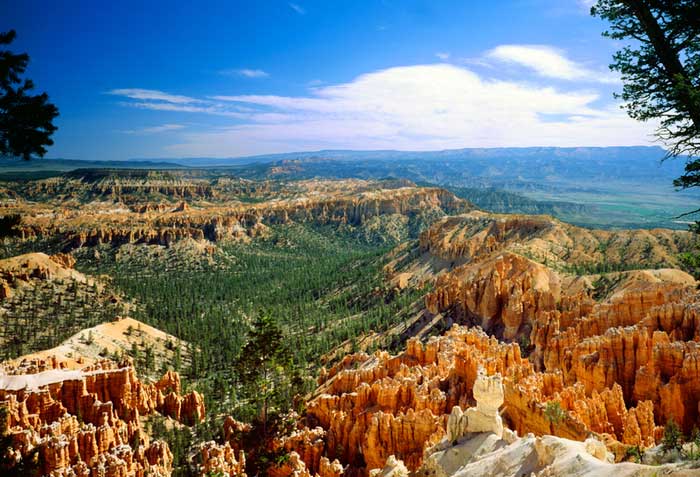
Bryce Canyon National Park, Utah. Photo by Carol Highsmith.
By Felicity Walker.
Bryce Canyon is not a canyon. It is the spectacular edge of the Paunsaugunt Plateau, where intricately carved stone towers and archways shimmer in a dazzling array of colors under the bright sun.
Utah is home to many beautiful National Parks, and Bryce Canyon National Park is among the most magnificent and awe-inspiring.
Fifteen million years ago, the Earth in this region began to shift, forming a series of plateaus. The Paunsaugunt is an extensive plateau, and the Paria River gradually eroded its edge, forming Bryce Canyon.

Bryce Canyon, Utah by Kathy Alexander.
The rock in Bryce Canyon comprises layer after layer of sediment deposits, deposited millions of years ago when the area was at the bottom of a lake. The Paria River has exposed the layers, allowing a detailed lake history to be determined.
The park was established in 1924 and was named after Ebenezer Bryce, an early settler in the area. He emigrated from Scotland, married a local girl, and then moved southwards in stages, building sawmills as he went. In the mid-1870s, he reached the Paria River, where he and his family settled for several years. At this time, Bryce made his immortal comment about Bryce Canyon – he called it “one hell of a place to lose a cow.”
The area remained undiscovered by European tourists; the first guest houses were built only after the park was officially established. Luckily, this has made Bryce Canyon an area of largely unspoiled beauty and a site of enormous scientific value, with historic information trapped in its pinnacles and spires.
The canyon is not stagnant; the rim recedes by about a foot every 50 years. Water plays the most vital role in shaping and eventually destroying the magnificent scenery in this ever-changing scene. Because the rock was laid down in layers, there is variation in the hardness of the resulting rock. When water runoff trickles across the rock, some areas erode rapidly, whereas others hold firm.
This variation in erosion rates forms pinnacles, or “hoodoos,” of stable rock. In some places, the water seeps through cracks and eats out holes beneath the surface. When the side rock erodes, an archway is left behind. Eventually, the arch collapses, leaving two more pillars to join the rest. The ever-changing vista of colors, spires, walls, and archways is spectacular in any season, and the park is open year-round.
In the warmer months, visitors can explore plenty of trails, from strolls to challenging hikes. Some of the best trails are in the Bryce Amphitheater, near the park’s entry.
Here, you can wander through the Queen’s Garden or gaze up at Queen Victoria, surveying the ‘flowers’ in her garden. Some of the area’s most awe-inspiring lookouts, including Sunset Point and Inspiration Point, are a must for any visitor. Walkers can also follow the Fairyland, Riggs Spring, and Under-the-Rim trails, which are longer but offer more opportunities to see the park’s different elements up close.

Bryce Canyon, Utah.
Summer temperatures at the base of the canyon can soar, so be prepared for the heat and carry plenty of water. In Winter, the roads are open between snowfalls, offering a different perspective on the park. Snow-capped pinnacles stand out sharply against the background of white snow and dark green trees. The air is also cleaner, letting visitors see farther. For the energetic, you can cross-country ski in several areas of the park, and on some trails, snowshoeing is an option instead of hiking.
For a slightly different view of the park, you can explore it in a 1930s limousine. Alternatively, you can rent a horse by the hour to trek along better trails.
Beyond the marvelous scenery of the ‘silent city,’ as the hoodoos are sometimes called, there is plenty to explore in the park. The park also contains many plant and wildlife species, including meadows and forests.
Ground squirrels abound near the viewing areas, and their antics can almost distract visitors from the scenery. On quiet mornings and evenings, you can also see deer, elk, and antelope grazing in the meadows.
Some bears and mountain lions also enter the park occasionally, but are rarely seen by tourists.
Bryce Canyon is a hidden jewel, and it thoroughly deserves to be as well known as its southern neighbor, the Grand Canyon. Include it on your itinerary, and you definitely won’t be disappointed.
Like almost every other visitor, you may be overwhelmed by Bryce Canyon’s fascinating, awe-inspiring beauty.
Contact Information:
Bryce Canyon National Park
PO Box 170001
Bryce Canyon, Utah 84717-0001
435-834-5322
About the Author: Traveling to the national parks in the U.S. is one of the author’s favorite things to do. Copyright Felicity Walker 2005. Article provided by: Ezine Articles (dead link). Compiled and edited by Kathy Alexander/Legends of America, updated November 2026.
Also See:
National Parks, Monuments & Historic Sites