|
Legends Home
Site
Map
What's New!!

American History
Ghost Towns
Ghostly Legends
Historic People
Native Americans
The Old West
Photo
Galleries
Roadside
Attractions
Rocky Mtn Store
Route 66
Travel
Destinations
Treasure Tales
Legends Blog
Free E-Newsletter
Facebook
Fanpage
Twittering

Contact Us
Please report
broken
links, missing pictures, or
other problems online by
clicking
HERE or send us
an
email. Thanks!
| |
|
|
|
ARIZONA
LEGENDS
Beyond Winslow
on Route 66 |
|

|
|
After
leaving Winslow
and heading west on
Route 66
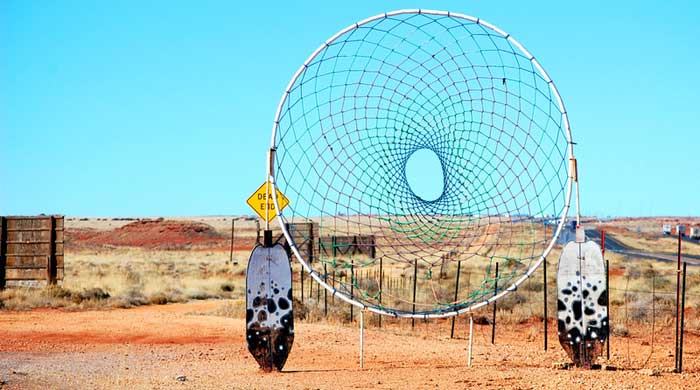
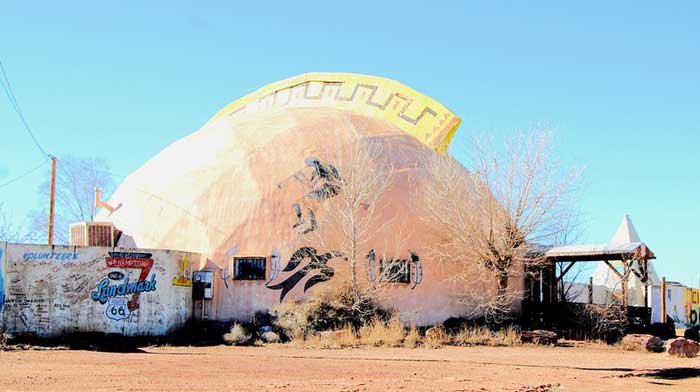
you will soon come to Meteor City, a tourist stop inviting you to sample
their many wares before heading on down to see the Meteor Crater. Just so ya
know, Meteor City, really isn’t a "city," rather, it’s trading post that
calls itself a city. However, it’s a great
photo opportunity with its geodesic dome, vintage trucks, and the world’s
largest dream catcher.
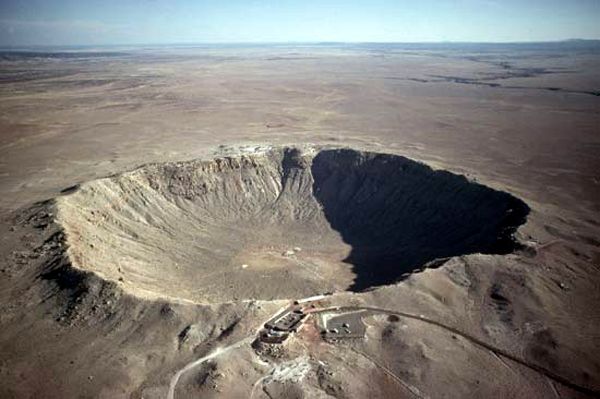
Just beyond Meteor City,
is the road to the Meteor Crater, some six miles south of I-40. The crater was formed approximately
50,000 years ago when an iron mass, weighing over 60,000 tons entered the
Earth's atmosphere, resulting in the formation which is about 4,000 feet
wide and 570 feet deep.
|

Meteor City isn't really a city, it's a
trading post,
painted and adorned in true vintage
Route 66. January, 2005, Kathy
Weiser.
This image available for photographic prints
HERE!
|
|

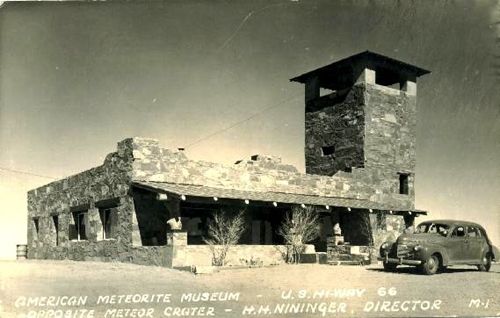
The American Metorite Museum in it's heyday.
Now, it is nothing more than a pile of stones.
|
During the hey days of
Route 66 a man named D.M.
Barringer built an observatory just off of the
Mother Road
so that the many travelers passing by the area could see the crater
without having to travel the additional six or so miles to the site.
For just 25 cents, travelers could stand from the observation tower and
see the crater through a telescope.
Today the observatory is nothing but
stone ruins; however, a visitor’s center and guided tours are available at
the crater itself.
|
|
Continuing west upon your journey you will soon see the
exit of Two
Guns. Here, there are actually two
ghost
towns –
Two Guns and
Canyon
Diablo, one almost on top of the other. Located on the far side of the canyon,
Canyon
Diablo was described, during its heyday, like this: "Tombstone,
Virginia City and Abilene could not hold a candle to this
end-of-the-rail depravity.”
Two Guns,
built after
Canyon
Diablo was already long dead, thrived during the peak years of
Route 66
popularity. Today, both towns sit silently looking upon the
canyon below. Located on private property, the site is sometimes
inaccessible, with gates closed and photo opportunities available only
from the frontage road. At other times, the gate is open,
seemingly inviting a visit.
The next
stop upon your journey is the old Twin Arrows Trading Post at exit
219. A long lasting
Route 66
icon, the Twin Arrows Trading Post didn’t cease doing business that
long ago, as its price of gas is frozen at $1.39/gallon. Sadly, its prominent red and yellow arrows are quickly deteriorating
against the desert winds and the Arizona
sun.
Padre Canyon
From Twin Arrows the oldest alignment of
Route 66
once traveled northwest of today’s I-40, crossing Padre Canyon which
dramatically breaks the relatively flat plains of the high desert.
Pre-dating
Route 66,
the 1914 Padre Canyon Bridge, on the old Flagstaff-Winslow highway,
was one of the most dangerous on the
Mother Road.
|
|
|
|
A number of serious accidents occurred here as
drivers were required to undertake six hazardous approach curves
descending into the canyon before crossing the narrow bridge, and climbing
out the other side. But, at the time it was the only way for the many
depression era travelers, and later, tourists taking vacations, to make
their way westward. Recognizing the traffic volume and the dangerous
aspects of the road,
Route 66
was re-aligned with a new bridge in 1937 in the same place that it is
today. This bridge, too, was replaced when I-40 came through, but its old
foundations can still be seen under the west bound lanes of I-40.
|
|
Today, the old Padre Canyon Bridge is listed on the National Register of
Historic Places. Though a little worse for wear, the architecture speaks
of another era when model-T’s were the norm. Though the bridge is just
about one mile northwest of the Twin Arrows exit, it cannot be seen from
the interstate because of its depth in the canyon. Located on private
property, permission should be obtained to access the bridge from the
east. Lacking permission, the bridge can also be seen by approaching it
from Winona on the old Forest Service Road. The bridge and canyon are
approximately eight miles on rough roads. A high clearance vehicle is
recommended. |

Padre Canyon Bridge, courtesy
The Road Wanderer
|
|

Old Winona Trading Post and station
postcards
|
Winona
Finally, in the words of Bobby
Troup, "don't forget Winona." Originally, the place was called
Walnut, predating its occupation in 1912. The town got its beginning when
a man named Billy Adams was making his way on a bicycle from Moody,
Texas to Long
Beach,
California to
visit his brother in the early 1900's. However, before he reached
California,
he came upon a spot, about 13 miles east of Flagstaff, which would become
Winona. He simply liked the place and traveling on to
Flagstaff he boarded a train and returned to
Texas. There
he married a girl named Myrtle and they soon returned to that "perfect
spot," building a trading post that exchanged supplies and groceries with
the Navajo and Hopi Indians for blankets, jewelry, and other native
crafts.
|
|
Though
Route 66
was not yet established, by the 1920's Model-T's were making their way
westward on the Flagstaff-Winslow Highway, passing right by the Adams'
trading post. Seeing opportunity, they soon established one of first
tourist camps in
Arizona, in 1920. Billy built 12
one room cabins as well as overnight camping for those who couldn't afford
the $1 night cabin fee. Billy's skilled trade was as a barber and after he
got the tourist camp going, he traveled to Flagstaff to work, while Myrtle
ran the store and tourist camp. Before long, a number of ranchers had
settled in the area and a post office was needed. Myrtle Adams became its
first Post Mistress in 1924. To make mail pick-up easier, she would hang
the mail sack outside so that it could be hooked by railroad men as the
train rolled by. A Texaco service station was also added. The Adams' continued to
live upstairs in the trading post through
the 1920's, when they moved across the highway. There, they homesteaded a
piece of land and Billy began ranching, a career he continued, increasing
their landholdings until they wound up with a sizeable spread and retired
in the late 1960's.
Winona grew as people began to travel
Route 66
in earnest, winding up with a population of just over 100 people. However, the small town's
Route 66
heydays would be short, as in 1937, the highway was routed south of
the town bypassing it all together. The Adams' sold the store in the
1940's to a couple named the Pills, who added a garage offering mechanical
work. When Mr. Pill retired, his son, Bill took over the operations. It
then sold two more times before closing down forever.
|
|
Winona never really prospered like so many other small
towns along the
Mother Road and never incorporated. It gained its greatest notoriety by being
mentioned in
Bobby Troup's Get Your Kicks on Route 66 song.
Today, there is little left of
Route 66 here, with
the exception of a great old bridge.
Next
stop –
Flagstaff, with its historic downtown, numerous photo
opportunities, and a wealth of side trips worth the taking.
Kathy Weiser/Legends
of America, © May, 2007 |

Old bridge at Winona,
Arizona, December,
2004,
Kathy Weiser
|
|

Canyon
Diablo ruins in the background, December,
2004, Kathy Weiser
|

Two Guns Camp, December, 2004, Kathy
Weiser.
This image available for photographic prints
HERE!
|
|

|
|
From the Rocky Mountain General Store
We've
been including great
bumper sticker
quotes in our
newsletters
since the beginning and many of you ask, why don't we sell them. Now we
do!

| |