
By Lauren Topor

Smith and Wesson Handgun.
This isn’t your typical history lesson. This is the story of Smith & Wesson Firearms, told from the Model 3 American revolver to today’s modern rifles.
The Early Days
It all started with a partnership forged in 1852. Horace Smith and Daniel B. Wesson, the business’s namesakes, learned the firearms trade while working at the National Armory in Springfield, Massachusetts. Wesson was a student of his brother Edwin, whom he worked for as an apprentice in the 1840s.
You wouldn’t know it today, but their first venture into pistols was not a financial success. Just a few years after establishing a partnership, the company was suffering financial hardship. These financial woes led Smith & Wesson to make a hard decision — sell the company to a shirt manufacturer. His name may be familiar, but you won’t likely recognize it for shirts. Oliver Winchester headed the company that acquired Smith and Wesson’s business.
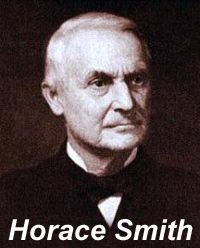
Horace Smith.
In 1866, Winchester Repeating Arms Co. began manufacturing arms using the original lever-action design invented by Smith and Wesson.
The Proof is in the Patent
When Winchester began making firearms, Smith & Wesson was still working together. The two produced a small revolver designed to fire a Rimfire cartridge, a cartridge they had patented in 1854. They found success. This revolver was the first entirely successful self-contained cartridge revolver, not just in the United States but worldwide. The two obtained patents on the revolver to prevent other manufacturers from applying their techniques, which proved very lucrative for Smith and Wesson.
A New Design
To maintain their top spot in the firearms market, the two realized they would need to update the design once their patents expired. Completed in 1869 and marketed in 1870, the Model 3 American catapulted Smith and Wesson to global firearms fame. This firearm was the world’s first large-caliber cartridge revolver, attracting attention from both domestic and international markets. Smith and Wesson achieved significant financial success in large part due to just two customers — the United States Cavalry for use on America’s Western Frontier and the Russian Imperial Government.
Moving Forward
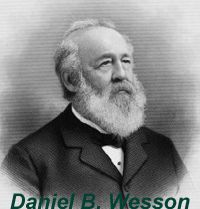
Daniel B. Wesson.
At the age of 65, Horace Smith retired from the business and left the company to Wesson. By the late 1880s, the firearms company introduced a new line of hammerless revolvers, which are still part of the Smith & Wesson firearms line today.
What came next is considered by some the world’s most famous firearm — the .38 Military and Police, or what is today known as the Model 10. Since its creation, it has been in continuous production and is used by police agencies and military forces worldwide.
In 1935, the company introduced the first Magnum revolver, the .357 Magnum, and, in 1955, the first double-action auto-loading pistol, the Model 39. Unveiled in 1956 and made famous in the Hollywood film Dirty Harry starring Clint Eastwood, the Model 29 was chambered in .44 mag. Ten years later, the world’s first stainless-steel revolver, the Model 60, was introduced, launching a new era, so to speak, of firearms.
Horace Smith and Daniel B. Wesson’s contribution to the firearms industry is undoubtedly immeasurable.
©Lauren Topor, for Legends of America, March 2017, updated November 2025.
About the Author: Lauren Topor is a full-time freelance writer and alumna of Arizona State University. Her professional work has appeared in various publications, from lifestyle magazines to business websites. Follow Lauren on Twitter @laurentopor.
Also See:
Old West (main page)
Another fun video from our friends at Arizona Ghostriders.