
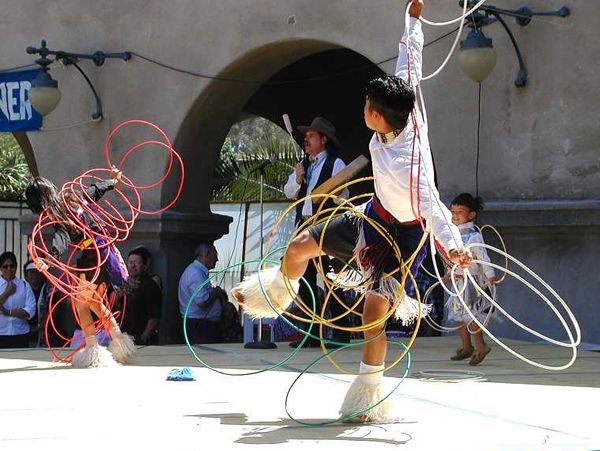
Carl Moore, Cedric Moore, and Jacob Fields performing a Native American Hoop Dance, courtesy of Wikipedia.
Going back centuries, the Hoop Dance is a storytelling dance that incorporates one to 40 hoops to create static and dynamic shapes. These formations represent the movements of various animals and other storytelling elements. In its earliest form, the dance is believed to have been part of a healing ceremony designed to restore balance and harmony in the world. With no beginning or end, the hoop represents the never-ending circle of life. The hoops, typically made of reeds or wood, create symbolic shapes, including butterflies, turtles, eagles, flowers, and snakes.
Several tales tell how the dance originated. Some say the Creator gave a dying man from the Northern Plains a series of wooden hoops and the “dance” as a gift to leave behind. Another story from the American Southwest says cliff dwellers developed hoops to help children learn dexterity.
A more prominent legend traces the Hoop Dance to the Chippewa culture, where an unearthly spirit was born to live among the people. The boy was not interested in typical boys’ activities, such as running and hunting; instead, he preferred to be alone and watch the animals. This caused his father to shun him, earning him the name Pukawiss, meaning “the disowned or unwanted.” However, the boy continued to watch the movements of eagles, bears, snakes, and birds, and before long, he spun like an eagle in flight, hopped through the grass like a rabbit, and created the Hoop Dance to teach the other Indians the ways of the animals. Soon, Pukawiss became so popular that every village wanted to learn the dance.
Today, the Hoop Dance remains a popular tradition. It is generally performed by a solo dancer who begins with a single hoop, evoking the circle of life. Additional hoops represent other life elements, including humans, animals, wind, water, and seasons. The dance incorporates rapid moves in which the hoops are made to interlock and extend from the body, forming appendages such as wings and tails. Practiced by several tribes today, it has evolved over the years, becoming faster and incorporating many non-traditional influences. It has also become highly competitive, with the first World Hoop Dance Competition held at the New Mexico State Fair in 1991. Today, the most popular competition is held annually at the Heard Museum in Phoenix, Arizona.

Native American hoop dance in Molalla Buckeroo. Molalla, Oregon, in 1936. Photo by Arthur Rothstein.