
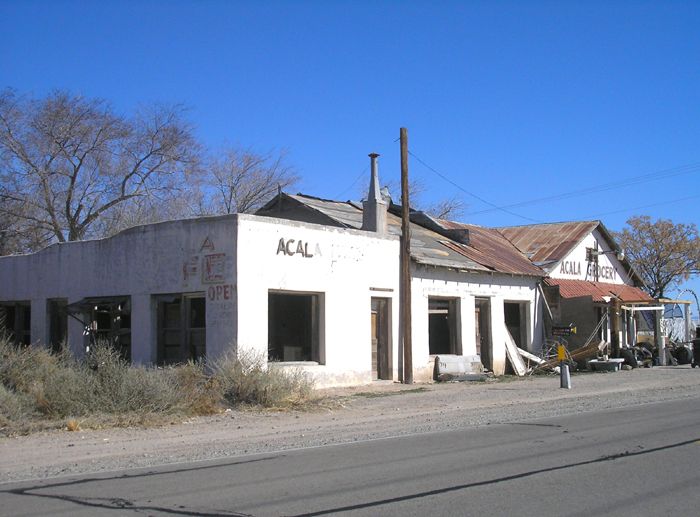
Alcala, Texas Buildings by Kathy Alexander.
Acala, Texas, is a ghost town in Hudspeth County, in the El Paso Valley of the Rio Grande.
Though the area comprises a scrub-brush desert, various crops have been grown in the region for hundreds of years, utilizing the waters of the Rio Grande. During the late 19th century, settlers began constructing large canals to carry the river water to distant fields. But no crops were planted in the area where Acala would be established until after the introduction of cotton to the region.
In 1917, three farmers combined their resources to plant experimental cotton near Tornillo, about 13 miles northwest of where Acala would later be located. After a successful first year, the men purchased more land the following year to grow irrigated cotton.
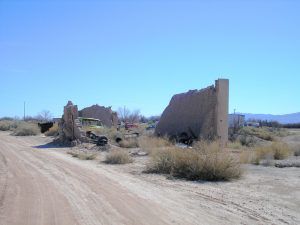
Alcala, Texas Ruins by Kathy Alexander.
Hearing about the success of these farmers, W.T. Young came to the area from El Paso, Texas, to try his hand at cotton farming. He purchased a large acreage of inexpensive desert land near the Southern Pacific Railroad tracks, southeast of Tornillo. Using mules to clear the brush and break the soil for the first time, he planted a Mexican variety of cottonseed called Acala. He was so successful that he built his cotton gin at the site known as Acala.
Soon, a road was built through the area, which connected El Paso with Fort Hancock. First called the Bankhead Highway, it later became U.S. Highway 80. Along with the railroad siding, this road provided ideal opportunities to ship cotton.
By the early 1920s, a town grew around Young’s cotton gin. Before 1925, a post office was established with Mrs. Julia A. Vaughn as postmistress. In 1927, Acala had a population of 50, and by 1929, that figure had doubled. In time, the town boasted a general store, tourist courts, a restaurant, a gas station, and a garage. Throughout the area, numerous canals and wells were dug for irrigation.
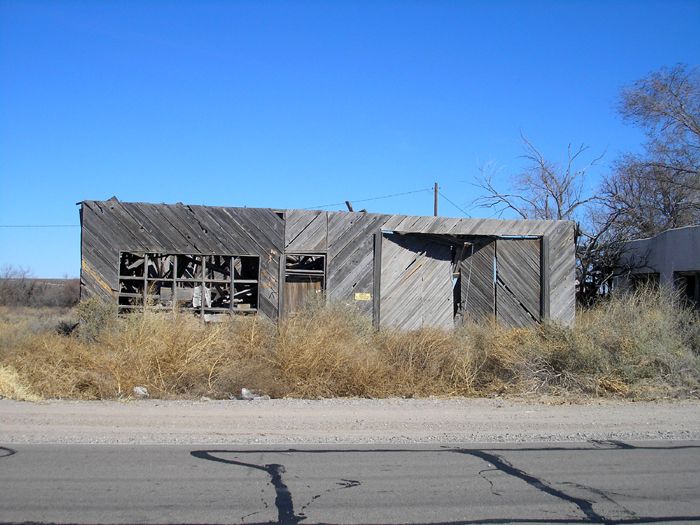
An old building in Acala, Texas, by Kathy Alexander.
Over the following decades, Acala’s population fluctuated with economic conditions, with approximately 100 residents in the 1950s. However, with the increased mechanization of cotton farming, the need for field workers decreased, and people began to relocate. By the late 1960s, the population had dropped to 50; the last available figure was 25 in the early 1970s.
Over the years, the railroad removed its spur to the town, and Interstate 10 replaced the old, two-lane Highway 80 through Acala, bypassing the town.
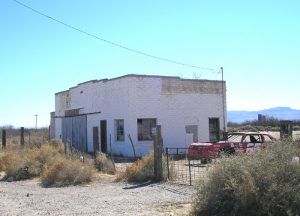
An old business in Acala, Texas, by Kathy Alexander.
Today, Acala contains several scattered residences and former business buildings. The old canals still carry Rio Grande water to the area’s agricultural fields.
Acala is located on Texas State Highway 20, 4.8 miles northwest of Fort Hancock.
©Kathy Alexander/Legends of America, updated November 2025.
Also See:
Texas Ghost Town Photo Galleries
Sources:
Baker, T. Lindsay; More Ghost Towns of Texas, University of Oklahoma Press, 2005.
Texas State Historical Association
Wikipedia