
By William Daugherty in 1891
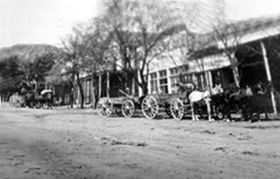
Early Pioche, Nevada.
During the rushing days in White Pine, Nevada, in the exciting times of 1869, one of the busy men of Hamilton was Ed Estes. He was a saloon keeper, and connected with it was a large gambling hall that was always crowded. Ed did not gamble, but he paid the State licenses on the tables, leased them out to others who paid the rents, furnished the money, and threw extensive patronage into the bar. This involved substantial capital, and as an illustration of the amount required, the quarterly licenses alone came to $2,800. Large sums were nightly deposited in the saloon safe, and a special watchman was employed to guard it.
The house was doing a large business, and Estes was also interested in mining enterprises that called for heavy outlays. He handled money carelessly, and when the collapse came, he found himself without any and utterly unable to tell what had become of it. Amid his financial distress, some eastern parties appeared to be considering his mining properties, and, desiring to make a good impression upon them, he determined to entertain them royally during their brief stay. This would involve an expense of $200, and, as he was short, he tried to borrow it from a friend, but the friend didn’t have it and suggested that Estes try to obtain a loan from the First National Bank.
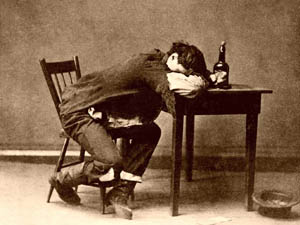
Drunk Man.
Estes was doubtful about obtaining it, as the bank refused loans unless they were accompanied by gilt-edged security. But, as a last resort, he walked in and, accosting the cashier, said: “Good morning, Mr. Gilmore; by the way, I hear you are getting pretty close in banking matters lately; how does my account stand?” He did not express himself clearly, nor did he mean what he said, for he supposed the account was balanced and closed long before, and the remark was thrown out to pave the way for a loan. The cashier turned to the balance book and pleasantly informed him that $1,750 was credited to his account. It startled Estes so much that he could barely speak, but he managed to say, “You may give me $250 that I need this morning.” The cashier replied, “All right; fill out a check,” and handed him a blank one. Estes was too nervous to write and asked the cashier to fill it out for him, which the cashier did. This gave Estes time to gather his wits, and he said: “I believe I will need it all today, so fill it out for the total.” This was done, and the money counted out to him, and Estes hurried out to conceal his surprise. He confidentially informed a friend that he had no recollection of having made the deposit and added, as he invited him to take a drink, “I must have been pretty drunk when I did it, and I guess that’s what was the matter.”
By William Daugherty, for the Reno Evening Gazette, March 23, 1891. Compiled and edited by Kathy Alexander/Legends of America, updated October 2024
About the Author: William Daugherty, who wrote for the Reno Evening Gazette in 1891. The Gazette was first published on October 12, 1876, and continued for the next 107 years. In 1977, it was merged with the Nevada State Journal and continues to exist today as the Reno Gazette-Journal.
Note: The article is not verbatim as spelling errors, minor grammatical changes, and editing have occurred for the ease of the modern reader.
Also See:
Pioneers on the Nevada Frontier (Reno Evening Gazette)
Tales of the Overland Stage (Reno Evening Gazette)
Nevada Mining Tales (Reno Evening Gazette)