
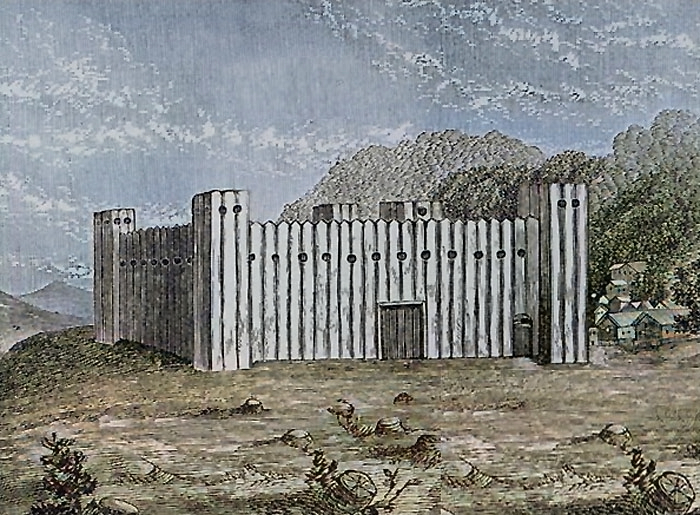
 Fort Solomon was built in Ottawa County, Kansas, in early 1864, when Indians became very troublesome. Their raids were frequent in adjoining counties, and six settlers in Saline, Ottawa, and Mitchell Counties lost their lives.
This prompted several families to band together for protection. Israel Markley, S.M. Wright, J.C. Boblett, J.C. Stull, A. Boss, S.Z. Boss, Thomas Dalrymple, Chapman, H.S. Wooden, J.M. Jones, Al and Ed Schellenbrand, and others built Fort Solomon on the East side of the Solomon River. The fort was a settler’s stockade for defense against the Indians, not a military post.
It was built on level ground, and the West side was bordered by a deeply cut bank along the river. The fort offered good views in all directions. The “stockade” itself was situated back 100 feet or more from the steep riverbank. Once completed in spring or summer 1864, the fort contained about 20 log houses arranged in a square and enclosed by a log stockade with at least three gated entrances. The structure’s walls and roof were covered with two or three feet of earth. It may have had gun ports.
Inside the enclosure was a well, a schoolhouse, and a well-protected dugout five feet deep, built of heavy timbers. Every precaution was taken to be prepared for a long siege, which, fortunately, the settlers did not have to endure. Most people in the county lived in these houses from the summer of 1864 to the spring of 1865.
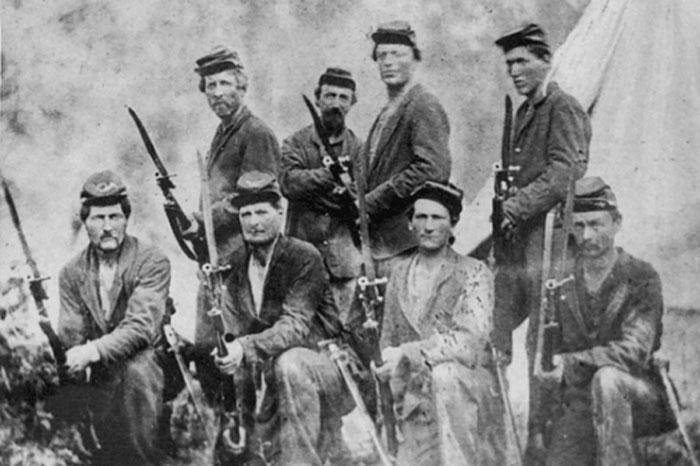
Kansas Militia.
While the fort was being constructed, the Solomon Valley Militia was organized, attracting about 30 men. They were armed with aging guns and a small cannon, probably a mountain howitzer. Most, if not all, of the weapons originated from Fort Riley.
This structure replaced the much smaller dugout owned by the Chapman family, which served as a refuge in times of trouble. The Chapman dugout was about a mile South of Fort Solomon.
Colonel John Kerwin started the first store at Fort Solomon in 1866.
The town of Lindsey, Kansas, grew just outside Fort Solomon, taking advantage of its protection. For a time, Lindsey was the county seat of Ottawa County.
The Cheyenne Indians raided within a few miles of the place twice — near Delphos in October 1868, and at Pierce’s Ford, just above Minneapolis, in the summer of 1869.
Afterward, the Indian raids ceased, and Fort Solomon was abandoned. By 1871, only a few cabins remained. Eventually, the fort’s structures collapsed from lack of maintenance.
©Kathy Alexander/Legends of America, updated October 2026.
Also See:
Sources:
Cutler, William G.; History of Kansas; A. T. Andreas, Chicago, IL, 1883.
Kansas State Historical Society
Wikipedia