
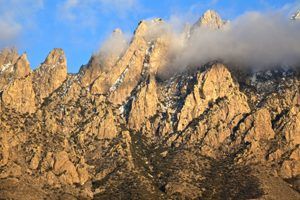
Organ Mountains in Southeast New Mexico by the Bureau of Land Management.
A priest named LaRue was stationed at Chihuahua, New Mexico, in 1797, during the last years of the Spanish occupation. Sitting with an old, dying soldier, Father LaRue listened as the man told him about a rich gold-bearing lode in the mountains North of El Paso del Norte (El Paso, Texas, today).
The soldier explained to LaRue that the mother lode could be found by traveling one day North of El Paso until three small peaks could be seen. When the peaks came into view, the journey would turn East across the desert to the mountains. In the first mountain range, a basin would have a spring at the foot of a solitary peak. A rich vein of gold lay in this mountain.
Soon after the soldier died, drought and famine devastated the Chihuahua settlement. The Padre called the villagers and asked if they would follow him North to a better climate and more water. They agreed, and the party moved North. After crossing El Paso del Norte, they followed the Rio Grande to the small village of La Mesilla near Las Cruces, New Mexico. North of there, they sighted the three peaks and turned East across the dreaded Jornada del Muerto desert, finally arriving in the San Andreas Mountains. After a couple of days of exploration, they found a basin with a spring at the base of a solitary peak, just as the old man had said. After settling the new colony at Spirit Springs in Doña Ana County, Larue sent the men out to search for gold. On one side of the peak, they located a rich vein in a deep canyon Southwest of the springs. They tunneled into the mountain and followed the vein downward. The deeper they went, the richer the ore became. The priest assigned dozens of monks and Indians to mine the gold, form it into ingots, and stack it along one wall of a natural cavern inside the mountain. LaRue extracted the gold from the mountain for two years, stockpiling it.
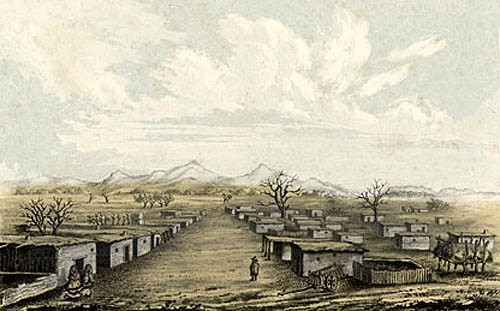
Historic La Mesilla, New Mexico.
Word leaked into Mexico that LaRue had set up his little empire, and he was extracting large quantities of gold. The Spaniards wasted no time in rounding up an expedition to send North. When a small group was in La Mesilla purchasing supplies, they learned the Mexican Army was on the horizon. Hurrying to camp, they spread the alarm. It was one thing for Padre La Rue to leave his post without permission from church officials in Mexico City, but it was quite another not to deliver the Royal Fifth (or Quinta) of the gold for shipment to Spain.
Father La Rue immediately set about concealing all traces of the mine. Working day and night, knowing the soldiers were drawing ever closer, he had his small group labor to seal the mine entrance. When the soldiers finally arrived and demanded to know where the gold came from, which was used to purchase the supplies in La Mesilla, Padre La Rue refused to answer. He died under torture, as did many of his followers. The soldiers searched the entire area, but finding no clues, they returned to Mexico empty-handed.
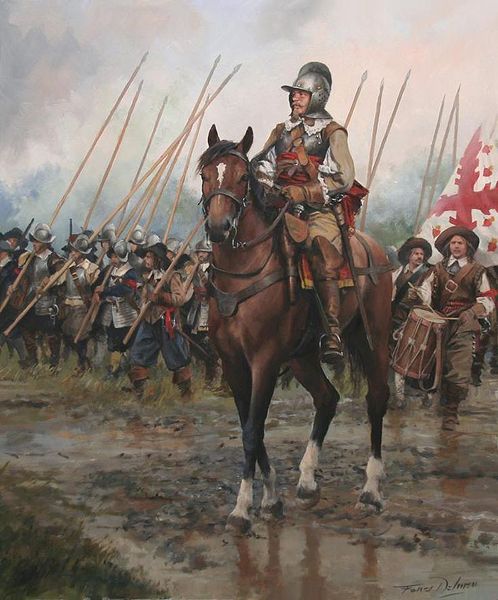
Spanish Conquistadors.
Although the historical facts suggest LaRue was in the Organ Mountains between present-day Las Cruces and Alamogordo, his mining operation was deep in the San Andres Mountains North of Las Cruces. According to the legend, the treasure was concealed here.
©Kathy Alexander/Legends of America, updated October 2026.
Back to:
New Mexico – Land of Enchantment
The Spanish Exploration of America
Treasure Hunting in New Mexico
See Sources.