
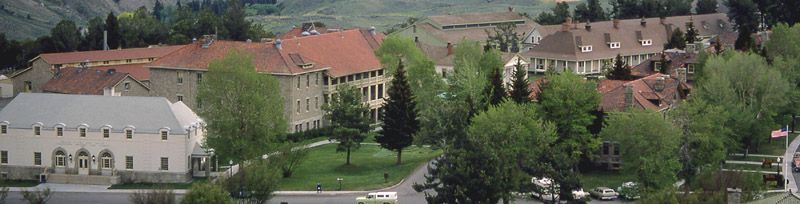
Fort Yellowstone by Hugh Crandall, National Park Service.
From 1886 until the creation of the National Park Service in 1916, the United States Army administered and managed Yellowstone National Park. However, the park was established in 1872, and for the intervening years, it suffered neglect from poachers and vandals.
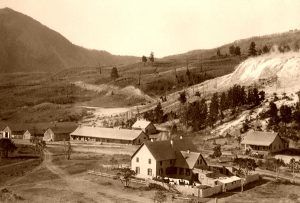
Camp Sheridan, Yellowstone, Wyoming, in about 1900.
Because the Federal Government administered the first National Park in the country, it had to learn over several years what would work best for park administration. In 1872, Nathaniel P. Langford was appointed as the first superintendent of Yellowstone. However, there was no funding for a salary, so he was forced to earn his living elsewhere and, during his five-year term, entered the park only twice. The second superintendent was Philetus Norris, who volunteered for the position. Reporting on the problems he witnessed firsthand, Congress finally provided funds for a salary and a minimal amount to operate the park.
Additional superintendents followed, but without adequate help, Yellowstone’s natural resources were being destroyed as poachers killed animals, souvenir hunters broke off pieces of geological formations, and developers established numerous tourist camps. The good intentions of these early administrators were no match for their lack of experience, funds, and manpower.
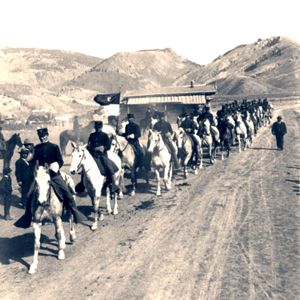
Fort Yellowstone Cavalry 1903.
As a result, the park sought assistance from the U.S. Army. In August 1886, men from Company M of the First United States Cavalry, stationed at Fort Custer, Montana Territory, under Captain Moses Harris, arrived in Yellowstone to begin more than 30 years of military presence in the park. At first, the troops lived in temporary frame buildings at Camp Sheridan, established at the foot of the Mammoth Hot Springs Terraces. After enduring five cold, harsh winters, the cavalry realized there was no end in sight to this assignment. Therefore, in 1890, Congress appropriated $50,000 for a permanent post.
Fort Yellowstone was completed by late 1891. Additional buildings were constructed as troop levels increased, including officers’ quarters, a guardhouse, headquarters, stables, barracks for enlisted men, and noncommissioned officers’ quarters.
In the winter of 1894, soldiers caught the notorious poacher Ed Howell killing buffalo. Because no laws existed to prosecute Howell, public indignation prompted Congress to enact the Lacey Act to protect Yellowstone National Park’s birds and animals and to punish crimes committed within the park.
In 1903, a building was constructed to serve as the headquarters for the Army Corps of Engineers, which was tasked with building and maintaining Yellowstone’s roads and bridges. During their tenure, they constructed over 400 miles of roads, a hydroelectric power plant that provided electricity for the fort’s buildings, and a water system.
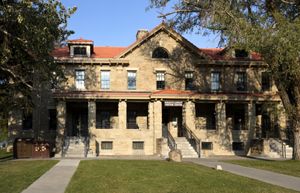
The old bachelor’s quarters at Fort Yellowstone now serve as a visitor center, as documented by Carol Highsmith.
In 1909, Scottish masons began constructing sandstone buildings in the park, including the Bachelor Officers’ Quarters, which now serves as the Albright Visitor Center; two-troop barracks for 200 men, which now serves as the administration building; and, later, the Chapel, the last of the structures to be built in 1913. Before its completion, religious services were held in the troop mess hall, the post exchange, or a private residence. The Chapel continues to serve the community today. These buildings were built of native sandstone from a local quarry between the Gardner River and the Mammoth Campground.
In 1910, at the height of the Army’s presence in Yellowstone, 324 soldiers—plus some families and numerous civilian employees—were stationed here. These troops staffed Fort Yellowstone and were stationed throughout the park in small details at various outposts.
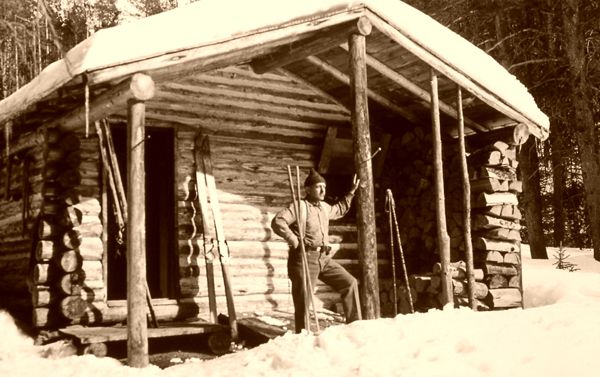
Ranger in front of one of the backcountry cabins.
Over the years, the Army has established several backcountry outposts to provide facilities for troops patrolling for poachers. Typically, these are about 16 miles apart, about a day’s travel by horseback.
Each cabin was built in a rectangular “Rocky Mountain” style, with sod roofs and dirt floors. Generally built on the edge of a relatively flat meadow, each cabin featured 1-2 rooms incorporating sleeping, cooking, and work areas.
Several backcountry cabins remain in use by the National Park Service for backcountry patrols. Today, they were updated to include shingled roofs and concrete floors. They are located in remote parts of the park and are accessible only by foot and horseback.
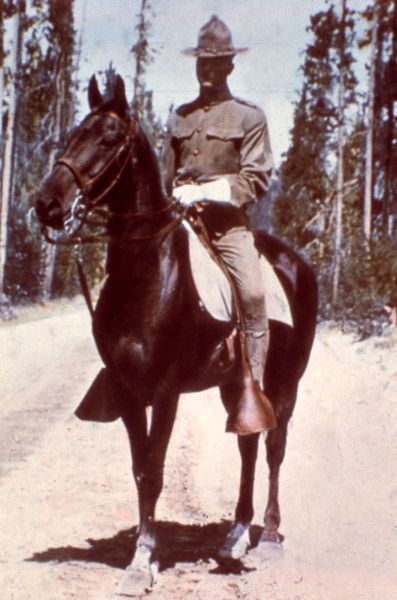
Fort Yellowstone Patrolman.
Fort Yellowstone was considered a prized assignment by many officers and enlisted men because of the post’s good facilities, relaxed discipline, and interesting surroundings. However, the park’s protection did not suffer. Soldiers were ordered to “conduct themselves in a courteous and polite, but firm and decided manner” when carrying out their duties.
A few years later, the Federal Government began to consider establishing alternative means of administering the park. In 1912, President Taft, in a special message to Congress, said: “I earnestly recommend the establishment of a Bureau of National Parks. Such legislation is essential to properly managing those wonderful manifestations of nature, so startling and so beautiful that everyone recognizes the government’s obligations to preserve them for the improvement and recreation of the people.”
The National Park Service Act was signed on August 25, 1916. Soon after, soldiers were discharged from the Army to form the first ranks of park rangers and a maintenance force. On October 1, 1916, the National Park Service assumed responsibility for the protection of Yellowstone National Park “by arrangement with the War Department, and with its hearty cooperation.” Although local opposition led to one final episode of Army residency, the National Park Service assumed full administrative responsibilities in 1918.
Today, the Army’s legacy is visible in wood and stone, and the very survival of Yellowstone is one of the world’s great symbols of the National Park idea. Fort Yellowstone is also noted by conservationists to have helped define how National Parks were to be managed. During the Army’s tenure, they developed regulations that emphasized conservation, and under their watchful eyes, the features and wildlife of Yellowstone National Park were protected from vandalism and extinction. The National Park Service later adopted many policies initiated by the Army at Yellowstone.

Soldiers drill on Parade Ground at Fort Yellowstone, Wyoming, circa 1910.
Today, the old post is the Fort Yellowstone-Mammoth Hot Springs Historic District, designated as a National Historic Landmark on July 31, 2003. Within the district is the administrative headquarters for the Yellowstone National Park. It is located in the northwestern portion of Yellowstone National Park on an old hot springs formation.
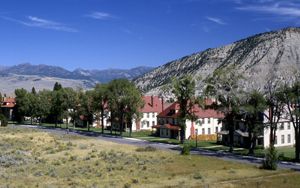
Fort Yellowstone, Officers’ Row as seen from Capitol Hill, by the National Park Service.
Numerous buildings from Fort Yellowstone’s tenure, including the Captain’s Quarters, Post Headquarters, Guard House, Hospital Annex, Commissary, and Quartermaster storehouses, continue to stand. A self-guided trail directs visitors to numerous historic buildings.
Contact Information:
Yellowstone National Park
P.O. Box 168
Yellowstone National Park, Wyoming 82190-0168
307-344-7381
©Kathy Alexander/Legends of America, updated December 2025.
Also See:
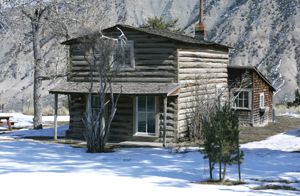
Mail Carrier Cabin at Mammoth Hot Springs, courtesy of National Park Service.
Forts & Presidios Photo Gallery
National Parks, Monuments & Historic Sites
The Yellowstone Tragedy, a Legend
See Sources.