
By Jim Hinckley.
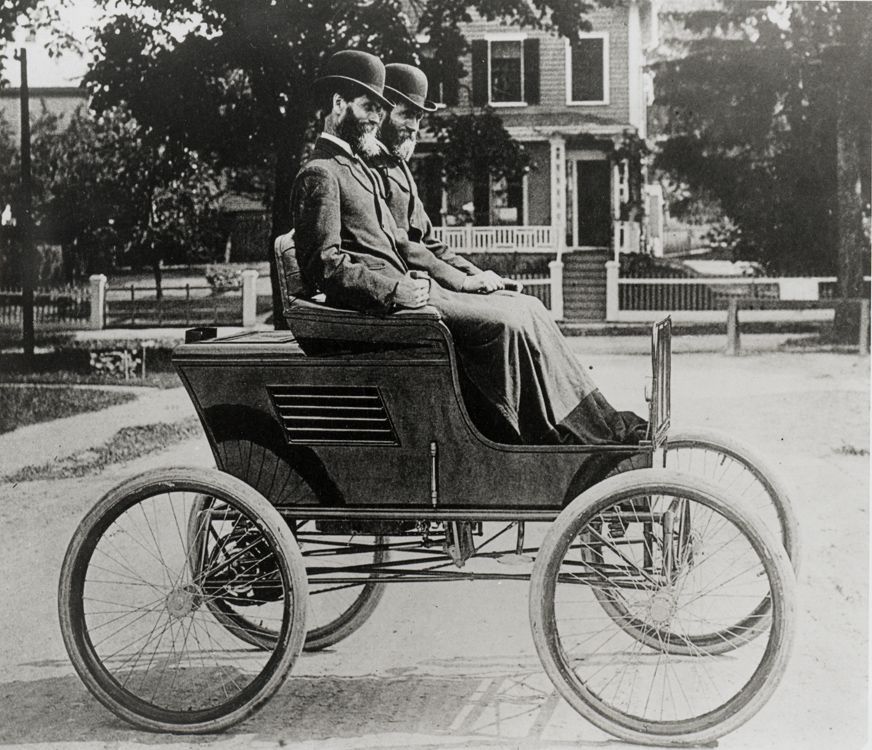
Stanley Twins in their first car, photo from the Stanley Museum
An old adage says two heads are better than one. Well, with the Stanley twins, F.O. and F.E., the adage was made manifest in spades.
The brothers began showing signs of sharp, inquisitive minds at a very early age. They also proved quite ambitious in their quest for knowledge.
Both brothers pursued a career in teaching, but for minds as imaginative as theirs, the confines of a classroom proved too restrictive. Instead, they turned their creative talents toward inventing and manufacturing endeavors, including establishing the first company for the commercial manufacture of violins, inventing a home gas generator for illumination, and pioneering early X-ray equipment.
Initially, success proved elusive. Then, in 1875, at age 26, F.E. purchased a photographic studio for $500, an endeavor that would become the brothers’ path to fame and fortune.
A decade of attentive management provided the capital to develop the first practical dry photographic plate process. F.O. joined his brother as a full partner in the new company.
In 1888, the facility in Lewiston, Maine, was sold, and a new, larger company, Stanley Brothers Dry Plate Manufacturing Company, was established in Watertown, Massachusetts. This pioneering company did not fall to anemic sales, poor management, malfeasance, or even technological development that rendered its primary product obsolete, but to a pivotal encounter with a steam-powered carriage display at the Brockton, Massachusetts, fair in 1896.
Though the initial demonstration of the primitive automobile was a lackluster affair marked by multiple breakdowns, it was enough to pique the inquisitive and imaginative mind of F.E. Early. In 1897, a steam engine and boiler were purchased from J.W. Penny & Sons, a body was purchased from Currier, Cameron & Company, and a wide array of other parts was acquired from a variety of manufacturers.
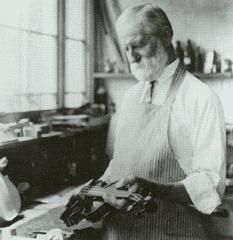
F.O. Stanley around 1920
The Stanley-built “steamer” debuted at the 1897 Brockton Fair, and the response was so strong that the brothers were compelled to manufacture three more “steam wagons,” each improving on the predecessor. The last of these initial models sold for $650 to John Brisbane Walker in 1898, who later sold it for a profit to Amzi L. Barber, a financier who specialized in investing in new technologies.
The Stanley-built “steam wagon” Walker bought generated so much interest that both Walker and Barber began negotiating to buy out the Stanley brothers. Initially, the brothers rejected these overtures and instead concentrated on perfecting their vehicle.
In November 1898, F.E. stunned more than 5,000 spectators as he drove the improved model around a one-third-mile track to set a new world automotive speed record, averaging 27.4 miles per hour without mechanical failure.
Inundated with hundreds of orders after the demonstration, the brothers felt compelled to begin manufacturing automobiles for sale to the general public. The first step in this new endeavor was acquiring a former bicycle factory adjacent to their former photographic plate company from Sterling Elliot in January 1899. Next, they established standardized, interchangeable mechanical components for their vehicles, and arranged with Currier, Cameron & Company to supply bodies.
By summer, they had completed and sold 100 vehicles, and the brothers had acquired patents for numerous key components. All of this led Barber and Walker to redouble their efforts to purchase the company.
By the end of the summer, the brothers succumbed to the astounding offer made by John Walker, who purchased the company the brothers had built for less than $20,000 for $250,000. He immediately sold half interest in the company to Amzi L. Barber for $250,000. Initially, the new company manufactured vehicles under the name Automobile Company of America, but within weeks it reorganized as Locomobile Company of America. Almost immediately the partnership disintegrated, and on July 18, 1899, it was announced, “A. Lorenzo Barber and J.B. Walker, organizers of the Locomobile Company of America, have made a partition and the outgrowth of this is two companies; Barber will retain the Locomobile Company in Watertown, Mass. and will manufacture Stanley Carriages. Walker has taken the Mobile Company of America and will manufacture Stanley Steam Vehicles. The Stanley brothers will act as general managers of both companies for one year.”
As a historical footnote, in 1899 the Stanley brothers played a key role in the launching of another American corporate icon. The sale of their patents and photographic plate manufacturing company became the cornerstone for the Eastman Kodak Company.
In 1901, as advances in the gasoline engine made it more practical, Locomobile reorganized, abandoned steam propulsion, and sold the Stanley patents and former factory to the Stanley brothers, who had been developing improved components for steam engines. The rest, as they say, is history.
By 1903, the all-new Stanley Brothers Manufacturing Company was well on its way to becoming an automotive icon that would outlive the company and the brothers, even though sales never surpassed 10,000 units per year. In part, this status resulted from stunning, record-setting prowess.
In 1906, at Ormond Beach (now Daytona Beach), Fred Marriott of the company’s repair department piloted a special-bodied Stanley to a stunning 127 miles per hour, a new automotive speed record. The following year he survived a horrendous crash at nearly 150 miles per hour during an attempt to break that record.
The death knell for the company sounded in 1912 with the introduction of an electric starter as standard equipment on Cadillac. A primary obstacle to the dominance of gasoline engines had been breached.
The company soldiered on despite declining sales until 1923, when it slid into bankruptcy and receivership. The assets formed a primary component in the formation of the Steam Vehicle Corporation of America, a company that produced a scant handful of vehicles under the Stanley name until 1927.
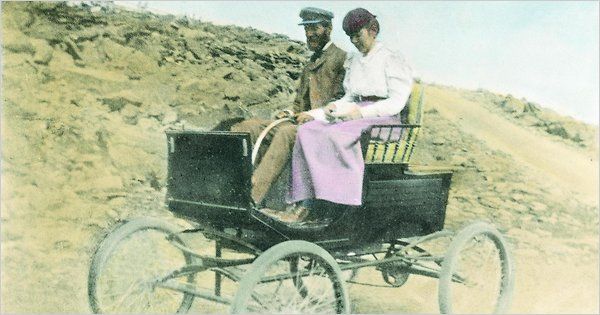
F.O. Stanley and wife Flora driving to the top of Mount Washington, New Hampshire on August 31, 1899.
The Stanley brothers were not myopic in their endeavors. In 1903, under a doctor’s recommendation, F.O. Stanley began spending time in Estes Park, Colorado. In 1907, he addressed the lack of amenities for the growing number of tourists by initiating construction of the Stanley Hotel, a grand hotel that opened in 1909, is currently listed on the National Register of Historic Places, and inspired Stephen King’s The Shining.
To further foster tourism in the area, which in turn boosted the hotel’s business, he had a road built from Lyons. For transport from the train station there to the hotel, he utilized specially constructed Stanley-built steam-powered buses.
What the brothers may have contributed to the world in the years after the First World War remains speculative, as F.E. Stanley died in an automobile accident in 1918. F.O. spent the rest of his life developing Estes Park by establishing the first bank there, as well as a sewer, power, and water company.
The Stanley brothers are just one of many pioneering automobile manufacturers who have obtained a dubious form of immortality. Their name is known throughout the world, but few know that behind the legendary automobile were men of diverse genius who transformed the world.
©Jim Hinckley, October 2012, updated October 2026.
Author Jim Hinckley
About the Author: Jim Hinckley is an award-winning author and photographer, and an official contributor to Legends Of America through a partnership developed in October 2012. Hinckley is a former Associate Editor of Cars and Parts Magazine, and author of multiple books, including several on Route 66. You can follow him on Jim Hinckley’s America.
Also See:
Legends of the American Automobile