
By Charles M. Skinner.
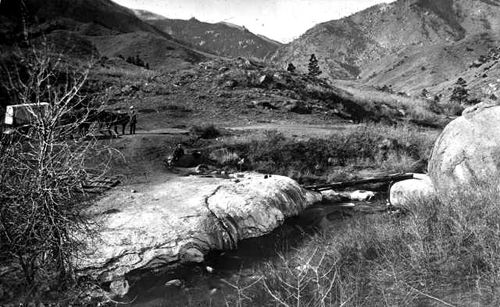
Manitou Spring in 1870.
When white men first penetrated America’s western wilderness, they found the Shoshone and Comanche tribes at odds, and legend says their differences began at the springs of Manitou. This “Saratoga of the West,” nestling in a hollow of the foothills in the shadow of noble Pike’s Peak, was, in the old days, a common meeting ground for several families of red men. Councils were safe there, for no Indian dared provoke the wrath of the Manitou whose breath sparkled in the “medicine waters.” None? Yes, one. For centuries, a Shoshone and a Comanche stopped here on their return from a hunt to drink.
The Shoshone had been successful; the Comanche were empty-handed and ill-tempered, jealous of the other’s skill and fortune. Flinging down the fat deer he carried homeward on his shoulders, the Shoshone bent over the spring of sweet water and, after pouring a handful on the ground as a libation to the spirit of the place, put his lips to the surface.
It needed but a faint pretext for his companion to begin a quarrel, and he did so in this fashion: “Why does a stranger drink the water at the spring so that his children may drink it undefiled? I am Ausaqua, chief of Shoshone, and I drink at the head-water. Shoshone and Comanche are brothers. Let them drink together.”
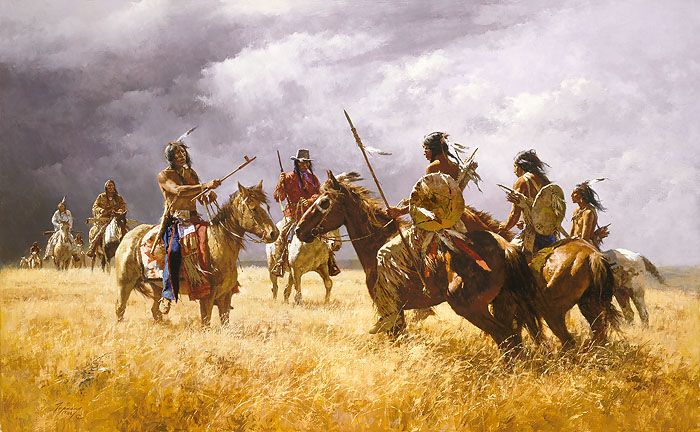
Comanche Warriors.
“No. The Shoshone pays tribute to the Comanche, and Wacomish leads that nation to war. He is chief of the Shoshone as he is of his own people.”
“Wacomish lies. His tongue is forked, like the snake. His heart is black. When the Great Spirit made his children, he said not to one, ‘Drink here,’ and to another, ‘Drink there,’ but gave water that all might drink.”
The other made no answer, but as Ausaqua stooped toward the bubbling surface, Wacomish crept behind him, flung himself against the hunter, forced his head beneath the water, and held him there until he was drowned. As he pulled the dead body from the spring, the water became agitated, and from the bubbles arose a vapor that gradually assumed the form of a venerable Indian with long white locks, in whom the murderer recognized Waukauga, father of the Shoshone and Comanche nation, and a man whose heroism and goodness made his name revered in both these tribes. The face of the patriarch was dark with wrath, and he cried, in terrible tones, “Accursed of my race! This day, thou hast severed the mightiest nation in the world. The blood of the brave Shoshone appeals for vengeance. May the water of thy tribe be rank and bitter in their throats.”
Then, whirling up an elk-horn club, he brought it full on the head of the wretched man, who cringed before him. The murderer’s head was burst open, and he tumbled lifelessly into the spring, that to this day is nauseous, while, to perpetuate the memory of Ausaqua, the Manitou smote a neighboring rock, and from it gushed a fountain of delicious water. The bodies were found, and the partisans of both the hunters began on that day a long and destructive warfare in which other tribes became involved until mountaineers were arrayed against plainsmen throughout that region.
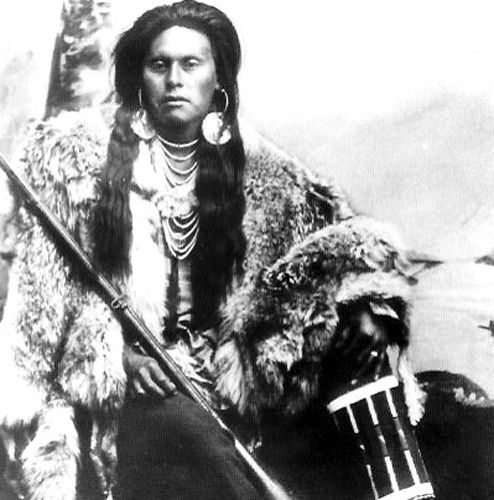
Shoshone Warrior.
By Charles Skinner, 1896. Compiled and edited by Kathy Alexander/Legends of America, updated September 2026.
Also See:
Native American Mythology & Legends
The Shoshone – Continuing the Traditions of Their Ancestors
The Comanche – Horseman of the Plains
Native American Photo Galleries
About the Author: Charles M. Skinner (1852-1907) authored the complete nine-volume set of Myths and Legends of Our Own Land in 1896. This tale is excerpted from these excellent works, now in the public domain.