

Ipswich, Massachusetts, in 1906.
Harry Maine — you have heard the tale;
He lived there in Ipswich Town;
He blasphemed God, so they put him down,
With an iron shovel, at Ipswich Bar;
They chained him there for a thousand years,
As the sea rolls up to shovel it back ;
So when the sea cries, the goodwives say
“Harry Maine growls at his work today.”
— James Appleton Morgan
In 1671, a fisherman named Harry Maine arrived in Ipswich, Massachusetts, from the Isles of Shoals near Portsmouth, New Hampshire. He brought with him another man named Andrew Diamond. Both had been successful fishermen in New Hampshire. Diamond prospered further in Ipswich, helping build several wharves, purchasing a profitable fleet of shipping boats in partnership with Francis Wainwright, and becoming quite wealthy. But Harry Maine didn’t fare as well and soon turned to crime.

Mooncussers.
Harry became known as the Wandering Jew of Ipswich and was said to have worked as a pirate, a smuggler, and a “mooncusser,” a pirate of the worst kind. Mooncussers were land-based pirates who lit fires or held lanterns on dangerous coasts to decoy ships and deliberately caused shipwrecks on breakers and sandbars at night. Once the vessels were wrecked, Maine and a crew of other pirates killed the survivors and plundered the wreckage for valuables.
These pirates, also called “wreckers,” were finally arrested, and Harry Maine was punished by being chained to Ipswich Bar, the scene of his former murderous exploits, and forced to shovel sand until he died. As the waters rose, threatening to drown him, his demoniacal yells of rage could be heard for miles around, while the area men just shook their heads and said: “Old Harry’s growling again!”
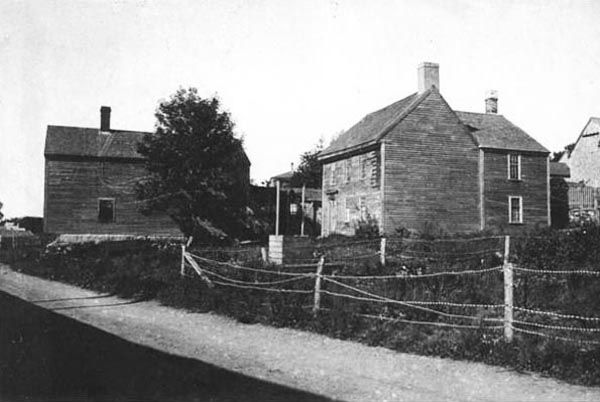
Harry Maine’s house on the right on Water Street, Ipswich, Massachusetts.
After the old vagabond died, his home on Water Street was ransacked, and the grounds dug up by people looking for the money and treasures he had stolen. But nothing was found.
Meanwhile, a local man began to dream of a place where vast sums were buried on a particular hill in the town. He could see the very spot. After dreaming of it three nights in a row, he decided to test it himself, and one night, just as midnight struck, he took his spade, his lantern, and his Bible and began to look for the spot on the hill. When he found the place that he recognized as the same as the one he had seen in his dream, he immediately went to work.
After plying his spade vigorously a while, it struck against a hard object, and he was sure he had found the prize. Scraping the earth away with feverish haste, he came to a flat stone with an iron bar laid across it. He eagerly grasped it with one hand and was about to turn the stone over with the other when a group of cats suddenly surrounded him, their eyes blazing in the darkness. The digger felt his hair slowly rising on end, and a cold sweat stood on his brow. He then grabbed the bar, waved it at the cats, and cried out, “Scat!” But when the felines fled, the treasure hunter stood up to his waist in cold water that had poured into the hole. The man then fled, clutching the iron bar in his hand. A blacksmith later turned the bar into a door latch, and Ipswich visitors often took it as a souvenir of the night’s adventure.
Afterward, the ghost of Harry Maine was often seen wandering about the sandhills on stormy nights, and his howls could still be heard for miles around. His ghost was also said to haunt his former residence on Water Street. Some were so afraid they wouldn’t venture out of doors after dark. Others said, “The Devil is raising Old Harry.” People often used his name to frighten children into obedience.
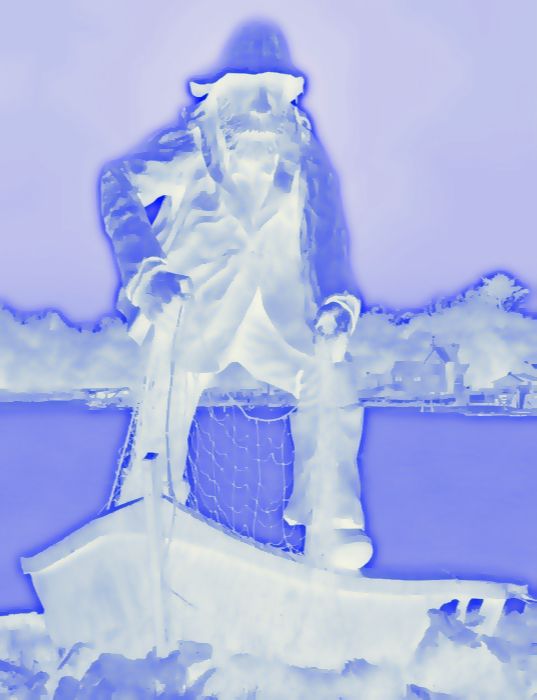 Today, his old home at 32 Water Street no longer stands.
©Kathy Alexander/Legends of America, updated October 2026.
Also See:
Legends, Ghosts, Myths & Mysteries
Sources:
Drake, Samuel; New England Legends and Folk-Lore, S.J. Parkhill & Co., 1901
Historic Ipswich
Listverse