
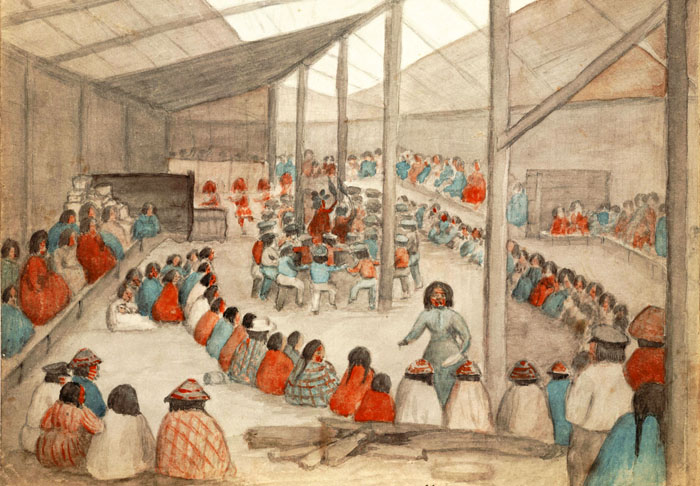
Potlatch Ceremony by James G. Swan.
A Potlach Ceremony is an opulent gift-giving ceremonial feast held by tribes of Northwest Indians of North America to celebrate an important event, including the Tlingit, Tsimshian, Haida, Coast Salish, Chinook, and Dene people. The term ‘Potlatch’ was taken from a Nootka Indian word meaning “gift.”
The ceremony celebrated a change of rank or status with dancing, feasting, and gifts. Those of the Northwest Coast associated prestige with wealth, and the potlatcher gained prestige according to how liberally he gave.
Held on the occasion of births, deaths, adoptions, marriages, and initiations into secret societies, Potlatches were also held for more minor events because the primary purpose of the ceremony was not the occasion itself but the validation of claims to social rank. It was also sometimes used as a face-saving device by individuals who had suffered public embarrassment, or as a means of competition between rivals in social rank.
Potlatch ceremonies were typically held in winter, while individuals procured wealth for the family, clan, or village during the warmer months. The ceremony often involved music, dancing, singing, storytelling, speeches, and games. The honoring of the supernatural and the recitation of oral histories are central to many potlatches.
Gifts included storable food, canoes, slaves, and ornamental “coppers,” which were sheets of beaten copper considered equivalent to a slave. They were owned only by individual aristocrats.
The donor distributed goods according to the recipients’ social rank. The size of the gatherings reflected the rank of the donor, and the efforts of the kin group of the host were exerted to maximize the generosity. The proceedings gave wide publicity to the social status of donors and recipients because there were many witnesses.
In addition to giving away or destroying wealth to demonstrate a leader’s wealth and power, potlatch ceremonies also reaffirmed family, clan, connections with other tribes, and connections with the supernatural world.
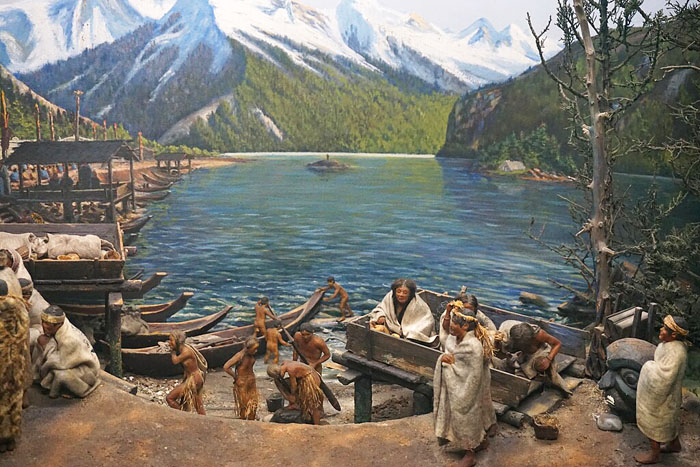
Kwakiutl Indians in British Columbia, a diorama at the Milwaukee Public Museum in Milwaukee, Wisconsin.
A true chief “always died poor” because he had potlatched his wealth. However, he died wealthy in rank and honor, which would pass on to his family, heirs, and descendants.
When Europeans arrived, they found that this social system, based on wealth distribution, was very alien. It soon came under attack by missionaries and government officials who felt the accumulation of goods for giving away would produce indigence and thriftlessness.
“It is not possible,” wrote an early commentator, “that the Indian can acquire property or can become industrious with any good result while under the influence of this mania.”
Such reasoning led the Canadian government to ban the ceremony.
The potlatch reached its most elaborate development among the southern Kwakiutl from 1849 to 1925.
Many other tribes, especially among the Plains Indians, also traditionally practiced potlatch, or gift-giving ceremonies and customs, sometimes lavishly distributing goods and food to other clans, villages, or tribes.
The potlatch has re-emerged in some communities and remains in others, such as the Haida Nation, which has rooted its democracy in potlatch law.
“In the potlatch, the host, in effect, challenged a guest chieftain to exceed him in his ‘power’ to give away or to destroy goods. If the guest did not return 100 percent on the gifts received and destroy even more wealth in a bigger and better bonfire, he and his people lost face, and so his ‘power’ was diminished.”
— Dorothy Johansen, American historian of the Pacific Northwest.
©Kathy Alexander/Legends of America, updated November 2025.
Also See:
Native American Photo Galleries
Native Americans – The First Owners of America
Native American Index of Tribes
Sources: