
History of the Dutch Oven
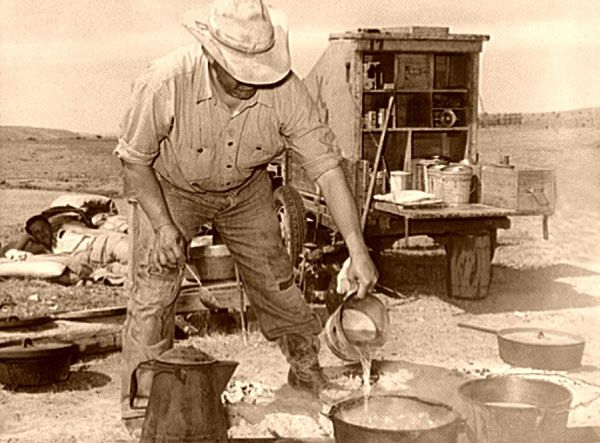
Camp Cook Marfa, TX – Lee Russell, 1939.
An absolute “must-have” for campfire cooking is an old-fashioned Dutch Oven. You know—the heavy cast-iron, lipped lid, three-legged pan. The history of this cooking wonder goes back hundreds of years in various forms. In 1704, an Englishman named Andrew Darby, inspired by the Dutch system for making these cooking vessels, patented a process similar to theirs and produced cast-metal cooking vessels for Britain and the new American colonies. The term “Dutch Oven” has been used since about 1710.
American’s changed the design over time, including making a shallower pot, putting legs on it, and flanging the lid, which has been credited to famous colonist Paul Revere.
You can use a Dutch oven on a wood stove or for open-fire cooking. Dutch Ovens come in all shapes and sizes, but the most usable size is a 12-inch diameter with legs, a bale handle on the body of the pan, a small loop handle on the lid, and a lipped lid — the heavier, the better. Twelve inches may seem like a large pan, but not so large that a meal for four would be lost, and versatile enough for a crowd of 8-10.
A heavy pan will retain heat longer and cook your food more evenly than a thinner pan. Any pan you use on the open fire needs to have a bale handle, as you will need to be able to slide a stick or pot lifter under the handle to move it.
You could buy a pan with a flat bottom, but these pans are best left to the conventional or wood stovetop. The flat surface of the bottom will not allow heat from a fire to absorb evenly into the iron to provide even cooking, and you won’t be able to get the coals up under it. A pan with three legs is more stable than one with four legs. An additional small loop handle on the lid will save time, as well as burned fingers when you take off the lid to check the food.
Finally, the lipped lid, with the lip running around the outer edge, will make it easier to regulate the temperature and keep the hot coals on as you move the pan around in the fire area. Most lids are dome-shaped and can be turned upside down to use as a griddle or frying pan on the hot coals.
Cast iron pans are slow to heat up, retain heat for a long time and work best when used at lower temperatures except when frying.
Seasoning the Pan
If you purchase a cast-iron pan, it is necessary to season it thoroughly to make it as non-stick as possible and extend its life. Some pans that are well cared for will last for generations. Wash the new pan with soap and warm water very well, as they usually have a lacquer that can burn onto the food the first time it’s used. Old, rusty pans can be scrubbed with steel wool and washed with soap and water, too, but be sure to clean any vestiges of steel shavings from the steel wool out of the pan.
Dry the pan well, then use a clean towel or paper towel to rub a thin layer of shortening or other vegetable oil over the cooking surface of the pan. You may also want to oil the pan outside, purely for appearances. Do not use animal fat or lard, as it can quickly become rancid.
After rubbing the oil into the pan, place the pan in a warm oven at 250 F, or over warm coals for 2 hours, replacing the coals often to maintain the temperature. Cool the pan, then repeat the oiling, heating, and cooling steps twice.
To clean your pan after the oiling and baking process, wash with a mild soap, rinse, and dry thoroughly after each use. When you wash your pan, dry it completely in a low oven or on warm coals. Then oil it lightly and bake in the oven or over coals again. This process, known as “curing,” will ensure that your pan maintains its non-stick surface and lasts a lifetime.
Cooking Methods When Using a Dutch Oven
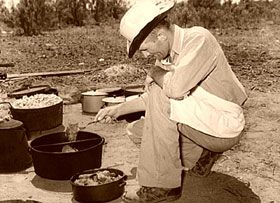
Cook of the SMS Ranch near Spur, Texas – Lee Russell 1939.
There are four different methods of cooking with a Dutch Oven over a campfire – each achieved by altering the source of heat.
Roasting – The heat from your coals should come from the top and bottom evenly in roasting. You will place coals on top, as well as pulling the coals up under the pan to create an even heat. Place the same amount of coals on the lid as under the pan. Roasting is best achieved at high temperatures and short cooking times. This will seal in the juices.
Frying and Boiling – When frying and boiling, all the heat should come from underneath the pan. The temperature should be high and kept even during the cooking process.
Baking – Baking requires cooking mainly from the top. You should place the coals on the lid and underneath the pan at a three-to-one ratio, with most of the coals on the lid. You will want to watch baking foods very carefully.
Simmering and Stewing – Most heat should be from the bottom of the pan. The coals should be placed on the lid and underneath the pan in a four-to-one ratio, with the bulk of the coals underneath the oven. Regulate the heat in stewing and simmering by moving hot coals underneath the pan
Remember not to rush the cooking process. If you allow adequate time for the oven to heat up before adding the food and keep the coals manipulated to maintain the temperature, you will have great results.
Number of Coals to Use to Achieve the Desired Temperature
Coals must be used on the Dutch Oven’s top and bottom. Use only quality charcoal briquettes for consistent temperature control. The chart below shows you how many coals to use for the desired temperature.
|
Temperature |
10″ Oven |
12″ Oven |
14″ Oven |
|||
|
Degrees F |
Top |
Bottom |
Top |
Bottom |
Top |
Bottom |
|
300 |
12 |
5 |
14 |
7 |
15 |
9 |
|
325 |
13 |
6 |
15 |
7 |
17 |
9 |
|
350 |
14 |
6 |
16 |
8 |
18 |
10 |
|
375 |
15 |
6 |
17 |
9 |
19 |
11 |
Note: Adding one coal to the top and bottom will raise the temperature of the Dutch Oven by approximately 25 degrees. Or conversely, removing one set of briquettes will lower the temperature by 25 degrees.
On the Menu
~~~~~~~~~~~~~~~~~~~~~~~~
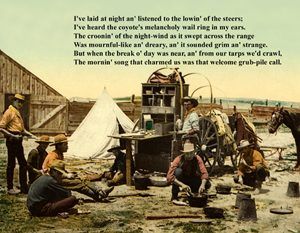
Grub Pile Poem Postcard from Legends’ General Store
Apple Crisp
Ingredients
- 5 pounds baked apples
- 2 Tbsp. flour
- 1 cup sugar
- 2 sticks margarine
- pinch of salt
- 2 cups sifted flour
- 2 Tbsp. cinnamon
- 2 cups brown sugar
- 2 Tbsp. nutmeg
Peel apples and cut in slices. Mix apples, sugar, salt, cinnamon, nutmeg, and 2 tbsp. flour in the Dutch oven. Combine margarine, flour, and brown sugar, mashing until crumbly. Sprinkle this mixture over the apple mixture. Bake 35-45 minutes with coals in the Dutch oven, or bake for 30-40 minutes in 350 F oven.
Baked Salmon
Ingredients
- 1 Salmon Filet (determine size according to the number of people served.)
- Black Pepper
- Garlic Powers
- 1 Fresh Lemon
- 4-6 Fresh Mushrooms
- 4-6 Green Onions
- 4 oz Creamed Cheese
Leave the skin on the salmon filet.
Slice the filet into wide strips. Place salmon strips, skin side down, into the bottom of the 12″ Dutch Oven. Sprinkle on black pepper to your taste. Sprinkle on garlic powder to your taste. Cut a fresh lemon into quarters and squeeze over salmon strips. Slice fresh mushrooms into thin slices and spread over salmon strips and onto the bottom of the oven. Slice fresh green onions into thin slices and spread over salmon and onto the bottom of the oven. Drop small chunks of creamed cheese onto salmon strips. Top with lemon slices for color and presentation. Cover Dutch Oven and cook for 15-20 minutes.
Barbecue Meatroll
Ingredients
- 4 pounds ground beef
- 2 cups oatmeal
- 4 eggs
- 3 tablespoons Worcestershire sauce
- 1 large sweet onion
- 1 small green pepper
- 8 oz. mushrooms
- 1 garlic clove (crushed)
Barbecue Sauce
Mix together:
- 2-8 oz cans tomato sauce
- 1/2 cup brown sugar
- 2 tablespoons cornstarch
- 1 teaspoon dry mustard
- 1/2 teaspoon cloves
- 1/2 teaspoon garlic powder
- 1/2 teaspoon onion powder
- 1/4 teaspoon allspice
- 2 tablespoons Worcestershire sauce
Pat meat out on Saran wrap, aluminum foil, or a cookie sheet. Use the rolling pin to roll it out to a rectangle about 1/2 inch thick. Place diced vegetables on top of the rectangle. Remove Saran wrap or foil if you used it. Roll meat and vegetables as you would a cinnamon roll. Place in an aluminum foil-lined 12-inch Dutch oven; if you have to make a seam in the foil, make sure the seam is down. Bend the meal roll to fit the Dutch oven if necessary. Bake for 15-20 minutes and baste with 1/2 of the barbecue sauce. Bake another 15 minutes. Add the remaining sauce. Bake for approximately 1 hour with coals on top and bottom.
Only a fool argues with the cook. Poster available at Legends’ General Store.
Barbecue Ribs
- 1/2 Rack of spare ribs
- Salt and Pepper ribs according to taste
- Your favorite barbecue sauce
Braise in a hot Dutch Oven for 30 to 40 minutes at approximately 450 degrees. Cover the lid completely with coals, same with the bottom. Check for browning; turn if necessary. Separate ribs and cover them with your favorite barbecue sauce. Bake for approx. 2 hours with 14 coals on top and bottom.
Bratwurst Stroganoff
Ingredients
- 2 lbs stadium style bratwurst
- 1 lb package of Portabella mushrooms, sliced thin
- 1 large, flat Vidalia onion sliced very thin
- 1 quart sour cream
- 1 quart white wine
- 1 to 2 tablespoons of flour
- 2 tablespoons of high-heat oil (peanut or olive)
- 1/2 tablespoon garlic powder
- salt and pepper to taste
- 2 large packages (24 oz to 32 oz total weight) extra wide egg noodles
Set sufficient water to boil following the package directions for the noodles. A large pinch of course salt may be added to speed boiling and help flavor the noodles. Heat a large skillet (12 to 14 inch) and add the oil. Immediately place the brats into the oil and move them around to brown them completely. This should take about ten minutes. Remove the brats from the pan and allow them to rest for at least five minutes. Check the water, and when appropriate, add the noodles. After the brats have rested, slice them into 1/2-inch pieces and set them aside for later use. Add the onions to the skillet and reduce the heat slightly to medium-high. Allow the onions to begin to clear, then add the mushrooms. Raise the heat slightly closer to high.
The vegetables should begin to absorb the drippings from the pan. When this happens, return the sliced brats to the pan and allow them to cook for about 5 minutes while continually stirring. If the pan appears to be dry additional cooking oil may be added a half tablespoon at a time. Add no more than one additional full tablespoon. Sprinkle half the flour over the contents of the pan and add the garlic. Stir to combine well and absorb the flour. Add the sour cream and combine well. Add the wine a little at a time to achieve a consistency like a sausage gravy or a bit thinner. This should take about half of the wine. When the noodles are finished, drain them well, add them to the sauce and combine well. Check the sauce. If it is too thick, add a little more wine and combine. If too thin (it doesn’t coat the noodles), sprinkle a little of the remaining flour over the dish and combine well. Do not use more flour than what was left over from the original recipe measure because too much raw flour will ruin the dish.
Campfire Breakfast
Ingredients
- 1/2 lb bacon (or pre-cooked sausage)
- 1 medium onion
- 2 lb. bag of frozen hash brown potatoes (can be defrosted first)
- 1/2 lb. grated cheddar
- 1 doz eggs
- Small jar of salsa-about 1 cup (optional)
This recipe requires 6-9 bottom coals and 12 -15 top coals.
Pre-heat 12″ Dutch Oven. Slice bacon and onion into small pieces and brown until onions are clear. Stir in the hash brown potatoes and cover. Remove, cover, stir occasionally to brown, and heat potatoes (15-20 minutes).
Scramble the eggs in a separate container and pour the mixture over the hash browns. Cover and cook until eggs start to set. (10 – 15 minutes)
Sprinkle grated cheese over egg mixture, cover, and continue heating until eggs are completely set, and cheese is melted. Optional: Pour a small jar of salsa over the cheese/egg mixture. Cover and cook for an additional 3-5 minutes. Slice and serve.
Chicken Pot Pie
Ingredients
- 2 large chicken breasts, cooked and cubed
- 2 large cans mixed vegetables
- 1 can cream of chicken soup
- 1 can cream of mushroom soup
- 1 10-pack refrigerated biscuits
Mix chicken, vegetables including liquid, and both cans of soup. Put in a Dutch oven and warm over coals. Do not boil. When warm, place the biscuits on top of the chicken mixture and cover them with a lid. Place coals on the lid. Check after 15 minutes. Cook until the biscuits are done. Usually takes about 30 minutes. Serves four.
Cowboy Beans
Ingredients
- 2 cups dried red beans
- 2 cups dried pinto beans
- 1 large yellow onion, chopped
- 3 tablespoons garlic, chopped
- 3 green chile peppers, grilled and diced
- 3 vine-ripened tomatoes, grilled, seeded, and chopped
- 1 tablespoon vegetable oil
- 7 quarts water or vegetable stock
- 1 smoked ham hock
- 1 teaspoon toasted coriander seed
- 1 bay leaf
- 2 whole dried red chile peppers
- Salt and pepper, to taste
Soak beans overnight in water to cover, changing the water once; drain.
When beans are ready, saute onion, garlic, green chiles, and tomatoes in oil in a large soup pot or Dutch oven over medium-high heat. Add water or stock and ham hock; bring to a boil. Add beans, coriander seed, bay leaf, and dried chiles. Continue to boil for 30 minutes, lower heat, cover, and simmer for three to four hours until beans are tender. Season with salt and pepper to taste. Makes 16 servings.
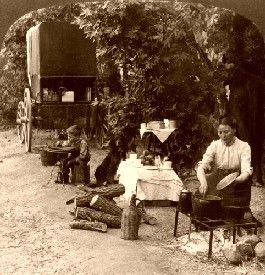
California Camping, 1907.
Dewberry Cobbler
Ingredients
Filling:
- 2 cans (approx 4 cups) frozen dewberries
- 2 packages of fresh Sugar to taste (1-2 cups).
You may substitute with fresh or frozen blackberries. Mix dewberries and sugar. This mixture should be enough to cover a 12-inch Dutch oven 2 inches deep. Cook this mixture until syrupy.
Crust:
- 1/2 cup butter
- 1/2 cup Crisco
- 2 cups flour
Cut butter and Crisco into flour. Add ice water. Mix until the crust is crumbly. You may need to add more flour. Don’t roll out! Sprinkle or crumble over the dewberry and sugar mixture. Sprinkle 1/4 cup sugar over top. Cover Dutch oven and put coals on lid. Cook 10-12 minutes or until crust is brown. Bake at 375°F for 20-25 minutes. Serves 10.
Dutch Oven Cobbler
Ingredients
- 6-10 refrigerated pie crusts
- 1 gallon of sliced peaches, drained – save syrup
- dried prunes, raisins or apricots (optional)
- brown sugar
- cinnamon
- butter or margarine
Grease your Dutch oven and add a pie crust or two. Put in a layer of sliced peaches, sprinkle with brown sugar and cinnamon, and add plenty of butter. Add another pie crust and repeat until you are out of peaches and pie crusts. You can add the dried fruit to the peaches if you like. Add the last pie crust. Takes about 3 hours, and not much fire under the oven.
Dutch Oven Biscuits
Ingredients
- 1/4 cup lard or shortening
- 1/2 cup warm water
- 2 cups flour
- 1/2 cup dry milk powder
- 2 Tb sugar
- 1 Tb plus 1 tsp baking powder
- 1/2 teaspoon salt
Build a charcoal fire with 36 briquets, and let them burn until they are covered with ash. Place 12 of the coals in a circle. Place a 12-inch Dutch oven over the circle of coals. Add the shortening to the Dutch oven and heat until melted. Using pot holders, tilt the Dutch oven to coat the interior lightly with the melted shortening. Pour the melted shortening into the warm water and combine with the well-mixed dry ingredients. Stir just to make a soft dough. Drop heaping tablespoons of the dough into the Dutch oven. Place the lid on top, then use a spade to spread the remaining coals onto it. Cook the biscuits until lightly browned, 15-20 minutes. Serve hot with wild honey.
Dutch Oven Potatoes
Ingredients
- 1 lb. bacon, diced
- 2 onions, diced
- 2 green peppers, diced
- 12 med potatoes, red pontiac, peeled and sliced dollar size
- 1 lb. sharp cheddar cheese
- 1/4 lb. swiss cheese
- salt and pepper
- mushrooms, optional
Fry bacon in Dutch Oven. Add onions, peppers (and mushrooms), and saute. Pour part of the bacon grease off and add potatoes. Add salt, pepper, and seasoning to taste. Mix together, but don’t stir while cooking. Put 8 briquettes under the oven and 14 on the lid. This will allow all the potatoes to cook uniformly without stirring. Cook approx. 45 minutes. Check with fork – when done, grate the cheese together and sprinkle evenly over the top of the potatoes and replace the hot lid. The cheese will melt down through the potatoes, and they are ready to eat.
Dutch Oven Pot Roast
Ingredients
- 1/2 lb. roast beef per person
- 3 teaspoons bacon grease or vegetable oil
- 1 beef bouillon cube
- 1 cup boiling water
- 4 teaspoons catsup
- 1 teaspoon Worcestershire sauce
- 1 small onion
- 1/2 clove garlic (minced)
- 2 teaspoons salt 1/2 teaspoon pepper
- 1 teaspoon celery salt
- 1 small can mushrooms
- 4 teaspoons flour
- 1 cup sour cream
Steps: Heat bacon grease or vegetable oil in Dutch oven (don’t let the fire get too hot) Add roast and brown on all sides Dissolve the bouillon cube in boiling water Add catsup, Worcestershire sauce, chopped onion, salt, garlic, garlic salt, and pepper. Stir and pour over roast. Put the lid on and cook for 2 to 2 1/2 hours over low heat (in the oven, 250 degrees) until the meat is tender Remove the Dutch oven from heat and take out the roast. Blend flour into the cooled liquid to make gravy Return to heat and add mushrooms and sour cream (stir until gravy is smooth and hot) Slice beef and serve with gravy.
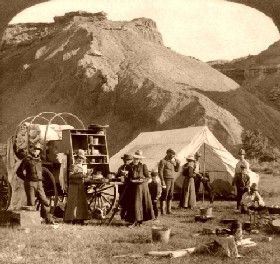
Wyoming Badlands 1904.
Giant Pecan Ring
Ingredients
- 2 1lb loaves frozen bread dough or homemade bread dough
- 1/2 c butter, melted
- 1/2 c sugar
- 1/2 c packed brown sugar
- 2 tsp cinnamon
- 1/2 c chopped pecans
- 1-1/4 c sufted powdered sugar
- 1/2 tsp vanilla
- Milk (about 4 tsp)
- Cinnamon sticks (optional)
- Pecan Halves (Optional)
Lightly grease the inside of the dutch oven. On a lightly floured surface, flatten the thawed dough slightly.
Cut each loaf into 4 pieces (total of 8). Form each piece into a rope about 18″ long.
Brush each rope on all sides with melted butter. Stir together sugar, brown sugar, and cinnamon. Place the mixture on a sheet of foil. Roll rope in sugar mixture to coat evenly. Shape the rope into a coil in the center of the Dutch oven. Roll another rope in sugar. Attach securely to the end of the first rope and continue coil. Continue coating ropes and attaching to form a 10-11″ circle.
Sprinkle any remaining sugar over the coil. Sprinkle with chopped pecans. Cover and let rise in a warm place for about 30-40 min. Bake at 350 for 30 to 3 min or till done. Cover with foil and last 15 minutes to prevent over-browning if necessary. Cool, about 15 min.
Stir together powdered sugar, vanilla, and enough milk to make a thick glaze. Spoon over the top of the cake. Decorate with cinnamon sticks and pecan halves, if desired. Serves 16.
Ham Casserole
For a big Dutch oven, use more ham/cheese/corn and double the topping. You can add anything you like, such as black olives, onions, mushrooms, etc.
Ingredients
- cubed ham
- corn niblets
- shredded cheese
- Italian seasoning
Topping
- 1/2 cup baking mix (Bisquick)
- 1 cup milk
- 2 eggs
Line the Dutch oven with foil all the way up the sides and grease or use non-stick spray. Put a 1/2 inch layer of ham on the bottom, then a layer of corn and a layer of cheese, and then sprinkle on some Italian seasoning. Mix the milk, eggs, and Bisquick until well blended. Pour on top of ham/corn/cheese layers, ensuring the liquid is evenly distributed. Cook for about 1/2 hour (about 350 degrees) until the casserole sets up. To serve, pull the foil out of the Dutch oven and peel it away from the casserole and cut it into wedges. Serves 6-8.
Hot & Spicy Chicken
Ingredients
- 2 @ chickens, quartered and skinned
- Sesame seeds
- 2 T. soy sauce
- 2 T. red wine vinegar with garlic
- 1/8 tsp. cloves
- 1 tsp. ginger
- 2 T. cornstarch
- 3/4 c. brown sugar
- 1 T. cooking sherry
- 1/2 tsp. cayenne pepper
- 1/8 tsp. nutmeg
- 3/4 c. water
Bake chicken in dutch oven for 40-50 minutes or until done at about 350 degrees. Use 4-6 Briquettes on the bottom and 12-16 on top.
Meanwhile, mix everything except water and starch. Bring to a boil. Mix water and starch, and add to the boiling mixture. Stir until thickened. Spoon over the chicken for the last 20 minutes of cooking. Sauce may be made ahead.
Hunters’ Dumplings
Ingredients
- 2 cups diced chicken or leftover turkey
- 1/2 stick butter
- 1 can cream of chicken soup
- 1 teaspoon salt
- 1/2 teaspoon pepper
- 2 large cans chicken broth or 2 quarts water with 8 bouillon cubes
- 8 flour tortillas
Bring broth and seasonings to a boil. Meanwhile, slice the tortillas into thin strips. Place in the boiling broth and cook for about 15 minutes. Add chicken pieces and cook for 15 more minutes uncovered. Serves 4-6.
 Mexican Casserole
Ingredients
- 1 lb breakfast sausage hot or regular
- 1 lb ground beef
- 1 medium onion chopped well
- 2 eggs
- 1 can Rotel diced tomatoes drained well
- bread crumbs as needed
Mix well adding bread crumbs to produce a dense meatloaf. Place in a #10 Dutch oven that has been sprayed well with a nonstick spray. Cover and cook for about 30 min or until almost done.
While that is cooking, mix 2 boxes of cornbread mix according to the instructions given and add the following:
- 1 small onion finely chopped
- 2 medium jalapenos finely chopped
- 1 can of creamed corn
Mix well.
Remove meat from oven and carefully drain off any liquid. Pour cornbread mixture over the top of the meat and return to oven for approximately 20 min. Watch this carefully. Check for doneness with a toothpick.
Monkey Bread
Ingredients
- 2 c. water (real warm)
- 1/2 c. sugar
- 1 T. salt
- 1 T. yeast
- 6 c. flour
- 1/4 c. oil
- 2 large eggs (beaten)
- 1/4 lb. butter
Mix 2 cups of warm, real water, ½ cup of sugar, 1 tablespoon of salt, and 1 tablespoon of yeast. Let set until bubbly. Add two large beaten eggs and 3 cups of flour, stir, do not beat. Add ¼ cup oil and 3 cups more flour. Dough will be sticky; cover and let rise until doubled in bulk.
Roll dough out on a floured surface to ½ inch thickness. Cut into 2 ½ inch circles.
Melt 1/4 pound of butter in a deep 14″ Dutch oven. Do not let butter get too hot. Dip circles of dough in butter, coating both sides. Lay circles of dough on the inside edge of the Dutch oven, overlapping approximately one-third. Place the second layer of dough circles like shingles inside the first ring.
Cook with 11 briquets on the bottom of each oven and 15-20 briquets placed around the outer rim of each lid. Bake for about 25 minutes. Remove the ovens from the bottom briquets and finish cooking with top heat only for approximately 10-15 minutes more. When finished, remove from the Dutch oven and serve warm.
Variations
Garlic Parmesan Monkey — Bread Follow the above recipe, adding ½ teaspoon garlic powder to the melted butter in the Dutch oven. After circles of dough are placed in the Dutch oven sprinkle the top with ¾ cup Parmesan cheese.
Sesame Seed Monkey — Bread Follow the above recipe adding 1 tablespoon of sesame seeds to the melted butter in the Dutch Oven. After circles of dough are placed in the Dutch oven sprinkle the top with 1 tablespoon sesame seeds.
One Pot Tortilla Breakfast
Ingredients
- 2 tsp. vegetable oil
- 2 medium green, red, and/or yellow peppers thin sliced
- 1 small red onion thin sliced
- 1 (1.25 oz.) package taco seasoning mix
- 1 can evaporated milk
- 6 large eggs, lightly beaten
- 12 (6 in.) fajita- size flour tortillas, warmed
- 1 jar of salsa
- 1 tub of sour cream
- 1 lb. shredded cheddar cheese
Heat oil in Dutch oven. Add pepper, onion and seasoning mix, stir well. Cook well for 3 to 5 minutes or until vegetables are crisp- tender. Transfer to bowl, cover.
Combine evaporated milk and eggs in bowl. Pour into oven and scramble until soft curds form. Move eggs to center of oven. Arrange vegetables around eggs. Sprinkle cheese over eggs and vegetables.
Serve with tortillas. Garnish as desired.
Prairie Steamer
Ingredients
- 3 young chickens, cut into eighths
- 18 small potatoes
- 12 small onions
- 12 sausages
- One dozen ears of corn.
Scrub the potatoes, peel onions, and husk corn. Save the husks, but discard the silk. Spread a layer of corn husks on the bottom of a boiler or large kettle. Pour in 1 quart water. Spread a layer of potatoes and onions on the husks. Add a layer of chicken pieces and sausages. Add another layer of husks, then a layer of corn, and another layer of husks. Top with one potato. When that potato is done, everything is done. Cover the pot and steam over the fire for 1 1/2 hours or until done.
Compiled and edited by Kathy Alexander/Legends of America, updated November 2025.
Also See:
The Chuck Wagon – The Real Queen of the Cattle Trail