
By James M. Enochs in the 1800s.
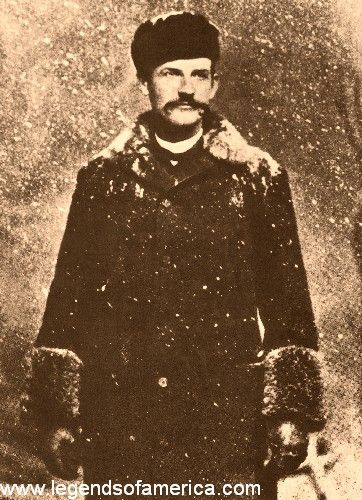
Frank Canton.
Ex-sheriff Frank M. Canton, adjutant general of the National Guard of Oklahoma, has solved the mystery of Bill Booth’s disappearance. Booth was a notorious character who loafed about the Pawnee Indian agency many years ago.
While Sheriff of Johnson County, Wyoming, Canton hanged Booth for murder in 1886. Since Canton’s return to Oklahoma, he learned that Booth lived in the territory and was charged with the murder of his wife and child. Booth left a trail of blood from Tippecanoe, Ohio, to Johnson County, Wyoming, traveling through Oklahoma, Colorado, and other states where crimes were charged against him.
The nature of the charges preferred in Ohio was never known to us. After living among the Pawnee Indians, Booth’s wife and child were murdered, and he was charged with the crime. The search for him was made over the west.
Later, he was heard of in Colorado, where a charge of killing a black man was made against him, but he evaded interception by the authorities. His next field of operations was Wyoming, where he murdered a German Trapper named Jake Cameron. [Editor’s note: Other accounts indicate the trapper’s name was Jacob Schmerer. A criminal Warrant dated May 1885 indicates Schmerer as well.]
Upon reaching Wyoming, Booth was trapped and made considerable money by selling wolf scalps, for which the territory placed a bounty. His operations were in the same vicinity as Cameron’s. After a short time, the two formed a partnership, the German teaching Booth many secrets of catching wild animals. A report circulated that Cameron had mysteriously disappeared, and his herd of horses had gone. The disappearance followed closely the sale of some land that the German had occupied, and he was known to have had several hundred dollars on him. This fact, coupled with the general demeanor of Booth, made Sheriff Canton suspicious of the man, and he fancied that Booth had murdered the German. Canton sent a description of Booth to practically all officials of the States of the Northwest, and for several months, a search was conducted to offer a $500 reward for Booth’s arrest and conviction. Meantime, a Negro found the body of Cameron buried beneath a pile of brush and dirt in a recess of a canyon a few miles from Cameron’s cabin. His skull had been crushed with an ax, and three bullet holes were found in his body.
Booth was arrested in Miles City, Montana, for horse stealing and was being held on those charges. The Sheriff did not know who he was. W.C. Smith, Deputy Sheriff and stock inspector, visited the jail and recognized Booth as the man we wanted, so we took a picture of the suspect and forwarded it to Canton and staff. Not a man of our staff knew Booth well enough to be sure, so we quietly passed the picture to Old Burr, the Negro who found the German. He recognized Booth at once.
We were sure of our man, but not about extradition. Not a single scintilla of proof. We could not prove Booth had anything to do with the killing of Cameron, but we wanted to give him a real sweating, hoping he might say something. Put the situation to the Miles City boys, and Billy Smith, the man who recognized Booth, offered to bring him to the Montana line near Parkman and give him a heave of strong arm on the Wyoming side to reach for him. That method of extradition is known in Sheriff’s parlance as “Rio Grande” extradition. I doubt the boys knew the state line in miles, but it beat kidnapping and worked.
Sheriff Canton and his Lieutenant, The Skripe, met the stage at Sheridan to double the guard as threats of lynching had been heard. The deputies told us Booth would talk. As soon as the overland stage pulled out from Sheridan, all the staff pretended to know a great deal about the killing, and to our utter astonishment, Booth opened up and told the whole story before we reached Big Horn. In his recital of this heinous crime, my hair pushed my Stetson off my head, for I realized he was breaking his neck. He could not justify packing the corpse on a horse and burying it as he did. We were all mighty glad when we landed him in jail.
Booth was the only prisoner we ever had to contend with who caused Sheriff Canton extreme anxiety. Sheriff Canton was one of the craftiest of officers. Booth was equally crafty. We never knew what to expect next. He continually tried to escape. He systematically worked us for stub pens and cut the rivets in his shackles, waiting for a chance to brain someone when detected. His work in attempting to saw through the floor is still in evidence in the Buffalo jail today, or was a few years ago.
Booth was duly tried and convicted of the charge of murder and was sentenced to be hanged. Shortly before the execution date, he called for a Minister. Canton asked a Methodist preacher, who had been a detective in the West, to call on the prisoner and find out what he could. When the preacher entered the cell, he said, “Booth, I have come to offer a prayer for your soul, but before it is done, I want to know whether I am to pray for a guilty or innocent man?”
Booth bowed his head, lost his former stoical demeanor, and said, “For a guilty man.”
Booth was the only legally hanged man in Northern Wyoming.
Handwritten Account by James M Enochs. Compiled and edited by Kathy Alexander/Legends of America, updated April 2026.
Also See:
Frank Canton – Cowboy, Outlaw, and Lawman
Historical Accounts of American History
Story of the Outlaw – Study of the Western Desperado
This story is excerpted and adapted from a handwritten tale by James Monroe Enochs, transcribed more than a century ago. The original article, titled “Bill Booth Hanged; Notorious Slayer,” has been slightly changed for the ease of today’s reader.
James Munroe Enochs (1854-1936) was born in Austin, Texas. As a young man, he served with the Texas Rangers, later moving longhorns up the Chisholm Trail to Dodge City and Abilene. In 1886, Enochs was appointed Deputy Sheriff of Johnson County, Wyoming, by Sheriff Frank M. Canton. Three years later, he became the first sheriff of the newly formed Sheridan County. He later served on the Sheridan City Council and in the Wyoming State Legislature. When telling the following story, Enochs would always add, “Bill Booth was the best-looking man at the hanging.”