
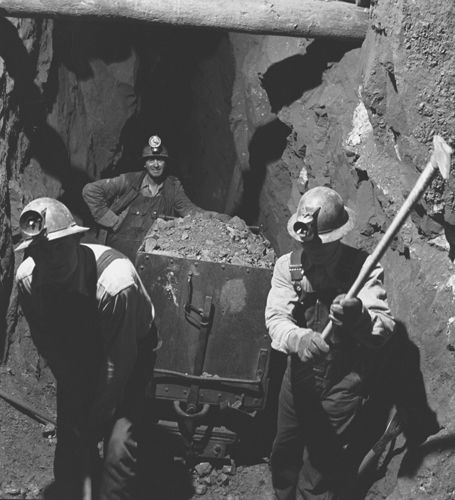
Silver miners.
By Albert S. Bolles in 1879
Silver was one of the last mineral products to attain prominence in the mining industries of the United States. Before 1859, the silver produced in this country was utterly insignificant. Only faint traces of it had been found here and there, and it was rarely made the object of particular exploration. The silver coin was almost exclusively of foreign metal, as was the plate in common use.
The early Spanish invaders of this continent found the Aztecs of Mexico and the Toltecs of Peru possessed significant quantities of this precious metal, which the Spanish obtained from the great mountain range that, under different discovery names, extends from the southern to the northern extremity of the New World. Mining was carried on even more extensively under the new governments, and immense quantities of treasure were carried home to Europe in Spanish ships. But that portion of this excellent treasure vault of nature included within our present boundaries remained almost entirely free from investigation until 1849. For ten years, the search was directed almost exclusively to finding gold.
However, the eastern colonists mixed silver with galena, or lead ore, in small quantities a century earlier. Such a vein, for instance, was discovered in Worcester County, Massachusetts, in 1754. Another was discovered in Columbia County, New York, and New England as early as 1740. Near it was an iron forge to reduce metal obtained from Connecticut. The same year, argentiferous galena was found in Dutchess County, New York, and later in Westchester County, the former being worked by the Germans of that vicinity. In a vein of copper discovered in New Jersey in 1719, silver was found in the proportion of four ounces to every hundred-weight of ore. The Swedes reported discovering silver in Pennsylvania in their day. It was found in small quantities near Davidson, North Carolina, and along the Savannah River in South Carolina. Later, the great galena mines of the Upper and Lower Mississippi River were discovered to contain a small proportion of this precious metal. In some of these localities, the silver was abundant enough to pay for extraction, but it rarely was. In the early colonial days, it was impossible to eliminate it as easily and successfully as now, and in most cases, such experiments were soon abandoned. Later, it became more profitable, yet the results were more than tempting in a few cases. In the second half of the 19th century, the North Carolina mines were the only ones in the eastern United States that worked this metal. No statistics show the exact amount of native silver produced in this country in 1850. Still, it is asserted that, at that period of our history, 99 of every 100 silver dollars in use in the United States were of Mexican or Peruvian metal.
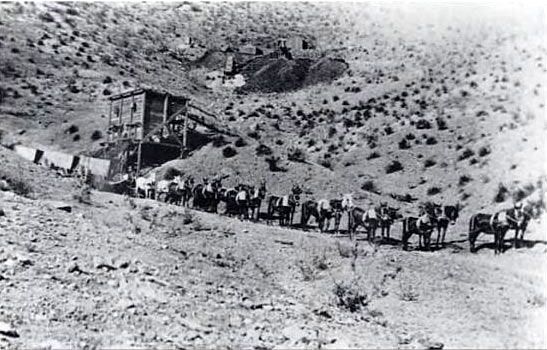
Arizona Silver Mine.
Before the discovery of the famous Comstock Lode, stock companies were organized in New York, Cincinnati, and many other cities to explore and work abandoned silver mines in Arizona, which had been ceded to the United States by the Gadsden Treaty. The Sonora Company of Cincinnati was the most prominent of these, but when it began operations in 1858, it was upon a new mine 75 miles south of Tucson, near the Mexican border. Their works were at Arivaca, seven miles from the mines. Operations were commenced in 1870 by the Maricopa Mining Company of New York, 70 miles north of Tucson, Arizona, whose mines yielded an argentiferous copper ore. The outlet for the product of both these mines was by wagon to Guaymas, Mexico, on the Gulf of California. These mines are upon the Pacific slope of the silver-yielding range of Sonora and Durango in Mexico. Other mines were found and worked with profit in Arizona, farther west, near the Gila River.
The most significant event in the history of silver mining in America was the discovery of the richest deposit in the world — on the eastern slope of the Sierra Nevada Range — in 1859. The range’s crest runs along the eastern part of the Comstock in California; this magnificent vein was found in the Washoe country, 25 miles over the border into Nevada. All during the interval between 1850 and 1860, those tireless, even heroic investigators, the prospectors, had ranged the whole West mountain region on foot with a knapsack, hammer, and blow-pipe. As they wandered from ledge to ledge, they picked out specimens here and there, cracked them, studied the appearance of the fracture, and now and then reduced a bit of the ore with the blow-pipe on a piece of charcoal. In 1858-59, a party of these prospectors was working its way up Six-Mile Canyon in Washoe. There, they found some rich sulphurets of silver interspersed with free gold. Immediately, Henry Phinney and Henry Comstock filed a claim to a mine. The former sold out his claim to the latter for a pinch of gold dust, not realizing the immense value of the discovery, and Comstock himself soon parted with the property, although his name still clung to the whole lode.

Virginia City, Nevada, Savage Works Mill, by Timothy H. O Sullivan, 1867.
Prospectors keep as close watch on one another’s luck as many coast fishermen. Before practical operations began, the great possibilities of this region began to be suspected, and a vast number of claims were filed all along these eastern foothills of the Sierra; and, as soon as mining was undertaken, it was realized that the wealthiest accumulation of this precious metal ever known was beneath the feet of the Washoe operators. Tidings of the extraordinary wealth hid there and spread like lightning, not over California alone (Nevada was not then a state and had scarcely any population), and not over the United States alone, but the whole civilized world. One of those periods of frantic excitement and wild sensation ensued, as Mark Twain has made us all familiar with in his “Roughing It.” A most extraordinary emigration ensued. Several significant new towns sprang up, notably Virginia City, Carson City, and Silver City; Nevada took place among the States of the Union; and the Central Pacific Railroad was extended through the region, its nearest station to the point of first discovery being at Reno, on the Truckee River, twenty miles away.
In “The Great Industries of the United States,” it is remarked, “There is, perhaps, no instance so striking of the promptness and daring with which American capitalists launch their money into an enterprise in which they have confidence as the development of this Comstock Lode. In 1861, this lode was a wall of black sulphuret, bedded primeval granite and quartz, on the steep slope of a lonely and barren mountain two hundred miles from roads and shops and wheat fields, parted from them by the gorges and snowy peaks of the Sierras: four years afterward a city of 20,000 inhabitants was planted on that wild declivity, and nearly $2,500,000 in assessments had been paid to develop the mines.”
The general excitement was increased by the discovery of silver deposits elsewhere in Nevada. Many thousand claims were located, not a few of which were large and well-defined, yet of little or no value. In the more significant number of cases, however, they were contracted, and the lodes on which they were staked lacked the features of actual veins or proved poor below the surface.
Mr. Kimball says, “Notwithstanding vast differences in merit, most of these claims — the best and the worst of them — passed at wildly inflated valuations into the possession of joint-stock companies organized upon the strength of extravagant expectations. While the excitement lasted for three years, 3,000 mining companies were incorporated in San Francisco alone to work mines in the Washoe District, with a nominal capital of a billion dollars. However, their market value never exceeded $60,000,000. Even more numerous companies in other parts of Nevada were formed in Eastern cities.
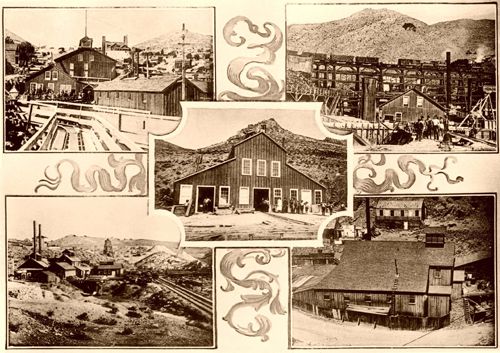
Hoisting Works, Virginia City, Nevada, 1890.
Without waiting for the result of exploration or development, most of the companies hurried into enormous expenditures for mills and machinery, of which a great deal was unfit for any use whatever, even if machinery had ever been needed; cities were built in an ambitious and luxurious style, and the traffic scarcely exceeded speculation in city and town lots in mining claims. The furor, if anything, grew for three years rather than decreased. In the summer of 1864, a reaction set in, it having by this time become apparent that, in the Washoe region, the only mines of any considerable and well-established value were those upon the Comstock, and even those for a time were objects of distrust; while the other regions of Nevada, of which such high hopes had been entertained, had together failed to contribute more than five or six percent of the total production of the State, the rest having been furnished by the Comstock Lode alone.”
Among the prominent companies on the Comstock Lode are Gould & Curry, the Ophir, the Savage, the Imperial, the Yellow Jacket, and the Belcher. Up to 1865, Messrs. Gould & Curry built companies that rivaled others. To get an idea of the business’s enormous profits, it may be stated that it cost about $10 a ton to mine the ore, and each ton yielded $50 worth of silver. An idea of the rapid development of these mines may be derived from the following figures. Wells, Fargo & Company received and transported silver bullion for these companies in 1861, 1872, 1863, 1864, and 1865, amounting to $20 million, $6 million, $12.5 million, almost $16 million, and $15 million, respectively. Altogether, some 70 million dollars worth of silver was taken from the Comstock Lode from its discovery until 1866.
After that, for a few years, production declined slightly; the lowest point was reached in 1869, when the whole lode was credited with only $7,528,607 in precious metal. A new development ensued, however, which was very rapid between 1872 and 1875, in which latter year the yield was $26,023,036. It is estimated, however, that 40% of the value of the Comstock Lode is in gold, which would make the proportion of silver for that year about $16,000,000. The $200,000,000 yielded from 1859 to 1876 is divided roughly into $80,000,000 gold and $120,000,000 silver. Within two years, rumors of still richer deposits were discovered on this lode, but the facts were concealed from the public, probably for stock-jobbing purposes.
Nearly ten years after the Comstock claim was first entered, silver was found abundantly in the white-pine district of Nevada. In some places, the White-pine deposit was so rich that, when the quartz had been mined away, the district. Sheets of almost pure metal, worth $17,000 a ton, could be torn out of the vein. This supply was limited, however, and the yield has not been steadily maintained. Silver has also been found in smaller quantities in other parts of Nevada.
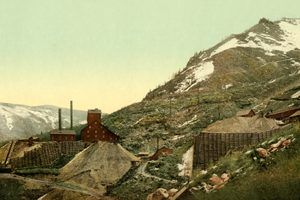
Aspen, Colorado, silver mines about 1900.
Colorado, in the Central City region, Idaho, and Montana also developed silver mines of considerable importance after 1865, but they would never reach the yields of Nevada. By 1879, the United States produced between $20 and $25 million of silver annually, about half of the world’s product. At that time, three-quarters of the amount came from the Comstock Lode. A contributor to The Atlantic Monthly magazine remarked that this country contained the most significant proportion of silver, compared with other metals, of any in the world, that the production of silver was steadier than that of gold, and that the signs of our silver supply holding out well for years to come were much more promising than those concerning gold.
Political influences, however, and the discovery of an increased supply later depressed the price of silver considerably, so there was far greater variability in its value than in gold. Even before demonetization in 1873, it had fallen off. But removing it from the place in our dollar coinage, and the similar action of Germany in 1874, reduced it by degrees to nearly one-eighth of its former price. However, when the demonetization act of 1878 was enacted, there was a tendency toward recovery; many economists began to think it would regain its old value and place in the world’s coinage.
This, however, was not the case, and the high values of the 1860s would never again be regained.
By Albert S. Bolles, 1879. Compiled and edited by Kathy Alexander/Legends of America, updated March 2026.
Also See:
Mining History in the United States
About the Article: The article first appeared in a book by Albert S. Bolles, entitled Industrial History of the United States, Volume IV, in 1879. Published by the Henry Bill Publishing Company, Norwich, C.N. Bolles was a lecturer in Political Economy at the Boston University, editor of the Banker’s Magazine, also lectured on banking and trusts at the University of the City of New York, and wrote several other books including The Financial History of the United States, The Conflict Between Labor and Capital, and Practical Banking. Note: The article as it appears here is not verbatim, as it has been edited for the modern reader.