
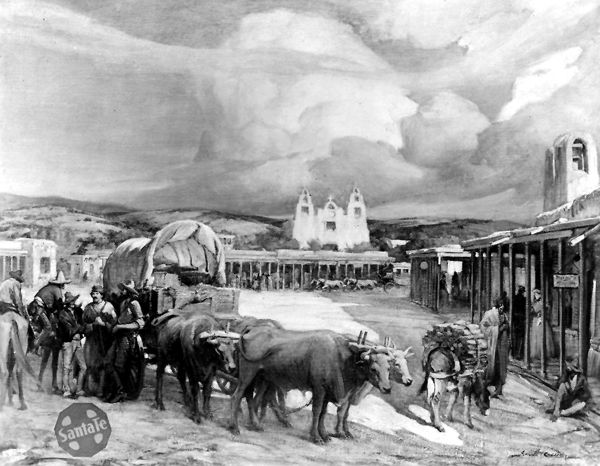
The End of the Santa Fe Trail by Gerald Cassidy, about 1910.
By Emerson Hough in 1918.
The story of the Santa Fe Trail, now passing into oblivion, was once on every man’s tongue. In its heyday, this old high road presented the most romantic and appealing features of earlier frontier life. The Santa Fe Trail was a major route of commerce between our frontier and the Spanish towns, with trade passing through Santa Fe. This commerce began in 1822 when about three score men shipped certain goods across the lower Plains by pack animals. By 1826, it employed 100 men and used wagons and mules. In 1830, when oxen were first used on the trail, the trade amounted to $120,000 annually. By 1843, when the Spanish ports were closed, it had reached $450,000, requiring 230 wagons and 350 men.
This great wagon trail first brought us into touch with the Spanish civilization of the Southwest. Its commercial totals are not so large today, but the old trail was titanic in its historic value.
This was the day not of water but land transport, yet the wheeled vehicles that passed out into the West as common carriers of civilization clung to the river valleys — natural highways and natural resting places of homebuilding man. This has been the story of the advance of civilization from the first movements of the world’s peoples. The valleys are the cleats of civilization’s golden sluices.
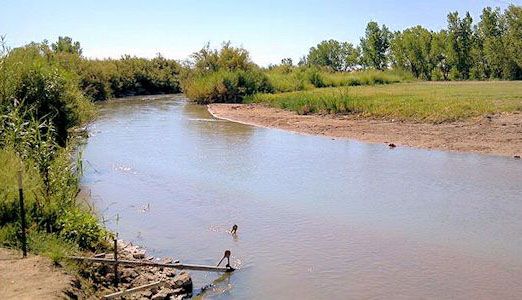
Arkansas River.
There lay the great valley of the Arkansas River, offering food and water, an easy grade, and a direct course reaching out into the West, even to the edge of the lands of Spain; and here stood wheeled vehicles able to traverse it and to carry dry goods and hardware, and especially domestic cotton fabrics, which formed the great staple of a “Santa Fe assortment.” The people of the Middle West were now, in short, able to feed and clothe themselves and to offer a little of their surplus merchandise to someone else in a sale. They had begun to export! Out yonder, in a strange and unknown land, lay one of the original markets of America!

Sacagawea guided Lewis and Clark on their expedition of 1804-06.
On the heels of Lewis and Clark, who had just explored the Missouri River route to the Northwest, Captain Zebulon Pike of the Army, long before the first wheeled traffic started West, had employed this valley of the Arkansas River in his search for the southwestern delimitations of the United States. Pike thought he had found the head of the Red River when, after a toilsome and dangerous march, he reached the headwaters of the Rio Grande. But it was not our river. It belonged to Spain, as he learned to his sorrow when he marched to Chihuahua in old Mexico and lay there during certain weary months.
Pike’s story of the far Southwest first started the idea of the Santa Fe Trail’s commerce. On that day, geography was a human thing, a thing of vital importance to all men. Men did not read the stock markets; they read stories of adventure, tales of men who had returned from lands out west.
Heretofore, the swarthy Mexicans, the folk of the dry plains and hills around the head of the Rio Grande and the Red Rivers, had carried their cotton goods and many other small and needful things from Vera Cruz on the seacoast over trails that were long, tedious, uncertain, and expensive. A far shorter and more natural trade route went West along the Arkansas River, bringing American goods to the doors of the Spanish settlements. After Pike and one or two others had returned with reports of the country, the possibilities of this trade were evident to anyone with the merchant’s imagination.
There is a rivalry for the title of “Father of the Santa Fe Trail.” As early as 1812, when the United States was at war with England, a party of men on horseback trading into the West, commonly called the McKnight, Baird, and Chambers Party, made their way West to Santa Fe, New Mexico. There, however, they met with disaster. All their goods were confiscated, and they lay in Mexican jails for nine years. Eventually, the returning survivors of this party told their stories, and those stories, far from chilling, only inflamed the ardor of other adventurous traders. In 1821, more than one American trader reached Santa Fe, and now that the Mexicans had thrown off the Spanish yoke, the goods were purchased eagerly rather than confiscated.
Rocky Mountain Rendezvous by William Henry Jackson.
Of course, it is to be remembered that trading of this sort to Mexico was not altogether a new thing. Sutlers of the old fur traders and trappers had already found the way to New Spain from the valley of the Platte River, south along the eastern edge of the Rocky Mountains, through Wyoming and Colorado. By some such route as that, at least one trader, a French Creole, an agent of the firm of Bryant & Morrison at Kaskaskia, Illinois, had penetrated to the Spanish lands as early as 1804, while Lewis and Clark were still absent in the upper wilderness. Each year, the great mountain rendezvous of the trappers — at Bent’s Fort on the Arkansas River, at Horse Creek in Wyoming, on the Green River in Utah, or even farther beyond the mountains — demanded supplies of food, traps, and ammunition to enable the hunters to continue their work for another year. Perhaps many pack trains that regularly supplied this shifting mountain market had already been traded in the Spanish country.
It is unnecessary to go into further detail regarding this primitive commerce of the prairies. It yielded a sure profit; it shaped the character of the men who carried it on. However, more importantly, it greatly influenced the country, leading to the establishment of the Missouri River border. It called yet more men from the eastern settlements to those portions that lay upon the Great Plains’ edge. There, it was crowded yet thicker, up to the line between the certain and the uncertain, with the restless westbound population of the whole country.
If, on the south, the Arkansas River valley led outward to New Spain, yet other pathways made out from the Mississippi River into the unknown lands. The Missouri River was the first and last great natural frontier road. Its lower course swept along the eastern edge of the Plains, far to the south, down to the doors of the most adventurous settlements in the Mississippi Valley. Those who dared its stained and turbulent current had to push up, onward, northward, past the mouth of the Platte River, far to the north across degrees of latitude, steadily forward through a vast virgin land. Then, the river bent boldly and strongly off to the west, across another empire. Its great falls indicated that it headed high; beyond the great falls, its steady sweep westward and, at last, southward led into yet other kingdoms.
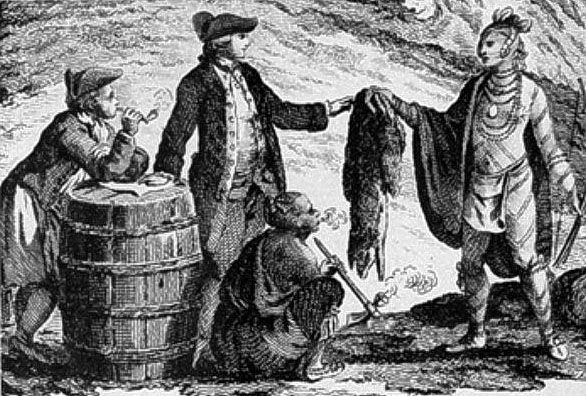
Fur traders.
When we travel by horse or modern motor car in that now accessible region and look about us, we should not fail to reflect on the long trail of the upbound boats that Manuel Lisa and other traders sent out almost immediately upon returning from the Lewis and Clark Expedition. We should see them struggling against that tremendous current before steam was known, driven by their lust for new lands. We may then understand fully what we have read of the enterprises of the old American Fur Company and bring to mind the forgotten names of Robert Campbell and William Sublette, of General Ashley and of Nathaniel Wyeth — names to be followed by others really of less importance, like those of Benjamin Bonneville and John Fremont. That there could be farms, that there ever might be homes in this strange, wild country, was, to these early adventurers, unthinkable.
Then, we should picture the millions of buffalo that once covered these plains and think of the waste and folly of their slaughtering. We should see the long streams of the Mackinaw boats swimming down the Missouri River, bound for St. Louis, Missouri, laden with bales of buffalo and beaver peltry, every pound of which would be worth ten dollars at the capital of the fur trade. We should restore to our minds the old pictures of tribesmen, decked in fur-trimmed war shirts and plumed bonnets, armed with lances, sinewed bows, and bull-neck shields, not forgetting where they got their horses and how they obtained their food.
The great early mid-continental highway, known as the Oregon Trail or the Overland Trail, followed the Missouri River up the Platte Valley and then across the mountains. We know more about this route because it was not discontinued; instead, it steadily gained popularity for various reasons. The fur traders used it, the Forty-Niners used it, the cattlemen used it in part, the railroads used it, and, lastly, the settlers and farmers used it most of all.
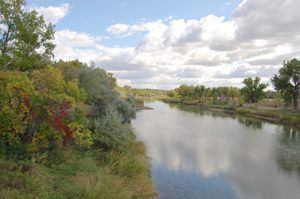
The Platte River at Fort Laramie, Wyoming.
In physical features, the Platte River route was similar to that of the Arkansas River Valley. For a few days’ travel, each at its eastern extremity passed over the rolling grass-covered and flower-besprinkled prairies before it broke into the high and drylands of the Plains, with their green or grey or brown covering of practically flowerless short grasses. However, between the two trails along the Arkansas and Platte Rivers, significant differences existed. In the mid-19th century, the two trails were quite distinct in personnel, if that term may be used. The Santa Fe Trail showed Spanish influences; the Platte Valley remained far more nearly American.
Thus far, the frontier had constantly been altering the man who came to it and, indirectly, continually altering those who dwelt back of the frontier, nearer to the Appalachian Mountains or the Atlantic Ocean. A new people were now in the process of formation- people born in a new environment. America and the Americans were conceiving. There was soon to be born, soon swiftly to grow, a new and lasting type of man. Man changes an environment only by bringing new or better transportation into it. The environment changes a man. Here, in the mid-continent, in the mid-century, the frontier and its ways were writing their imprint on the human product of our land.
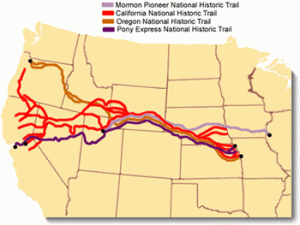
Map of the Overland Trails.
When the wagon trains went out hundreds strong, the first great caravans of the Platte Valley were not the same as the scattering cavalcade of the fur hunters and the ox-trains and mule-trains of the Santa Fe traffic. The men who wore deepest the wheel marks of the Oregon Trail were neither trading nor trapping men, but homebuilding men — the first real emigrants to go West with the intent of making homes beyond the Rockies.
The explorers of the fur trade had laid out the Oregon Trail. Zealous missionaries had made their way over the trail in their thirties. The Argonauts of ’49 passed over it and left it only after crossing the Rockies. But, before gold in California was dreamed of, there had come back to the States reports of lands rich in resources other than gold, lying in the far Northwest, beyond the great mountain ranges and, before the Forty-Niners were heard of, farmers, homebuilders, emigrants, men with their families, men with their household goods, were steadily passing out for the far-off and unknown country of Oregon.
The Oregon Trail was the route John Fremont took in 1842, perhaps the most overrated explorer of the West, though this comment may seem harsh to some. Kit Carson and Bill Williams led Fremont across the Rockies almost by the hand. The Indian tribes had taken across Carson and Bill Williams themselves. But Fremont could write, and the story he had set down during his first expedition inflamed all zeal. Men began to head out for that faraway country beyond the Rockies. Not a few scattered bands, but very many, passed up the valley of the Platte River. A tremendous trek of thousands of men began, seeking homes somewhere beyond the frontier. And that was more than ten years before the Civil War. The cow trade was not envisioned; the coming cow country was overlooked.
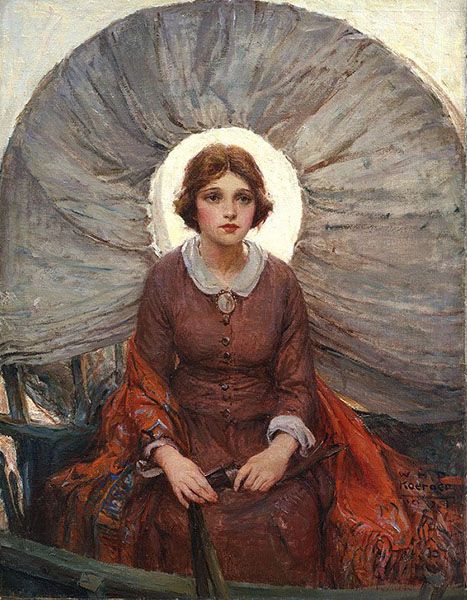
Woman in a covered wagon.
Our national horizon extended immeasurably along that dusty way. Using the Oregon Trail, we first became great. The chief figure of the American West, the figure of the ages, is not the long-haired, fringed-legging man riding a raw-boned pony. Still, the gaunt and sad-faced woman sitting on the wagon’s front seat, following her lord where he might lead, her face hidden in the same ragged sunbonnet that had crossed the Appalachians and the Missouri River long before. That was America, my brethren! There was the seed of America’s wealth. There was the great romance of all America — the woman in the sunbonnet and not, after all, the hero with the rifle across his saddle horn. Who has written her story? Who has painted her picture?
They were large days, those of the great Oregon Trail, not always pleasingly dramatic but oftentimes tragic and terrible. We speak of the Oregon Trail, but it means little to us today, nor will any mere generalities ever make it mean much to us. But what did it mean to the men and women of that day? What and who were those men and women? What did it mean to take the Overland Trail in the great adventure of abandoning forever the known and the safe and setting out for Oregon or California at a time when everything in the far West was new and unknown? How did those good folk travel? Why and whither did they travel?
There is a book written by C.F. McGlashan, a resident of Truckee, California, titled “The History of the Donner Party,” which contains a great deal of actual historical information. McGlashan, living close to Donner Lake, wrote in 1879, describing scenes with which he was perfectly familiar and recounting facts he had from direct association with participants in the ill-fated Donner Party. He chronicles events in 1846, a year before the discovery of gold in California. The Donner Party was one of the typical American caravans of home seekers who set out for the Pacific Slope with no purpose other than to build homes there and with no expectation of sudden wealth from the mines. I desire, therefore, to quote largely from the pages of this book, believing that, in this fashion, we shall come upon the history of a fundamental sort, which shall make us acquainted with the men and women of that day, with the purposes and the ambitions which animated them, and with the hardships which they encountered.
The States along the Mississippi River were sparsely settled in 1846. Yet, the fame of the fruitfulness, the healthfulness, and the almost tropical beauty of the land bordering the Pacific tempted the members of the Donner Party to leave their homes. These homes were in Illinois, Iowa, Tennessee, Missouri, and Ohio.
Families from these States joined the train and participated in its terrible fate. Yet, the party proper was organized in Sangamon County, Illinois, by George and Jacob Donner and James F. Reed. Early in April 1846, the party set out from Springfield, Illinois, and by the first week in May, reached Independence, Missouri.
Here, the party grew to include additional members, and the train carried about 100 people… “In the party were aged fathers with their trusting families about them, mothers whose very lives were wrapped up in their children, men in the prime and vigor of manhood, maidens in all the sweetness and freshness of budding womanhood, children full of glee and gaiety, and babes nestling on maternal breasts.
“There were lovers, to whom the journey was tinged with rainbow hues of joy and happiness, and strong, manly hearts whose constant support and encouragement were the memory of dear ones left behind in their homeland.
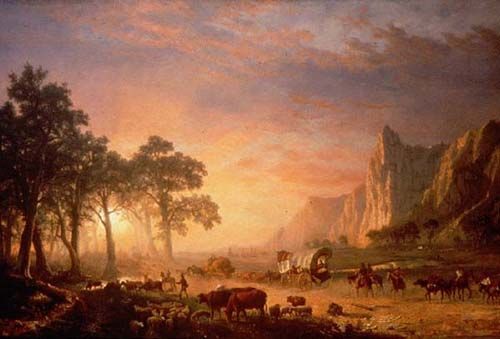
Oregon Trail, Albert Bierstadt, 1869.
“The wonderment which all experience in viewing the scenery along the line of the old emigrant road was peculiarly vivid to these people. Few descriptions of the route had been given, and all were novel and unexpected. The road was broadly and deeply marked in later years, and reasonable camping grounds were distinctly indicated. The bleaching bones of cattle that had perished, or the broken fragments of wagons or castaway articles, were thickly strewn on either side of the highway. But, in 1846, the way was through almost trackless valleys waving with grass, along rivers where few paths were visible, save those made by the feet of buffalo and antelope, and over mountains and plains where little more than the westward course of the sun guided the travelers. Trading posts were stationed at only a few widely distant points, and the party rarely met with any human beings, save for wandering bands of Indians. All survivors speak of these first days as being marked by peaceful enjoyment and pleasant anticipation. There were beautiful flowers by the roadside, an abundance of game in the meadows and mountains, and at night, there were singing, dancing, and innocent plays. The party had several musical instruments and many excellent voices, and the kindliest feeling and good fellowship prevailed among the members.
The formation of the company known as the Donner Party was purely accidental. No pre-concerted arrangement had occasioned the union of so many emigrants into one train. Many of the Donner Party were not aware, at the outset, that such a tide of emigration was sweeping to California. In many instances, small parties would hear of the mammoth train just ahead of them or just behind them and, by hastening their pace or halting for a few days, joined themselves to the party. Many were on the train for part of the journey but left the Donner party for some reason before reaching Donner Lake. Soon after the train left Independence, Missouri, it contained between 2 and 300 wagons, and when in motion, it was 2 miles long. The members of the party proper numbered ninety.”
This caravan, like many others in the remarkable westbound assemblage at that time, had significant variations in personnel. Some were out for mere adventure, while others were single men seeking a location. Most of them were fathers of families, among them several people of considerable means and good standing in the community they were leaving. While we may suppose that most of them were folk of no extraordinary sort, certainly some were persons of education and intelligence. Among these was the wife of George Donner — Tamsen Dormer, a woman of education, a musician, a linguist, a botanist, and of the most sublime heroism.
Tamsen Donner sent back stories of the caravan’s daily doings now and then along the route, and such letters are of the utmost interest to anyone who desires precise information of that time. It would seem that the emigrants, for a significant part of their route, met with no great adventures nor appeared to be undertaking an unusual affair. They followed a route up the Platte Valley, which was already long known to those of the eastern settlements.
“Near the Junction of the North and South Platte, June 16, 1846 — “The roads have been good, and the food is plentiful. The water for part of the way has been indifferent, but at no time have our cattle suffered for it. Wood is now very scarce, but buffalo chips are excellent; they kindle quickly and retain heat surprisingly well.
“My Old Friend: We are now on the Platte, 200 miles from Fort Laramie. Our journey so far has been pleasant; the roads have been good, and the food plentiful. The water for part of the way has been indifferent, but our cattle have never suffered for it. Wood is now very scarce, but “buffalo chips” are excellent; they kindle quickly and retain heat surprisingly. This morning, we had buffalo steak broiled over them, and it tasted the same as it would have over hickory coals.
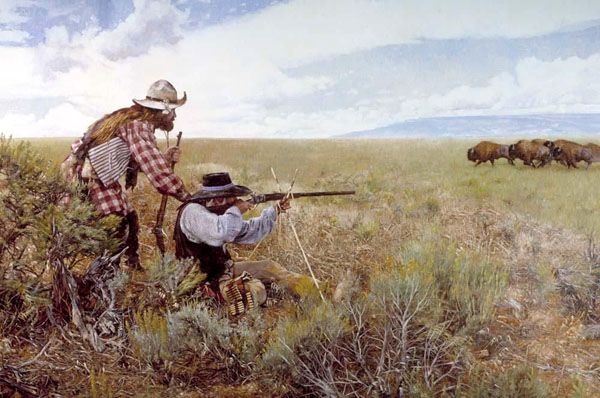
Game Hunters by Craig Tennant.
“We feel no fear of Indians; our cattle graze quietly around our encampment unmolested. Two or three men will go hunting 20 miles from camp, and last night, two of our men lay out in the wilderness rather than ride their horses after a hard chase.
“Indeed, if I do not experience something far worse than I have yet done, I shall say the trouble is all in getting started. Our wagons have not required many repairs, and I cannot yet identify any areas for improvement. Indeed, they cannot be too strong. Our preparations for the journey might have been better in some respects.
“Bread has been the principal article of food in our camp. We laid in 150 pounds of flour and seventy-five pounds of meat for each individual, and I fear bread will be scarce. Meat is abundant. Rice and beans are good articles on the road; cornmeal, too, is acceptable. Linsey dresses are the most suitable for children. Indeed, if I had one, it would be acceptable. There is such a cool breeze at all times on the Plains that the sun does not feel as hot as one would suppose.
“We are now 450 miles from Independence. Our route at first was rough and through timbered country, which appeared fertile. After striking the prairie, we found a first-rate road; the only difficulty we have had is crossing the creeks. In that, however, there has been no danger.
“I never could have believed we could have traveled so far with so little difficulty. The prairie between the Blue and the Platte Rivers is beautiful beyond description. Never have I seen a country so varied and so suitable for cultivation. Everything is new and pleasing; the Indians frequently come to see us, and the chiefs of a tribe breakfasted at our tent this morning. All of them are so friendly that I cannot help but feel sympathy and friendship toward them. But on one sheet, what can I say?
“Since we have been on the Platte, we have had the river on one side and the ever-varying mounds on the other. We have traveled through bottomlands that are one to two miles wide, with little to no timber. The soil is sandy, and last year, due to the dry season, the emigrants found grass scarce here.
“Our cattle are in good order, and none have been lost when proper care has been taken. Our milk cows have been of great service, indeed. They have been of more advantage than our meat. We have plenty of butter and milk.
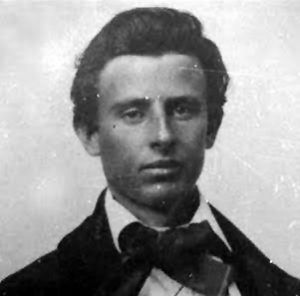
George Donner.
“Captain Russell, an amiable man, commands us. George Donner is himself yet. He crows in the morning and shouts out, “Chain up, boys — chain up,” with as much authority as though he was “something in particular.” John Denton is still with us. We find him useful in the camp. Hiram Miller and Noah James are in good health and doing well. We have some of the best people in our company, as well as some who are not so good.
“Buffalo show themselves frequently. We have found the wild tulip, the primrose, the lupine, the eardrop, the larkspur, and the creeping hollyhock, and a beautiful flower resembling the bloom of the beech tree, but in bunches as large as a small sugarloaf and of every variety of shade, from red to green.
“I botanize and read some, but cook heaps more. As far as we have heard, there are 420 wagons on the road between here and Oregon and California.
“Give our love to all inquiring friends. God bless them.
“Yours truly, Mrs. George Donner.”
By the Fourth of July, the Donner Party had reached Fort Laramie, Wyoming. They pushed west over the old trail up the Sweetwater River and across the South Pass, the easiest of all the mountain passes known to the early travelers. Without many adventures, they reached Fort Bridger, which was only a trading post. Here, the Donner Party made its fatal mistake.
Someone at the fort strongly advised them to take a new route, a cut-off said to shorten the distance by about 300 miles. This cut-off passed along the south shore of Great Salt Lake and caught up the old California Trail from Fort Hall, Idaho — then well-established and well-known along the Humboldt River.
The grand Donner Caravan was delayed for several days at Fort Bridger, hesitating over which route to take. The party is divided. All those who took the old road north of Salt Lake by way of Fort Hall reached California in complete safety. Of the original Donner Party, 87 people remained. All of these took the cut-off, eager to save time on their travels. They reached Salt Lake after unspeakable difficulties. Further west, they lost many of their cattle in Nevada’s deserts.
Now dissensions and grumblings began among the party. The story is a long one. It reached its tragic denouement just below the summit of the Sierras on the shores of Donner Lake. McGlashan’s words may now best serve our purpose.
“Generally, the ascent of the Sierra brought joy and gladness to weary overland emigrants. To the Donner Party, it brought terror and dismay. The company had hardly obtained a glimpse of the mountains before the winter storm clouds began to assemble their hosts around the loftier crests. Every day, the weather appeared more ominous and threatening. The delay at the Truckee Meadows had been brief, but every day ultimately cost a dozen lives.
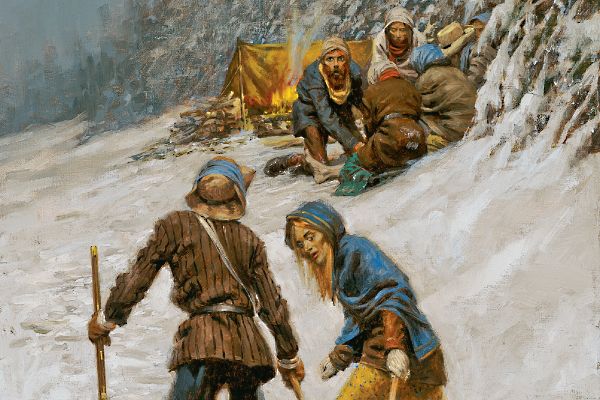
The Donner Party by Andy Thomas.
“On the twenty-third of October, they became thoroughly alarmed at the angry heralds of the gathering storm and, with all haste, resumed the journey. It was too late! At Prosser Creek, three miles below Truckee, they were encompassed with six inches of snow. The snow was two to five feet deep on the summits. This was October 28, 1846. The Sierra had donned its mantle of ice and snow almost a month earlier than usual. The party was for prisoners!
“All was consternation. The wildest confusion prevailed. In their eagerness, many went far in advance of the main train. There was little concert of action or harmony of the plan. Not all arrived at Donner Lake on the same day. Some wagons and families did not reach the lake until the thirty-first day of October; some never went farther than Prosser Creek, while others, on the evening of the twenty-ninth, struggled through the snow and reached the foot of the precipitous cliffs between the summit and the upper end of the lake. Baffled, wearied, and disheartened, they turned back to the foot of the lake.”
These emigrants did not lack health, strength, or resolution, but here they were in surroundings absolutely new to them. A sort of panic seized them now. They scattered; their organization disintegrated. All thought of conjoint action, of a social compact, a community of interests, seems to have left them. It was a history of every man for himself, or at least every family for itself. All track of the road was now lost under the snow. At the last pitch up to the summit of the Sierra’s precipitous cliffs abounded. No one knew the way. And now the snow has come once again.
The travelers knew their supplies would not last long. On the 12th of November, a relief party attempted to move forward, but after struggling a short distance toward the summit, they turned back, wearied and broken-hearted, unable to make their way through the deep, soft snow. Then someone said that it had been F.W. Graves of Vermont, who thought of making snowshoes out of the oxbows and the hides of the slaughtered oxen. With these, they did better.
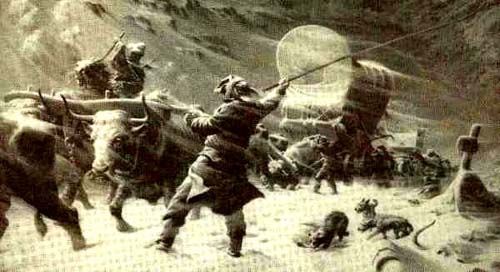
The Donner Party by Andy Thomas.
Volunteers were called for yet another party to cross the mountains into California. Fifteen people volunteered. Not all of them were men — some were mothers, and one was a young woman. Their mental condition was a little short of desperation. Only, in the midst of their intense hardships, it seemed to all that somewhere to the westward was California and that there alone lay any hope. The party traveled four miles on the first day, and their campfires were visible below the summit. The next day, they traveled six miles and crossed the divide.
They were starving, cold, worn out, their feet frozen to the bursting point, their blood chilled. At times, they were caught in some of the furious storms of the Sierras. They did not know their way. On December 27, certain of the party resolved themselves to that last recourse, which alone might mean life. Surrounded by horrors as they were, it seemed they could endure the thought of yet an additional horror… There were the dead, the victims who had already perished!
Seven of the fifteen made it through to the Sacramento Valley, among them the young girl, Mary Graves, described as “a very beautiful girl, of tall and slender build, and exceptionally graceful character.” The story brought out by these survivors of the first party to cross the Sierras from the starving camp set all of California aflame. There were no fewer than three relief expeditions formed, which crossed the mountains to the east at varying dates. Some men crossed the snow belt five times in all. The rescuers were often in as much danger as the victims they sought to save.
And they could not save them. Back there in their tents and hovels around Donner Lake, starvation was doing its work steadily. Contemporary history also provides details on this. Tamsen Donner, the heroine she was, kept a diary that would have been valuable to us, but this was lost along with her paintings and botanical collections. The best-preserved diary is Patrick Breen’s, done simply and matter-of-factly throughout most of the starving winter. Thus:
“Dec. 17. Pleasant; William Murphy returned from the mountain party last evening; Baylis Williams died the night before last; Milton and Noah started for Donner’s eight days ago; not returned yet; think they are lost in the snow.
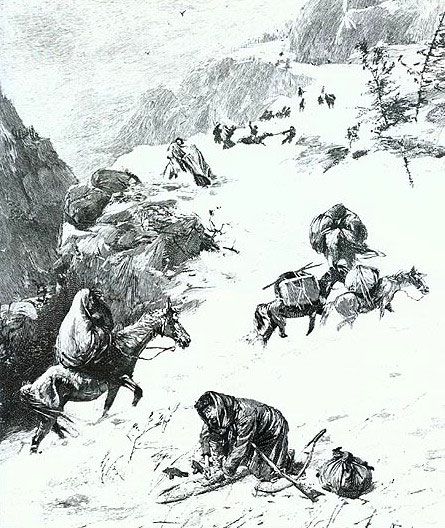
The Donner Party was stranded in the Sierra Nevada Range in 1847.
“Dec. 21. Milton got back last night from Donner’s camp. Sad news: Jacob Donner, Samuel Shoemaker, Rhineheart, and Smith are dead; the rest of them are in a low situation; snowed all night, with a strong southwest wind.
“Dec. 23. It’s Clear today; Milton took some of his meat away. All is well at their camp. I began this day by reading the “Thirty Days’ Prayers.” Almighty God, grant the requests of unworthy sinners!
“Jan. 13. It is snowing fast, higher than the shanty, and it must be thirteen feet deep. We cannot get wood this morning, and it is a dreadful sight for us to look upon.
“Jan. 27. Commenced snowing yesterday; continues today. Lewis Keseberg, Jr. died three days ago; food was growing scarce; we don’t have enough fire to cook our hides.
“Jan. 31. The sun does not shine out brilliantly this morning; it froze hard last night, and the wind is northwest. Landrum Murphy died last night about ten o’clock; Mrs. Reed went to Graves’s this morning to look after goods.
“Feb. 4. It snowed hard until twelve o’clock last night, making many uneasy for fear we shall all perish with hunger. We have but little meat left and only three hides. Mrs. Reed has only one hide, which is in Graves’s house. Milton lives there and will likely keep that. Eddy’s child died last night.
“Feb. 7. Ceased to snow at last; today it is pretty pleasant. McCutchen’s child died on the second of this month.
[This child died and was buried in the Graves’s cabin. Mr. W.C. Graves helped dig the grave near one side of the cabin and laid the little one to rest. One of the most heart-rending features of this Donner tragedy is the number of infants that perished. Mrs. Breen, Mrs. Pike, Mrs. Foster, Mrs. McCutchen, Mrs. Eddy, and Mrs. Graves each had nursing babes when the fatal camp was pitched at Donner Lake.]
“Feb. 8. Fine, clear morning. Spitzer died last night, and we will bury him in the snow; Mrs. Eddy died on the night of the seventh.
“Feb. 9. Mrs. Pike’s child all but dead; Milton is at Murphy’s, not able to get out of bed; Mrs. Eddy and child buried today; wind southeast.
“Feb. 10. Beautiful morning; thawing in the sun. Milton Elliott died last night at Murphy’s cabin, and Mrs. Reed went there this morning to see about his effects. John Denton is trying to borrow meat for Graves; he has none to give; they have nothing but hides. All are entirely out of meat, but a little we have; our hides are nearly all eaten up, but with God’s help, spring will soon smile upon us.”
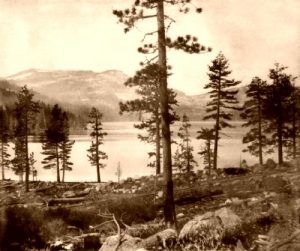
The ill-fated Donner Party was said to have buried their savings near Alder Creek and Donner Lake.
One survivor of the Donner Lake camp was a man named Lewis Keseberg, of German descent. That he was guilty of repeated cannibalism cannot be doubted. In his cabin, the heroic Tamsen Donner met her end after losing all her loved ones. Many thought he killed her for the one horrid purpose.
Such is the story of one of the great emigrant parties that set out west in search of new fortunes in the early days of the Oregon Trail. Happily, there has been no parallel to the misadventures of this ill-fated caravan. Without reading these bald and awful details, it is challenging to realize the vast difference between that day and this. Today, we may arrive at Donner Lake by the gentle stages of a pleasant railway journey. Little trace remains, nor does any kind soul wish for more definite traces of those awful scenes. Only a cross here and there with a legend, faint and becoming fainter every year, may be seen, marking the more prominent spots of the historic starving camp.
Upon the high mountainside, mostly hidden in the forest, lie the snow sheds and tunnels of the railway, now encountering its stiffest climb up the steep slopes to the summit of the Sierras. The author visited this spot of melancholy history in company with the vice president of the great railway line, which swings up steadily and easily over the Sierras. Bit by bit, we checked out the fateful spots mentioned in the story of the Donner Party. A splendid motor highway runs by the lakeside now. While we halted our own car there, a motor car drove up from the westward — following that practical automobile highway that now exists from California’s plains across the Sierras and east over precisely that trail where once the weary feet of the oxen dragged the wagons of the early emigrants. It was a small, inexpensive car. It was loaded down with camping equipment until the wheels were scarcely seen. It carried five human occupants—an Iowa farmer and his family. They had been out to California for a season. Casually, they had left Los Angeles, had traveled north up the valleys of California, east across the summit of the Sierras, and were here now bound for Iowa over the old emigrant trail!
We hailed this new traveler on the old trail. I do not know whether he had any idea of the early days of that great highway; I suspect he could tell only of its present motoring possibilities. But his wheels were passing over the marks left more than half a century ago by the cracked felloes of the emigrant wagons going west, searching for homes. If we seek history, let us ponder that chance pause of the eastbound family, traveling by motor for pleasure, here by the side of the graves of the travelers of another day, itself so briefly gone, what an epoch was spanned in the passing of that frontier!
Compiled and edited by Kathy Alexander/Legends of America, updated February 2026.
Also See:
Early Traders on the Santa Fe Trail
Santa Fe Trail – Highway to the Southwest
Tales & Trails of the American West
Author and Notes: Excerpted from the book The Passing of the Frontier, A Chronicle of the Old West, by Emerson Hough, Yale University Press, 1918. Emerson Hough (1857–1923) was an author and journalist who wrote fictional accounts and historical novels of life in the American West. His works helped establish the Western as a popular genre in literature and motion pictures. For years, Hough wrote the feature “Out-of-Doors” for the Saturday Evening Post and contributed to other major magazines. The text as it appears here, however, is not verbatim, as it has been edited for clarity and ease for the modern reader.