
By Charles Carroll Goodwin in 1913

Stagecoach Driver
Mohammed was a camel driver, but he was not like other camel drivers. The stage drivers in the old California and Nevada days were unlike other stage drivers. Marysville, California, was the headquarters for the California Stage Company, and it was there that staging was seen at its fullness.
As soon as it was light on those delicious mornings, the criers began. One can still hear them — “Empire Ranch, Rough and Ready, Grass Valley, and Nevada” was the first cry. Then came “Oregon Ranch, Camptonville, Downieville.” Then, “Oroville, Forbestown, and Moore’s Flat.” Then “Tehama, Red Bluff, Shasta, and Yreka,” and at steady intervals in a glorified baritone rang out “Sacramento, Sacramento.”
Then, from the stables would come the stages. The horses had been driven across the plains, turned out on their arrival, and by the following spring, they had grown a hand in height, and when taken up, fed grain, and groomed, they were most beautiful.
The great Troy coaches for 27 passengers and drawn by eight horses had the right-of-way. At first, they were driven on alternate clays by ‘Big John” and: ‘Big Jake.” Their real names were John Littlefield and Jacob Putnam. Later, Oscar Ross was put upon that line, but one morning, he ran his coach into an opposition coach and knocked it to pieces. A passenger on the opposition coach, as soon as he could extricate himself from the wreck, fired a full charge of birdshot, at close range, into Oscar’s side and he died three days later.: “Big John” became dissipated, and the company took him from the Sacramento route and gave him one of the Camptonville coaches, who were four-horse coaches. After a few days, he made a night with the boys in Camptonville. He was a little: ‘How-came-you-so” when he mounted the box the next morning, and, going down the Goodyear hill grade, rolled his coach over, broke the rail from the top of it, bruised a Chinese passenger badly, but managed to get to Marysville. He had the coach repaired at his own expense and drove up in front of the stage office the next morning. While waiting for the time to start, a clerk came out of the office and, walking up to the coach, said: “Mr. Littlefield, President Hayworth has instructed me to inform you that your salary has stopped.”
Littlefield began to wind the reins around the brake bar and, in a soft voice which grew harsher as he went on, said: “My compliments to President Hayworth, and kindly say to him that while I hate to disappoint him if what you have just said is true, I’ll be d—-d if I drive !”
Robert Robins and his twin brother Dan drove the Shasta stages, leaving Marysville on alternate days. They were known as “Curly Bob” and “Curly Dan” because of their curly hair. As the railroad stretched toward Tehama and Red Bluff and staging declined, they came to this side of the Sierras and drove on the Overland and branch lines.
They were fine-looking men and great drivers and had none of the wild strata in them, which is so common in men of their calling. Rob died some years ago in Idaho, and Dan in Salt Lake City a few months ago.
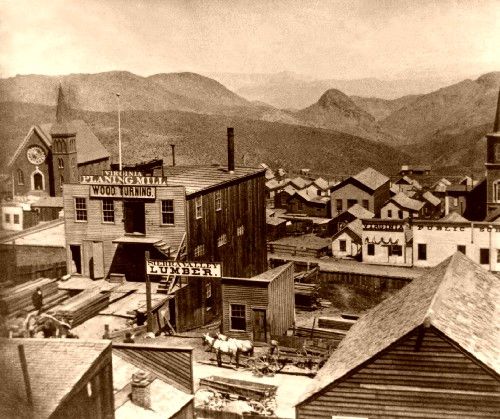
Virginia City, Nevada, 1866
Baldy Green was another famous whip. He was an old-time California driver and then, for years, handled the ribbons on the Overland between Virginia City and Austin.
The last I heard of him, he was a justice of the peace in Humboldt County. His knowledge of the law was limited, but he surely had a great deal of horse sense. He must have been of the Sancho Panza order of magistrates.
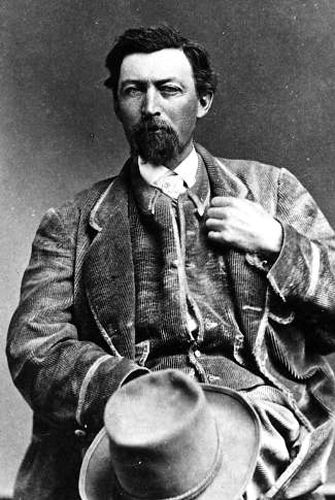
Hank Monk, stagecoach driver.
Of course, half of the world has heard of Hank Monk. Before there was any grade over the Sierras and before the finding of the Comstock, Monk drove a stage between Genoa and Placerville. It was there that Horace Greeley encountered him, and the famous story has been told with more variations than are used when “Home, Sweet Home” is played on the piano by an amateur.
There was not much to it except that Greeley grew impatient going up the mountains from the Genoa side and sharply told Monk that he was put down for a lecture in Placerville that night. Monk, with his drawl, told him to keep his seat, that he would have him there on time. Reaching the summit, Monk shook out his team, and Mr. Greeley’s head collided with the top of the coach at short intervals, which caused him to cry out to go slower, but Monk’s only reply was: “Keep your seat, Mr. Greeley; I will have you there on time.” Mr. Greeley did not know it, but the man on the box was about the most superb reinsman in the world. His secret was his exact calculation. With every ribbon apparently loose, he would turn a running team on a narrow street, bringing them to a complete stop at precisely the right point.
A friend of mine came down one evening with Monk from Glenbrook on Lake Tahoe to Carson City, fourteen miles, in 45 minutes. The friend asked him if he ever rolled a stage over on that route, for the horses were at full gallop half the time. “Oh, no,” was the reply, “When you strike a level grade, ride your brake and let the stock go, but when you turn a curve, take off your brake and give the wheels full play because to ride a brake around a curve when going lively might make you trouble.”
Monk had a superior education and was famous for droll expressions. I was riding beside him once when, nearing a wayside hotel, a man with an overcoat on his arm came running- out of the hotel to the coach. Monk pulled up his team when the man said: “Monk, have you seen Bill lately?”
‘Yes, saw him yesterday; he’s coming down with me tomorrow,” was the reply.
The man said he was glad, turned, and walked back to the hotel, and Monk, easing up on the reins, the team trotted on. When we had gone a few rods. Monk said: ‘I wonder what Bill that yahoo meant?”
“What, Bill, did you mean?” I asked.
“I meant the way-bill,” said Monk.
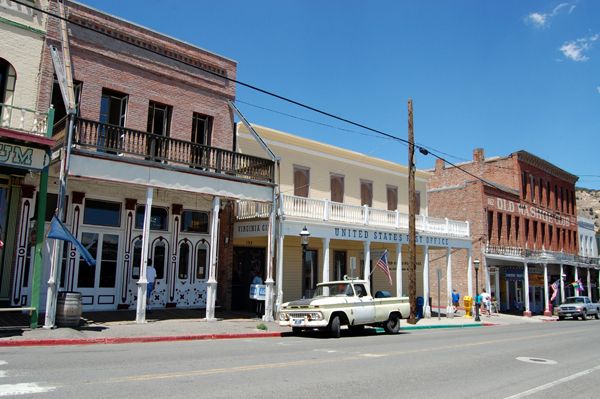
Virginia City, Nevada, today by Kathy Alexander.
Mrs. _____ of Virginia City went up to Tahoe in a carriage one day for a few weeks’ rest in the hot weather. She left her trunk a skyscraper to be sent next day by coach. When Monk reached the hotel at the lake, the lady, a fidgety little woman, was on the upper piazza looking for her trunk. It was not there, and, knowing Monk well, she called to him and asked where it was.
‘They were sawing it in two when I left,” he replied, will bring half of it tomorrow and the other half next day.”
The lady rushed to her room and cried out to her husband: ‘They are sawing my trunk in two in Carson, and all my good clothes are in that trunk: all my party dresses.”
“Oh, well,” said the husband, “that will be all right; you are not more than half-dressed anyway when you go to a party.”
At last, after many years, Monk tipped a stage over. He never recovered from the humiliation of it and died a few months later.
But, stages and stage drivers reached perfection when the Comstock was discovered. The coaches were beautiful, the horses magnificent, covered with ivory rings, tassels on their headstalls, and trappings generally as splendid as could be invented. There were two rival lines: the California Stage Company’s line from Dutch Flat via Donner Lake to Virginia City and Wells Fargo & Company’s pioneer line from Placerville via Genoa and Carson City to Virginia City. The drivers were the finest that could be found. Among these were John Burnett, whose nickname was “Sage Brush,” William Gephardt, “Curly Bill,” Charlie Livermore, and others.
“Sage Brush” was a wonder with the reins. He was driving for Jack Gilmer in Nebraska and Dakota when, in a quarrel one night, he killed or desperately wounded a man. The difficulty was fixed up some way, but he thought it best to leave that region and finally reach Sacramento. He was a small man and was much travel-worn, but he walked into the stage office then in charge of Grant Israel and asked if he needed a stage driver.
Israel had just quarreled with a recalcitrant driver, discharged him, and was in no good humor. Turning fiercely upon Sage Brush, he said: “A stage driver? Did you ever drive a stage?” Sage Brush had a drawl like Mark Twain and answered, “A little.” “Ever drive two horses?” was Grant’s next question. “Sometimes,” said Sage Brush. ‘Ever drive four?” asked Israel. “Occasionally,” was the answer.: ‘Ever drive six?” asked Grant fiercely. “Oh, yes, once in a while,” said Sage Brush. ‘When can you go to work?” asked Israel. “Whenever you like,” was the answer.: ‘Do you know where the stage barns are?” was Israel’s next question. Sage Brush said he did.
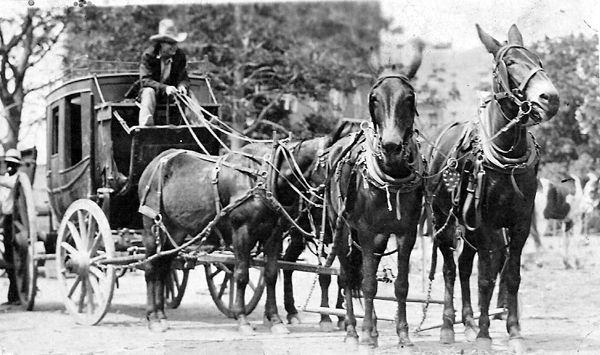
Stagecoach Driver
“Well,” said Israel, “go there tomorrow morning at six o’clock and tell the men you will have the six bays for the Placerville route. Come down the street that the barn is on to a block below this, then turn to the left a block, then turn into this street and bring the coach to this door!” “All right,” said Sage Brush and turned to the door. But Israel hailed him and, calling him back, said: T suppose you are broke; take this,” extending a twenty-dollar gold piece, “and get yourself a square meal!”
“No, thanks,” said Sage Brush. “I have plenty of money. I only drive stage for exercise,” and went out.
Then the clerks in chorus said: “Mr. Israel, you surely are not going to give that team to that emigrant! They will kill him before he ever reaches this office.”
“Suppose they do? You don’t know how much I would give to see a stage driver killed. I have felt that way for a week.”
Israel was out on time the next morning to see the tenderfoot bring down the team; so were the clerks. He did not come down the back street but down the street on which the office was situated, only on the other side, and the team was trotting along gently enough, all their pranks seemingly put aside. When a little below the office, the driver seemed to rouse himself. There was a swift tightening of the reins, a sharp crack of the whip, the leaders came around on the run, the swings on a gallop, the wheelers on a fast trot; at just the right moment, all the reins were pulled taut, the driver’s toe touched the brake, from the driver’s lips came a low “ehe,” and the team stood still. “A stage driver at last, by – -.” cried Israel, and the clerks said, “You bet.”
The stable boys said that before the new driver mounted the box, he inquired the name of each horse, then went to each one, called him by name, rubbed his nose a minute, talked low to him, and “hoodooed the whole bunch.” “Sage Brush” drove the first coach on the Donner Lake route out of Virginia City every night, and “Curly Bill” the second. “Curly Bill” was not nearly so expert a reinsman as was “Sage Brush,” but was a tremendously powerful man. One day a lady in his coach called to him asking protection from a passenger. The passenger was a distinguished army officer who had made a great name in the Civil War. But that day, he was in his cups and in a vicious mood. Curly, Bill got off the box and, going to the stage door said to him that one wearing the uniform he had on should respect it too much to make a woman afraid.
The officer made an insulting reply, whereupon “Curly Bill” reached in, took him by the collar, and hauled him out, bringing the coach’s door with him. The officer was appalled by the terrible strength of the driver, appalled and sobered. He apologized to “Curly Bill” and to the lady, and for the rest of the journey was “childlike and bland.”
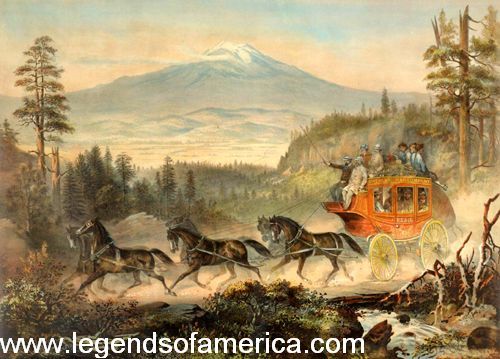
Mountain Stagecoach
The teams driven in and out of Virginia City were marvels, but when the climbing of the Sierras began, less valuable horses were used. One day at Hunter’s Station on the Truckee, Spaulding, superintendent of the road, asked “Curly Bill” if he would not, for a few days, exchange his team going west from there for that of “Sage Brush.” At this, “Curly Bill” demurred, saying that he had taken pains with his team, that they traveled together like clockwork, and he did not want to give them up. Then Spaulding said: “But that team of Sage Brush’s are big half-breeds, wild as Zebras and a bit vicious withal, and ‘Sage Brush’ is afraid that someday when he has a big load of passengers on the grade something will happen and he will have a spill.”
“Oh, that is different !” said Bill. “Give me the right-of-way, and I will try them.” The next day, the passengers were seated in the coach, and Bill was on the box when the “devils” were brought out. It required two men to each horse to hook them to the stage, then the reins were passed to Bill, and he nodded to let them go. They all ran over the bridge they flew and up the road for a mile, when Bill said to a man beside him: “I wonder if they are real game.” With that, he gathered the reins, touched his foot to the brake, and all six went up into the air like they had struck a stone wall. “Why, they’re dunghills,” said Bill, and, taking his whip, he lashed them for a mile, then threw them up into the air again, and thus lashed them and hauled them up by turns all the way to Crystal Peak. They went into Crystal Peak in a sickly lope. They were all afoam and trembling, almost in a collapse of exhaustion.
“Sage Brush” had crowded Bill’s team to the utmost and reached the Peak a few minutes later.
Bill, pointing to the panting, trembling horses, said: “They are broke, Sage Brush.” And Sage Brush replied: “They look it.”
When the railroad superseded the stage, “Curly Bill” established a livery stable in Virginia City and later moved it to San Francisco, where he died last year.
“Sage Brush” drifted to White Pine and then back to Austin. There, one night, he ran upon his own sister in a questionable place, went to his room, and shot himself dead.
Charlie Livermore drove out and into Virginia City on the Placerville route.
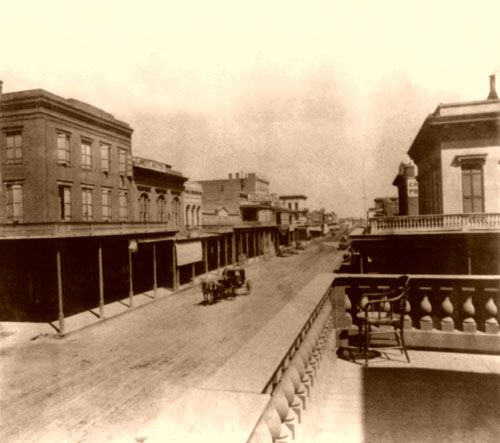
Sacramento, California 1866
At the beginning of this paper, I made a reference to Big John Littlefield. After losing his situation in California, he went to Virginia City, Nevada, and his friend, Deland, who had the Eclipse mine, gave him a fine six-horse team and wagon and set him to hauling quartz. But he got full, let the team get away from him, and smash the wagon. Livermore told me that one morning, he was driving his coach up the steep grade through Gold Hill. He had his pet six-horse chestnut team with all their trappings on, a full load, inside and out, of passengers, ladies and gentlemen, and he believed he had the finest team and coach in the world. Then he caught sight of Big John — who had driven the Troy coach and eight horses between Marysville and Sacramento — driving a donkey not much bigger than a jackrabbit on a whim close beside the road. Livermore said: “I was foolish enough to call to him and say, ‘Why, John, what are you doing there?’ When, in a voice like a foghorn John shouted back, ‘I am trying to see to how d—-d fine a point I can reduce this stage-driving business’.”
Littlefield went north and died, I believe, in Oregon many years ago.
After the collapse of staging in Nevada, Livermore went to Arizona to drive on a line there. He had nothing left but one ivory ring, such as are used where the reins cross between a team.
His first drive was at night, and his only instructions were to follow the road. He was given four mules as wild as deer. It took several men to hitch them up; when they started, it was on a run. A jolt put out all the lights. After a few minutes, the coach stopped, and the leaders disappeared in the darkness, the lead reins being pulled through Charley’s hands. His first word was “Keno !’
Someone trying to find water had sunk a great shaft fifty feet deep; the lead mules had run directly into this shaft. As they fell, the gooseneck of the wagon pole broke, leaving the wheelers and coach on the brink. Asked what he thought, Livermore said: ”I knew in a minute that my ivory ring was gone forever.”
When Big Jake gave up staging, he went to Virginia City and opened a bank, not a national bank, but one of King Faro’s, and became wealthy. Each year, when the snow was deep and the sleighing good, it was his custom to hire a four or six-horse team and sleigh with double bob-runners, fill the sleigh with robes and children, and give the children the ride of their lives.
They are all gone. I do not know one of the old band that is left.
The world will never see their like again unless somewhere in the Cordilleras or Andes, another Comstock may be found, beyond the reach of railroads, where steep grades will have to be climbed and descended and sharp curves rounded, and commerce will have to return to old methods.
As it is, the old race has all passed away as did that driver in Sacramento, who, when dying, whispered: “It’s a downgrade, and I can’t reach the brake.”
Compiled by Kathy Alexander/Legends of America, updated January 2024.
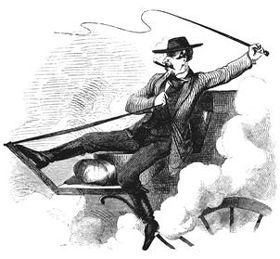
Stagecoach Driver
About the Author: Charles Carroll Goodwin was a Nevada Judge, journalist, and newspaper editor with an active interest in Nevada mining. During his lifetime, he authored numerous newspaper articles, short stories, poetry, and several books, including As I Remember Them, in 1913. Old Stage Drivers is a chapter of that publication.
Also See: