
By General Wesley Merritt in 1890.
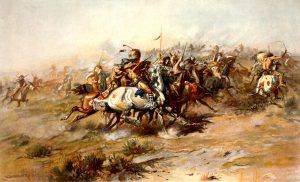
Battle of the Little Bighorn by C.M. Russell.
Making war on Indians is unlike any other war-making in which armies engage. Finding them, not fighting them, is a difficult problem to solve. If the reader will consider that the theatre of operations in any Indian campaign whether in Wyoming, Dakota, the Indian Territory, and Texas, or Arizona is about as large as the New England States with New York added; that each of these possible theatres of war is an uninhabited wilderness; that they are without roads, and often impenetrable for hundreds of miles because of arid deserts or impassable mountain ranges; that while all parts of each territory are to the Indian as familiar as the paths of the home orchard are to the farmer and his children, it is and of necessity must be an unknown land to the best informed white man; that in these trackless wilds the Indian has no fixed habitation; that upon being discovered by his enemy the direction of the trail he takes is a matter of indifference to him; that where night finds him is his home, and that his subsistence and clothing are always with him – if all these and collateral matters depending on them are considered, an idea can be formed of how difficult it is to make successful war on the Indian.
In war, the Indian, though partially civilized, reverts to his worst phase of savagery. Much has been written about the false sentimentality which crops up in the discussion of the Indian question by humanitarians and lovers of fair play, which it is not intended here to repeat. But it may adequately be observed that it is worse than nonsense to urge that the Indian regards the white intruders as the descendants of those who, two centuries and more ago, came to this country and, by might deprive the Indians of their lands and hunting fields, and is through his children pursuing the red man toward the setting sun. The Indians’ knowledge of history scarcely extends beyond one generation. His white enemy is served in war as any other enemy for the same reasons. He has no inherited animosities dating from the time of the Pilgrim Fathers, nor does he feel gratitude for the kind usage shown to his ancestors or himself. The annuities paid him are looked upon as tributes exacted by fear or some less worthy principle, and kindnesses shown him are evidence to his mind that those by whom they are shown are weak and afraid of him.
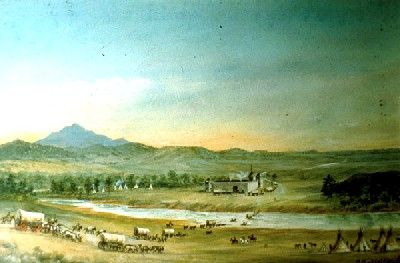
Old Fort Laramie, Wyoming.
Fortunately for the whites, the Indians in their warfare are not in the habit of attacking our so-called forts on the frontier. Otherwise, the horrors of past wars would equal in any year the fearful pictures of the Indian mutiny against the English. Our frontier forts have often been at the mercy of the Indians. Still, the capture in any instance could not have been made without significant loss of life, and it is characteristic of the race that they are slow to attack when certain death awaits any great numbers. They are brave, where superstitious beliefs significantly increase the chances of safety in their favor, but they will not take the risks that satisfy the civilized warrior.
The three consecutive years commencing with the Centennial year are remarkable for three of the most memorable campaigns against Indians known to our annals. The country will not soon forget the thrill of horror with which the news of the massacre of Custer and his command was received in 1876. An entire command of 15 officers and 232 enlisted men was annihilated, with not one left to tell the details of their destruction. All know the history of this sad affair: it is a thrice-told tale, with nothing to redeem it or downplay it as a disaster. It added only to the prowess. Of the Indian, and forever saddened the lives of those who were left to mourn.
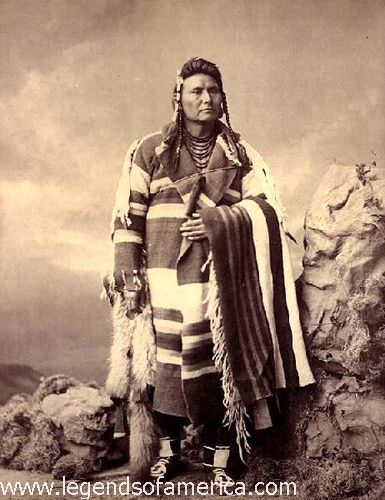
Chief Joseph of the Nez Perce tribe.
The following year, 1877, occurred the wonderful retreat and defense of Chief Joseph with the Nez Perce, pursued by General Howard and his command from Idaho Territory to Montana, a distance of more than 1300 miles, along which, at different points, were intercepting forces, which hacked and cut at the Indians, till at last, reduced in numbers and equipment, they surrendered to an intercepting force, part of the original pursuers being present at the surrender. It was a wonderful pursuit, pluckily persisted in the face of every possible hardship, but who can do justice to the retreat’s labor, courage, and endurance? How intensely interesting would be an account from Chief Joseph if he had the pen of a ready writer and could make his report of his feints, stratagems, and ambuscades; the resolute marches in which he distanced his pursuers; his defense and passage of rivers, with all his impedimenta, including women and children; the meeting and battling with the intercepting forces, or the avoidance of these and escape across the rugged and unknown country, until, finally deceived only about the character of the country he was seeking and the friends he was to meet, he was finally brought to bay like a hunted lion, terrible even in his death struggles.
The year following 1878, another campaign, regarding which less has been written but which is nonetheless remarkable, indicates the genius of war intended to deceive and defeat pursuit, for which the Indian has become so famous.
While General Howard was pursuing the Nez Perce and the intercepting forces were giving them battle or being deluded by their maneuvers, an extensive campaign in the departments of the Platte and Dakota was being waged against the Northern Cheyenne, which resulted in the capture of large numbers of them, nearly a thousand of whom were sent under guard to the reservation set apart in the Indian Territory. This met with great dissatisfaction among many of the Cheyenne, and they were not slow to show it. To address the possibility of an escape attempt, the order was given to take their arms and horses from the Cheyenne, but it was rescinded when it was found that enforcing it would be contrary to the terms of their surrender.
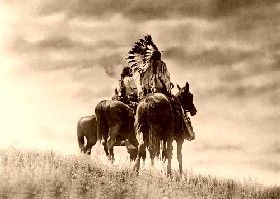
Cheyenne Warriors by Edward S. Curtis.
The army, often at great cost to itself, has habitually kept faith with the Indians. Many of the Cheyenne, finding friends and kindred among the Southern Cheyenne, with whom they were quartered, settled down and became contented.
About one-third of them, under their Chiefs Dull Knife and Little Wolf, finally escaped, notwithstanding that their designs had been suspected and increased care had been taken to prevent it. In the night, early in September, about 90 men, 100 women, and more than 100 children left their lodges standing and went out into the darkness for a destination nearly a thousand miles away, on the road beset with foes and pursued from the start by a force of cavalry little less than that of the warriors of the party. Without tentage or shelter of any kind, save what they could carry on their horses, at a season of the year when there are marked alternations in the temperature, the nights being cold and the days very warm, through a country one – half of which on their route was inhabited, though sparsely, by whites; with the railroads and telegraph at the disposal of their pursuers; burdened with about 250 women and children-this desperate band set out on their almost hopeless retreat.
The two cavalry troops followed closely on their trail. Two other cavalry troops were ordered from Fort Elliott, Texas, about 200 miles distant, to join in the pursuit. The infantry garrisons of Fort Dodge, Kansas, Fort Supply, Oklahoma, and Fort Lyon, Colorado, were ordered along the Arkansas River to intercept or overtake the escaping band. Nor was this all. Allowing for the failure of the more southern cordon of interceptors, a second line of troops to watch for and cut off the escaping party was formed along the line of the Kansas Union Pacific Railway.
And lest all these should fail, further dispositions were made still to the north on the line of the retreat along the Union Pacific Railroad in Nebraska and Wyoming Territory, which the fleeing Indians must cross on the way to the end of their journey.
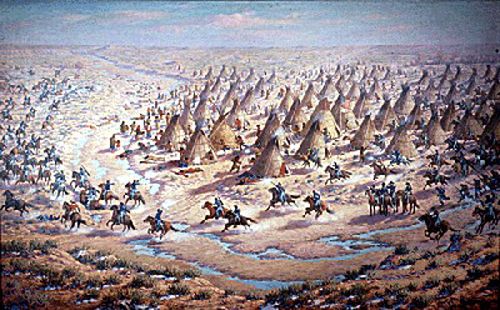
Sand Creek Massacre by Robert Lindneaux, 1936.
The first news of the refugees was received just one week after their escape. They were reported on Bluff Creek, near the Kansas line, about 200 miles from the point of departure, gathering and killing cattle for their subsistence. Just five days after the Cheyenne were located on Bluff Creek, a force of some 200 men, including some 50 citizens, came up with the Indians on Sand Creek, Colorado, and skirmished with them about dark. Three days after this first skirmish, the trail of the Cheyenne was found east of Pierceville, about seventy-five miles beyond Sand Creek, showing they had crossed to the north of the Arkansas River. Thus, the hope of intercepting them on this river had vanished.
As soon as this had satisfactorily arrived, Colonel Lewis took the field from Fort Dodge with detachments of troops on hand. The only cavalry he had consisted of two troops that had just joined him, marching since September 20 from Fort Elliott in Texas, as previously mentioned. Colonel Lewis marched rapidly from Fort Dodge in a north-westerly direction and overtook the fugitives on a tributary of the Smoky Hill River at the end of two days. In the meantime, he had come up with three troops of cavalry. The Indians were firmly entrenched and ready for battle.
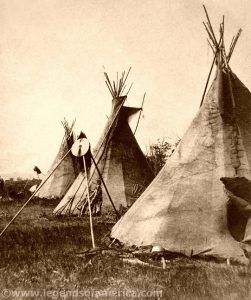
Nez Perce Tipis, Montana, 1871
They were attacked at once, Colonel Lewis leading the advance upon their position. Unfortunately, in the first assault, he fell, mortally wounded. In the temporary confusion resulting from this night closing in, the Indians took advantage of the darkness to continue their flight. The following morning, the trail was followed, and on the morning of the 29th, it was discovered that the Indians had escaped through the second line of troops posted with a view to their interception on the Kansas Pacific Railway.
The pursuit was at once commenced by all the troops that had been watching the line of the Kansas Pacific road, as well as the column that had fought the battle under Colonel Lewis. The command of this force fell to Captain Mauck of the Fourth Cavalry, an officer of ability, courage, and energy, whose command, being infantry in wagons and cavalry, was the only force in the field then fit to pursue the well-mounted Cheyenne. The Indians, on the days following the battle, in which they undoubtedly lost considerably in killed and wounded, though only one Indian killed was found on the field, commenced murdering and devastating through the settlements on the Beaver, the Solomon, and the Republican rivers, killing every man they encountered, and stealing the horses they found. In this way, the Cheyenne re-equipped themselves, while the pursuing force had to continue the pursuit on tired horses, many of which had marched farther than had the Indians.
In the meantime, the utmost activity of the troops of another military department that of the Platte prevailed, and a new line to intercept the fleeing hostiles was formed along the Union Pacific Railway in Nebraska. However, the hope of intercepting the Indians was not great, as the line to be watched was long and the troops to occupy it were few; as was feared, the Indians passed through unseen. This practically ended all hope of successful pursuit, as the country beyond was well known to the Indians, and by scattering in the sandhills of the Platte country, they could defy discovery. It only remains to follow Mauck, the indomitable captain of cavalry, to complete the work of his pursuit for this paper. After marching on an average of 40 miles for five days, commencing September 30, he came to the crossing by the Indians of the railway, replenished his subsistence for men and animals, and then crossed two rivers, the North and South Platte, pursued the fugitives for twenty-three miles. This was on October 5. The next day, his last in the pursuit, he marched forty miles. Following orders, he swerved from the trail and sought a much-needed rest for his command.
As it has been given in brief, the recital of the march and pursuit conveys only a faint idea of the trials, suffering, and anxieties in such an Indian campaign. Let us look at the facts. The command of Captain Mauck, starting from Port Elliott and joining in the pursuit of the renegades, marched 17 consecutive days, making an aggregate of over thirty-five miles a day. It crossed three important rivers, fought a battle in which the field officer commanding the entire force was mortally wounded, and traversed a distance of over 600 miles, often camping without wood or water and suffering at times from extreme changes of temperature, cold at night and heat by day. In consequence of the wounding of Colonel Lewis, the only medical officer with the command had to be left behind, and yet in the face of the fact that a battle without medical assistance meant an increased death rate in the command, this heroic officer and his brave men pressed on, loaded with anxieties and nearly exhausted with the exertion. Nothing could have saved the Indians from this unrelenting chase, but they were refurnishing themselves with fresh horses in unlimited numbers just at the critical time of the pursuit.
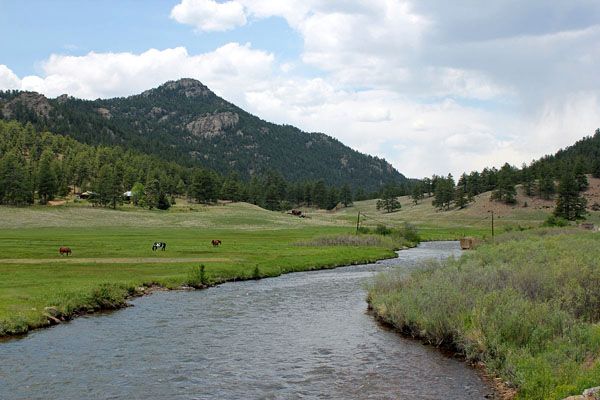
South Platte River, Colorado.
In concluding the recital of the events of this campaign, it may be remarked that over two months after the cessation of the pursuit, this refugee band of Cheyenne was either annihilated or captured, and the remnant returned to the distasteful reservation, where they were forced to live. It is not our purpose to follow the troops in their sufferings from the intense cold of winter during the completion of this work. The Indians protested that they would rather die by their own hands than return to the reservation. The desperateness of the struggle against Indians, impelled by such sentiments, can readily be imagined.
In speaking of this campaign and those of two years preceding, General Sheridan, in his report for the year, says: “These wars might have been regarded as inevitable, and therefore a sufficient number of soldiers should have been provided to meet them, but it was not done, and hence the fatal results which followed. No other nation in the world would have attempted the reduction of these wild tribes and occupation of their country with less than 60,000 or 70,000 men, while the whole force employed and scattered over the enormous region described never numbered 14,000 men, and nearly one-third of this force has been confined to the line of the Rio Grande to protect the Mexican frontier. The consequence was that every engagement was a forlorn hope and was attended with a loss of life unparalleled in warfare. The Indians gave no quarter, and the officers and men had to enter upon their duties with the most barbarous cruelties staring them in the face in case of defeat. It would have been less expensive if an army of 60,000 or 70,000 men had been maintained, and the blood of gallant officers, soldiers, and citizens would not have rested on our hands.”
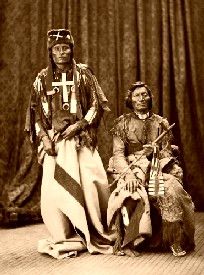
Chiefs Little Wolf and Dull Knife.
In the period before the Civil War, battling with the Indians on our plains was quite a different matter. Then, while the advantage of numbers was still on the side of the Indians, the whites had a significant advantage in arms. There was then never any hesitation on the part of an army detachment, however small, in attacking any force of Indians, however large. The bow, tomahawk, and spear, rudely made, though skillfully handled, were never a match for the firearms of the white man. It was an unwritten law of the frontier, religiously observed, that arms and ammunition should never, at any price, be furnished to the Indians. This has all been changed. Now the most approved arms and the best ammunition are accessible to the Indians, made so by the greed of the traders who infest the frontier, and the Indian today is a more dangerous foe than would be a like number of veteran soldiers. To prove this, it is only necessary to compare the list of casualties in recent Indian wars with those among civilized nations, bearing in mind the numbers engaged.
Incidents Of Indian Campaigning In Arizona
The following events connected with the subjugation of the Apache, given substantially in the words of an accomplished officer who took part for several years in the Indian wars in Arizona, afford an illustration of another phase of the occupation of the army on the frontier in so-called times of peace.
A parallelogram formed by a line from Camp Verde eastward to the White Mountains, south to the San Carlos, continued westward to Camp McDowell, and thence north to the point first named, would contain 15,000 square miles of rocky mountain peaks, deep canyons, heavily wooded mountain streams, and dark pine forests. Beautiful little valleys or parks are found here and there, each an isolated oasis. It is in this isolation and the intervening barriers that the peculiar difficulties of the region for campaigning purposes are discovered.
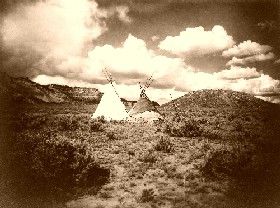
Apache Teepees in Arizona.
After incredible upward toil along the zigzag trail, the scouting party reaches the sharp rocky ridge, whence the almost precipitous descent begins to the pleasant campground far below, and it is seen from the commanding height that the beautiful grassy plain is of minimal extent, and shut in on all sides by almost impracticable mountains. Thus are anticipations of rest and refreshment somewhat dashed by the prospect of the unending, heart-breaking, rock-climbing struggle to begin again at daybreak. In most wild mountain regions, the narrow berme on the edge of streams, or the stream’s bed itself, is the only passable route. Still, here, the mountain torrents that pour out in every direction from the great ranges pass mostly through dark precipitous box canons, which cut off communication between the parks, strung together like beads by the pure, clear, deep streams. All who were penetrating the mountain ranges must do so by painfully climbing their rugged sides.
In this Apache paradise, a wide variety of climates are found. From the cool shade of the pine forests on the Black Mesa to the burning sandy wastes that form the valleys of the Salt and Gila rivers, one passes from one extreme to the other but would prefer instead to remain in the worst than encounter the torture of a journey over the miles on miles of confused and chaotic masses of rocky mountain-peaks to reach the better.
The theatre of operations thus faintly outlined, as well as adjacent portions of the immense territory of Arizona, has been for many years the scene of innumerable conflicts between the troops and the many Apache tribes. A record carefully compiled by the historian of one of the cavalry regiments, which took its share of the sufferings and hardships of the mountain scouting between, shows that in that period, the regiment had ninety-seven combats with the marauding Indians.
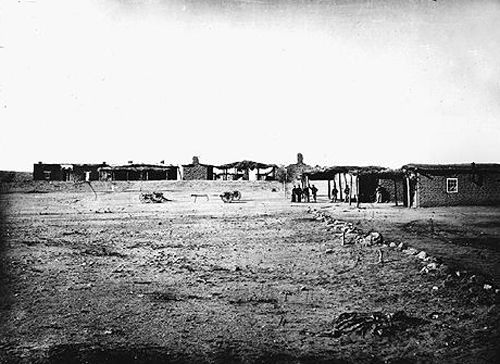
Camp Grant, Arizona.
Early in 1872, it became evident that a portion of the Arivipa Apache were using Camp Grant as a base of supply and pushing their marauding parties out in every direction into the settled parts of the territory. The dread entertained by the settlers for these marauders is best appreciated when the character and mode of warfare of the mountain tribes are understood. As an old wagon master remarked to a cavalry officer: We have a horror of them that you feel for a ghost. We never see them, but when on the road, we always look over our shoulders in anticipation. When they strike, all we see is the rifle’s flash resting with secure aim over a pile of stones, behind which, like a snake, the red murderer lies at full length.
All the Apache are footmen and mountain climbers. They will steal and use horses, but when driven into the mountains, the horses become a part of their rations. Graceful, well-formed, with legs of steel wire, light and active as a cat, the Apache on the rocky hillside is unapproachable, and to fight him, with any chances of success, he has to be attacked with skill and great caution at gray dawn in his bivouac far up among the rocks. Many a surprise has been effected by night marches against natural fortresses unassailable in the daytime by any number of men. If the Indians had discovered the ascending columns, even at night, they could have repulsed them with a great slaughter.
As a first step in the campaign, the commanding general directed that all warriors receiving rations be counted every day at a place to be selected within five miles of the post. So that the officer detailed for this delicate and dangerous duty might be able to identify and keep a record of the young men, a metal tag stamped with a number was issued to each Indian of fighting age.
Many Indians received the order with sullen dissatisfaction because, if carried out, it would checkmate their rovings. Seated on their heels in increasing concentric circles in front of the general, the crouching attitude and the steady glare of their brilliant bead-like eyes made them resemble snakes coiled, ready to strike, and it was plain that when opportunity offered, they would resist the most deadly means of this effort to scotch them. The next day, the cavalry officer detailed rode out four miles from the post, accompanied by one orderly, to meet the young Indians and make the first count.
The officer selected had seen considerable service and fighting. Still, he subsequently confessed that he would have been glad to exchange the duty assigned him for a detail to lead a forlorn hope over a breastwork.
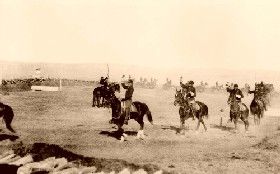
Saber exercises, Fort Custer, Montana.
However, he had been told by the general that it was undesirable to send a force on duty, as some of the warriors might become alarmed and, in their ignorance, make trouble, and that the object was to give the Indians a fair chance. So out he rode, with his heart in his throat, feeling pretty confident that unless he kept his head, some young buck would stab him in the back and, thus distinguishing himself, take his departure for the warpath. The place selected was at the foot of a hill, where the largest Indian village on the reservation was situated. Arriving at the point, the officer was met by the whole band rushing down the hillside with yells and shouts, and as they approached nearer, he had a horror of perceiving that they were nearly all drunk. They celebrated the disagreeable order of the day before with a spree of tiswin.
The lieutenant received the charge by dismounting and standing at the foot of a large cottonwood tree, with a nonchalance far from natural, the orderly, mounted, holding the horses a few yards in the rear. It was soon apparent that several of the chiefs had remained sober and were doing their utmost to prevent trouble. By their exertions, the rabble was halted about twenty yards from the tree and seated with some attempt at the usual half-circle formation. The counting officer then approached with a book and pencil in hand. Though appreciating the danger of assassination, he resolutely passed along the front of each circle and checked off the numbers on the tags.
Many of the rascals, with impudent drunken leers, shook the tags in his face, and one fellow refused to show his. Passing the mutineer, for the time being, the lieutenant concluded the checking process. A formidable problem now confronted him: either he must capture the drunken young Indian or submit to the indignity of seeing the orders entrusted to him for execution treated with contempt, of which the Indians were sure to take advantage, taking it for a confession of weakness. In this perplexity, he called up the orderly with the horses, then turned to one of the most reliable of the chiefs standing near and made signs to him to bring up the young man and force him to show his tag.
The young fellow lounged up when bidden by the chief but stood immovable, staring at the government’s representative with drunken insolence. Giving the orderly, who was still mounted, a few words of direction, the lieutenant mounted his horse as if to ride off. At a signal, the orderly, a fine old soldier, suddenly drew his revolver and covered the young Indian, simultaneously making an imperious sign to him to jump up behind the officer. The old chief took in the situation instantly and, seizing the fellow under the arms, almost threw him up on the croup of the horse behind the lieutenant, and so, the orderly’s steady pistol covered them and rode off. The Indians were quick to appreciate the defeat of the braggart, and yells, screams, and jeering laughter followed the little procession of prisoners and captors. The prisoner was safely landed in the post-guard-house, a substantial witness to the nerve and courage of a relentless officer over the Indian fury of the Apache. Such captures were not always made so successfully. A few months later, two soldiers approached to arrest a young fellow seated on the ground, wrapped in a blanket. Quick as a thought, the Indian threw off the blanket and, by a right and left stroke with a knife, killed one soldier and severely wounded the other.
No further trouble occurred at the daily verification of the Indians. The young men who preferred war to steady rations quietly slipped away and were seen no more, and a correct estimate of the number of hostiles was obtained through the counting process. There was one exception to the quiet manner of departure. Chontz and Cochenay, two desperadoes aspiring to be war chiefs, committed a cold-blooded murder within the limits of the military post and then fled to the mountains, followed by their immediate relatives. This party was pursued immediately by an officer and ten cavalrymen summoned from the drill ground. The soldiers, reinforced by three Apache scouts from the band of Casadore (who had always remained friendly), took up the trail from the scene of the murder, where lay the body of an inoffensive young Mexican, brained from behind by the cowardly assassin. Following the trail, the scouting party soon found a place where a mark was drawn in the dust across the path, and a red flag stuck up on a stick indicated war.
The trail then led over a country the roughest imaginable. Down deep into the bowels of the earth, it seemed to go before the stream at the bottom of the first box canon was reached, and then up, up, along the slanting, slippery path worn in the face of the opposite rocks. The little party pushed on all day on foot, leading their stumbling horses over the broken rocks, halting only after dark, when the trail could not be followed, to spend the chilly winter night on the bare rocks without food and with their saddle blankets alone for cover. The party continued this pursuit for days but, unfortunately, without success. This, however, was a prelude to a tragedy in which Chontz and Cochenay, natural leaders and desperadoes, were principal characters.
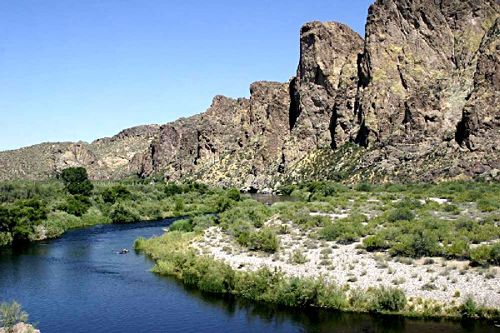
The Gila River northeast of Phoenix, Arizona.
A little later, the agency having been moved to San Carlos, these desperadoes, taking advantage of a stormy night and a sudden rise in the Gila River, which separated the camp of the cavalry from the Indians, boldly entered the Apache village.
It so happened that many of the young men that night, feeling secure from the interference of the soldiers on account of the swollen stream between them, were drinking tiswin and fast ripening into a fit mood for any mischief. This habit of the Apache of intoxicating themselves deliberately by using a liquor made by the Indian women from fermented corn was a challenging thing to deal with. Parties of soldiers under determined young officers were frequently sent into their camp to break up the drunken sprees, a most dangerous duty, consistently successful for the time. Still, with all care, it was impossible to prevent them from stealing or buying corn and again making tiswin.
Just what happened in the Indian camp after Chontz and Cochenay, with their followers, arrived is difficult to say. Casadore subsequently reported that they harangued the bands and said that all young men, not cowards, would follow their lead. Taunts, reproaches, and appeals at such a time produced an explosion. A rush was made for a wagon train loaded with supplies for the troops, camped on the Indian side of the river directly opposite the cavalry camp. The teamsters were instantly killed, and the wagons plundered, and then, with wild yells, the whole tribe started for the mountains.
Here was work, indeed. Hurrying from Fort Apache, the nearest post, two cavalry troops made the seventy miles in one march, bringing with them a company of the gallant and faithful White Mountain Apache, enlisted as scouts.
Taking up the trail, these troops followed the wake of the devastating Apache. Straight for the San Pedro River settlements, it led and was found returning up the valley of that stream and making for the mountains north of the Gila River.
No need to follow the trail to the ruined homes of the white settlers down the San Pedro. At the point where it was encountered, returning from the raid, torn dresses, children’s clothing, and broken household utensils were scattered along the path, showing that the red devils had swept through the peaceful colony like a whirlwind, leaving nothing but the wreckage behind. And so it proved, as those who later visited the scene reported. Dead mothers, appealing to the sky with staring eyes, the lifeless bodies of helpless little children, and last, the scalped and mangled forms of the natural protectors of the frontier home, composed the too-familiar picture presented of the visit of an Indian war party.
After much suffering in the mountains and three days of absolute fasting, the advance troops finally reported that they had located the whole band of Indians on the top of the Pinal Mountains in a position unassailable by direct attack. The commanding officer of the San Carlos, a man of nerve and one familiar with the ins and outs of Apache character, had by this time secured the services of a renegade from the hostiles, who promised to lead the troops into the natural fortress under cover of darkness.
The expedition started at once. It included the soldiers from Fort Apache and the cavalry troops summoned from the nearest posts. Marching only at night and halting during daylight hours for concealment, it reached at dawn on the third morning a point fifteen miles in an air line from the Pinal Mountains.
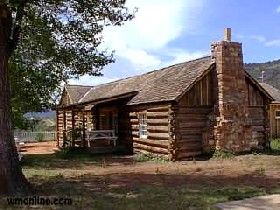
Old Commanding Officer quarters at Fort Apache today, courtesy of White Mountains Online.
As the sun rose, the outlines of the Indian stronghold became visible. Towering up against the sky, it looked formidable indeed. Disheartening evidence of the difficulties of approach was afforded by the unusual sight of the smoke of campfires, which the hostiles did not attempt to conceal.
The curling pillars of smoke indicated the extent of their impregnable position along the rocky ridge, and it was apparent that the Apache felt defiant and secure.
Although only 15 miles in an air line, the renegade insisted that a detour to the north would be necessary to avoid the fearful chasms that intervened, and 25 miles of the roughest country in Arizona must be crossed to reach the crest of the mountain.
Early in the afternoon, the storming party set out. Only the very best of the men were taken. All marched on foot. The sick and exhausted were left in charge of the horses and pack-mules, with orders to keep everything concealed from any outlying enemy scouts. In a single file, in one long column, the troops for the advance were pushed out, led by their White Mountain allies. Stripped to their breechcloths, lithe, graceful fellows, the Indian scouts surrounded and guarded the sullen renegade guide like a pack of greyhounds. Officers and men alike carried their two days’ rations on their backs but had divested themselves of all extra weight, and saving their breath by silence, they strove manfully to keep up with their fleet-footed guides.
A terrible task was before them. The country was one mass of broken rocks, and canons with almost precipitous sides crossed the trail at frequent intervals. All night long, they stumbled, struggled, and scrambled forward. No one in the party could ever tell how they succeeded in crossing the gloomy, pitch-black canons. Keeping in touch with each other and guided by faith, they groped their way to the bottoms of the dark chasms and, in the same order, toiled, panting for breath, up the opposite sides. Treachery on the part of the Apache scouts would have turned any of the dark holes into a slaughter pit.
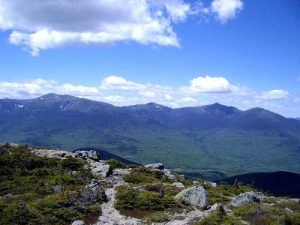
White Mountains
The briefest halts for rest were made, for should daylight come before the crest was reached, discovery, repulse, and death to many must follow. Before the glimmer of the dawn appeared, it was apparent that they were climbing up the side of the last and highest ascent, and with increased caution, the men pulled themselves upward from rock to rock. From the almost steep face of the ridge, sharp rocky spurs ran out at intervals in the direction from which the troops advanced. Three parties made the attack, each ascending by one of these natural scaling ladders.
So well-timed was the operation that when, just at the first streak of dawn, the White Mountain scouts on the right opened fire, and with shouts charged the startled hostiles, the troops had gained the top of their rocky spurs, and the fortified camp, which, warned of the attack, could have repulsed a brigade, was carried in three places. The capture of this natural fortress, which Chonts and Cochenay, the war chiefs, had labored to prove to the bands was impregnable, broke up the tribe’s unity, shook confidence in their leaders, and increased their fear of the troops. The Indians, not killed or captured, dispersed in small parties into the surrounding mountains. In a like manner, the expeditionary force separated and, in small squads, scouted the mountains in every direction, giving the hostiles no chance to attack the settlements.
Before long, runners from the scattered tribe came into San Carlos, asking for peace and permission to return. The commanding general met every such messenger with the information that any band might come in to surrender one or all of the four outlaws named. These were Chontz, Cochenay, Pedro, one of the most active leaders in the murders on the river of that name, and Sondazzy, the tool of Chontz in the killing, a short time before, of a cavalry officer at the agency. They were also notified that if they could not surrender the outlaws named alive, they should mete out the punishment of death, and that upon proof that a just fate had overtaken the desperate criminals, all the other Indians could come in and live at peace.
So it finally turned out: the Indians themselves punished the outlaws, furnishing satisfactory proof that justice had been done, and before summer, the Arivipa tribe was re-established at the San Carlos Agency.
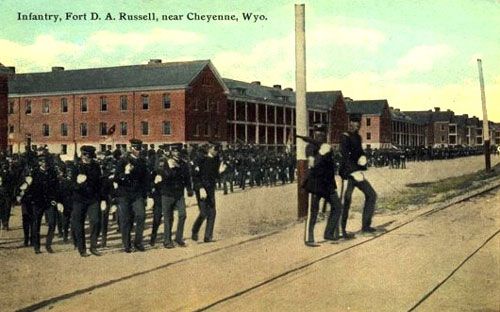
Fort Russell, Wyoming.
On October 1, 1879, the garrison at Fort Russell, Wyoming Territory, was startled by the receipt of telegrams recounting a disaster that had overtaken the command of Major Thornburg, who was known to be marching to the relief of the white inhabitants of the Ute Indian Agency. This command, which the Ute had attacked, was part of the Fort Russell garrison. Major Thornburg is killed; Captain Payne and two other officers, including the command surgeon, are wounded. The command is surrounded and constantly pressed by the hostiles; fifty men are killed and wounded, and all the horses are killed.
These fragments of news dribbled through the wires, all too slowly for the impatient comrades of the small, beleaguered force in the wilds of Colorado. You will proceed with all available troops in your command to the rescue of Payne and his sorely pressed command, said the dispatch from the commanding general of the department to the officer in command at Fort Russell. Officers were assembled, and the orders for preparation were given. No need to insist on haste; the dead, wounded, and beleaguered were kith and kin to those going to the rescue, endeared by hundreds of associations that make men stick closer than brothers. Each officer did their work with the coolness and precision of the usual preparation for a routine service. However, decisions and promptitude told of the serious work ahead.
In four hours from the time the news first reached Fort Russell, all the troops of cavalry, with their horses and equipment, for which there was transportation by rail, were on the cars and running as fast as steam could carry them toward Rawlins, a point 200 miles distant on the Union Pacific Railroad, from which the march was to commence across the country to the scene of the disaster.
By daylight on the following morning (October 2), a force of about 200 cavalry and less than 150 infantry had collected at Rawlins station. The move to the relief of Payne and his command must be made as soon as sufficient force is collected. Payne had reported he was sorely pressed by the Indians on every side and had many wounded, among the rest, the medical officer. His supplies were sufficient to last for five days from September 29. The way to the scene of the disaster was long, and assistance must arrive within three days of the time still left for the troops at Rawlins. Other troops were being hurried forward, but they could not reach the railroad starting point for at least a day or two. Rumors were current that the Southern Ute had broken out, which would significantly increase the strength of the hostiles. The greater their strength, the less time remained for saving the shattered and maimed command. Even then, the Ute Indians on the warpath had been largely augmented by the malcontents from kindred bands and were trying to destroy the weak remnant of Thornburg’s command.
In anticipation of the fewness of the available cavalry for the rescue and with the knowledge that no infantry unassisted could make the march in time to be of service, light wagons, with as good teams as the country could afford, had been ordered collected from the country around Rawlins, in which to transport the infantry. This was all done, and the supplies of every kind were transferred to wagons and pack trains so that the command marched out from Rawlins at eleven o’clock on the morning of October 2. There was a distance of 170 miles to be traversed before the fate of the besieged command could be determined.
The march was a case for calculation and judgment. A dash of 50 or even 75 miles can be made by horses, as racing men say, on a breath, but at the end of this greatest distance, a hundred more miles were left to be accomplished. Too much haste at first, wearing out the horses, would leave the command afoot and helpless. Whether the command would reach its destination in time was the one absorbing thought of every officer and trooper.
It is difficult for one who has never marched on the plains to form a conception of the monotony and seeming slowness of progress. The cavalry command scouting after the Indians will see the landmarks. A few miles off, made so by the clear atmosphere of the plains, stand out as though one could walk to them in a few hours and remain during days of marching in the same places and with the same appearance. Were it not that nearer objects conveyed the fact of distance gained, one might easily imagine that he was journeying in a land where the sorcerer’s art nullified the efforts at motion, and progress was impossible. And if this is so, when a usual march is being made, who can tell the exasperation at the want of apparent progress on the road and the rate of travel on which means life or death to those whom it is one’s duty to save. At the end of the first ten hours, the relieving column had accomplished about forty-five miles. Everything was brought up, and the command was still in good condition. Here, a halt was made till dawn at the break, when the onward march resumed.
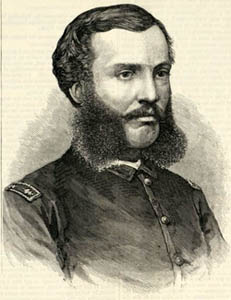
Major Thomas Tipton Thornburgh
Let us now, while still marching forward, recall what had occurred to Thornburg’s command, as was done by everyone in the rescuing column hundreds of times. Ten days before the news of his disaster reached Fort Russell. Major Thomas Thornburg left Rawlins Station with a force of cavalry and infantry to protect the agency and its white inhabitants from the Indians. They were there to feed and instruct. The Indians had grown restless under the agent’s efforts to teach them farming and other white industries, and the agent became anxious for his own and his family’s safety. Thornburg moved leisurely through the country, making convenient camps after usual marches, without molestation, and not until the sixth day were any Indians seen. In the camp, after it was established on this day, several Ute Indians of prominence visited Major Thornburg in the afternoon, talked freely and pleasantly with him and his officers, and departed about nightfall, apparently in a friendly mood. This was more than 100 miles from the agency. After this, Thornburg pursued his march without incident. On the morning of September 29, while a short distance separated his command, he came on the Ute in strong force near a pass in the mountains that bounded their reservation. Their attitude was extremely hostile. While incredulous of their intent to fight, he took the precaution to deploy the part of the command with him, at the same time by signs trying to open communication with the Indians. His overtures were met by a volley from the Indians, which was at once replied to by the troops, the skirmish line being slowly withdrawn to connect with the rest of the command and to protect the wagons. In battle, Indians always send warriors to the flanks and to the rear of the force with which they fight. This they do without reference to the strength of the enemy. It has, therefore, passed into a proverb that there is no retreat in an Indian engagement.
The Ute pursued these tactics under Thornburg’s command, violently engaging his skirmishers at the front. While concentrating his command, when a few hundred yards from the wagons, Thornburg was killed. The command was united at the wagons and surrounded by the hostiles; hurried measures were taken for defense; the fighting on each side continued with desperation. The wagons were formed in an irregular circle, and the contents, together with the dead animals that had fallen nearby, were used to construct a sort of defensive work. Within this ghastly protection, the wounded men were conveyed, and soon, with the implements in the wagons, a circular rifle pit was constructed. And now a new danger threatened. A high wind arose soon after the commencement of the attack, and the Indians fired the dry grass and brush to the windward of the wagons and, taking advantage of the smoke and fire, made a furious attack in the hope of burning the defenders out. This was a terrible danger, but with coolness and courage, the troops combated the flames, and it was not long before their fury was expended. Later in the day, the Ute made a violent onslaught on the breastworks but, being repulsed, settled down to watch their prey in the hope that starvation or lack of water would finish the work. During the night, the means of defense were strengthened, and water was obtained by force from the stream nearby for the famished, wounded, and suffering defenders. Couriers were also sent out into the darkness in different directions, in the hope that the command’s distressful condition could be made known and relief hurried to them. The couriers succeeded in passing out and carried the news that started the relief command from Fort Russell.
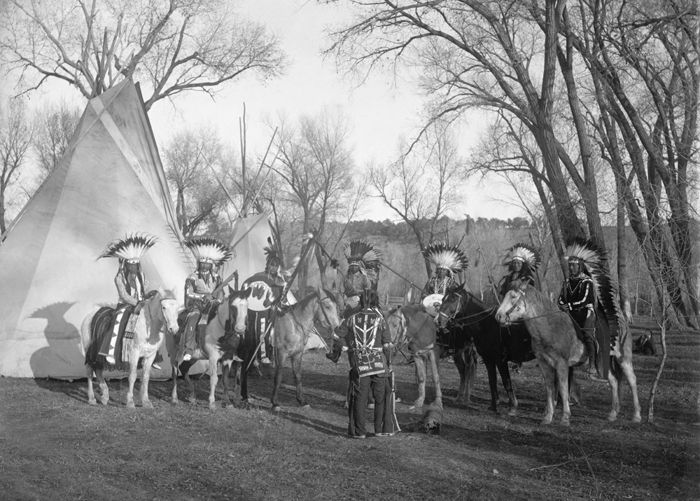
Ute Indians, Frank Gonner, 1904
On the last day of September and for four days in October, the command contended with the Indians, repulsing attacks made from time to time, answering shot with shot and taunt with taunt – for many of the Ute spoke English. Each night, the defensive works were strengthened, and each day, they defended against renewed attacks. A deep square pit was dug in the circle’s interior, in which the wounded were made comfortable. The medical officer, though wounded himself, was dressing the wounds of those most needing attention. At night, armed parties sent out for water also succeeded in bringing in a supply, though they sometimes met resistance and fought for what they obtained. In this way, the time for five long days and nights was occupied; who can tell with what anxieties, gloomy forebodings, and doubting hopes!
In the meantime, the rescuing force was losing no time. Without drawing rein, save for a needed rest at intervals to conserve strength for the whole of the work, the command pressed on with tireless energy, marching with the advance guard and, at times, the flankers to prevent ambuscade or surprise. The country was quiet, and no signs of Indians were discovered. A halt was made on the second night after completing a little less than two-thirds of the distance to be accomplished. At dawn on October 4, the march was resumed. The following dawn must complete the unfinished distance. About 100 miles had already been accomplished in twenty-three marching hours. More than seventy miles, to be marched over in daylight and darkness, in the next twenty-four hours, was before the command. This would require a little less than twenty hours of constant marching if all went well.
In these days of rapid transit, it is not easy for people to bring their ideas of travel down to the rate of the march of a cavalry column. If long distances are marched, this cannot safely exceed four miles per hour, including halts for rest. A single horseman can do more than this, for he can regulate the rate according to the road, and he has not the dust and crowding of a mass of cavalry horses on a narrow road to contend with. Besides, the single horseman provides himself with the best of horses, while the march of a cavalry column must be regulated to meet the abilities of the least enduring animal. All these elements were used to calculate the rescue force’s march. It must make the march, and that, too, with undiminished numbers.
On this day’s march, several settlers were met by the command, fleeing for safety, and rumors of murders and depredations by the Indians were received from all quarters. At one point, the head of the column was approached by an excited party asking for medical assistance, who led the medical officer to a wagon in which a citizen was lying on an improvised bed, who was an unsightly mass of wounds and had been left by the Indians for dead. His companion had been killed. When he discovered that the wagon body in which he lay was nearly half full of loose cartridges, in which he had been trading with the Indians, sympathy for him was greatly diminished.
As night came on, the difficulties of marching increased significantly due to the darkness and rough roads. From time to time, halts had to be made, and staff officers were sent to the rear to direct the column in the darkness and see that all were kept well closed. After a seemingly interminable season of marching by the uncertain light of a waning moon, in which objects were dimly defined and always distorted, the hour indicated to the weary. However, watchful horsemen were approaching the scene of the conflict. No sound broke the stillness of the chilly night save the steady tramp of the horses and the rattle and jingle of the men’s equipment. The infantry part of the command, owing to the darkness and difficulties of travel, had fallen behind.
A blackened heap of ashes on the highway, with fragments of iron and chains and pieces of harness and rubbish, marked where a train loaded with stores for the agency had been burnt, and further on the bodies of the slaughtered trainmen with distorted features and staring eyes, told all too plainly of their short-run for the life of the mercy they had to plead for, and how the relentless foe had answered their prayers. These were not cheering omens. Had Payne and his men shared a like fate? No one had come to tell. But it would soon be known. It can’t be far from here, said the guide, for the third time, as the command was brought to a halt, and everyone strained eyes and ears for a sight of the surrounding country or a sound from the front. A bugler with his trumpet ready was close at hand to sound the call known as officers’ call in the cavalry, a particular sign of recognition that there might be no collision with friends who, hearing the tramp of horses, might mistake the force for foes. Presently, the guide satisfied himself that the command was near the place, and the trumpet’s clear notes awakened the night’s echoes.
In recounting the event, Captain Payne says: “Believing it just possible for help to reach us next morning, I directed one of my trumpeters to be on the alert for the expected signal.” And so it was: just as the first gray of the dawn appeared, our listening ears caught the sound of officers’ call, breaking the morning’s silence and filling the valley with the sweetest music we had ever heard. Joyously, the reply rang out from our corral, and the men, rushing from their rifle pits, made the welkin ring with their glad cheers.
Old West Greetings Postcard.
By General Wesley Merritt in 1890, compiled by Kathy Alexander/Legends of America, updated March 2026.
About the Author: General Wesley Merritt (1834-1910) was a general in the U.S. Army during the American Civil War and the Spanish-American War. He is noted for distinguished service in the cavalry. Three Indian Campaigns appeared in Harper’s Magazine, Volume 80, Issue 479, in April 1890.
Also See:
Battles, Campaigns & Massacres of the Indian Wars