
By Emerson Hough in 1905
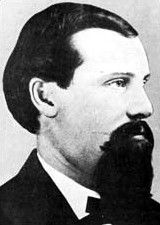
Henry Plummer
Henry Plummer was, for several years in the early 1860s, the “chief” of the widely extended band of robbers and murderers who kept the placer-mining fields of Montana and Idaho in a state of terror. Posing part of the time as an officer of the law, he was all the time the leader in the reign of lawlessness. He was always ready for combat, and he so relied upon his own skill that he would even give his antagonist the advantage — or just enough advantage to leave himself sure to kill him. His victims in duels of this sort were many, and, as to his victims in the cold-blooded robbery, in which death wiped out the record, no one will ever know the list.
Plummer was born in Connecticut in 1837, and, until his departure as a young man for the West, he was all that might be expected of one brought up under the chastening influences of a New England home. He received a good education and became a polished, affable, and gentlemanly appearing man. He was about five feet ten, possibly five feet eleven inches in height, and weighed about 160 pounds, being rather slender in appearance.
His face was handsome, and his demeanor was always frank and open, although he was quiet and did not often talk unless accosted. His voice was low and pleasant, and he had no bravado or swagger about him. His eye was light in color and singularly devoid of expression. Two features gave him a sinister look — his forehead, which was low and brutish, and his eye, which was cold and fish-like. His was a strong, well-keyed, nervous organization. He was quick as a cat when in action, though apparently suave and easy in disposition. He was a good pistol shot, perhaps the best of all the desperadoes who infested Idaho and Montana at that time. Not even in his cups did he lose control of his voice, eye, and weapon. He was always ready — a cool, quiet, self-possessed, well-regulated killing machine.
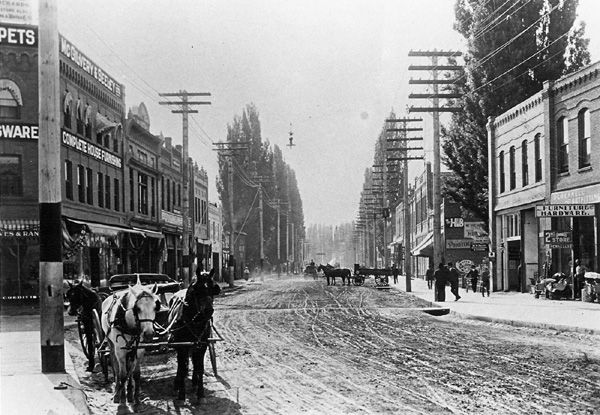
Lewiston, Idaho
At the date of Plummer’s arrival in the mining country, the town of Lewiston, Idaho, was the emporium of a wide region then embraced under the name of Idaho Territory, the latter also including Montana at that time. Where his life had been spent previous to that is not known, but it is thought that he came over from California. Plummer set up as a gambler, and this gave him the key to the brotherhood of the bad. Gamblers usually stick together pretty closely and institute a sort of freemasonry of their own so that Plummer was not long in finding, among men of his own profession and their associates, a number of others whom he considered safe to take into his confidence. Every man accepted by Plummer was a murderer. He would have no weaklings. No one can tell how many victims his associates had before they went into his alliance, but it is sure that novices in man-killing were not desired, nor any who had not been proved of nerve. Plummer soon had so many men that he set up a rendezvous at points on all the trails leading out from Lewiston to such mines as were producing any gold. One robbery followed another until the band threw off all restraint and ran the towns as they liked, paying for what they took when they felt like it and laughing at the protests of the minority of the population, which was placed in the hard strait of being in that country and unable to get out without being robbed. It was the intention to seize the property of every man who was there and who was not accepted as a member of the gang.
One killing after another occurred on the trails, and man after man was lost and never traced. Assaults were made upon many men who escaped, but no criminal could be located, and, indeed, there was no law by which any of them could be brought to book. The express riders were fired upon and robbed, and the pack trains were looted. No man expected to cross the mountain trails without meeting some of the robbers, and when he did meet them, he expected to be killed if he made resistance, for they outnumbered the parties they attacked in nearly all instances. The outlaws were now indeed about three times as numerous as those not in sympathy with them.
Rendered desperate by this state of affairs, a few resolute citizens who wanted law and order found each other out at last and organized into a vigilance committee, remembering the success of the Vigilantes Of California, whose work was still recent history. Plummer himself was among the first to join this embryonic vigilante movement, as was the case in so many other similar movements in other parts of the West, where the criminal joined the law-loving in order to find out what the latter intended to do. His address was such as to disarm all suspicion completely, and he had full knowledge of facts which enabled him to murder for vengeance as well as for gain.
After Oro Fino, Idaho, was worked out as a placer field, the prospectors located other grounds east of the Salmon River range, at Elk City and Florence, and soon Lewiston was forsaken, all the population trooping off over the mountains to the new fields. This broke up the vigilante movement in its infancy and gave Plummer a longer lease of life for his plans.
All those who had joined the vigilante movement were marked men. One after another, they were murdered; none knew by whom or why. Masked robbers were seen every day along the trails leading between one remote mining camp and another, but no one suspected Henry Plummer, who was serving well in his double role.
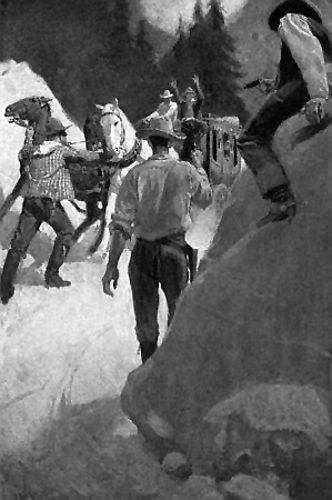
Holding up the stage
In the meantime, additional placer grounds had been discovered a hundred and fifty miles south of Florence, on the Boise River, and some valuable strikes were also made far to the north at the upper waters of the Beaverhead. All the towns to the westward were now abandoned, and the miners left Florence as madly as they had rushed to it from Oro Fino and Elk City. West Bannack and East Bannack, Montana, were now all the cry. To these new points, as may be supposed, the organized band of robbers fled with the others. Plummer, who had tried Elk City, Deer Lodge, and other points, now appeared at Bannack.
One after another, reports continued to come of placers discovered here and there in the upper Rockies. Among all these, the strikes on Gold Creek proved to be the most extensive and valuable. A few Eastern men, almost by accident, had found fair “pay” there and returned to that locality when they found themselves unable to get across the snow-covered mountains to Florence. These few men at the Gold Creek diggings got large additions from expeditions made up in Denver and bound for Florence, who also were unable to get across the Salmon River Mountains. Yet others came out in the summer of 1862 by way of the upper plains and the Missouri River so that the accident of the season, so to speak, turned aside the traffic intended to reach Florence into quite another region. This fact, as events proved, had much to do with the later fate of Henry Plummer and his associates.
These Eastern men were different from those who had been schooled in the mines of the Pacific Slope. They still clung to law and order, and they did not propose to be robbed. The first news of the strikes brought over the advance guard of the roughs who had been running the other camps; and, as soon as these were unmasked by acts of their own, the little advance guard of civilization shot one of them, Arnett, and hung two others, Jernigan and Spillman.
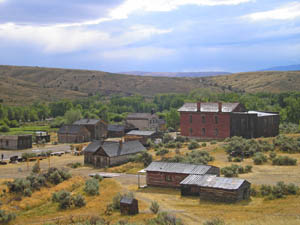
Bannack, Montana Town View by Kathy Alexander.
This was the real beginning of a permanent vigilante force in Montana. It afforded perhaps the only known instance of a man being buried with a six-shooter in one hand and a hand of cards in the other. Arnett was killed in a game of cards and died with his death grip thus fixed.
The new diggings did not at first prove themselves, and the camp at Bannack on Grasshopper Creek was more prosperous. Henry Plummer, therefore, elected Bannack as his headquarters.
Others of the loosely connected banditti began to drop into Bannack from other districts, and Plummer was soon surrounded by his clan and kin in crime. George Ives, Bill Mitchell, Charlie Reeves, Cy Skinner, and others began operations on the same lines that had so distinguished them at the earlier diggings west of the range. In a few weeks, Bannack was as bad as Lewiston or Florence had ever been. In fact, it became so bad that the Vigilantes began to show their teeth, although they confined their sentences to banishment. The black sheep and the white began to be segregated.
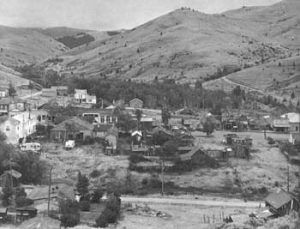
Virginia City, Montana
Plummer, shrewd to see the drift of opinion, saw that he must now play his hand out to the finish that he could not now reform. He accordingly laid his plans to kill Jack Crawford, who was chosen as miners’ sheriff. Plummer undertook one expedient after another to draw Crawford into a quarrel in which he knew he could kill him, for Plummer’s speed with the pistol had been proved when he killed Jack Cleveland, one of his own best gun-fighters. Rumor ran that he was the best pistol shot in the Rockies and as bad a man as the worst. Plummer thought that Crawford suspected him of belonging to the bandits and so doomed him. Crawford was wary and defeated three separate attempts to waylay and kill him, besides avoiding several quarrels that were thrust upon him by Plummer or his men. Dick Phleger, a friend of Crawford, was also marked by Plummer, who challenged him to fight with pistols, as he frequently had challenged Crawford. Phleger was a braver man than Crawford, but he declined the duel. Plummer would have killed them both. He only wanted the appearance of an “even break,” with the later plea of “self-defense,” which has shielded so many bad men from punishment for murder.
Plummer now tried treachery and told Crawford they would be friends. All the time, he was hunting for a chance to kill him. At length, he held Crawford up in a restaurant and stood waiting for him with a rifle. A friend handed Crawford a rifle, and the latter slipped up and took a shot from the corner of the house at Plummer, who was across the street. The ball struck Plummer’s right arm and tore it to pieces. Crawford missed him with a second shot, and Plummer walked back to his own cabin. Here he had a long siege with his wound, refusing to allow his arm to be amputated since he knew he might as well be dead as so crippled. He finally recovered, although the ball was never removed, and the bone never knit. The ball lodged in his wrist and was found there after his death, worn smooth as silver by the action of the bones. Crawford escaped down the Missouri River, to which he fled at Fort Benton. He never came back to the country. Plummer went on practicing with the six-shooter with his left hand and became a very good left-hand shot. He knew that his only safety lay in his skill with weapons.
Plummer’s physician was Dr. Glick, who operated under the cover of a shotgun and with the cheerful assurance that if he killed Plummer by accident, he himself would be killed. Afterward, Glick dressed the wounds of more than one outlaw but dared not tell of it. Plummer admitted to him at last that these were his men and told Glick he would kill him if he ever breathed a word of this confidence. So the knowledge of the existence of the banditti was known to one man for a long time.
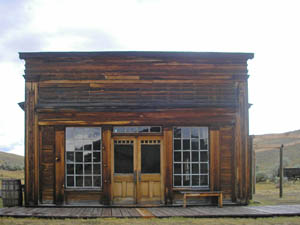
Cy Skinner’s Saloon, Bannack Montana by Kathy Alexander Alexander
As to Bannack, it was one of the wildest camps ever known in any land. Pistol fire was heard incessantly, and one victim after another was added to the list. George Ives, Johnny Cooper, George Carrhart, Hayes Lyons, Cy Skinner, and others of the toughs were now open associates of the leading spirit, Plummer. The condition of lawlessness and terror was such that all the decent men would have gone back to the States, but the same difficulties that had kept them from getting across to Florence now kept them from getting back East. The winter held them prisoners.
Henry Plummer was now elected sheriff for the Bannack mining district to succeed Crawford, whom he had run out of the country. It seems very difficult to understand how this could have occurred, but it will serve to show the numerical strength of Plummer’s party. The latter, now married, professed to have reformed. In reality, he was deeper in deviltry than ever in his life.
The diggings at Gold Creek and Bannack were now eclipsed by the sensational discoveries on the famous Alder Gulch, one of the phenomenal placers of the world and the most productive ever known in America. The stampede was fast and furious to these new diggings. In ten days, the gulch was staked out for twelve miles, and the cabins of the miners were occupied for all of that distance and scattered over a long, low flat, whose vegetation was quickly swept away. The new camp that sprung up on one end of this bar was called Virginia City. It need not be said that among the first settlers, there were the outlaws earlier mentioned, with several others: Jack Gallagher, Buck Stinson, Ned Ray, and others, these three named being “deputies” of “Sheriff” Plummer. A sort of court was formed to try disputed mining claims. Charley Forbes was clerk of this court and, incidentally, one of Plummer’s band! This clerk and these deputies killed one Dillingham, whom they suspected of informing a friend of a robbery planned to make away with him on the trail from Bannack to Virginia City. They were “tried” by the court and freed. Hayes Lyons admitted privately that Plummer had told him to kill the informer, Dillingham. The invariable plan of this bloodthirsty man was to destroy unfavorable testimony by means of death.
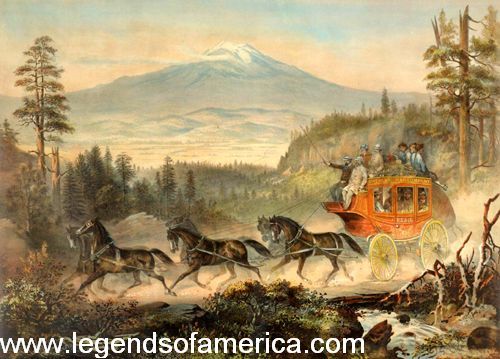
Mountain Stagecoach
The unceasing flood of gold from the seemingly exhaustless gulch caused three or four more little camps or towns to spring up, but Virginia City now took the palm for frontier reputation in hardness. Ten million in “dust” was washed out in one year. Everyone had gold, sacks, and cans of it. The wild license of the place was unspeakably vitiating. Fights with weapons were incessant. Rude dance halls and saloons were crowded with truculent, armed men in search of trouble. Churches and schools were unknown. Tents, log cabins, and brush shanties made the residences. “Hacks rattled to and fro between the several towns, freighted with drunken and rowdy humanity of both sexes. Citizens of acknowledged respectability often walked, more often perhaps rode side by side on horseback with noted courtesans, in open day, through the crowded streets, and seemingly suffered no harm in reputation. Pistols flashed, bowie knives flourished, and oaths filled the air. This was indeed the reign of an unbridled license, and men who at first regarded it with disgust and terror, by constant exposure, soon learned to become part of it and to forget that they had ever been aught else. Judges, lawyers, doctors, even clergymen, could not claim exemption.”
This was in 1863. At that time, the nearest capitals were Olympia, on Puget Sound; Yankton was 2,000 miles away in present-day South Dakota; and Lewiston, Idaho, 700 miles away. What machinery of the law was there to hinder Plummer and his men? What better field than this one, literally overflowing with gold, could they have asked for their operations? And what better chief than Plummer?
His next effort was to be appointed deputy United States marshal, and he received the endorsement of the leading men of Bannack. Plummer afterward tried several times to kill Nathaniel P. Langford, who caused his defeat, but was unsuccessful in getting the opportunity he sought.
From Bannack to Salt Lake City was about five hundred miles. Mails, by this time, came in from Salt Lake City, which was the supply point. If a man wanted to send out gold to his people in the States, he had to go over this long trail across the wild regions.
There was no mail service and no express office nearer than Salt Lake City. Merchants sent out their funds by private messenger. Every such journey was a risk of death. Plummer had clerks in every institution that was making money, and these kept him posted as to the times when shipments of dust were about to be made; they also told him when any well-staked miner was going out to the States. Plummer’s men were posted all along these mountain trails. No one will ever know how many men were killed in all on the Salt Lake Trail.
There was also a stage between Bannack and Virginia City, and this was regarded as a legitimate and regular booty producer by the gang. Whenever a rich passenger took the stage, a confederate at the place put a mark on the vehicle so that it could be read at the next stop. At this point, there were sure to be others of the gang who attended to further details. Sometimes, $2,000 or 3,000 would be taken from a single passenger. A stage often carried fifteen or twenty thousand dollars in the dust. Plummer knew when, where, and how each stage was robbed, but in his capacity as sheriff, he covered up the traces of all his associates.
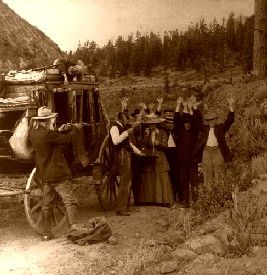
Stagecoach robbery re-enactment
The robbers who did the work were usually masked. Although suspicions were rife and mutterings began to grow louder, there was no actual evidence against Plummer until, one day, he held up a young man by the name of Tilden, who voiced his belief that he knew the man who had held him up. Further evidence was soon to follow. A pack train, bound for Salt Lake City, had no less than eighty thousand dollars in dust in its charge, and Plummer had sent out Dutch John and Steve Marshland to hold up the train. The freighters were too plucky, and both the bandits were wounded and so marked, although, for the time, they escaped. One or two victims also recognized George Ives and began to be watched on account of his numerous open murders.
At length, the dead body of a young man named Tiebalt was found in a thicket near Alder Gulch, under the circumstances showing a revolting murder. At last, the slumbering spirit of the Vigilantes began to awaken. Two dozen men of the camp went out and arrested Long John, George Ives, Alex Carter, Whiskey Bill, Bob Zachary, and Johnny Cooper. These men were surprised in their camp, and among their long list of weapons were some that had been taken from men who had been robbed or murdered. Friends identified these weapons. Old Tex was another man taken in charge, and George Hilderman was yet another. All these men wanted a “jury trial” and wanted it at Virginia City, where Plummer would have official influence enough to get his associates released! The captors, however, were men from Nevada City, the other leading camp in Alder Gulch, and they took their prisoners there.
At once, a Plummer man hastened out on horseback to get the chief on the ground, riding all night across the mountains to Bannack to carry the news that the citizens had, at last, rebelled against anarchy, robbery, and murder. On the following morning, two thousand men had gathered at Virginia City and had resolved to try the outlaws. As there was rivalry between Virginia City and Nevada City camps, a jury was made up of twenty-four men, twelve from each camp. The miners’ court, the most dread of all tribunals, was in session.
Some forms of the law were observed. Long John was allowed to turn the state’s evidence. He swore that George Ives had killed Tiebalt and declared that he shot him while Tiebalt was on his knees, praying after he had been told that he must die. Then, a rope was put around his neck, and he was dragged to a place of concealment in the thicket where the body was found.
Tiebalt was not dead while so dragged, for his hands were found full of grass and twigs which he had clutched.
Ives was condemned to death, and the law and order men were strong enough to suppress the armed disturbance at once started by his friends, none of whom could realize that the patient citizens were, at last, taking the law into their own hands.
A scaffold was improvised, and Ives was hung — the first of the Plummer Gang to meet retribution. The others then in custody were allowed to go under milder sentences.
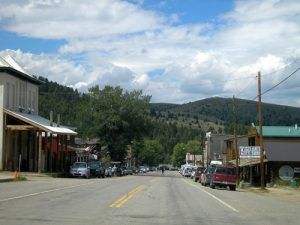
Virginia City, Montana, by Kathy Alexander.
The Vigilantes were now organized with vigor and determination. One bit of testimony was added to another, and one man now dared to voice his suspicions to another. Twenty-five determined men set out to secure others of the gang now known to have been united in this long brotherhood. Some of these men were now fleeing the country, warned by the fate of Ives, but the Vigilantes took Red Yager, Buck Stinson, and Ned Ray, two of them Plummer’s deputies, as well as another confederate named Brown. The party stopped at the Lorain Ranch, near a cottonwood grove, and tried their prisoners without going into town. Red Yager confessed in full before he was hung, and it was on his testimony that the whole secret league of robbers was exposed and eventually brought to justice. He gave the following list:
Henry Plummer was chief of the gang; Bill Bunton, stool-pigeon and second in command; George Brown, secretary; Sam Bunton, roadster; Cyrus Skinner, fence, spy and roadster; George Shears, horse thief and roadster; Frank Parish, horse thief and roadster; Bill Hunter, telegraph man, and roadster; Ned Ray, council-room keeper at Bannack; George Ives, Stephen Marshland, Dutch John (Wagner), Alex Carter, Whiskey Bill (Graves), Johnny Cooper, Buck Stinson, Mexican Frank, Bob Zachary, Boone Helm, Club Foot George Lane, Billy Terwilliger, Gad Moore, were roadsters.
The noose was now tightening around the neck of the outlaw, Henry Plummer, whose adroitness had so long stood him in good stead. The honest miners found that their sheriff was the leader of the outlaws! His doom was said then and there, with that of all these others.
A party of the Virginia City law and order men slipped over to Bannack, Henry Plummer’s home. In a few hours, the news had spread of what had happened at the other camps, and a branch organization of the Vigilantes was formed for Bannack. Stinson and Ray were now arrested, and then Plummer himself, the chief, the brains of all this long-secret band of marauders. He was surprised with his coat and arms off and taken prisoner. A few moments later, he was facing a scaffold where, as sheriff, he had lately hung a man. The law had no delays. No court could quibble here. Not all Plummer’s wealth could save him now, nor all his intellect and cool audacity.
An agony of remorse and fear now came upon the outlaw chief. He fell upon his knees, called upon God to save him, begged, pleaded, wept like a child, and declared that he was too wicked to die thus soon and unprepared. It was useless. The full proof of all his many crimes was laid before him.
Ray, writhing and cursing, was the first to be hanged. He got his finger under the rope around his neck and died hard, but he died. Stinson, also cursing, went next. It was then time for Plummer, and those who had this work in hand felt compunction at hanging a man so able, so urbane, and so commanding.
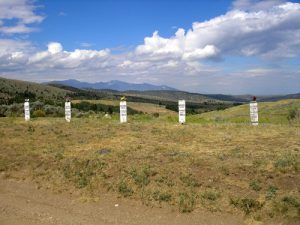
Boothill in Virginia City, Montana, by Kathy Alexander.
Nonetheless, he was told to prepare. He asked for time to pray and was told to pray from the cross-beam. He said goodbye to a friend or two and asked his executioners to “give him a good drop.” He seemed to fear to suffer, he who had caused so much suffering. To oblige him, the men lifted his body high up and let it fall, and he died with little struggle.
To cut short a long story of bloody justice, it may be added that of the men named as guilty by Yager, everyone was arrested, tried, and hung by the Vigilantes. Plummer, for some time, must have dreaded detection, for he tried to cover up his guilt by writing back home to the States that he was in danger of being hanged on account of his Union sympathies. His family would not believe his guilt and looked at him as a martyr. They sent out a brother and sister to look into the matter, but these two found proof which left them no chance to doubt. The whole ghastly revelation of a misspent life lay before them. Even Plummer’s wife, whom he loved very much and who was a good woman, was at last convinced of what at first she could not believe. Plummer had been able to conceal from even his wife the least suspicion that he was not an honorable man. His wife was east in the States at the time of his death.
Plummer went under his true name. George Ives was a Wisconsin boy from near Racine. Both he and Plummer were 27 years of age when killed, but they had compressed much evil into so short a span. Plummer himself was a master of men, a brave and cool spirit, an expert with weapons, and, in all, not a bad specimen of the bad man at his worst.
He was a murderer, but after all, he was not enough of a murderer. No outlaw of later years so closely resembled the great outlaw, John A. Murrell, as did Henry Plummer, but the latter differed in one regard: — he spared victims, who later arose to accuse him.
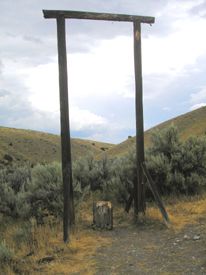
Bannock, Montana Gallows by Kathy Alexander.
The frontier has produced few bloodier records than Plummer’s. He was the principal or accessory, as has been stated, in more than 100 murders, not to mention innumerable robberies and thefts. His life was lived out in scenes typical of the early Western frontier. The madness of adventure in new wild fields, the lust for gold, and its unparalleled abundance drove to crime men who might have been respected and of note in proper ranks of life and in other surroundings.
~~
Note: Today, historians question whether Plummer was actually an outlaw or was set up by politicians. For an updated story, see Henry Plummer – Sheriff Meets A Noose
Go To the Next Chapter – Boone Helm
Compiled and edited by Kathy Alexander/Legends of America, updated October 2023.
About the Author: Excerpted from the book The Story of the Outlaw: A Study of the Western Desperado, by Emerson Hough; Outing Publishing Company, New York, 1907. This story is not verbatim, as it has been edited for clerical errors and updated for the modern reader. Emerson Hough (1857–1923).was an author and journalist who wrote factional accounts and historical novels of life in the American West. His works helped establish the Western as a popular genre in literature and motion pictures. For years, Hough wrote the feature “Out-of-Doors” for the Saturday Evening Post and contributed to other major magazines.
Other Works by Emerson Hough:
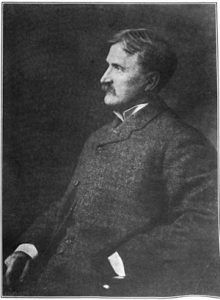
Emerson Hough, author
The Story of the Outlaw – A Study of the Western Desperado – Entire Text