
By John Moody in 1919
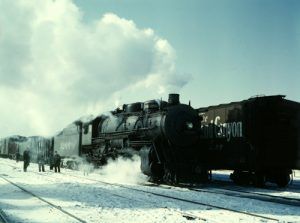
Atchison, Topeka & Santa Fe Railroad.
The Santa Fe Route, or the Atchison, Topeka, and Santa Fe Railroad, which was developed into one of the largest and most profitable railroad systems in this country, was projected long before the idea of a transcontinental line to the Pacific coast had taken full possession of men’s minds. As early as 1858, a plan was worked out for constructing a line of about 40 miles within the State of Kansas to connect what were then the obscure and unimportant townships of Atchison and Topeka. At that time, not a mile of the railroad had been built in Kansas or any Territory west of that state, except on the Pacific coast, to which the wonderful discovery of gold had occasioned enormous immigration.
The outbreak of the Civil War delayed the undertaking of the Atchison-Topeka line, and nothing more was done until 1868. In that year, new interests took control of the enterprise. They acquired rights for its extension through southwestern Kansas in the direction of Santa Fe, the capital of the Territory of New Mexico.
The company, which had been initially the Atchison-Topeka, changed its name to the Atchison, Topeka & Santa Fe and obtained from the Government a very valuable land grant of 6,400 acres for every mile constructed, the only condition being that within ten years, the line should be completed from Atchison to the western border of Kansas. The plan involved building only 470 miles of road, which, when finished, would assure the company nearly three million acres of land within the State of Kansas.
A decade would seem to be ample time to construct this comparatively short railroad, particularly with the inducement of an extraordinary land grant. Not only the Union Pacific but the Central Pacific and Kansas Pacific Railroad — all built within this decade — had to accomplish far more construction to secure their respective grants. Yet they had their complete lines in operation years before the Santa Fe had 50 miles of track in actual commission. The reason for this delay was a financial one. The other roads received government aid in cash or securities and land grants. But the Atchison line was, from the start, thrown on its own resources in raising capital, and it was not until late in 1869 — nearly a year after the opening of the Union Pacific to the coast — that any construction work whatever was done. In that year, the section from Topeka to Burlingame, consisting of about 28 miles, was opened for traffic, and a year later, the extension to Emporia was finished, thus making a total of 61 miles under operation.

Railroad tracks across Kansas.
The terms of the land grant provided that the entire line across Kansas should be completed by June 1873. By 1872, only 61 miles of track had been built, the company still had over 400 miles to go within ten months if it expected to obtain the land grant. But so energetically did the owners of the property work from that time on that within seven months, they had reached the eastern boundary of Colorado and saved the grant.
But like most of the Western railroads built in those early days, the Santa Fe property was, in a sense, ahead of its time. The rapidity with which it shot across Kansas in 1872 was equaled only by the promptness with which it fell into financial straits. No sooner had its complete line been opened for traffic than the panic of 1873 occurred; the company became embarrassed by a large floating debt, and a compromise had to be made with the bondholders whereby a postponement of a year’s interest was arranged.
No attempts were made to extend the Santa Fe during the long period of depression following the panic of 1873. The road ended in 1872 at the Colorado state line. During the next few years, the only building of importance was a western spur to connect with the Denver & Rio Grande at Pueblo, thereby giving an outlet to the growing city of Denver and the rapidly developing mining regions of Colorado. In about 1880, construction was resumed leisurely, down the valley of the Rio Grande into New Mexico and in the direction of Albuquerque. In this extension, as in later building, the line of the old Arizona trail was usually followed. One writer has declared that “the original builders of the Atchison followed the line of the Arizona trail so religiously that if the trail skirted a ten-foot stream for a quarter of a mile to strike a shallow spot for fording, the railroad builders did likewise, instead of bridging the stream where they struck it, and where the trail ran up a tree or hid in hollow rock to avoid the wolves or savages, the railroad did the same!”
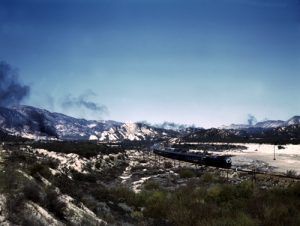
Santa Fe Railroad through the Cajon Pass, California, 1943
The traveler of a generation ago, over this particular section of the Santa Fe lines, might have felt that there was some truth in this criticism. Still, the Atchison has long since cut out these idiosyncrasies of early construction, and the main line in this section of New Mexico is now noted for alignment and absence of curves and grades.
The builders of the Santa Fe lines in the early days, no doubt, planned ultimately to penetrate the Pacific coast, knowing that the real opportunity for the road lay in that direction. The Southwest was yet but sparsely settled, and no railroad which had as its objective the plains or alkali deserts of Arizona or New Mexico could thrive — at least it could not for decades to come.
And yet, in the early 1880s, the fundamental objective of the Atchison system had not been determined. Having passed its original objective point, Santa Fe, the road had reached Albuquerque, but it could not afford to stop there. Through traffic, it must have or die. With its thin population and lack of development, New Mexico could not supply the insufficient traffic amount even to “feed the engines.”
To extend somewhere, then, was an imperative necessity. But would it? Several routes were under consideration. The Southern Pacific lines had worked eastward to El Paso on the Mexican border, several hundred miles due south from Albuquerque. It looked feasible to extend the Atchison to that point and arrange a traffic agreement with the Southern Pacific or to build an extension through New Mexico to Deming and then westward along the river valleys and down into Mexico to Guaymas on the Gulf of California. In the third place, it was possible to build directly west from Albuquerque through Arizona and Southern California to the coast. Ultimately all of these plans were carried out.
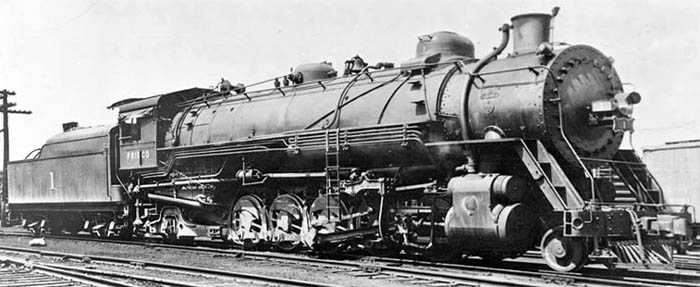
St. Louis & San Francisco Railroad
The first extension of the Santa Fe was to Deming, New Mexico, where in March 1881, its tracks met those of the Southern Pacific. By agreement, the company secured the use of the Southern Pacific to Benson, Arizona. This new route to the Pacific began to pay handsomely from the first. Later, the line into Guaymas, Mexico, was added by purchasing the Sonora Railway. Soon afterward, the Santa Fe secured from the St. Louis & San Francisco Railway a half interest in the charter of the Atlantic and Pacific, a company that planned to build through to the coast. Meanwhile, the Gould and Huntington interests acquired the St. Louis & San Francisco, which, as the owners of the Texas and Pacific and the Southern Pacific systems, naturally opposed the plans of the Santa Fe. The matter was compromised by the agreement of the Santa Fe to build no farther west than the Colorado River, where the Santa Fe was to be met by an extension of the Southern Pacific line from Mojave, California.
This arrangement proved unprofitable to the Santa Fe, for the Southern Pacific naturally diverted traffic to El Paso and Ogden. A new arrangement was accordingly made in 1884, involving the purchase, by the Atlantic and Pacific, of the Southern Pacific division between Needles and Mojave, the obtaining of trackage rights between Mojave and San Francisco, and the use of the Southern Pacific terminals at San Francisco. To assure a connection with the coast in Southern California, the Santa Fe built a line to Colton, acquired the California Southern Railway from Colton to San Diego, and effected an entrance to Los Angeles by leasing the Southern Pacific tracks from Colton.
The Santa Fe had reached the Pacific coast over its own lines, but poor connections with the East handicapped it. Its next move was eastward to Chicago, where it acquired the Chicago and St. Louis Railroad between Chicago and Streator, Illinois, and then constructed lines between the latter point and the Missouri River. During the same year, the company opened branches southward to the Gulf of Mexico until, by May 1888, the entire system comprised 7,100 miles.
This rapid expansion of the property, combined with extravagance in management and a reckless policy in the payment of dividends, brought the company into financial difficulties within a year after the completion of the system. Unprofitable branches had been built, becoming an immediate burden to the main system. It is the same story that has been told of most of the large railroads of those days. Strenuous efforts were made to save the property from a receivership, and a committee was appointed in September 1889 to devise ways and means of reform and reorganization.
The new management of the Santa Fe was rational and substantially reduced the obligations of the road. Had its spirit been maintained, a second failure and reorganization would not have been necessary a few years later. New interests, however, came into the property. Though it was hoped that they would support a conservative policy, the former program of expansion was resumed until, in 1890, the St. Louis and San Francisco system was merged with the Santa Fe on a very extravagant basis. Within a year, it was clear that the St. Louis and San Francisco would prove more of a liability than an asset. During the same time, the less important purchase of the Colorado Midland Railway also turned out to be a poor investment.
The next four years were marked by more bad financial management, which culminated in the failure of the reorganized company. In 1892 an exchange of income bonds for fixed interest-bearing bonds so increased the company’s fixed charges that, as a result of the panic of 1893 and its ensuing depression, the great Santa Fe system suddenly found itself in the hands of a receiver. The president, John W. Reinhart, had persistently asserted throughout 1893 that the company was financially sound. Still, an examination of its books subsequently made in the interest of the security holders disclosed gross irregularities, dishonest management, and manipulation of the accounts.
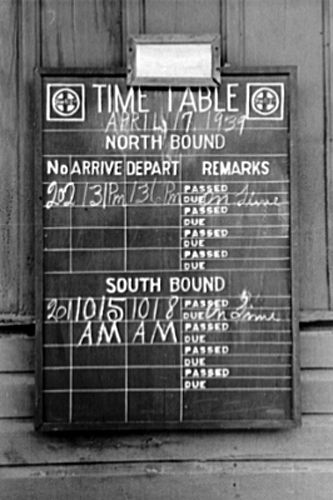
Santa Fe Timetable
During 1894, the property was operated under the protection of the courts, and early in 1895, a new and comprehensive scheme of reorganization was carried out. This latest plan involved dropping the St. Louis and San Francisco system, the Colorado Midland, and all other unprofitable branches; it wiped out the floating debt; it supplied millions of new capital, and it enabled the succeeding management at once to build up and improve the property.
At the head of the new company was placed Edward P. Ripley — a railroad manager of great executive ability and a practical, broad-minded businessman of the modern type, who has ever since remained president of the road. The history of the Santa Fe since 1895 has been closely identified with Ripley’s business career, and its record during these two decades was an enviable one. Steady progress from year to year in the volume of business, in the general development of the system, in the improvement of its rights of way, terminals, and equipment has characterized its history through periods of depression and times of prosperity. Its resources have grown to vast totals; its credit equals that of the best of American railroads; its stocks and bonds are prime investments, and each year it pours millions of dollars of profits into the hands of its stockholders.
Compiled and edited by Kathy Alexander/Legends of America, updated July 2023.
About the Author: John Moody wrote The Railroad Builders, A Chronicle of the Welding of the States, written in 1919. Penetrating the Pacific Northwest is the seventh chapter of the book. The tale is not 100% verbatim, as minor grammatical errors and spelling have been corrected.
Also See:
Atchison, Topeka, and Santa Fe Railroad,