
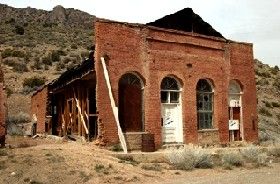
Tybo, Nevada, old General Store, courtesy Robert Wynn
A once-thriving mining town, Tybo, Nevada, was “discovered” in 1866 when a local Indian led white settlers to the site where he had found gold ore. Though these prospectors did their own digging, the main lode that would eventually establish the mining camp wasn’t discovered until 1871.
A smelter was built in 1872, but it would take several years before the town was officially established in 1874. Named Tybo, a word derived from the Shoshone, meaning “white man’s district,” the settlement began to boom the following year when the Tybo Consolidated Mining District was formed.
Controlling three major mines near the camp, the town soon reached its peak population of about 1,000 residents in 1876. It boasted a school, a post office, a newspaper, a Wells Fargo office, a bank, several retail businesses, and numerous saloons.
Though the settlement started out as a quiet community, this would change when the camp began to experience racial problems. Filled mostly with European immigrants, the difficulties began when the company that owned the charcoal burners hired Chinese workers to cut the wood that fired the charcoal kilns.
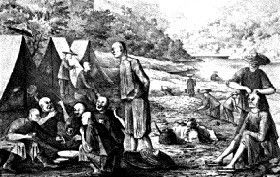
Chinese Camp.
As in many mining camps of the west, the white settlers did not like the Chinese, and angered by the many who had “invaded” their camp, heated talk, with the help of flowing liquor, started in the saloons. Before long, they retaliated against the Chinese with words, fists, knives, and guns, leading to several nameless graves in the cemetery.
The frenzy continued until it culminated in a drunken mob storming the sleeping camp of the Chinese workers with cracking bullwhips and blazing guns. Fleeing for their lives, the Asians hid in the hills until their employers rounded them up and put them back to work under the watchful eye of armed guards. The miners again threatened to storm the Chinese camp, but this time they gave the charcoal company an ultimatum – get rid of the Chinese in 24 hours, or they would kill them. This time, the Chinese fled for their lives.
In 1881, the Tybo Consolidated Mining Company failed after ore quality dropped dramatically, and by the end of the year, Tybo’s population had fallen to about 100. Three years later, in 1884, much of the once prosperous community was destroyed by a disastrous fire that leveled 32 buildings.
Over the years, numerous mining companies attempted to revive operations, but all failed, with the last mill closing in 1937. The last known miners known to work the area were 18 men who hauled old tailings to Tonopah in 1942-1945.
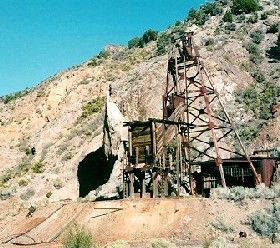
Tybo Headframe, courtesy High-Grade Treasures.
All in all, the district’s silver, lead, and zinc production netted some $9.8 million in valuable ore during its production years.
Though a handful of people still make their homes in Tybo, today, the settlement is a ghost town with its few remaining once-prosperous businesses standing in stages of ruin. That said, Tybo offers several picturesque photo opportunities for ghost town enthusiasts, including the town’s old general store, with its imposing brick facade and arched windows. Many other original buildings, cabins, charcoal kilns, and a cemetery can also be seen. In the hills near the town, nothing remains of the mills but foundations; however, mines continue to dot the landscape. A few shafts remain uncovered, so hikers should take care. We should note that most buildings and land are now private property, so be respectful and take pictures from the road.
Tybo is in Nye County, approximately 17 miles from Warm Springs, Nevada. From Warm Springs, take Highway 6 northwest to Toiyabe Basecamp Road and turn left, following to Tybo. Some portions of the road are unpaved.
©Kathy Alexander/Legends of America, updated November 2025.
Also See:
Mining on the American Frontier
Riot in Rock Springs Leads to Massacre, Wyoming
See Sources.