
Articles from the Reno Evening Gazette, 1891.
The City of the Dead – (Reno Evening Gazette, February 21, 1891)
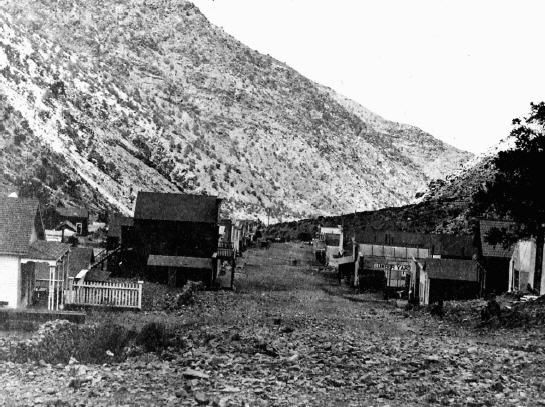
Panamint City, California, 1875.
In the first settlement of Panamint, situated in Inyo County, California, on the western side of the summit overlooking Death Valley, its population contained some of the worst desperadoes on the coast, outside the penitentiaries. There were many lawless scenes enacted and several deaths by violence, which were dismissed from the mind as soon as the victims were buried. The burial plot was in a little gulch above the town, which was called Sour Dough Canyon, and when a man was laid to rest, the sports referred to the fact in a flippant manner and the words, “Oh, he’s planted in Sour Dough.” In the early settlement, no wagons were used in the camp because the canyons and hillsides were so steep that wheels were useless, and all transportation was done on the backs of mules and burros.
There was one exception, and that was a little wagon used by the butcher to move meats from the slaughterhouse to the market. Two sure-footed little brown mules hauled it. This outfit was pressed into service whenever needed for a hearse, and the little mules would lop their ears in solemn gravity as they plodded along with the silent mourners on their way up Sour Dough.
At the first Fourth of July celebration, the same outfit was used for the Car of State, and the little mules held their ears high in patriotic defiance of the blare of a bass tuba and a drum that composed the band on the occasion. The canyon was narrow, and to turn the Car of State, it had to be lifted and carried around by the procession that followed on foot. Besides the driver, the Goddess of Liberty, and three children, the Car of State carried all the little folks in camp. As an illustration of the creative imagination of the editor of the Panamint News, his description of the car was: “The Car of State was gotten up by Grand Marshal Paris and Mr. Stebbins, and reflected much credit on these gentlemen for its gorgeous beauty. It was brought into the procession at an early hour, filled with young ladies and children of Panamint.” And, he added further, that he “was sorry he could not obtain for publication the names of all the children.” The celebration was strictly non-partisan and probably as patriotic as any celebration kept perfectly sober.
The day closed with a fine exhibition of fireworks under the management of Dave Nagle. Not long after this event, Senator Stewart and Trenor W. Park, the Vermont capitalist, visited the camp to inspect their mining properties. On the morning of their departure, just as they were preparing to step onto the stage, one of their employees, McKinney, had a few words with a man named Jim Bruce, and in less time than it takes to tell it. They commenced firing and emptied their revolvers into each other. The Senator and his companions took hasty refuge behind a stone wall, as they were “not in it.” Both combatants were carried off on stretchers. McKinney was mortally wounded and died in a short time. Bruce recovered with a crippled arm, had an examination before the Justice, and was discharged. To illustrate how the press was muzzled, here is the introductory sentence used by the Panamint News in giving the account of what it termed “An Unfortunate Affair.” It said: “We are pained to record that during a slight misunderstanding that occurred at the express office before the departure of the stage yesterday, one of our esteemed fellow citizens was compelled to resort to violent measures to protect his person. His opponent will be buried tomorrow in the little cemetery in Sour Dough.”
The Death Of Kit Carson, Jr. – (Reno Evening Gazette, April 3, 1891)
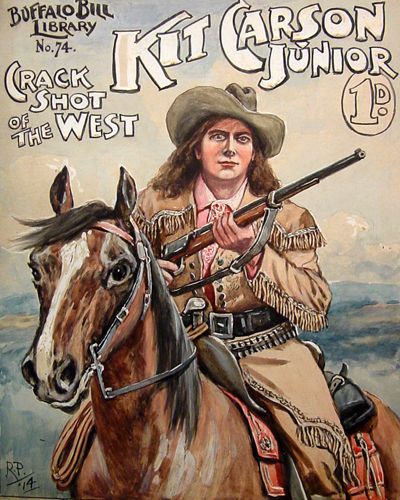
Kit Carson Jr, Penny Weekly Publications, 1914.
In the fall of 1870, news was received from Pioche announcing the death of Kit Carson, Jr., whose body was found weltering in his blood near a house on Lacour Street that was then only sparsely built upon. A bullet wound showed the cause of death, and it was at first supposed to be a case of suicide, as he held his revolver grasped in his hand. But, an examination showed that all the chambers were loaded, and none had been recently discharged. An inquest was held, and a verdict rendered that death resulted from a pistol shot fired by someone unknown to the jurors. It was looked upon as cold-blooded murder, but, in those days, people said nothing and were satisfied “to keep their eye on the gun,” for the “Peep ‘O Day Boys” were numerous, as was evidenced by the silent witnesses the cemetery below the town.
People held theories as to the ones suspected of taking the life of Kit Carson, and one man was living in Hamilton, 150 miles distant, who felt decidedly uncomfortable about it, for on the handle of the revolver held in Kit’s hand was engraved the name of the man in Hamilton. He was never called upon to explain, for he was a well-known agent of the leading stage line and was known to have been on duty in the Hamilton office when the deed was committed.
Kit had pawned the revolver to him when going to Pioche only three months before, upon a promise to redeem it within 30 days, which he did, and had the revolver sent to him by express. When it was in pawn, a friend of the agent, who had run the stage office in an idle hour without asking permission, had the name engraved on it, supposing the agent to be the owner. It could not be erased from the silver-plated handle and was returned to Kit in that condition. Thus, the agent’s name was connected with the murder, and the temporary suspicion threw the scent off the trail of the real slayer, and he escaped without ever being suspected, or if so, was at least never named.
Kit Carson Jr. was a nephew of Kit Carson, the famous scout, and like his uncle, was wedded to frontier life and the freedom that surrounded it. He was uncultivated but generous to a fault, as true as steel and as courageous as he was stoical and indifferent to death. He scorned skulking or taking advantage of an unarmed foe, and the supposition was that his death was due to his open defiance of the lawless ruffians who then held sway in the camp. He was shot from behind, but in the throes of almost instant death, he drew the gun as he fell.
Death Wounds (Reno Evening Gazette, April 28, 1891)
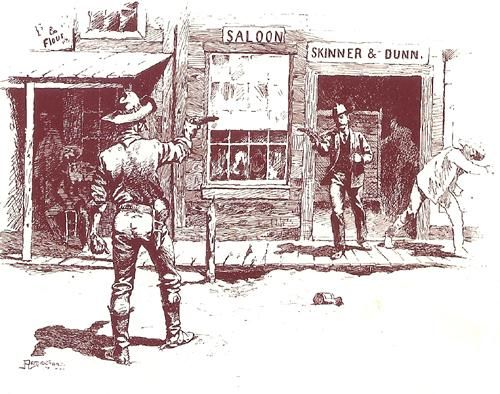
Gunfight.
Billy Killingly was a somewhat noted character in the early history of eastern Nevada. Not for reputation, for all he possessed of that was not to be envied. But, he was one of that class that lived a life of leisure; “he toiled not, neither did he spin,” but he never missed a meal, and if he ever paid a cent, his method of earning it was unknown to the general public. He was generally supposed to be retained by mining companies to maintain titles of possession and under-employ to meet force with force if necessary. Hence, he became well known throughout that part of the State, and it was the general impression that he would meet the fate usual for people of that class and, on no distant day, “die with his boots on.” In due time, the report came from Cherry Creek early in 1873 that Billy had been killed in difficulty there. The report was generally believed, for it was to the effect that the death wound was a bullet hole that extended clear through his head as it entered at one side just over and forward of the ear and passed out at the other side directly opposite.
All at a distance, those who had known him supposed that death was instant and dismissed the subject with the remark that it was just as predicted and expected. The result was otherwise, and some months afterward, Billy was sporting around Eureka with a white patch on each temple covering the holes made by the bullet. He seemed in excellent health and the best of spirits when, one day, he was met by an old acquaintance who looked at him as one risen from the dead and, accosting him, asked in surprise if it was a ghost or the original Billy Killingly. He answered with an assurance of identity and, when questioned, confessed that the ball made a hole clear through his head. When asked if it gave him no inconvenience, he said no, only when he blew his nose, he felt the air pass through the corner of his eyes. He fully recovered from the gunshot wound, and as if to illustrate the truth of the old proverb, that if one is born to be drowned.
He will not be hanged; his final fate was just the reverse; for a few years afterward, he was reported as being hanged for horse stealing in Arizona. The incident is merely related to illustrate the remarkable curative qualities of the rare atmosphere of this mountain region, where mortal wounds heal up, where dead animals mummify, and where even consumption in advanced stages disappears and leaves the patient with lung cells healed.
Mormon Fanaticism and Prospectors’ Perils (Reno Evening Gazette, February 5, 1891)
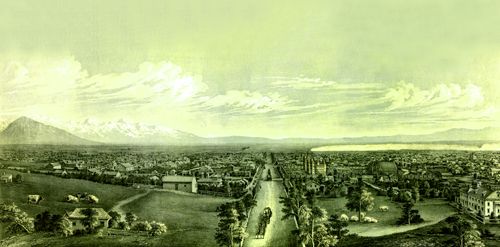
Salt Lake City, Utah.
Twenty years have wrought a remarkable change in the condition of life in Salt Lake City. Then, the leaders of the Mormon Church exerted such an influence over their followers that the poor fanatics were led or driven at will, and they were inspired with such intense hatred for the Gentiles that led to the frequent commission of crimes of violence and resulted in making life for the latter a very interesting problem. About that time, the city began filling up with a crowd of prospectors.

Porter Rockwell.
From all the mining regions of the Pacific Coast and adjacent territories, and as the Mormon Church threw in their way every obstacle at their command, it proved slow work to obtain a foothold. The prospectors made their headquarters principally at a hotel kept by Gentiles, who, like all other newcomers, were regarded as intruders and trespassers and were watched like thieves in every move they made by the Mormon spies and church hirelings. Then it was that Porter Rockwell, with his long, wild locks flowing over his shoulders, and his running mate, Brig Hampton, bore the reputation of being the two leading destroying angels of the Mormon Church.
Frequently, during the day and evening, the Mormons elbowed their way through the crowded office of this Gentile hotel in the character of city policemen, but which was only a disguise to enable them to keep surveillance of Gentile movements. Night after night, patrons of the hotel would come running in and relate attacks made upon them by Mormons while passing along the shaded streets, perhaps not two blocks away but so isolated that their only safety lay in flight. The proprietors and patrons of the hotel were kept in hot water, which finally reached a critical point when one of the daughters of a Mormon apostle was driven from home to speak to a Gentile and sought the hotel as a refuge. This intensified the Mormon hatred, and the proprietors endeavored to dispel threatened trouble by conducting the girl to some relations living some distance south of the city.
The Mormons threatened to raid and ransack the premises, as they had done for other obnoxious Gentiles before, and the occupants of the hotel prepared for war. The house was filled with Nevada men, among them being genial Bob Howland, the comrade of Mark Twain in the early Territorial days; Jim Orndorf, now of the Cafe Royal of San Francisco, with his brother Tip, long since dead; John Caley, now of the Del Monte; James Sevenoakes, Dave Buell, Ike Bateman, William Belding, Pat Lannan, Judge Reed, and many others then prominent in mining circles, whose names the writer cannot now recall.
As soon as the proprietors were convinced that danger was impending, they notified their guests to take such measures for defense as they thought proper while assuring them that they would remain and fight for their lives and property. The Nevada guests were true as steel and, in fact, anxious for the opening of hostilities and volunteered in a body to stand by the proprietors. It was an exciting time from that hour, about noon, until evening. The hotel office looked like an arsenal.
The prospectors all had guns and firearms of some kind, and the office was soon stacked with Henry and Winchester rifles and Navy revolvers of all sizes, which were overhauled, loaded, and put in working order. The afternoon was spent in feverish preparation movements, as the raid was expected in the early evening. Guards were placed on duty at all the entrances. Every visitor was closely scanned as he entered the house, and as there were nearly two hundred patrons in the house, the surveillance kept up a constant commotion, and the excitement grew as the shades of evening approached. Meals were served as usual and eaten quietly and orderly, for it was a temperance house, and there was no evidence of liquor in the crowd of determined men.
The proprietors were anxious to avoid bloodshed if it could be prevented. After every preparation, they went with two comrades to the City Hall. They sought the Chief of Police, Burke, who was afterward killed there, and quietly informed him that they were led to expect serious trouble during the evening from a mob to be led by his sergeants of police and that they should resist any unlawful attempt to molest them or their guests, and were prepared to fight as long as the ammunition held out. They waited for no answer but politely left his office and returned to the hotel. The excitement continued to increase, and everyone was watchful while guards were doubled at every entrance and around the rear premises. As the evening wore away, crowds were seen passing and watching from the opposite sides of the streets, expecting hostilities to begin at any moment.
The hours slipped by until midnight without any evidence of an attack, and the conclusion was arrived at that the Chief of Police had suppressed the movement through fear of a bloody contest after hearing of the preparations made. After midnight, many retired, leaving about twenty well-armed men in the office, who made themselves comfortable in the chairs and passed the time smoking and talking but always on the alert for any suspicious sound. At about 1:00 a.m., there came suddenly the startling cry of “murder” from a voice in the courtyard in the rear. Instantly, every man rushed to the relief, and those who had retired came pell-mell downstairs, partly dressed but armed and looking for the enemy. The ladies and children were aroused at the commotion, screamed with fear, and added to the confusion. For a few moments, it seemed the Destroying Angels were undoubtedly at their bloody work.
Amidst this, it was discovered that one of the guards in the rear, a black man, had been scared at a passing shadow and raised a needless alarm. It, however, required some time to restore quiet, but the results were lasting, like the Mormons, having learned that they were dealing with determined men, rarely ever after that indulged in any lawless deeds.
Murder Most Foul (Reno Evening Gazette, May 14, 1891.)

Hamilton, Nevada.
In February of 1869, a brutal murder was committed on White Pine Mountain near Hamilton, Nevada, which, for fiendish atrocity, was never surpassed in the criminal chronicles of the State. A prospector with a two-horse wagon and miner’s outfit had been camped for a few days there, and with the hills full of men as they were then, his presence had been duly noted by many, who had, in passing, accosted him or engaged in talk and make inquiries. One morning, the outfit was missing from its accustomed place, and the first prospectors to pass the deserted campfire were attracted by the odor of burning flesh, and a nearer approach showed them a half-consumed body of the prospector burned to a crisp.
In the smoldering embers of the campfire. A hasty examination of the incinerated body disclosed the fact that murder most foul had preceded the attempt at cremation to conceal it, and the absence of the horses, wagon, and other property was convincing proof that robbery was the motive.
Word was brought into Hamilton in the early morning, and the sickening details of the revolting crime sent many from the restaurant tables without finishing breakfast. Searching parties were immediately organized, and pursuit was given to overtake and arrest the fiendish perpetrators. The snow and frost on the ground made the task easy from the camp to the main road when the tracks were mingled with others and lost. But the general direction was disclosed, and parties were soon scouring the country from various directions south of Shermantown and Eberhardt.
Deputy Sheriff Mason and a comrade who accompanied him by request were among the pursuers. Getting upon the runaway’s track, they followed it until night overtook them and, camping in their blankets, waited for a moon to enable them to continue on the trail. As soon as the moon was up, they cautiously resumed the pursuit and, just at daybreak, came suddenly upon the camp. There, within easy sight of them, were the horses and wagon, and sleeping on the ground were the two men suspected of being the murderers. Hastily dismounting out of sight, the sheriff and his comrade reconnoitered and planned the capture. They could see a rifle and two pistols partly exposed under the heads of the sleeping men, and desiring to effect the capture without bloodshed, they decided to stealthily approach and secure the guns first before waking the men.
They drew straws to decide which should advance and secure the weapons, the other to follow closely with his shotgun bearing upon the sleepers. It fell to the lot of the sheriff’s comrade to reach for the guns when near enough. Starting at once, they crawled on hands and knees and reached the sleepers. He removed one revolver from under their heads and, reaching for the rifle, grasped it and just drew it from the covering when the movement disturbed the sleepers, and with a start, they raised. At this point, the captor gave a hoarse command, “Throw up your hands,” and to his surprise and great relief, they did so. While the captor held them covered with his revolver, the sheriff advanced at their backs and clasped on the handcuffs. The capture was complete, and all the murdered man’s property was found in their possession. Placing them in the wagon, they returned to Hamilton immediately and were lodged in jail. Shortly after, to the amazement of the plucky captors and the surprise of the general public, the District Attorney decided there was no evidence to hold them on, much less to convict them, and they were turned loose.
They quickly disappeared and thus ended the history of White Pine’s darkest crime. The principal of the two captors is the only one now residing in the State and is D.H. Jackson, the Superintendent of the Northern Belle at Candelaria. He is free to confess that the only motive that influenced him in attempting the risky capture was a desire to bring to justice the miscreants who committed the fiendish crime, and had he anticipated the final result, he would never have placed his life in the danger required to accomplish their capture.
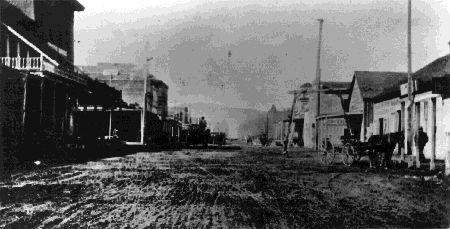
Carson City Nevada in the early days. Photo from Visit Carson City.
Peasley’s Revenge (Reno Evening Gazette, February 5, 1891)
All old timers will recollect the killing of Peasley and Barnhart, which occurred in Carson in 1864. Peasley was down at Carson and was sitting in a bar room with his feet resting on the gas pipe railing surrounding a large stove, in which a good fire was burning when Barnhart entered. He noticed Peasley, who did not see him and walked directly towards him. As he reached the side of his victim, he drew a large six-shooter and, shoving it against Peasley, fired two shots into his body. The latter sank in his chair, and his head fell lifeless on his chest. At this, Barnhart ceased firing and struck his dying victim twice on the head with his weapon. Jumping to his feet, Peasley drew his revolver, but at the first movement, Barnhart started to run and succeeded in passing into another room and closing a glass door between himself and his pursuer.
Peasley did not stop to open the door but shoved his pistol through the glass and fired. The shot found Barnhart’s heart for its mark, and he fell dead on the floor.
Peasley also fell, but he was cool and collected. After requesting that word be sent to his brother, Andy, he asserted the ruling passion strong in death by asking his friends to pull off his boots. When this was accomplished, and he had been assured that Barnhart was dead, he breathed his last without regret.
A Victim Of Violence (Reno Evening Gazette, May 8, 1891)
In the booming times in Pioche, the stages arrived daily from Salt Lake City and other points, loaded with incoming strangers. Among the arrivals one evening was observed a genteel-looking man clad in a neatly made, tailor-fitting gray cloth and bearing himself with the dignified reserve of a man of quiet habits and unobtrusive ways. But, the cold look from his grey eyes indicated determination, and one’s first impression was not to offend him. On the morning after his arrival, the superintendent of the leading mining company stepped into the stage office with the newcomer and, handing the agent three hotel checks, directed him to send them to a leading hotel in Salt Lake City and obtain the baggage.
NOW IN A BOOK & DOWNLOAD
More Terms, Expanded Definitions + Reverse Lookup + More Pictures
They represented, paid the bill held for, had the baggage delivered at Pioche, and charged the account, whatever it might be, to the mining company, and the Superintendent would see it paid. As this was satisfactory, the commission was sent at once. In due time, the baggage arrived and was found to consist of a small satchel, an ivory-handled, silver-mounted revolver, and a Henry rifle. On each of the latter articles was engraved the name of the owner, M. Courtney.
Before the baggage arrived, he was known by some and generally understood to be engaged to the mining company whose superintendent guaranteed the charges on the baggage. In the disputes over the company’s boundary lines, his presence was usually found beneficial in preserving all they claimed. Still, as there were other men in the camp of the same character and the employ of other companies, the result was to engender bad blood, and in due time, Morg Courtney, as he was called, killed a man named Jim Sullivan. The shooting occurred on the main street and was done from opposite sides of the street and directly across. After Sullivan fell, Courtney coolly replaced his revolver in his rear pocket and, taking a quill toothpick, stood there quietly picking his teeth until arrested a moment later. In 1873, Courtney met his death at the hands of one George McIntyre. They had quarreled and separated, each to go and “heel himself.” McIntyre was the first to return and took his position behind a boot-black stand of the kiosk pattern that stood just off the sidewalk on Main Street. It was night, and the lamps from the saloons only lit the streets. Very soon, Courtney came walking down the street and passed the stand where McIntyre was concealed, and what followed was told by McIntyre.
In substance: “I waited until he passed and then turned loose. The first shot went through his right shoulder and disabled his arm. He turned and tried to draw his gun with his right but couldn’t. He made a movement to draw with his left but failed and then turned to run. Then I peppered him in the back.”
Needless to say, he fell and soon expired. In due time, McIntyre was tried, but so potent was the evidence produced in his defense, through the influence of the mining company that had McIntyre under engagement, that he was duly acquitted. And, thus Morg Courtney, who was noted for being calm, collected, and fearless in facing danger, met his death and was buried in a cemetery which, it was asserted, was started with thirty-six interments of bodies of men who were the victims of violence.
Articles By William Daugherty, 1891. Compiled and edited by Kathy Alexander/Legends of America, updated March 2025. Written by William Daugherty for the Reno Evening Gazette in 1891. The Reno Evening Gazette was first published on October 12, 1876, and continued for the next 107 years. In 1977, it was merged with the Nevada State Journal and continues to exist today as the Reno Gazette-Journal. Note: The article is not verbatim, as spelling errors, minor grammatical changes, and editing have occurred for the modern reader’s convenience.
Also See:
Tales of the Overland Stage (Reno Evening Gazette)
Nevada Mining Tales (Reno Evening Gazette)
Pioche Land Jumpers and the Death of Jack Harris (Reno Evening Gazette)
Pioneers on the Nevada Frontier (Reno Evening Gazette)