
An Interview with F.J. Elliott in 1938.
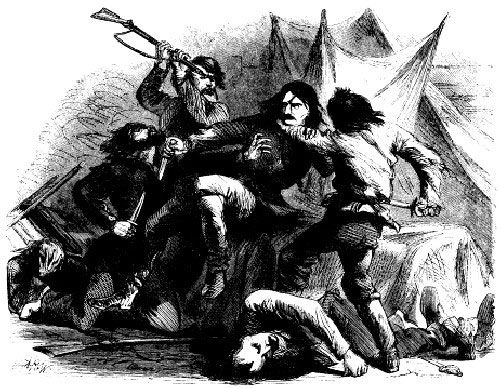
Wild Bill Hickok takes on the McCanles gang single-handedly
For a long time now, many people have been very interested in getting the story of this famous mix-up of long ago, which occurred at the old David McCanles home just southeast of what is now Fairbury, Nebraska, on July 11, 1861. [editor note: The incident occurred on July 12]
We, like others, were interested too and, for some time, have been gathering every account we could get, talking to people whose fathers and mothers lived there at the time, visiting the scene of the conflict several times, and reading old history. But for all that, the absolute certainty of the facts is lacking, and our honest opinion is that the real facts never will be known.
The last living witness of the affair, William Monroe McCanles, a son of the one killed, was then 12 years of age. Just a few years ago, he first brought out the story as he told it. In our opinion, his waiting until all those who knew the facts and the character of these two men had passed on has hurt his story, we believe.
The ones who take the other side are all honest, upright people. They get their story from their fathers and mothers, who knew McCanles and Wild Bill Hickok.
The sons and daughters of McCanles are fine people, and we do not wish to hurt them, nor do the folks who know them. They say Wild Bill was a good, law-abiding man, but all say McCanles was an evil man.
The first account of the affair we take from an old history published about 1882, the author says:
“The facts are from S C. Jenkins and S.J. Alexander, who arrived at the ranch within two hours after the trouble took place and before the bodies were removed, and from many others, and reports of Wild Bill’s trial. The author states that Wild Bill was, at the time, tending stock for the Ben Holiday State Company at Rock Creek Station. James McCanles, once owner of the station, did not have an enviable reputation, was a Southern sympathizer, and was trying to raise a company to assist the South. He approached Wild Bill and tried to persuade him to join and to turn over the stage company’s stock. On his refusal, McCanles threatened to kill him and take the stock. That afternoon, McCanles returned with three other men and started to enter the house. Wild Bill shot him. Two of the other men were killed, and one got away. At Wild Bill’s trial, which was held in Beatrice, no one appeared against him. His plea was self-defense, and he was cleared. The historian closed with the following: “It was evident that the design of the men was to take Wild Bill’s life, or it is most probably that the man who got away would have appeared against Wild Bill at the trial.”
The story of the affair, as told by William McCanles, Jr., son of David McCanles, killed by Wild Bill, appeared in the Fairbury Journal on September 25, 1930, stated this:
“Probably the motive for the killing was fear. Father had told Mrs. Wellman to tell her husband to come out. The Wellmans were the folks who lived there and kept the station. She said he wouldn’t, and Father said if he didn’t come out, he would go in and drag him out. I think rather than be manhandled, he killed father.” It would seem McCanles intends to pound up Wellman. When he said if he didn’t come out, he would go in and drag him out. This brings out a point that justified the killing of McCanles when he started to force his way into another man’s home.”
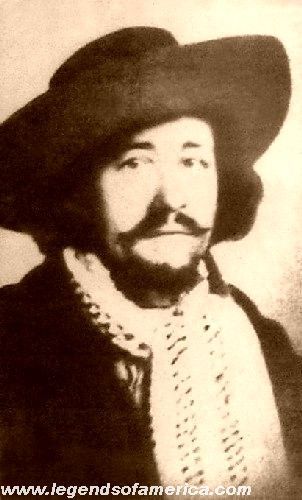
David McCanles.
This part of the story by William McCanles bears out the stories told around Fairbury by those whose parents knew David McCanles to be brutal and overbearing. The question arises: Why did William McCanles, Jr. not appear against Wild Bill at the trial? He was an eyewitness and perhaps 12 years of age.
We talked for a long time with a man whose name we cannot recall. His folks were neighbors of the McCanles family. Mrs. McCanles often visited with his folks, and he had often heard her speak of the affair. She never blamed Wild Bill. He told about Kate Shell, who lived at the west station and kept a store where she sold food, supplies, and whiskey to those going over the old Oregon Trail. Mrs. McCanles did not like her, but occasionally, she had to get up for dinner and invite Kate over. Then Kate would have a big dinner, and McCanles would have to go over there; she just had to go!
A while ago, a writer for the Dearborn Independent, Henry Ford’s paper, wrote up the whole affair and told a lot about Kate’s part, and there were never any denials.
Then, about the toll bridge. We visited where it stood; only a few stones are left now. The logs of which it was made had crumbled to dust or been carried away. Rock Creek is just a little stream, and in crossing it, one hardly knew that one had crossed a creek. It wasn’t a bad place at all — just a little work without a bridge would have made it far better than hundreds of other places on the old trail they had to cross. But the toll charged for crossing brought in a lot of money to McCanles. A little way to the north was a good crossing, but if the travelers attempted to cross there, someone would appear with a gun and insist they were trespassing, and they would have to go back and pay to cross the bridge.
Out in Canon City, Colorado, where an old friend of ours lives, Blancett, whose father had a station on the Oregon Trail farther east from the McCanles station. He knew both Wild Bill and McCanles and knew of the Wild Bill McCanles affair. Later, he became a plainsman and a scout. To help pass the time, he tells a friend about his early experiences, who writes them up for a Colorado paper, The Sunday Post. In one of the articles, the following appeared:
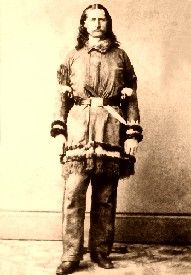
Wild Bill Hickok
“In 1860, my father, brothers, and I kept the stage station at Ashpoint, Kansas. He said Wild Bill was inclined to be reticent, talked little of himself or about others, and he was a man of action, not words. He was to guard the cash box on the coach that carried it. I never saw him without his feet off this box. This box was the guard’s particular trust, and he was under orders to guard it with his life. Bill handled a pistol with the speed of lightning. When talking, wishing to emphasize something, he had a way of throwing his right or left hand towards you with the trigger finger pointed at you. His hands moved with incredible swiftness, and I believe he practiced this mannerism with such purpose that it became a part of his nature and probably made him the fastest two-gun man of his day. He was not a wanton killer and used his guns only in the line of duty. He had plenty of opportunity to kill oftener than he did, knowing that he could start a graveyard at any time and the government would pay all funeral expenses. We never knew him to be intoxicated and never knew him to kill but one man, except in the line of duty. The exception was McCanles, who kept the Rock Creek Station near the Little Blue River. The two men got into a dispute, no one seems to know why, and Bill drew his gun first. My father and McCanles were friends and were both station keepers. In closing, Mr. Blancett says: ‘Anyone who wanted to make the acquaintance of Wild Bill, and would mind their own business, not get too inquisitive, would find him a perfect gentleman in every way.’ In those days, he was not known as “Wild Bill,” that name did not become general until the early 1870s, when I had lost track of him.”
From the Fairbury Journal of some time ago, we take the following:
“George Jenkins of Bellingham, Washington, was in Fairbury this week, accompanied by his wife, visiting places of interest with which he was familiar in an early day. Mr. Jenkins is a son of the late [?.C.] Jenkins, who came through in 1858 and brought his family out here to live in 1859, remaining until 1884. His family was the first to be permanently located in this country. George Jenkins was born in the house where Wild Bill killed McCanles in the year of birth, 1864. His father, C. Jenkins, was the second county superintendent of schools, a Justice of the Peace, a county commissioner, and a member of the Legislature. Referring to the McCanles tragedy, he recalls hearing his father and mother tell about it many times. Jenkins says his father told him McCanles had made threats to run off livestock from the ranches of the settlers for the benefit of the Confederacy and that the settlers were organized to resist such attempts, that his mother expressed extreme relief when the news reached them that McCanles had been killed, that his father helped bury the bodies of McCanles, Woods and Gordon, what the talk always was at the Jenkins home that McCanles was a wild reckless man and a Southern sympathizer.”
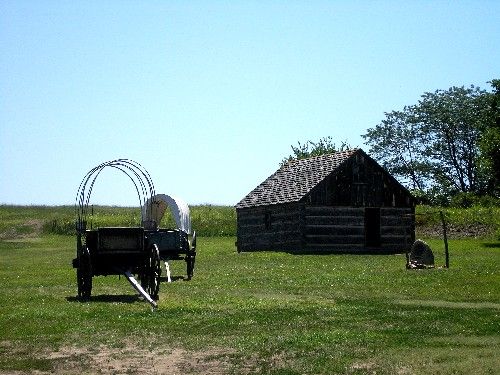
Rock Creek Station, Nebraska, by Kathy Alexander.
Another story published in the DeWitt Times News a few years ago covered a little different phase and was told by the foreman of the state stations. This man tells it this way:
“At the time of this affair, I was at a station farther west and reached this station just as Wild Bill was getting ready to go to Beatrice for his trial. He wanted me to go with him, and as we started on our way, imagine my surprise and discomfort when he announced his intention to stop at the McCannles’ home. I would have rather been somewhere else, but Bill stopped. He told Mrs. McCanles he was sorry he had to kill her man, then took out $35.00 and gave it to her, saying: ‘This is all I have, sorry I do not have more to give you.’ We drove on to Beatrice, and at the trial, his plea was self-defense; no one appeared against him, and he was cleared. The trial did not last more than fifteen minutes.”
From an old history of La Salle County, Illinois, we take the following:
W.A. Hickok, the father of Wild Bill, came here from Grand Isle County, Vermont, to Union Grove, Putnam County, Illinois, in 1833. On June 16, 1834, they went to Baileys Point with Reverend Gould and Isaac Fredenburg, then to Troy Grove, La Salle County, in November 1836. He was a deacon of the Presbyterian Church and opened the first store kept at Homer. He was a worthy man and died on May 5, 1852.
His widow, a much-respected woman, had three sons left — Lorenzo, Hiram, and Bill. James P. “Wild Bill,” born and raised at Troy Grove, became notorious on the western frontier and won the name of “Wild Bill.” A man over six feet tall, lithe and active, he was more than a match for the roughs he met on the debatable ground between civilized and savage life, and is said to have often killed his man. At one time, he is said to have killed four men in 60 seconds–they were on his track seeking his life. He served with Jim Lane in the Kansas troubles and was elected constable. At the same time, a minor in Kansas, he was a U. S. Marshal at Abilene, Kansas, for two years and was regarded as a very efficient and reliable officer. He was killed at Deadwood, South Dakota, on August 2, 1876, while playing cards. His assailant came silently behind him and shot him in the head. His murderer was tried by a mob jury and acquitted, but later was arrested under forms of law, convicted, and hanged.
Work Projects Administration (WPA), 1938. Compiled and edited by Kathy Alexander/Legends of America, updated March 2026.
The interview of F.J. Elliott was conducted by George Hartman, a Works Progress Administration (WPA) writer from Lincoln, Nebraska, on November 26, 1938. Elliott was from Wilbur, Nebraska. The article, as it appears here, however, is not verbatim as it has been edited for corrections and ease of the modern reader.
Also See:
Wild Bill – 1867 Harper’s Weekly Article
Wild Bill Hickok & the Deadman’s Hand
Rock Creek Station and the McCanles Massacre
Historical Accounts of American History
Source: Library of Congress