
By Pliny Earle Goddard in 1911
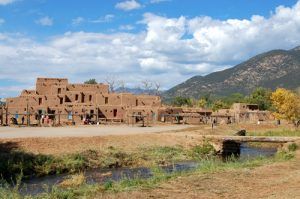
Taos Pueblo, New Mexico, by Kathy Alexander.
Four men lived in Taos, New Mexico, long ago, lying in a shade. They went about with their minds, but their bodies remained in Taos. One of them went east looking for the enemy and found their camp. The four men came there and stood facing inward from the four directions. They killed the enemy, driving them toward the center. They killed the enemy and burned up their property. After this, they would return to Taos and lie in the shade.
One went east again and found the enemy camped on this side of the Arkansas River at Tsekûîaye, “rock stands up.” He came back and reported. They sent him to Santa Fe, saying, “Go to Old-woman-her-hand-white and tell him to kill the enemy for us. Tell him to come at once.”
The messenger came to the governor and told him. The governor did not believe the man but put a ball and chain on his ankle to roll along as he walked.
He did not return at the end of the first or second day. “May you die! Old-woman-white-hands, you have done something to him. That is why he does not come back,” they said. The next day, he did not come, although they expected him. “May you die! You must have done something to Okadî. Now, we had better go after him,” they said. When they came there, they asked, “Where is the man we sent to you asking that you kill the enemy for us?” Then Okadî came from the jail, strolling, the ball tied to him rolling along. They looked at him and said, “His father was good to him and made a rattle for him.” “You had better unfasten the chain. This is the man who came to tell you to kill the enemy for us,” one of them said to the governor.
After two days, they said, “Hurry and get ready. We will go back to Taos and wait there for you.”
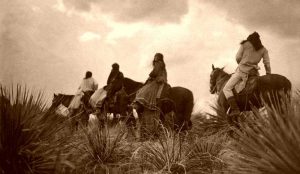
Apache Before the Storm, Edwards S. Curtis, 1906.
They gave them horses fitted out with bells. They started back, the bells sounding.
They said again, “Oh, his father was good to him. He travels with the bells jingling.” They came there, gave the horses and bells to the Pueblo Indians, and then went upon their shade.
They remained there one day and then the next, saying, “May you die! What is Old-woman-white-hands doing while another day passes?” And then over there, the horses’ dust rose as they came. They came to Taos with their sweaty horses and camped by the sinking place.
In the evening, they came to see them, saying, ” Old woman-white hands, where shall we camp tomorrow?” “Close by,” he told them. Oh, you must be with a child,” they told him. We will start early tomorrow and get there before you,” one of them said.
They were already eating in the evening when the others rode up with sweaty horses. After dark, they came to the governor’s camp and said, “Now, Old-woman-white-hands, where shall we camp tomorrow?” “Not far,” he replied. “You must be with the child if you can’t go farther than that, Old-woman-white-hands,” they said. “We will start early tomorrow ahead of you.”
They sat there, eating, about sunset when the others rode up with sweating horses. They went to him in the evening, saying, “Old-woman-white-hands, where shall we camp tomorrow?” “Not far,” he replied. “Oh, Old-woman-white-hands, you must be with child. A little farther than that,” they told him. “We will start early tomorrow ahead of you.”
They were sitting there eating already. “You had better go and look at the enemy again,” they told Okadî, their servant. He went and looked. “Their camp is all quiet yet,” he reported. They moved toward them. When they were near, they told him again, “You had better go and look again. We will wait until evening.” When they were near the enemy’s camp, they built a fire. “Now, Okadî, go to the enemy and get something to eat.”
He went to where they were eating, and they gave him some meat. The four men were sitting eating. “Go again and get water,” they told him. He went there again and borrowed a water basket, with which he brought them water. When they had drunk, they said, “Carry the water basket back to your enemy.” He carried it back.
The four men lay down. The others came about daybreak the following day. They moved toward the enemy, who had their camp on either side of an arroyo. The next day, the men stood facing from the four directions. The enemy discovered them. They began to kill the enemy with their war clubs. They had no arrows but just clubs for weapons. On the other side of the arroyo, they were not fighting. They fought with those on the one side until they were all killed. They went among those who had not fought, saying, “These are my folks,” and stroked their hair as a sign of friendship. They gathered up all the personal property and the horses. “Now, Old-woman-white-hands, tell your people to stand in line on the other side,” one of them told the governor. They distributed the goods among them.
Then he said to those of the enemy with whom he had made friends, “Pick out your horses.” They picked them out.
“Now, Old Woman White Hands, give the other horses to your people,” he told the governor. When the horses had been given out, he said to the governor, “Now, Old Woman White Hands, you may camp after us as short marches as you wish. You have become a rich man. Go back as slowly as you wish.” The four men returned from there in one day and climbed up to the top of their shade.
Pliny Earle Goddard, 1911. Compiled and edited by Kathy Alexander/Legends of America, updated May 2025.
Also See:
Apache – Fiercest Warriors in the Southwest
Native American Mythology & Legends
About the Author: Pliny Earle Goddard (1869-1928) was an ethnologist and linguist of American Indian languages. After college graduation, he worked in a religious organization helping with several impoverished schools and eventually took a position as a missionary with the Women’s Indian Aid Association. Deciding to make ethnology his life’s work, he continued his studies, gaining a Ph.D. in linguistics. During his lifetime, he published several books and journals, including several volumes entitled The Anthropological Papers of the American Museum of Natural History. This tale comes from his Jicarilla Apache texts, from Volume VIII of that series, published in 1911.