
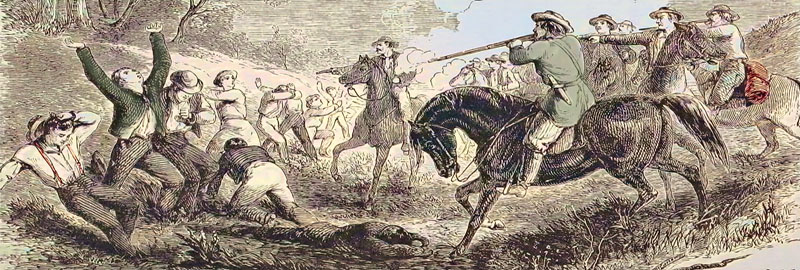
Bleeding Kansas.
By Frank W. Blackmar in 1912
During the summer and fall of 1855, excitement ran high in Kansas due to the struggle between the Free-State and pro-slavery parties. Several events exacerbated the strife between men of opposing political interests. Charles W. Dow, a Free-State man, was shot by Franklin N. Coleman, a pro-slavery leader of Hickory Point, in a dispute over a claim. This occurred on November 21, 1855, and marked the beginning of a series of difficulties that ultimately led to the Wakarusa War. The culminating event was the rescue by Free-State men of Jacob Branson, with whom Dow had lived, after Samuel J. Jones, the sheriff of Douglas County, arrested Branson. Jones started for Franklin with his posse and sent a dispatch to his father-in-law, Colonel Boone, at Westport (now Kansas City), Missouri, asking for aid to recapture Branson.
Word was sent to Governor Wilson Shannon at Shawnee Mission, Kansas, for 3,000 men to put down the rebellion at Lawrence. Some people believed that the whole affair was planned as a trap to catch the Free-State men and serve as an excuse for the destruction of Lawrence.
Without ascertaining the actual condition of affairs, the governor issued a proclamation calling out the militia of Kansas — which meant the ruffians of Missouri — to put down the rebellion at Lawrence. The people of Missouri were ready and responded quickly to the call. In his History of Kansas, Holloway says, “For two or three counties back from the western line of Missouri, troops were sent fully equipped and expecting to fight.” In three days, some 1,500 had rushed across the border and confronted Lawrence. Said Governor Shannon: “Missouri sent not only her young men, but her gray-haired citizens were there. The man of seventy winters stood shoulder to shoulder with the sixteen-year-old youth. There were volunteers in that camp, and with them were their sons and grandsons to join in the fray.” The main camp of the besiegers was near Franklin, about three miles southeast of Lawrence, and the other wing was in position near Lecompton, under the command of Strickler and Richardson.
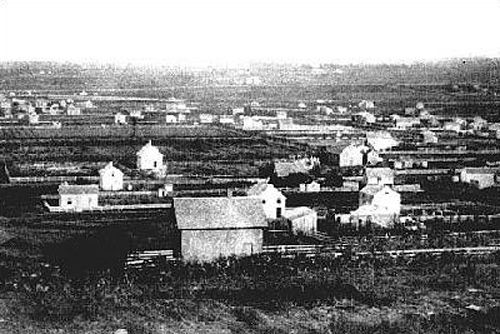
Wakarusa Valley, Kansas.
In Lawrence, preparations for defense were going on. As soon as it was learned that a force was gathering on the Wakarusa, all those concerned with the rescue of Branson were requested to leave Lawrence. This was done to show that the town had taken no part in the rescue. A committee of safety was appointed, which organized the citizens into squads of 15 or 20 men, enrolling them and taking their addresses so they could be called out at any moment. This way, they could pursue their business and still be ready to take up arms at a signal.
The news of the threatened invasion and the intention to destroy Lawrence spread rapidly through the territory, prompting the Free-State men to rush to the aid of the besieged, until there were probably 800 men armed and equipped for defense in the town. The Committee of Safety appointed Dr. Charles Robinson as commander-in-chief of all the forces, with Colonel James H. Lane as second in command. Lyman Allen commanded the Lawrence Stubbs; Samuel Walker, the company from Bloomington; Major Abbott, the Wakarusa company; a man named Shore, the Ottawa Creek company; McWheeney, the company from Palmyra; and the Pottawatomie company was under the command of John Brown, who arrived with his four sons, arms and ammunition just as the treaty of peace was about to be signed.
Every house was filled with soldiers, and the Free-State hotel was used as a barracks. Five redoubts were built, which commanded every approach to the city. The largest was erected on Massachusetts Street near the crossing of Pinckney.
It was circular and made of hewn timber, against which an earth embankment was thrown up about 5 feet high and 4 feet wide at the top. Surrounding it was a deep entrenchment. It was designed as a retreat for women and children in case of an attack. The second line of works was located on Massachusetts Street, consisting of three rudimentary forts in a line across Vermont, Massachusetts, and Rhode Island Streets, coinciding with Henry Street.
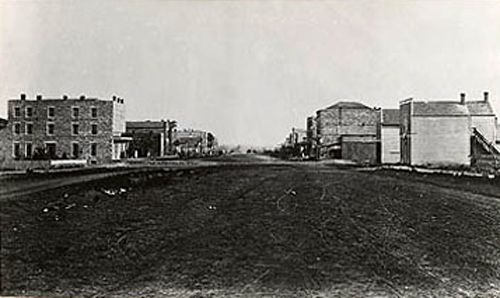
Lawrence, Kansas, 1856.
The third was a circular redoubt built on an elevation north of Henry Street between Massachusetts and New Hampshire Streets. The fourth was south of the fort on Henry Street and was built to repulse an attack from Mount Oread, should one be made from that direction. The fifth was on Kentucky Street, commanding an entrance from a ravine on the west. A cannon that had been sent to Kansas City was also smuggled into the besieged town.
The siege commenced on Saturday, December 1, and lasted about a week. The forces on both sides were prepared for war. The defenders spent much time drilling and strengthening their position while the invaders waited for Sheriff Samuel Jones‘ command to move upon Lawrence.
The Sharps rifles that had been shipped to Lawrence from New England became of immense value at this time, as the fear of them kept the enemy from a sudden attack. Blackmar, in his Life of Charles Robinson, says: “It was a strange spectacle, almost a comedy had it not been so near a tragedy, and in any case was certainly a travesty on free government, for the United States Senator Atchison to be commanding this singular horde, while Governor Shannon was hurrying other commands to the scene of war. There was no excuse for it all. The rescuers of Branson had left the town, and there was not a day in which Jones might not go through Lawrence unmolested in doing his duty. He did go to the town and returned without being disturbed. Governor Shannon became alarmed about the safety of the attacking Missourians and Lawrence. At Leavenworth, he sent to Colonel Sumner for United States troops, but Sumner would not come without orders from “Washington.”
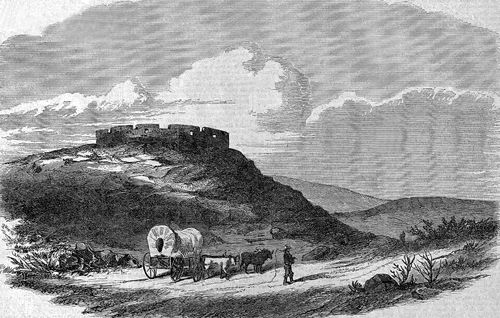
Lane’s Fort atop Mount Oread, Lawrence, Kansas.
Lawrence continued to receive reinforcements from the surrounding towns, which were usually surprised to find that the inhabitants were strictly on the defensive, rather than aggressive, as reported by the pro-slavery men. Finally, the citizens sent a delegation to the governor to acquaint him with the true situation. Being incredulous, he was persuaded to go to Lawrence to see for himself, and upon his arrival, he was amazed at the situation. He brought the besiegers and besieged the conference. The governor, Colonel Albert Boone of Westport, Missouri, Colonel Kearney of Independence, Missouri, and General Strickler of Kansas, were duly conducted to Lawrence and the rooms of the committee of safety in the Free-State Hotel. Dr. Robinson and Colonel James Lane conducted the negotiations on behalf of the Free-State men as members of the safety committee. After both sides of the question had been discussed, the governor suggested that a treaty be drawn up and signed by the leaders, which was done. Blackmar, in his Life of Charles Robinson, says, “It was an excellent way out of a dilemma, but here was another scene in the drama of spectacular government; the town of Lawrence in rebellion, treating with the Kansas militia, the latter commanded by officers living in Missouri.”
The treaty showed the goodwill of the people of Lawrence and their genuine desire to settle the war. After signing it, Robinson and Lane accompanied the governor to the militia camp, where Governor Shannon persuaded them to accept the treaty and withdraw. This was not easily accomplished, but the Missourians finally began their journey home.
Compiled and edited by Kathy Alexander/Legends of America, updated July 2025.
Editor’s Note: Although the “Wakarusa War” ended without bloodshed, this marked the beginning of what would become known as Bleeding Kansas, characterized by several subsequent assaults, including the Sacking of Lawrence by Sheriff Jones on May 21, 1856.This historic text was published in Kansas: A Cyclopedia of State History, Volume I; edited by Frank W. Blackmar, A.M., Ph.D.; Standard Publishing Company, Chicago, IL, 1912.
Also See:
Bleeding Kansas & the Missouri Border War