
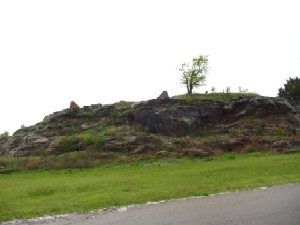
Pawnee Rock, Kansas by Kathy Alexander.
Jutting out above the prairie near Larned, Kansas, is a landmark called Pawnee Rock, where dozens of gold and silver caches are said to have been buried. For centuries, Pawnee Rock was a site where the Comanche, Kiowa, Arapaho, and Cheyenne Indians held councils of war and peace.
Many Indian battles were fought here, and arrowheads can often be found bearing witness to these bloody conflicts. The Indians also used the sandstone citadel as a vantage point to spot buffalo herds and, later, approaching wagon trains.
Rising out of the plains, Pawnee Rock was a landmark for explorers and a popular campsite for travelers crossing the prairie. The large rock formation became a popular stop on the Santa Fe Trail for white settlers heading west in search of adventure and fortune. The Rock was considered the midpoint of the long road between Independence, Missouri, and Santa Fe, New Mexico, lying between long stretches of dry plains. Water, provided by the nearby Arkansas River, and fresh meat, obtained by plentiful game, were vital to the survival of the wagon trains.
Explorers Zebulon Pike, Webb, Gregg, Doniphan, and other travelers mentioned Pawnee Rock in their journals. In 1826, when Kit Carson was just 17 years old, the wagon train he was working for camped near the Rock. Drawing guard duty that night, he shot his own mule, thinking it was an attacking Indian.
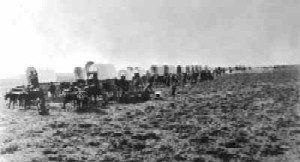
Wagon Train.
As the hundreds of thousands of trappers, soldiers, gold seekers, and emigrants passed by, they carved their names into every conceivable place upon the sandstone face of the bluff. In 1848, James Birch, a soldier on his way to the Mexican War, wrote: “Pawnee Rock was covered with names carved by the men who had passed it. It was so full that I could find no place for mine.”
Although the rock was one of the most famous landmarks along the 750-mile trail, it also became known as one of the most dangerous points as the angry Pawnee Indians began ambushing the caravans. Word of the attacks spread from one end of the trail to the other, but the wagon trains still stopped at the vital campsite needing fresh provisions for the rest of their journey.
It quickly became standard practice for travelers to bury their valuables before bedding down for the night. Hidden, the money would be safe if Indians or robbers attacked them. The massacres continued, and many travelers were slain before they could dig up their caches. Today, the number of lost buried treasures is estimated at well over a hundred, ranging from small caches of the lone traveler to huge ones belonging to Spanish expeditions or to rich Santa Fe freighters returning east, carrying gold or silver from the sale of their goods.
When the railroads began crossing the plains in 1872, the town of Pawnee Rock was founded, lying at the foot of the sandstone cliff. These settlers quarried the bluff for building materials, reducing its elevation by at least one-half of its original height.
In 1908, the Women’s Kansas Day Club acquired the remaining portion, and the following year, it was turned over to the State of Kansas as a historic site. On May 24, 1912, a stone monument was dedicated with a grand celebration before a crowd of 8,000 onlookers.
Today, the state park provides a road leading to a shelter house and a monument on the summit. An overlook, monument, and historical signs now grace its reduced summit, where visitors can stand and witness the view that so many throughout history have shared. The site is open from sunrise to sunset.
Pawnee Rock State Historic Site is located one-half mile north of Pawnee Rock, Kansas, in the southwest corner of Barton County.
Starting from any direction, a treasure hunter might look within two miles of the Rock for hidden treasures. The area is also rich in relics from Indians, early Spanish explorers, and Santa Fe Trail pioneers.
That being said, please note that treasure hunting, metal detecting, digging, or removal of objects is not permitted at Kansas State Historic Sites.
©Kathy Alexander/Legends of America, updated November 2025.
Also See:
Ghosts, Legends, Myths, & Mysteries
See Sources.