
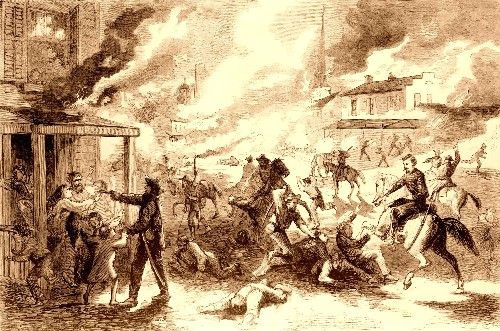
Lawrence, Kansas Raid.
About the Article: The Lawrence Massacre is based on a letter written by Reverend Richard Cordley, pastor of the Congregational Church and eyewitness to Quantrill’s Raid on Lawrence, Kansas, in 1863. The contents were then published by J.S. Broughton of Lawrence, Kansas, in 1865, from the Kansas Collection of Kenneth Spencer Research Library and the Department of History of the University of Kansas. Mr. Alec Miller prepared the electronic copy in Lawrence, Kansas, on June 30, 1994.
Introduction
It is a fact that no complete account of this massacre has ever been published. The letter furnished by Reverend R. Cordley to the Congressional Record a few days after the event, and before all the facts and incidents had become known, was republished in Boughton & McAllister’s Directory of Lawrence, 1865. This is about all the literature we can find.
Mr. Cordley’s letter serves as the basis for this history. It adds the personal experience and observations of several residents who escaped the general slaughter and now recall the terrible events of those few hours as though they occurred yesterday.
We aim to share the personal experiences of every survivor and, in particular, record in detail the deeds of heroism performed by the brave women of Lawrence. In that fearful hour, he saved many precious lives and extinguished the flames in nearly 100 burning dwellings. But volumes would be required for such an undertaking.
August 21, 1863 – 150 Men Killed, Eighty Women Made Widows, and 250 Children Made Orphans
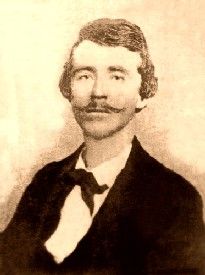
William Quantrill.
The destruction of Lawrence had no doubt been long contemplated by the border rebels. Since the war had commenced, rumors of the maturing of such a purpose had constantly been circulating. Each rumor prompted efforts to defend. The people had become so accustomed to alarms that they were almost unaffected by them. At several times, the prospect had been threatening. This was especially the case after the battle of Springfield, Missouri, and again after the rebels’ capture of Lexington, Missouri. The people had never felt more secure than for a few months preceding the August 1863 raid. The power of the rebellion was broken in Missouri, and the federal forces were on the border. While it could prevent depredations by small gangs, it seemed sufficiently vigilant to prevent the gathering of any significant force. No rumors of danger had been received for several months.
Still, many citizens did not feel that the place was entirely safe. Early in the summer, Mayor Collamore convinced the military authorities to station a squad of soldiers in Lawrence. These soldiers were under the command of Lieutenant Hadley, a very efficient officer. Lieutenant Hadley had a brother on General Ewing’s staff. On about August 1, this brother wrote him that his spies had been in William Quantrill’s camp, had mingled freely with his men, and had learned from Quantrill’s clerk that they proposed to make a raid on Lawrence about the full of the moon, which would be three weeks before the actual raid. He told his brother to do all he could for the town’s defense, fight them to the last, and never be taken prisoner, for Quantrill killed all prisoners. Lieutenant Hadley showed the letter to Mayor Collamore, who immediately set about putting the town on a state of defense. The militia was called out, pickets were detailed, the cannon was ready, and the country was warned.

Guerilla Raid during the Civil War in Missouri by Thomas Nast, 1862.
Had Quantrill’s gang come according to promise, they would have been “welcomed with bloody hands and hospitable graves.” Someone asked Quantrill, when in Lawrence, why he had not come before when he had said he would. He replied, “You were expecting me then, but I have caught you napping now.”
It may be asked why the people of Lawrence relaxed their vigilance so soon after receiving such authentic evidence of Quantrill’s intentions. The city and military authorities made the fatal mistake of keeping the grounds of apprehension a profound secret. Nobody knew the reason for the preparations. Rumors were circulating, but they could not be traced to a reliable source. Companies came in from the country but could not determine why they were sent for, and went home to be ridiculed by their neighbors. Unable to find any ground for alarm, people soon began to think that the rumors were like the other false alarms by which they had been periodically disturbed for the last two years. The course of the military authorities tended to strengthen this view.
Mayor Collamore sent troops and cannons to Fort Leavenworth. They were sent over at once but were met at Lawrence by a Kansas City dispatch ordering them back. A few days later, the squad of soldiers under Lieutenant Hadley was ordered away. Therefore, it was evident that the military authorities at Kansas City, who ought to know, did not consider the place in danger.
The usual sense of security soon returned. Citizens were assured that Quantrill could not penetrate the military line on the border without detection. They felt sure, too, that he could not travel 50 miles through a loyal county without their being informed of the approach of danger. The people never felt more secure and were never less prepared than the night before the raid.
The Approach
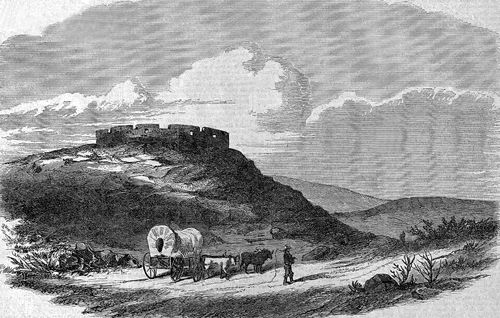
Lane’s Fort atop Mount Oread, Lawrence, Kansas.
Quantrill assembled his gang about noon the day before the raid and started towards Kansas at about two o’clock. They crossed the border between five and six o’clock and struck directly across the prairie toward Lawrence. On the old Santa Fe wagon road, he passed through Gardner at about 11:00 p.m. They burned a few houses and killed one or two citizens. They passed through Hesper, ten miles southeast of Lawrence, between two and three o’clock. The moon was now down, the night was dark, and the road doubtful. They took a little boy from a house on Captain’s Creek nearby and compelled him to guide them into Lawrence. They kept the boy during their work in Lawrence, and then Quantrill dressed him in a new suit of clothes, gave him a horse, and sent him home. They entered Franklin about the first glimmer of day. They passed quietly through, lying upon their horses, to attract as little attention as possible. The command, however, was distinctly heard, “Rush on, boys, it will be daylight before we are there! We ought to have been there an hour ago.” From here, it began to grow light, and they traveled faster. When they first came in sight of the town, they stopped. Many were inclined to waver. They said: “They would be cut to pieces, and it was madness to go on.” Quantrill finally declared that he was going in, and they might follow who would. Two horsemen were sent ahead to see that all was quiet in town. Those horsemen rode through the town and back without attracting attention. They were seen walking down Main Street, but their presence there at that hour was nothing unusual. At the house of the Reverend S. S. Snyder, a gang turned aside from the main body, entered his yard, and shot him. Mr. Snyder was a prominent minister among the United Brethren. He held a commission as lieutenant in the Second Colored Regiment, which probably accounts for their hostility.
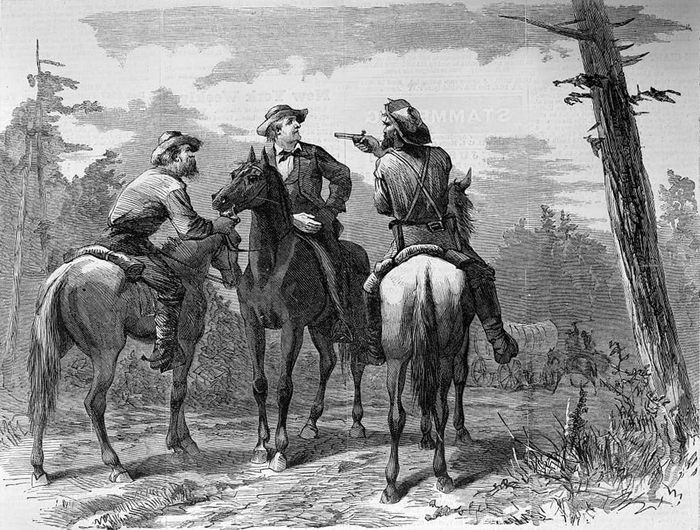
Confederate Guerrillas.
Their progress from here was relatively rapid but cautious. Now and then, they checked up their horses as if fearful of proceeding. They were seen approaching by several persons on the outskirts of the town, but in the dimness of the morning and the distance, they were mistaken for Union troops. They passed on in a body till they came to the high ground facing Main Street when the command was given, “Rush on to the town!” Instantly, they rushed forward with the yell of demons. The attack was perfectly planned. Every man knew his place. Detachments were scattered in every section of the town, and it was done with such promptness and speed that before people could gather the meaning of their first yell, every part of the town was full of them. They flowed into every street. Eleven rushed up to Mount Oread, from which all the roads leading into town could be seen for several miles. These were to keep watch of the country roundabout lest the people should gather and come in on them unawares.
Another and larger squad struck for the west part of the town, while the main body made for the hotel by two or three converging streets. They first came upon a group of recruits for the Kansas Fourteenth. On these, they fired as they passed, killing 17 out of 22. This attack did not check the speed of the general advance. A few turned aside to run down and shoot fugitive soldiers, but the company rushed on at the command, “To the hotel!” which could be heard all over the town. In all the bloody scenes that followed, nothing equaled, in wildness and terror, that which now presented itself. The guerrillas’ horsemanship was perfect. They rode with that ease and abandon acquired only by a life spent in the saddle amid desperate scenes. Their horses scarcely seemed to touch the ground, and the riders sat with bodies and arms perfectly free, with revolvers on full cock, shooting at every house and man they passed and yelling like demons at every bound. On each side of this stream of fire, as it poured toward the street, were men falling dead and wounded, and women and children half-dressed, running and screaming, some trying to escape from danger and some rushing to the side of their murdered friends.
The Capture Of The Hotel
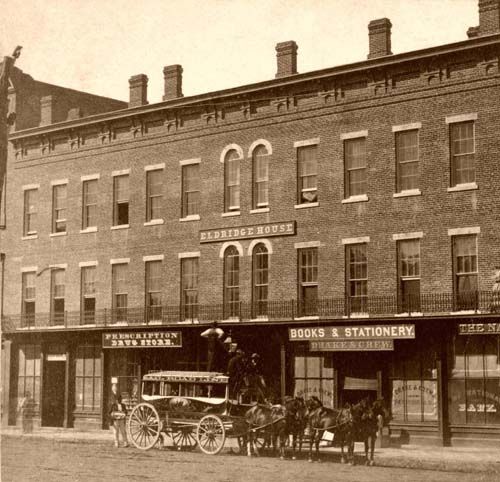
Eldridge House Hotel, Lawrence, Kansas, 1867.
They dashed along the main street, shooting at every straggler on the sidewalk and into almost every window. They halted in front of the Eldridge House. The firing had ceased, and all was quiet for a few minutes. They expected resistance here and sat gazing at the windows above them, apparently in fearful suspense. Captain Banks, Provost Marshal of the State, opened a window, displayed a white flag, and called for Quantrill in a few moments. Quantrill rode forward, and Banks, as Provost Marshal, surrendered the house, stipulating the safety of its inmates.
At this moment, the big gong in the hotel began to sound through the house to arouse the sleepers. At this, the whole column fell back, evidently thinking this was the signal for an attack from the hotel. In a few moments, meeting with no resistance, they pressed forward again and commenced the work of plunder and destruction. They ransacked the hotel, robbing the rooms and their inmates. They gathered these inmates together at the head of the stairs, and when the plundering was done, they marched them across the street onto Winthrop Street under a guard. When they had proceeded a little distance, a ruffian rode up and ordered a young man out of the ranks and fired two shots at him, but with no effect.
One of the guards interposed and threatened to kill the ruffian if one of the prisoners was molested. Quantrill then rode up and told them the City Hotel would be protected on the riverbank because he had boarded there some years ago and had been well treated. He ordered the prisoners to go there and stay in, and they would be safe. The prisoners were as obedient to orders as any of Quantrill’s men and lost no time gaining the house of refuge. This treatment of the prisoners of the Eldridge House shows that they expected resistance from that point and were relieved by the offer of surrender. They not only promised protection but kept their word. Other hotels received no such favors and had no experience of rebel honor.
At the Johnson House, they shot at all that showed themselves, and the prisoners that were finally taken and marched off were shot a few rods from the house, some of them among the fires of the burning buildings. Such was the common fate of those who surrendered themselves as prisoners; Mr. R.C. Dix was one of these. His house was next door to the Johnson House, and, being fired at in his own house, he escaped to the Johnson House. All the men were ordered to surrender. “All we want,” said a rebel, “is for the men to give themselves up, and we will spare them and burn the house.” Mr. Dix and others surrendered themselves. They marched them towards town, and when they had gone about two hundred feet, the guards shot them all, one after another. Mr. Hampson, one of the number, fell wounded and lay as if dead till he could escape unseen. A brother of Mr. Dix remained in the shop and was shot four times through the window and fell almost helpless. The building was burning over his head, and he was compelled to drag himself out into the next building, which fortunately was not burned. The air was so still that one building did not catch the sound of another.
The Carnage – “Hell Let Loose”
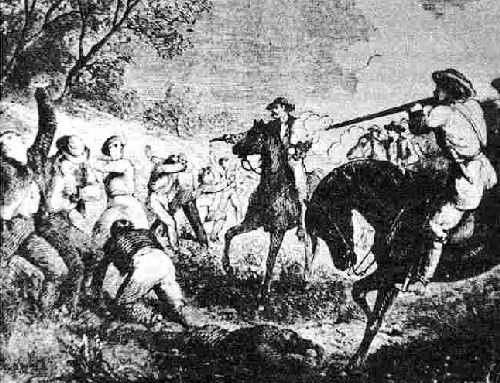
Jayhawkers and Bushwackers fight over Kansas becoming a free state or a pro-slavery state.
After the Eldridge House surrendered and all fears of resistance were removed, the ruffians scattered in small gangs to all parts of the town in search of plunder and blood. The order was “to burn every house and kill every man.” Almost every house was visited and robbed, and the men found in them were killed or left according to the character or whim of the captors. Some of these seemed brutalized entirely, while others showed some signs of remaining humanity. One lady said that as gang after gang came to her house, she always met them and tried to get them talking. She could get at the little humanity left in them if she only got them to talk. Those ladies who faced them boldly fared the best.
It is doubtful whether the world has ever witnessed such a horror scene — certainly not outside the annals of savage warfare. History gives no parallel where an equal number of desperate men, so heavily armed, were let perfectly loose in an unsuspecting community. The carnage was much worse because the citizens could not believe men could be such fiends. No one expected an indiscriminate slaughter. When it was known that the town was in their possession, everybody expected they would rob and burn the town, kill all military men they could find, and a few notable characters. But few expected a wholesale murder. Many who could have escaped, therefore, remained and were slain. For this reason, people of color fared better than whites. They knew the men slavery had made, and they ran to the bush at the first alarm.
A gentleman who could see the whole scene said it was the perfect realization of the slang phrase, “Hell let loose,” that could be imagined. Most men looked like wild beasts; they dressed roughly and swore terribly. They were mostly armed with a carbine and two to six revolvers, which were often strapped around their bodies.
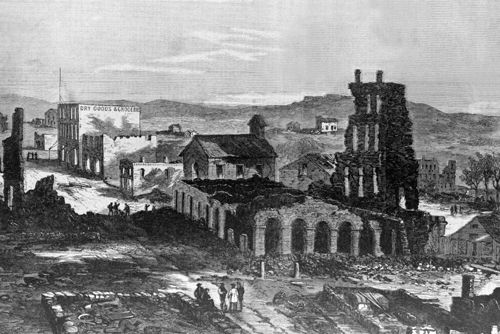
Ruins of Lawrence, Kansas, 1863.
The surprise was so complete that no organized resistance was possible. Before people could fully comprehend the actual state of the case, every part of the town was full of rebels, and there was no possibility of rallying. Even the recruits in the camp were so taken aback that they were not in their designated places. The attack could scarcely have been made at a worse hour. The soldiers had just taken in their camp guard, and people were waking from sleep. By some fatal mistake, the authorities had kept the city’s arms in the public armory instead of in each man’s house. There could be no general resistance, therefore, from the houses. When the rebels gained possession of the main street, the armory was inaccessible to the citizens. The judicious disposition of squads of rebels in other parts of the town prevented even a partial rally at any point.
There was no time nor opportunity for consultation or concert of action, and every man had to do his best for himself. However, many did start with what arms they had toward the street. I saw immediately that the street could not be reached and turned back. Some went forward and perished. Mr. Levi Gates lived about a mile in the country, opposite that by which the rebels had entered. As soon as he heard the firing in the town, he started with his rifle, supposing that the citizens would make a stand. When he arrived in town, he immediately saw that the rebels had taken possession. He was an excellent marksman and could not leave without trying his rifle. In the first shot he made, the rebel jumped in the saddle but did not kill him, and when he was dead, he brutally beat his head into pieces.

Civil War Guerrillas.
Mr. G. W. Bell, County Clerk, lived on the side hill overlooking the town. He saw the rebels before they made their charge. He seized his musket and cartridge box, hoping to reach the main street before them. His family endeavored to dissuade him, telling him he would be killed. “They may kill me, but cannot kill the principles I fight for. If they take Lawrence, they must do it over my dead body.” With a prayer for courage and help, he started. But he was too late. The street was occupied before he could reach it. He endeavored to get around by the back way and reach the ravine west of the street. Here, he met other citizens. He asked, “Where shall we meet?” They assured him it was too late to meet anywhere and urged him to save himself. He turned back, apparently intending to get home again. The rebels were scattered in all directions, and he was in their midst. A friend urged him to throw his musket away, which he did. Finding escape impossible, he entered an unfinished brick house and got up on the joists above with another man.
A rebel came in and began shooting at them. He interceded for his friend and soon found that the rebel was an old acquaintance who had often eaten at his table. He appealed to him in such a way that he promised to spare both their lives, for old acquaintance’s sake, if they would come down. They came down, and the rebel took them to about 20 of his companions outside. “Shoot him! Shoot him!” was the cry at once. He asked for a moment to pray, which they granted, and then shot him with four balls. His companion was wounded and lay for dead, but afterward recovered. The treacherous rebel who deceived and murdered him afterward went to his house and told his wife, who was ignorant of her husband’s fate: “We have killed your husband, and now we come to burn his house.” They fired it, but the family saved it. Mr. Bell was a man of excellent character and left a wife and six children to miss and mourn him.
The slight resistance offered to the rebels only deepened their cowardice, as much as their general license deepened their brutality. On the opposite bank of the river, twelve soldiers were stationed. When the rebels first came into town, they filled Massachusetts Street. They even attempted to cut the rope to the ferry. But these brave boys on the opposite side made unrestricted use of their rifles, firing at every butternut. Their many balls went screaming up the street, and it was not many minutes before that section of the town was pretty much deserted. If one of the ruffians passed along that way by chance, he was careful not to expose himself to the bullets from across the river. The result was that the entire section of the town stretching along the riverbank was saved. In this section stood Governor Charles Robinson’s house, which was inquired for. Here was the armory they took possession of early, but left unharmed with most of its guns.
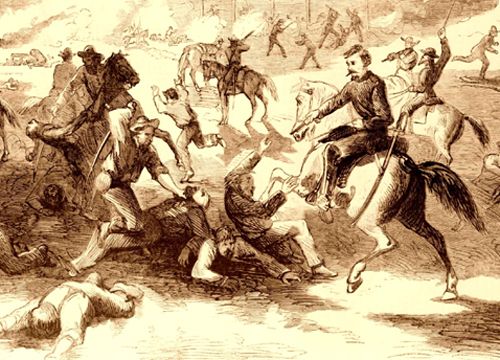
Rebels in Lawrence, Kansas.
Another evidence of their cowardice was shown in that very few stone houses were molested. They shunned almost all houses that were tightly closed so they could not see in when the inmates did not show themselves. A deep ravine, wooded but narrow, ran almost through the town center. In this, many citizens escaped. They often chased men into this ravine, shooting at them. But they never followed one into the ravine and seldom followed up to the brink. They would shy off as if expecting a stray shot whenever they came near it. The cornfield west of town was filled with refugees. The rebels rode up to the edge often as if longing to go in and butcher those who had escaped them, but a wholesome fear that it might be a double game restrained them. Mrs. Hindman lived on the edge of this cornfield. They repeatedly came to her house for water. The gang insisted on knowing what was in the cornfield. The brave woman replied, “Go in and see. You will find it the hottest place you have been in today.” Having had to carry a drink to the refugees, she could testify to the heat. The rebels took her word and left. So, every little ravine and thicket around the outskirts of the town was shunned as if a viper had been in it. Thus, scores of lives that would otherwise have been destroyed were saved.
In almost every case where a determined resistance was offered, the rebels withdrew. Mr. A.K. Allen lives in a large brick house. A gang came to his door and ordered him out. “No!” replied the old gentleman, “if you want anything of me, come where I am. I am good for five of you.” They took his word for it, and he and his house were thenceforth unmolested. The two Messrs. Rankin were out in the street trying to gain a particular house when they were overtaken by six of the ruffians. They at once faced their foes, drew their revolvers, and began to fire when the whole six broke and fled. The cowards did not come to fight but to murder and steal.
Scenes And Incidents
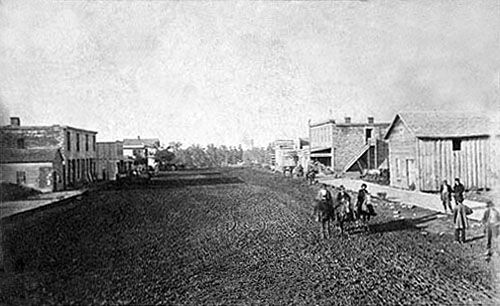
Lawrence, Kansas, 1863.
We can only give a few incidents of the massacre as specimens of the whole. The scenes of horror we describe must be multiplied until the amount reaches one hundred and eighty, the number of killed and wounded.
General Collamore, Mayor of the city, was awakened by their shouts around the house. His house was well known, and they struck it to prevent him from taking defensive measures. When he looked out, the house was surrounded. Escape was impossible. There was but one hiding place — the well. He at once went into the well.
The enemy searched the house for the owner, swearing and threatening. They set the house on fire and waited to see it burn, failing to find him. Mrs. Collamore spoke to her husband while the fire was burning.
However, the house was so close to the well that when the flames burst out, they shot over the well and fell in. When the flames subsided so that the well could be approached, nothing could be seen of Mr. Collamore or the man who had descended into the well with him. After the rebels had gone, Mr. Lowe, an intimate friend of Gen Collamore, went down the well at once to seek for him. The rope supporting him broke, and he also died in the well, and three bodies were drawn from its cold water. At Dr. Griswold’s, there were four families. The doctor and his lady had just returned from a visit east the evening before. Honorable S.M. Thorp, State Senator; Mr. J.C. Trask, Editor of the State Journal; and Mr. H.W. Baker, grocer, along with their wives, were boarding with Dr. Griswold’s family. The house was attacked at about the same time as General Collamore’s. They called for the men to come out. When they did not obey readily, they assured them “they should not be harmed if the citizens quietly surrender, it might save the town.” This idea brought them out at once. Mr. Trask said, “If it will help save the town, let us go.” They went downstairs and outside. The ruffians ordered them to get in line and march before them toward town. They had scarcely gone twenty feet from the yard before the four were shot down. Dr. Griswold and Mr. Trask were killed at once. Mr. Thorp and Mr. Baker were wounded and died. The ladies attempted to reach their husbands but were driven back. A guard was stationed just below, and every time the ladies attempted to go from the house to their dying friends, this guard would dash up at full speed and drive them back with oaths and threats. After the bodies had lain about half an hour, a gang rode up, rolled them over, and shot them again. Mr. Baker received his only dangerous wound at this shot. After shooting the men, the ruffians went in and robbed the house. They demanded even the ladies’ jewelry. Mrs. Trask begged for the privilege of retaining her wedding ring. “You have killed my husband; let me keep his ring.” “No matter,” replied the heartless fiend and snatched the relic from her hand. Dr. Griswold was one of the principal druggists of the place; Mr. Thorp was a State Senator; Mr. Trask was the editor of the State Journal; and Mr. Baker was one of the leading grocers of the place. Mr. Thorp lingered in great pain till the next day, when he died. Mr. Baker, after long suspense, recovered. He was shot through the lungs.
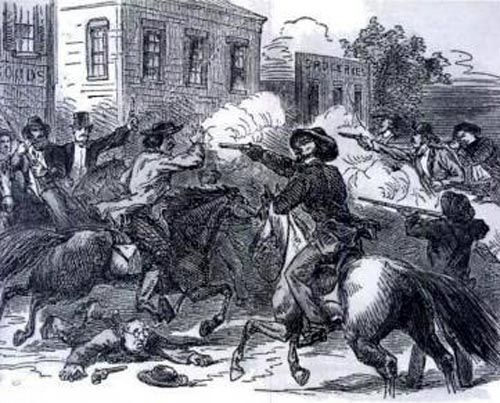
The Sacking of Lawrence, Kansas.
The most brutal murder was that of Judge Carpenter. Several gangs called at his house and robbed him of all he had, but his genial manner was too much for them, and they all left him alive and his house standing. Towards the end, another gang came, more brutal than the rest. They asked him where he was from. He replied, “New York.” “It is you, New York fellows, doing all the mischief,” one replied, drawing his revolver to shoot him. Mr. Carpenter ran into the house, upstairs, then down again, the ruffian after him and firing at every turn. He finally eluded them and slipped into the cellar. He was severely wounded, so the blood lay in pools in the cellar, where he stood for a few minutes. His hiding place was soon discovered, and he was driven out of the cellar into the yard and shot again. He fell mortally wounded.
His wife threw herself onto him and covered him with her person to shield him from further violence. The ruffian deliberately walked around her to find a place to shoot under her and finally raised her arm, put his revolver under it, and fired so she could see the ball enter his head. They then set the house on fire, but the fire was extinguished through the wife’s sister’s energy. The Judge had been married for less than a year. He was young but had already won considerable distinction in his profession. He had held the office of Probate Judge for Douglas County and, a year before, was a candidate for the office of Attorney General of the State.
Mr. Fitch was called downstairs and instantly shot. Although the second ball was probably fatal, they continued to fire until they lodged six or eight balls in his lifeless body. They then began to fire the house. Mrs. Fitch endeavored to drag her husband’s remains from the house, but was forbidden. She then endeavored to save his miniature but was forbidden to do this. Stupefied by the scene and the brutality toward her, she stood there gazing at the strange work around her, utterly unconscious of her position or danger. Finally, one of the ruffians compelled her to leave the house, or she would probably have been consumed with the rest. Driven out, she went and sat down with her three little ones in front of her, watching the house consumed by her husband’s remains. Mr. Fitch was a young man of excellent character and spirit. He was one of Lawrence’s “first settlers” and taught the first school.
James Perine and James Eldridge were clerks in the “County Store.” They were sleeping in the store when the attack was made and could not escape. The rebels entered the store and ordered them to open the safe, promising to spare their lives. The moment the safe door opened, they shot them dead and left them on the floor. They were both up-and-coming young men, about 17 years old.
Mr. Burt was standing by a fence when one of the rebels rode up to him and demanded his money. He handed up his pocketbook, and as the rebel took the pocketbook with one hand, he shot Mr. Burt with the other. Mr. Murphy, a short distance up the same street, was asked for a drink of water, and as the fiend took the cup with his left hand, he shot his benefactor with his right. Mr. Murphy was over sixty years of age. Mr. Ellis, a German blacksmith, ran into the corn in the park, taking his little child with him. For some time, he remained concealed, but the child, growing weary, began to cry. Hearing the cries, the rebels outside ran in and killed the father, leaving the child in his dead father’s arms. Mr. Albach, a German, was sick in his bed. They ordered the house cleared so that they might burn it. The family carried the sick man on the mattress and laid him in the yard when the rebels came out and killed him on his bed, unable to rise. These are species of cruelty that savages have never yet attained.
One of the guerrillas went to the stable of J. G. Sands, corner of Pinckney and Tennessee Streets, and stole his carriage horse and the pet pony “Freddie,” while engaged in this, four others came up the alley; one of them was heard to say, “why in h___ are not these houses burnt.” Dismounting to execute their threat, they were met by “Freddie” running past them, who had escaped from his captor. They were urged to assist in securing the runaway; at once remounting, they all followed him, who led them away from this part of town, and before he was again secured, they were engaged in other scenes of murder. This providential escape of the pony undoubtedly saved the houses and the lives of Dr. Fuller, B.W. Woodward, and J.G. Sands.
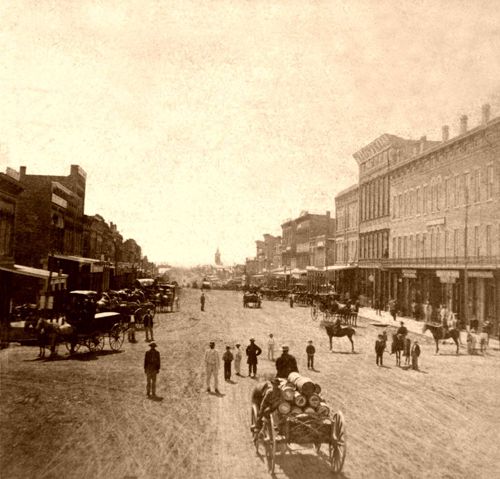
Lawrence, Kansas, 1867.
H. Sargeant’s was on New Hampshire Street between Winthrop and Henry. Early in the day, the guerrillas entered the house and robbed the inmates of all their valuables. Notice was given to them to remove furniture as the house would be burned. Before applying the torch, one party assisted in carrying the piano. During the burning, Mr. Sargeant, Charley Palmer, and Mr. Young, a printer, were in the yard. Mrs. Sargeant, a sister of J.G. Sands, Esq., and Mrs. Mary Hanom were also present.
A squad of ruffians fired a volley into the men, killing Mr. Palmer and wounding Mr. Sargeant but missing Mr. Young, who dropped and feigned death. Noticing life in Mr. Sargeant, one of the men coolly reloaded his pistol, saying he “would soon finish him.” Mrs. Sargeant immediately fell on her husband’s prone body, begging for his life, but the murderer placed the pistol above her shoulder and sent a ball crashing through his head. Mr. Sargeant survived eleven days. By this time, the body of Mr. Young was scorched by his nearness to the burning building, but his presence of mind saved him. The ladies dragged him into the weeds, in line with the other bodies, covered them with sheets, and were now more molested.
The soldiers seldom matched the courage these ladies showed in the excitement of a battle. Men were falling on every side; Mr. Williamson was killed near them, and Mr. Hay was shot down. Bullets were flying all about them, but they stood guard over the dead and dying.
More squads than any other place probably visited the residence of F.W. Read in the heart of the city. Seven different bands called there that morning. Mr. Read had been drilled with his company the day before and had left his gun in the store; he started for it but was met at the door by robbers and retreated into his house. He ran upstairs and raised his head to look out the window when a bullet struck the windowsill within six inches of his right eye. The squad piled bedding and books at the foot of the stairs and set them on fire to burn him out, but Mrs. Read put it out. The following squad was involved in a theft; after demanding, as they all did, firearms, they then wanted money and helped themselves to whatever they could find. In the back of a bureau drawer, they found a small box containing a pair of gold and coral armlets to loop around the shoulder of their little girl, Addie, who had died a few months before. Mrs. Read begged very hard that he would not take them as they had been her little dead child’s, and she wanted them to remember her by; the brute replied with an oath, “Damn your dead baby, she’ll never need them again.” The next squad entered the bedroom and turned the clothes down; one took out a big Bowie knife and cut the mattress for a yard, while another lit a match to set it on fire. It proved to be a hair mattress and would not burn. They set the clothing on fire, but it was put out. The next squad that rode up only came in the house; he looked and seemed satisfied that there was not much left in the house worth carrying off. On looking around, he coolly said, “This is all I want, Madame,” and stepped up to the piano and, with one jerk, pulled off the piano cover, which was a new and very nice one, walked out, took the saddle from his horse, and put it on for a saddle blanket. The next squad was half-drunk and demanded, with an oath that had put the fire out, that Mrs. Read tell them she had done it and would do it again. The order was given to hold that woman; a villain grabbed her by the wrists and held her in a vice-like grasp while the others piled up bedding and books on a cotton lounge under a window and set it on fire, and remained inside until the smoke drove them all on the porch where Mrs. Read was dragged and held till the casing, curtains and drove them all on the porch where Mrs. Read was dragged and held till the curtains and lounge were burning up and out of the top of the window when they let her go and said, “Damn you, you can have your home now if you will put it out,” and went away.
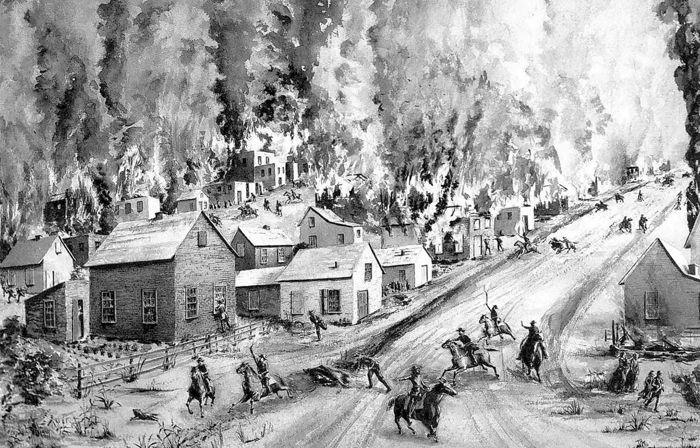
Lawrence Massacre by Lauretta Louise Fox Fiske.
Mrs. Read rushed through the smoke into the bedroom, grabbed a pillow in each hand, and thus protected, shoved against the window so burned that it fell out on the ground, and the home was saved. The next squad was commanded by an officer who inquired about Mr. Read and was told that he had gone east to purchase goods. “Where was your store?” She pointed to Woodward’s Drug Store, on the corner of Massachusetts and Henry Street, and replied that it was all burning up. One man in his squad immediately replied, Yes, someone has gone east from that store. There was P.R. Brooks, who was then clerking for Mr. Read, which showed how well-posted they were and that their spies had been here and done their work only too well. Mrs. Read said, “You seem to be an officer; look at this house and that burning store and say if you have not punished us enough.” The officer turned to his men and commanded, “Men, go away from here and tell all the other squads not to molest these premises today; this family has been punished enough.” He remained on the porch for one-half hour. He was the only one Mrs. Read saw that day who did not act like a brute, and is believed to be a highly respectable man now living in Missouri. The last man to come was named Skeggs. To tell what he has done would make this story too long. He was cruel and brutal; he stayed too long and was killed, the only one of the rebels known to have been killed.
Mr. Thornton had remained in his house till it was in flames. He then ran out, and they shot him three times in the hips. Another shot struck the back of his shoulders and passed clear down his back. Another shot struck his head. The rebel then leaped from his horse with a brutal oath, exclaimed, “I can kill you,” and pounded him over the head with the butt end of his revolver till he fell senseless from exhaustion. The man was going to shoot again, but Mrs. Thornton ran between them and prevented him, and the brute soon left. Though so terribly shot, Mr. Thornton still lived, but two bullets in the hip joints could never be extracted, and he was a cripple for life.
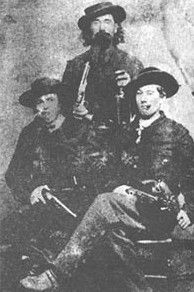
D.W. Palmer, a gunsmith, was wounded and thrown into the flames of his burning shop. Mr. Langley lived about a mile from town. He was a fine old gentleman of 60. He was a peaceable man, taking no particular part in public affairs. He and his wife lived on a small farm by themselves. Two of the pickets stationed outside the town came to the house. Mrs. Langley begged them “to be merciful: they were old people and could not live long at best.” But her requests had no effect; they hunted the old gentleman around the house and shot him in the yard. The first shot was not doing its work; they shot him repeatedly. They then set fire to the house, but through the old lady’s powers, the fire was extinguished, and the house was saved.
There were many hair-breadth escapes. Many ran to the cornfields near the town; others fled to the “friendly brush” by the riverbank. The ravine ran almost through the town center, providing a safe refuge for scores. The cornfield west of town and the woods east were all alive with refugees. Many hid in the “Park,” which was planted with corn. Many others who could get no further hid among the weeds and plants in their gardens. Mr. Strode, a colored blacksmith, had a little patch of tomatoes not more than ten feet square. He took his money and buried himself among the vines. The rebels burned his shop, not more than ten feet off, but did not discover him.
Mr. Hampson, who had been shot, lay wounded by a burning building. It would be certain death to show signs of life. Therefore, his wife stood by him and asked one of the rebels to help carry her husband’s body away from the flames. He took hold of Hampson and carried him out of reach of the fire without discovering that he was alive. His wife helped him onto a handcart as soon as possible, covered him with rags, and then drew him away from danger. The rebels she passed thought her crazy for “drawing off that load of old rags.”
One of the most wonderful escapes was Reverend H.D. Fisher’s. We give an account of it in his own words: “When Quantrill and his gang came into our town, almost all were in their beds. My wife and second boy were up, and I was in bed because I had been sick with quinsy. The enemy yelled and fired a signal. I sprang out, and my other children and I clothed ourselves as quickly as possible.
I took the two oldest boys and started running up the hill, since we were completely defenseless and unguarded. I ran a short distance and felt I would be killed. I returned to my house, where I had left my wife with Joel, seven years old, and Frank, six months old, and thought to hide in our cellar. I told Willie, twelve years old, and Eddie, ten years old, to run for their lives, and I would hide. I had scarcely found a spot to secrete myself when four murderers entered my house and demanded of my wife, with horrid oaths, where her husband was hiding in the cellar. She replied, “The cellar is open; you can go and see for yourselves.
My husband started over the hill with the children.” They demanded a light to search. My wife gave them a lighted lamp, and they came, light and revolvers in hand, swearing to kill me at first sight. They came within eight feet of where I lay, but my wife’s self-possession in giving the light had disconcerted them, and they left without seeing me. They set the house on fire in four places, but my wife extinguished the fire with almost superhuman efforts with the baby in her arms. Soon after, three others came and asked for me. But she said, “Do you think he is such a fool as to stay here? They have already hunted for him, but thank God! They did not find him.” They then completed their work of pillage and robbery and fired the house in five places, threatening to kill her if she attempted to extinguish it again. One stood, revolver in hand, to execute the threat if attempted. The fire burned furiously. The roof fell in, then the upper story, and then the lower floor, but a space about six by twelve feet was, by great effort, kept perfectly deluged with water by my wife to save me from burning alive. I remained thus concealed as long as I could live in such peril. At length, and while the murderers were still at my front door and all around a lot watching for their prey, my wife succeeded, thank God, in covering me with an old dress and a piece of carpet and thus getting me out into the garden and to the refuge of a small weeping willow covered with morning glory vines, where I was secured from their fiendish gaze and saved from their hellish thirst for my blood. I still expected to be discovered and shot dead. But a neighbor woman who had come to our help aided my wife in throwing a few things saved from the fire over and around the little tree where I lay to cover me more securely.”
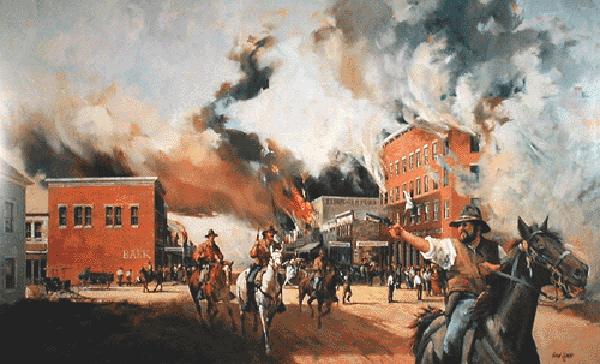
Border War between Missouri and Kansas.
Honorable S.A. Riggs, District Attorney, was set upon by the vilest ruffian of the lot. His wife rushed to his side at once. After a short conversation, the man drew his revolver and aimed. Mr. Riggs pushed the revolver aside and ran. The man started after him, but Mrs. Riggs seized hold of the bridle rein and clung to it till she was dragged around a house, over a woodpile, and through the yard back onto the street again. Mr. Riggs was still in sight, and the man was aiming at him again when Mrs. Riggs seized the other rein and turned his horse around. Mr. Riggs was beyond reach. The man was swearing, striking at her with his revolver, and threatening to shoot her all this time.
Old Mr. Miner hid among the corn in the Park. Hearing the racket around Mr. Fisher’s house nearby, he ventured to the edge of the corn to gratify his curiosity. He was seen and immediately shot at. He ran back into the corn, but had not proceeded far before he heard them breaking down the fence. The corn was evidently to be searched. He ran, therefore, through the corn and lay down among the weeds beyond. The weeds only partially covered him, but it was the best he could do. He had scarcely lain down when the rebels came dashing through the corn and stationed a picket at each corner of the field to prevent escape. They searched the field but found no one. They did not happen to look among the grass almost at their very feet.
Near the town center was an outdoor cellar with a very obscure entrance. A woman, whose name we have been unable to obtain but who ought to be put on record as one of the heroines of that day, took her station at a convenient distance from that cellar. She directed every poor fugitive that came into that region into this hidden cellar. Thus, eight or ten escaped from the murderers. Finally, the rebels noticed that their victims always disappeared when they came into this locality and suspected this woman of aiding in their escape. They demanded that she show them their hiding place. She refused. One of them drew his revolver and, pointing it at her, said, “Tell us, or I will shoot you.” “You may shoot me,” answered the brave woman, “but you will not find the men.” Finding they could not intimidate her, they left.
Mr. Bergen was wounded and taken off with six or eight other prisoners. After taking them a short distance, their captors shot all of them dead except Mr. Bergen. He was lying down, exhausted from losing blood, and they passed him by for some reason. There he lay among the dead, feigning death. After lying briefly, a rebel rode up and, discovering he was not dead, took aim at his head and fired. He felt the ball pass and instinctively dropped his head, and the rebel, supposing he had completed his work, rode off. His head was now brought under the body of a young man killed with the rest. There he lay, the living under the dead, till the rebels left town. At one time, the young man’s mother came to wash the blood from the face of her murdered son. Mr. Bergen begged her not to move her son’s body, as his only hope of life was lying his head under the corpse.
Several saved themselves by their ready wit. When the attack was made, an officer in the camp of recruits ran away at full speed. He was followed by several horsemen, who were firing at him continually. Finding escape impossible, he dashed into the house of a colored family and, in the twinkling of an eye, slipped on a dress and shaker bonnet, passed out the back door, and walked deliberately away. The rebels surrounded the house, and some entered and searched, but found no prey.
A son of John Speer hid for some time under the sidewalk. The fire soon drove him into the street full of rebels. He went boldly up to them and offered to hold their horses. They asked his name, and thinking that the name Speer would be his death warrant, he answered, “John Smith, and he remained among them unharmed to the last.
One man was shot while running away and fell into the gutter. His wife thought he had killed and began to wring her hands and scream. The rebel, thinking that her husband was dead, left. As soon as he was gone, the man said, “Don’t take on so, wife, I don’t know as I am hit at all.” And so it proved.
Mr. Winchell, being hard pressed, ran into the house of Reverend Charles Reynolds, Rector of the Episcopal Church. Mrs. Reynolds arrayed him in female attire at once, shaved off his mustache with a knife, set him in a rocking chair with a baby in his arms, and christened him “Aunt Betsie.” The rebels searched the house but did not disturb “Aunt Betsie.”
Mr. G. Grovenor had a narrow and almost providential escape. He lived where he now does, at the corner of Berkeley and New Hampshire Streets. While standing on his porch, a rebel rode up to within ten feet of him and snapped his pistol at him; it missed fire. It failed the second time, but at that instant, another gang rode up, and the leader said, “Don’t shoot that man,” and told Mr. Grovenor to go to the cellar or somewhere. The house was now in flames, but he secreted himself in the cellar under the back kitchen until the danger had passed. One gang ordered Mrs. Grovenor to draw water for themselves and their horses. More human than the others, a young man alighted from his horse and told her he would draw the water. This young man said he had no idea such murderous work was contemplated. He was told they would recapture some stolen horses. He had not killed anyone nor set fire to any houses, and was not going to.
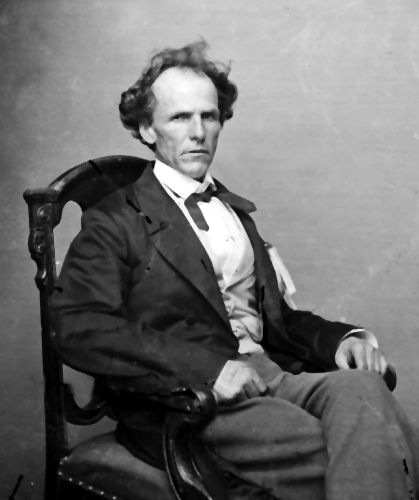
General James H. Lane.
General James H. Lane, who was, of course, among the first sought for, hearing them coming, jumped from his bed, seized an ax and chopped the door plate from his front door, and then fled in his night clothes to the cornfield west of his house, taking the door plate with him; passing through the field, he obtained clothes from a house on the outskirts of town and commenced to gather a posse for resistance and pursuit.
John Speer had a 17-year-old son sleeping in the Republican office building, and no trace of him has ever been found. Another son was also brutally murdered.
Mr. Joseph Savage, who lives two miles southwest of town, had just arisen and was out back making his morning toilet. When he heard the tramp of horses’ feet coming up the road and presently heard a loud knocking at the door, he supposed the horsemen were Union troops and the caller a soldier who wished to make some inquiry. After completing his toilet, he opened the door, and the man who had come to murder him was going out the gate. Mr. Savage owes his life to the deliberate manner in which he performed his morning wash.
Among the last brutal murders perpetrated were the killing of Mr. Stone and two or three others at the City Hotel or Whitney House, where Quantrill had promised protection and, as far as he knew, evidently kept his word. But two drunken ruffians came at the last and, hearing the weeping and wailing of some women who had just heard that their husbands were lying in the street dead, demanded what all the fuss was about. On being told, they replied, “We’ll give you something to cry for,” and immediately commenced firing into the hotel full of people. The old man, Stone as he was called, was the first to fall. At least two others were killed, and several were wounded.
“As the scene at their entrance was one of the wildest, the scene after their departure was one of the saddest that ever met mortal gaze. Massachusetts Street was one bed of embers. On this one street, 75 buildings were destroyed, containing at least twice as many places of business and offices. The dead lay along the sidewalk; many were so burned that they could not be recognized and could scarcely be taken up. The bones of those who had perished in the buildings and been consumed could be seen among the embers. On two sides of another block lay seventeen bodies. Almost the first sight that met our gaze was a father, looking almost frantic, as he searched among the embers of his office for his son’s remains. The work of gathering and burying the dead soon began. From every quarter, they were being brought in until the floor of the Methodist Church, which was taken as a sort of hospital, was covered with dead and wounded. Almost every house could hear the wail of the widow and orphan. The work of burial was sad and wearying. Coffins could not be procured. Many carpenters were killed, and most of those living had lost their tools. But they rallied nobly and worked night and day, making pine and walnut boxes, fastening them with the burnt nails gathered from the ruins of the stores. (It sounded rather harsh to friends’ ears to have the lid nailed over the bodies of their loved ones, but it was the best that could be done.) Thus, the work went on for three days till one hundred and twenty-two were deposited in the cemetery, and many others were in their yards. Fifty-three were buried in one long grave. Early in the morning, after the massacre, loud wailings attracted our attention. We went in the direction of the sound, and among the ashes of a large building sat a woman holding the blackened skull of her husband, who was shot and burned in that place. Her cries could be heard over the whole desolated town and added much to the feeling of sadness and horror which filled every heart.”

Personalized Wanted Poster
The rebels were in the town from about five o’clock until nine. At that time, a body of United States mounted troops, who had left Kansas City the night before, as soon as Quantrill’s movement was known, was seen approaching from the east, about eight miles distant. The rebel pickets saw them first from the hill where the university now stands. The forces were called together at once, and they left town by the road leading south, thus avoiding the troops. These latter struck across the prairie and overtook the rebels about ten miles south of Lawrence. For some reason, no attack was made, and the two bodies marched in sight of each other all day. At night, the rebels escaped to their hiding places in Missouri. The first ten miles of their route out of town were marked by burning farm buildings and haystacks — they were continuing their murderous work.
The population of Lawrence was approximately 2,000, and there could not have been more than 400 men, many of whom were in the army. The proportion of killed among these was vastly more significant than in the war’s bloodiest battle. About 80 widows and 250 orphans were left. The whole number killed was about one hundred and fifty. One hundred and forty-three bodies were found and buried. Several were killed and burned in buildings, and their bodies were never found; 25 were wounded, and two died a few days later.
There were between 300 and 400 people in the company. About one-half were rebel cavalry thoroughly drilled; the other half were the ruffians of the border. They were the same clans who had disturbed the country in the early days of Kansas — “the border ruffians.” They remembered their former defeat and, for all these years, had been nursing their wrath to keep it warm. The former clan was the most effective, the latter the most brutal.
Quantrill was once a school teacher in Ohio. He came to Kansas before the war to stay for six months. He went by the name of Charly Hart. He boarded at the City Hotel and kept his prisoners during the slaughter. He became implicated in a horse-stealing affair, which was a fatal disease, and left for parts unknown. When the war broke out, he found it convenient to take his place on the rebel side of the line. His fate has always been involved in mystery. He has been reported killed at a dozen different times and has been reported as living in half a dozen different places. However, there is little doubt he was killed or disabled in the spring following the raid. About June 1864, he suddenly disappeared from the field of action and was never present again. There is a belief that he died of wounds and disease sometime after this, in the hospital at Louisville, which is not unlikely.
Conclusion
Many other states, including Ohio, Indiana, and Pennsylvania, had severe raids during the war, but none approached the Quantrill Raid in the destruction of life and property. The Legislature of their states assumed the losses and paid the sufferers. In contrast, the Legislature of Kansas has never done anything for the widows and orphans whose husbands and fathers helped carve out a life from the “Great American Desert,” the best and most prosperous agricultural state that God’s bright sun has ever shone upon.
Reverend Richard Cordley.
Notwithstanding there is about money enough in the State Treasury to pay it, or the fact that it would be only a tax of one mill on the dollar each year for four years if it were necessary to raise funds that way, there is a moral certainty that the United States would assume the debt and payback to the state the just claim it has been reserved for the Legislature of 1865 to immortalize themselves, by paying a bill for their relief, which injustice they should. We have no doubt, but we will do it.
Killed 134, Wounded 22, and Missing 3.
Compiled and edited by Kathy Alexander/Legends of America, updated June 2025. Based on the information provided by Reverend Richard Cordley in 1863, published in 1865. The text as it appears here is not verbatim, as it has been edited for clarity.
Also See: