
By Robert M. Wright, 1913
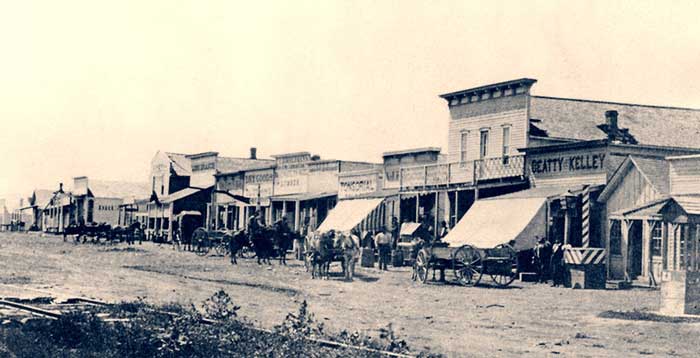
Dodge City, circa 1875
Established in 1872, upon the establishment of the Atchison, Topeka & Santa Fe Railroad, Dodge City was in the very heart of the buffalo country. Hardly had the railroad reached there, long before a depot could be built (they had an office in a boxcar), business began, and such a business! Dozens of cars a day were loaded with hides and meat, and dozens of carloads of grain, flour, and provisions arrived each day. The streets of Dodge were lined with wagons, bringing in hides and meat and getting supplies from early morning to late at night.
Charles Rath & Company ordered two hundred cases of baking powder from Long Brothers of Kansas City at one order. They went to Colonel W. F. Askew, to whom we were shipping immense quantities of hides, and said: “These men must be crazy, or else they mean two hundred boxes instead of cases.”
They said there were not two hundred cases in the city. Askew wired us if we had not made a mistake. We answered, “No, double the order.” Askew was out a short time after that and saw six or eight carloads of flour stacked up in the warehouse. He said he now understood. It was to bake this flour up into bread.
I have been to several mining camps where rich strikes were made, but I never saw any town equal to Dodge. A good hunter would make a hundred dollars a day. Everyone had money to throw at the birds. There was no article less than a quarter –a drink was a quarter, a shave was a quarter, a paper of pins a quarter, and needles the same. In fact, that was the smallest change. Governor St. John was in Dodge once when he was notified that a terrible cyclone had visited a little town close to the Kansas line in Nebraska. In two hours, I raised one thousand dollars, which he wired them.
Our first calaboose in Dodge City was a well fifteen feet deep, into which the drunkards were let down and allowed to remain until they were sober. Sometimes there were several in it at once. It served the purpose well for a time. Of course, everyone has heard of wicked Dodge; but a great deal has been said and written about it that is not true. Its good side has never been told, and I cannot give it space here. Many reckless, bad men came to Dodge and many brave men. These had to be met by officers equally brave and reckless. As the old saying goes, “You must fight the devil with fire.” The officers gave them the south side of the railroad track, but the north side must be kept respectable, and it was. There never was any such thing as shooting at plug hats. On the contrary, every stranger that came to Dodge City and behaved himself was treated with politeness; but woe be unto the man who came seeking a fight. He was soon accommodated in any way, shape, or form that he wished.
Often have I seen chivalry extended to ladies on the streets, from these rough men that would have done credit to the knights of old. When some man, a little drunk, and perhaps unintentionally, would jostle a lady in a crowd, he was soon brought to his senses by being knocked down by one of his companions, who remarked, “Never let me see you insult a lady again.” In fact, the chivalry of Dodge toward the fair sex and strangers was proverbial. Never in the history of Dodge was a stranger mistreated; but, on the contrary, the utmost courtesy was always and under all circumstances extended to him, and never was there a frontier town whose liberality exceeded that of Dodge. But, while women, children, and strangers were never, anywhere, treated with more courtesy and respect; while such things as shooting up plug hats and making strangers dance are all bosh and moonshine, and one attempting such would have been promptly called down; let me tell you one thing –none of Dodge’s well-known residents would have been so rash as to dare to wear a plug hat through the streets, or put on any “dog,” such as wearing a swallow tailor evening dress, or any such thing. The general reputation of young Dodge City is well described in an article entitled “Reminiscences of Dodge,” written in 1877, and expressing what a stranger has to say about the town. The article runs as follows:
 “By virtue of the falling off in the cattle drive to Kansas for this year, and the large number of cattle driven under contract, Dodge City became the principal depot for the sale of surplus stock; buyers met drovers at this point, purchased and received purchases without unnecessary delay, thereby greatly facilitating business and enabling quick returns of both owners and hands. In the future, situated upon one of the best railroads traversing the country from east to west, the Atchison, Topeka & Santa Fe, it will probably occupy an enviable position as a cattle market. “Dodge has many characteristics which prevent its being classed as a town of strictly moral ideas and principles, notwithstanding it is supplied with a church, courthouse, and jail. Other institutions counterbalance the good works supposed to emanate from the first mentioned. Like all frontier towns of this modern-day, fast men and fast women are around by the score, seeking whom they may devour, hunting for a soft snap, taking him in for cash. Many are the Texas cowboys who can testify to their ability to follow up successfully the calling they have embraced in quest of money.
“Gambling ranges from a game of five-cent chuck-aluck to a thousand-dollar poker pot. Nothing is secret, but with open doors upon the main streets, the ball rolls on uninterruptedly. More than occasionally, some dark-eyed virago or some brazen-faced blonde, with a modern sundown, will saunter in among the roughs of the gambling houses and saloons, entering with inexplicable zest into the disgusting sport, breathing the immoral atmosphere with a gusto which I defy modern writers to explain. Dance houses are ranged along convenient distances and supplied with all the trappings and paraphernalia which go to complete institutions of that character. Here you see the greatest abandon. Men of every grade assemble to join in the dance. Nice men with white neckties, the cattle dealer with his good clothes, the sport with his well-turned fingers, smooth tongue, and artistically twisted mustache, and last but not least the cowboy, booted and spurred as he comes from the trail, his hard earnings in his pocket, all join in the wild revel; and yet with all this mixture of strange human nature a remarkable degree of order is preserved. Arms are not allowed to be worn, and any noisy whisky demonstrations are promptly checked by incarceration in the lock-up. Even the city mayor indulges in the giddy dance with the girls, and with his cigar in one corner of his mouth and his hat tilted to one side, he makes a charming-looking officer.
“Some things occur in Dodge that the world never knows of. Probably it is best so. Other things occur that leak out by degrees, notwithstanding the use of hush money. That, too, is perhaps the best. Men learn by such means.
“Most places are satisfied with one abode of the dead. In the grave, there is no distinction. The rich are known from the poor only by their tombstones, so the sods upon the grave fail to reflect the characters buried beneath them. And yet Dodge boasts of two burying spots, one for the tainted whose very souls were steeped in immorality and who have generally died with their boots on. ‘Boot Hill‘ is the somewhat singular title applied to the burial place of the class just mentioned. Any particular title does not designate the other, but it is supposed to contain the bodies of those who died with a clean sheet on their beds-the soul, in this case, is a secondary consideration.”
So much for one view of Dodge City, but this view was not quite universal, though common. Sometimes a writer appeared who could recognize a few slightly better features in the border town and who could look beyond its existing lawlessness and see the possibilities and beginnings of a higher state of things. In proof of this, I’ll quote an article written in 1878, a year later than the last, and entitled “The Beautiful, Bibulous Babylon of the Frontier“:
“Standing out on the extreme border of civilization, like an oasis in the desert, or like a light-house off a rocky coast, is ‘The Beautiful, Bibulous Babylon of the Frontier,’ Dodge City, so termed by Lewis, editor of the ‘Kinsley Graphic.’ Dodge City is far-famed, not for its virtues, but for its wickedness; the glaring phases of its vices stand preeminent and attract the visitor’s attention, and these shadows of Babylon are reproduced in the gossip’s corner and- n the press. It is seldom the picture has fine embellishments, but the pen artist of the ‘Graphic’ put the finer touches of nature to the pen portrait of Dodge-‘she is no worse than Chicago.'”
This, we admit, is slight leverage in the social scale to be placed in the category of Chicago’s wickedness.
Dodge City has magnetic attractions. Few people are attracted here by curiosity; everyone has a business except the tramps, and they have no business here. But our visitors see it all before they leave, and they use the same circumspection here they would under their own vine and fig tree. Many of them are not charitable enough to tell the unvarnished truth. In vain boast and idle glory, they recount the pilgrimage to Dodge as though they passed through blood, rapine, and warfully attested their courage.”
But the Kinsley Graphic pays the “Bibulous Babylon” a high compliment, besides raising the moral standard of Dodge to that of the immaculate virtue of Chicago.
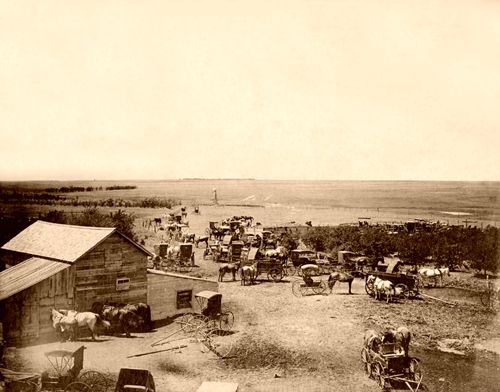
Dodge City Gathering, late 1800’s. Click for prints & products.
“Kansas has but one Dodge City. With a broad expanse of territory sufficiently vast for an empire, we have only room for one Dodge City. Without particularizing at length, we were most favorably impressed generally during a brief visit to our neighboring city Tuesday.
Beautiful for situation, cozily nestled on the ‘beach’ of the turbid Arkansas River, while on the north, the palisades rise above the busy little city, which in the near future will be ornamented with cozy cottages, modern mansions, and happy homes. The view from the elegant brick courthouse, situated above the town, is grand. The panorama spread out west, south, and east takes in a vast scope of valley scenery such as only can be found fringing our river. Seventy-five thousand head of cattle, recently driven in from the ranges south, can be seen lazily feeding on the nutritious native meadows. At the same time, the cowboys gallop here and there among these vast herds, displaying superior horsemanship. Five miles down the river, the old flag floats proudly over the garrison at the military Post.
The city proper is a busy beehive of bustle and business, a conglomerated aggregation of every line of business alternating with saloons. Francis Murphy don’t live in Dodge. Dodgeites are justly proud of a few institutions — the ever-popular Dodge House, ‘The Times’, the courthouse, the fire company, Mayor Kelley’s hounds, and the ‘Varieties.’ Much has been said of the wickedness and unrighteousness of the city. If ‘old Probe’ should send a shower of fire and brimstone up there, we would not vouch for there being a sufficient number of righteous citizens to save the city. Yet, with all her wickedness, she is no worse today than Chicago and many other cities where the music of the chimes are daily heard. However, there is but one difference, which is a frontier characteristic; our neighbors do not pretend to hide their peculiarities. A few years hence Dodge City will be a model of morality and a city of no mean importance.
For courtesies shown us, we acknowledge our obligations to Messrs. Kline & Shine of the lively ‘Times,’ Judge Gryden (who deserves to be known as Prince Harry, and whose only fault is his rock-footed Democracy), Mayor Kelley, Hon. H. M. Sutton, the popular county attorney, E. F. Colburn, the modest city attorney, Samuel Marshal, the portly judge, Fringer, the postmaster, Hon. R. M. Wright, Dr. McCarty, Sheriff Masterson, and his efficient lieutenant City Marshal Bassett, and our old friends at the signal office.”
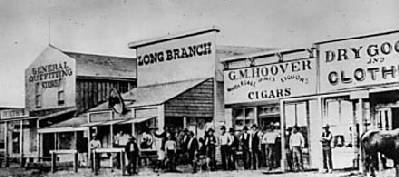
Dodge City in 1874, courtesy Ford County Historical Society
Again, under the heading, “The Wickedest City in America,” the “Kokomo, Indiana, Dispatch,” of an issue in July 1878, refers to Dodge:
“Its character as a hell, out on the great plains, will be,” said a local writer, “maintained in the minds of traveling newspaper writers, just so long as the city shall remain a rendezvous for the broad and immense uninhabited plains, by narrating the wildest and wickedest phases of Dodge City; but we have to commend them for complimenting Dodge on its orderly character.”
The Dispatch speaks very highly of Dodge as a commercial point, and his letter bears many complimentary features. We extract the following:
“‘My experience in Dodge was a surprise all around. I found nothing as I pictured it in my mind. I had expected, from the descriptions I had read of it, to find it a perfect bedlam, a sort of Hogathian Gin Alley, where rum ran down the street gutters, and loud profanity and vile stenches contended for the mastery of the atmosphere. On the contrary, I was happily surprised to find the place in the daytime as quiet and orderly as a country village in Indiana, and at night the traffic in the wares of the fickle Goddess and human souls was conducted with a system so orderly and quiet as to actually be painful to behold. It is a most difficult task, I confess, to write up Dodge City in a manner to do impartial fairness to every interest; the place has many redeeming points, a few of which I have already mentioned. It is not nearly so awful a place as reports make it. It is not true that the stranger in the place runs a risk of being shot down in cold blood, for no offense whatever.”
In the year 1878, the Topeka Times says, in a certain issue:
“During the year 1873, we roughed it in the West. Our first stopping place was the famous Dodge City, at the time a perfect paradise for gamblers, cut-throats, and girls. On our first visit, the buildings in the town were not buildings, with one or two exceptions, but tents and dugouts. Everyone in town nearly sold whisky or kept a restaurant, perhaps both. The Atchison, Topeka & Santa Fe Railroad was just then working its way up the low-banked Arkansas, and Dodge was the frontier town. Its growth was rapid, in a month from the time the railroad was completed to its borders, the place began to look like a city; frame houses, one story high, sprang up; Dodge became noted as the headquarters for the buffalo hunters, and the old town was one of the busiest of trading points, and they were a jolly set of boys there.
They carried a pair of Colt’s revolvers in their belts, wore their pants in their boots, and when they died, did so generally with their boots on. It wasn’t safe, in those times, to call a man a liar or intimate that his reputation for honesty was none of the best unless you were spoiling for a fight. In those days, ‘Boot Hill‘ was founded, and the way it grew was astonishing to newcomers and terrifying to tenderfeet. We well remember, but now forget the date, when a party of eastern capitalists came out to look around with a view to locating. They were from Boston and wore diamonds and kid gloves. The music at one of the dance halls enticed the bald-headed sinners thither, and what with wine and women, they became exceedingly gay. But in the midst of their sport, a shot was fired, and another, and, in a little time, the room gleamed with flashing pistols and angry eyes. This was enough, and the eastern capitalists hurried to the depot, where they remained until the first train bore them to the classic shades of Boston. But with all its wildness, Dodge could then, as it does yet, boast of some of the best, freest, and whitest boys in the country.
We were down there again last week and were surprised by the change in the city. It has built up wonderfully, has a fine courthouse, church, good schools, large business blocks, a good hall, first-class hotels, and two live newspapers. The editor of the Times was not in, but we saw Honorable D. M. Frost, the editor of the Globe. Dodge is coming out and is destined to be a city of considerable size.”
Another writer of the Times, defending Dodge City, says:
“There is an evident purpose to malign and create false impressions concerning the character of Dodge City. It is a pretty general impression that a person here is insecure in life, and that the citizens of Dodge are walking howitzers. This is a bad impression that should, by all means, be corrected. Having but a short residence in this town, it is our deliberate opinion, from a careful observation, that Dodge is as quiet and orderly as any town of its size in Kansas. We have been treated with the utmost cordiality. We have observed officers prompt and efficient, in the discharge of their duties. There is an ordinance prohibiting the carrying of firearms, which is rigidly enforced. The citizens are cordial, industrious, and display business alacrity, characteristic of the frontier tradesman. We are surprised to note the difference of character of this town and the impression aimed to be made upon us before coming here. There is lurking jealousy somewhere that gives rise to false rumors, and we trust every citizen of Dodge City will correct these false impressions, as far as lies in his power. This, alone, would efface bad impressions and false rumors, but forbearance ceases to be a virtue, and we kindly protest.”
Again, the character of early Dodge was defended by Charles D. Ulmer, of the Sterling Bulletin, thus:
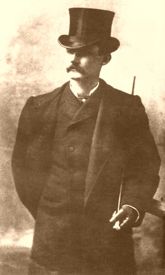
Luke Short
“On Friday, the party visited Dodge City, the rip-roaring burg of the West. As we glided into the depot, we looked anxiously along the street, expecting to see many squads of festive cowboys, rigged out with arms enough to equip a regiment and ready to pop a shot at any plug hat that might be in the crowd, but nothing of the kind was to be observed; instead, there was a busy, hustling little city, like many others in Kansas, with, perhaps, a few extra saloons thrown in for variety. Dodge City was a surprise to us. It is beautifully located — the residence portion on the hills which command a magnificent view of the country, east, west, and south. The business portion is on the level bottom at the foot of the hills. The railroad track is a little close to the main business street for convenience.
“The party, on landing, instead of being received by a howling lot of cowboys, with six-shooters and Winchester rifles rampant, were received by a delegation of as gentlemanly and courteous men as can be found in the state. During our stay in Dodge, we had the pleasure of meeting most of the men who have been so prominently mentioned in the late trouble at that place. Instead of low-browed ruffians and cut-throats, we found them to be cultivated gentlemen, but evidently possessing plenty of nerve for any emergency. Among those we met and conversed with was Luke Short, his partner, Mr. Harris, who is vice-president of the Dodge City bank, and Mr. Webster. The late trouble originated in differences between Messrs. Short and Webster, and, we believe, after both sides get together, it could and should have been settled without the hubbub made, and interference of the state authorities. Mr. Short, Mr. Harris, and others assured us that their side, at all times, was ready and willing to submit their differences to the decision of the courts. The trouble has been amicably adjusted, and no further trouble is anticipated on the old score.”
But, as has already been stated, often only the worst side of Dodge City was written up, in a way to make the most of it. In protest against this practice, a local writer of early times refers to a write-up of the sort, in this wise:
“A verdant editor of the ‘Hays City Sentinel’ visits our brothels and bagnios. From the tone of his article, he must have gone too deep into the dark recesses of the lascivious things he speaks of, and went away in the condition of the monkey who got his tail too near the coals.
He says: ‘After a long day’s ride in the scorching sun, I arrived in Dodge City. Dodge is the Deadwood of Kansas. Her incorporate limits are the rendezvous of all the unemployed scallawagism in seven states. Her principal business is polygamy without the sanction of religion, her code of morals is the honor of thieves, and decency she knows not. In short, she is an exaggerated frontier town, and all her consistencies are operated on the same principle. Her everyday occurrences are such as would make the face of a Haysite, accustomed as he is to similar sights, color to the roots of his hair and draw away disgusted. Dodge is a fast town and all of her speedy proclivities exhibit to the best advantage.
The employment of many citizens is gambling. Her virtue is prostitution and her beverage is whisky. She is a merry town and the only visible means of support of a great many of her citizens is jocularity. Her rowdyism has taken a most aggravated form and was it not for the most stringent ordinances (some of which are unconstitutional,) and a fair attempt to enforce them, the town would be suddenly depopulated and very much in the manner that Ireland got rid of her snakes. Seventeen saloons furnish inspiration and many people become inspired, not to say drunk. Every facility is afforded for the exercise of conviviality, and no restriction is placed on licentiousness. The town is full of prostitutes and every other place is a brothel. Dodge by day and Dodge by night are different towns;’ and, then he goes on with more abuse too vile and untruthful to mention. Our brother from Hays City must indeed have been hard hit, but must not have visited any good spot in Dodge City, but, on the contrary, must have confined himself entirely to the very lowest places and worst society in Dodge. Birds of a feather, you know, will flock together. We hope his dose was a mild one-though he does not deserve our sympathy.”
Besides this generally sensational mode of writing up the town, Dodge City was the theme of many lurid stories and sulfurous jokes which tended, no less than the write-ups, to establish her position, in the public eye, as the “Wickedest Town in America.” The following letter is from the .
“Dodge City is a wicked little town. Indeed, its character is so clearly and egregiously bad that one might conclude, were the evidence in these later times positive of its possibility, that it was marked for special Providential punishment. Here those nomads in regions remote from the restraints of moral, civil, social, and law enforcing life, the Texas cattle drovers, from the very tendencies of their situation the embodiment of waywardness and wantonness, end the journey with their herds, and here they loiter and dissipate, sometimes for months, and share the boughten dalliances of fallen women. Truly, the more demonstrative portion of humanity at Dodge City gives now no hopeful sign of moral improvement, no bright prospect of human exaltation; but with Dodge City itself, it will not always be as now. The hamlet of today, like Wichita and Newton farther east in the state, will antagonize with a nobler trait, at some future day, its present outlandish condition. The denizen of little Dodge City declares, with a great deal of confidence, that the region around about the place is good for nothing for agricultural purposes. He says the seasons are too dry, that the country is good for nothing but for grazing, and that all they raise around Dodge City is cattle and hell. The desire of his heart is the father of the statement. He is content with just what it is, and he wants that to remain. He wants the cattle droves and his associations and surroundings to be a presence and a heritage forever.”
Referring to this article, the Ford County Globe, of January 1, 1878, says:
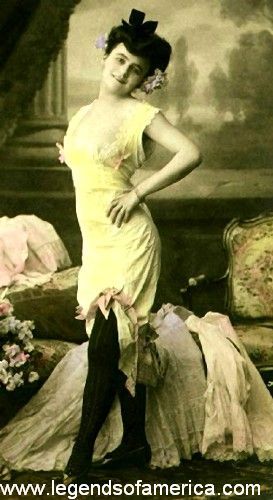
Soiled Dove or Prostitute
“We think this correspondent had a sour stomach when he portrayed the wickedness of our city. But we must expect it unless we ourselves try to improve the present condition of things. There is not a more peaceful, well-regulated, and orderly community in the western country;” and then, as the office boy entered to say that somebody wanted to see him, he took his bowie knife between his teeth, put a Colt’s new pattern six-shooter on his desk in front of him, and then said: “Jim, get out another coffin, a plain one this time, and let the critter come in.”
About thirty miles from Dodge, the train stopped at a little station, and a cowboy got on, very drunk and fully equipped in chaps, spurs, six-shooter, and quirt. The conductor, John Bender, asked him his fare and destination. He replied, “I want to go to hell!” Bender said, “All right; give me a dollar and get off at Dodge.”
Thus Dodge City’s evil reputation became established, whether deserved or undeserved. People living at a distance and having no way of knowing where truth ended and falsehood began naturally gave credence to all reports they saw published until, in places, remote, the very name of Dodge became a synonym for all that was wild, reckless, and violent. Strangers, approaching the town for the first time, did so with dread, entered it with fear and trembling, or passed through it with a sigh of relief as its last roof was left behind. Tales of the fate of tenderfeet in the border city struck terror to the soul of many a newcomer in the community, and the dangers apprehended by these new arrivals on the dreaded scene were limited only by the amount of courage, credulity, and imagination they possessed. To illustrate, a young man, going west with a party of movers, wrote a card to his father back east, just before reaching Dodge City, not mailing it till after passing through. Here is what he wrote while anticipating the entrance into the dreaded town:
“In Camp Fifteen Miles from Dodge, May 7, 1877. Dear Father: As I’ve a little time, I’ll drop you a card, so you can see we are all well and headed west. Have laid over here to wait for a larger crowd so as to be perfectly safe going through Dodge. There are nine teams now, and will be three more in the morning, so we will be safe anyway. There are a good many coming back from Colorado, but that don’t discourage us any. That is no sign we can’t do well. Everything goes on as nice as clockwork among ourselves; not a word as yet and no hard feelings. – Herbert.”
In somewhat sarcastic comment upon this postal card, the Dodge City Times, of May 19, 1877, says:
“The card was evidently written while awaiting reinforcements to assist in making a charge through our city, but not mailed until they had run the gauntlet and halted to take a breath at a safe distance on the west side. To the father and friends who are no doubt anxiously waiting to know if our blood-thirsty denizens exterminated the caravan, we can say that they escaped us without a serious loss of life.”
What made Dodge City so famous was that it was the last of the towns of the last big frontier of the United States. When this was settled, the frontier was gone, it was the passing of the frontier with the passing of the buffalo, and the Indian question was settled forever.
Here assembled people from the east, people from the south, people from the north, and people from the west. People of all sorts, sizes, conditions, and nationalities; people of all color, good, bad, and indifferent, congregated here because it was the big door to so vast a frontier. Some came to Dodge City out of curiosity; others strictly for business; the stockman came because it was a great cattle market, and here, on the Arkansas River, was the place appointed for the cattle going north to be classed and passed on, for bargains to be closed, and new contracts made for next year; the cowboy came because it was his duty as well as delight, and here he drew wages and spent them; the hunter came because it was the very heart of the greatest game country on earth; the freighter came because it was one of the greatest overland freight depots in the United States, and he hauled material and supplies for nearly four hundred miles, supplying three military posts, and all the frontier for that far south and west; last but not least, the gambler and the bad man came because of the wealth and excitement, for obscene birds will always gather around a carcass.
Money was plentiful and spent lavishly, and here let me say, there are different classes of men who are producers or money-makers, and misers, up to a certain amount. There were numbers of people, to my certain knowledge, who would carefully save up from two hundred to five hundred dollars, and then come to Dodge City and turn it loose, never letting up until every dollar was gone. There were others whose ambition was higher.
They would save up from five hundred to two thousand dollars, come to Dodge City and spend it all. ‘ There were still others who would reach out to five thousand dollars and upwards, come to Dodge, and away it would all go, and, strange to say, these men went back to their different avocations perfectly satisfied. They had started out for a good time and had had it, and went back contented. Indeed, one man started with twenty thousand dollars for New York, struck Dodge City, spent the most of his twenty thousand, and went back to begin over again.
He said: “Oh, well, I did start to have a good time in New York, but I tell you, you can make New York anywhere if you only have the money and the luxuries and attractions are there.” And these all could be had for the price, in Dodge City. There were women, dance halls, music, saloons and restaurants, equipped with every luxury, while gambling in every conceivable form, and every gambling device known at that time was in full blast.
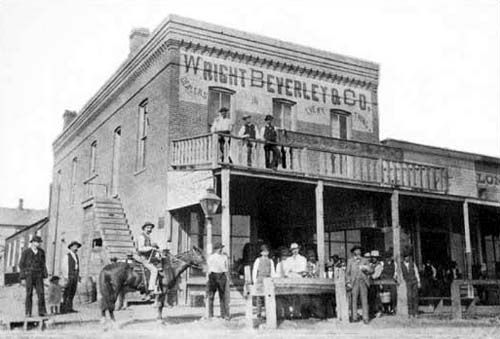
Robert Wright Business, 1883
I will now say something of the business of early Dodge, which has been mentioned as being tremendous. At that time, we were often asked, “What sustains your city?” “Where does your trade come from?” and many such questions, which no doubt, will recur to the mind of the reader at the present time. First and foremost of our industries was the cattle and stock trade, with its buying, selling, and shipping for the whole southwestern range, which lasted until other railroads extended into this territory’ and cut off the trade from Dodge City.
Then there was the government freight business, with Dodge the point of supply to many military posts and their garrisons in the surrounding wilderness.
This, alone, was heavy traffic, while local and general freighting, to ranches, inland settlements, and hunters’ camps, was an important addition to this line of business. Again, as Dodge City was the point of supply, in all general commodities, for so vast a section of the country, the mercantile business promptly assumed enormous proportions.
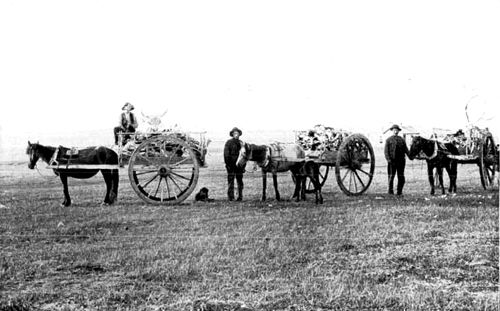
Gathering Buffalo Bones
One of Dodge City’s great industries was the bone trade. It certainly was immense. There were great stacks of bones piled up by the railroad track — hundreds of tons of them. It was a sight to see them. They were stacked up way above the tops of the boxcars, and often there were not sufficient cars to move them. Dodge excelled in bones, as she did in buffalo hides, for there were more than ten times the number of carloads shipped out of Dodge than out of any other town in the state, and that is saying a great deal; for there was a vast amount shipped from every little town in western Kansas.
The bones were a godsend to the early settler, for they were his main stock in trade for a long, long time, and, if it had not been for the bone industry, many poor families would have suffered for the very necessaries of life. It looked like a wise dispensation of Providence.
Many poor emigrants and settlers came to Kansas with nothing but an old wagon and a worse span of horses, a large family of helpless children, and a few dogs — nothing else. No money, no work of any kind whatever to be had, when, by gathering buffalo bones, they could make a living or get a start. Game was all killed off and starvation staring them in the face; bones were their only salvation, and this industry saved them. They gathered and piled them up in large piles during the winter and hauled them to Dodge at times when they had nothing else to do when they always demanded a good price.
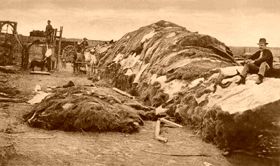
Charles Rath sitting atop buffalo hides in Dodge City, 1878. Click for prints & products.
This industry kept us for many years and gave the settler a start, making it possible for him to break the ground from which he now raises such large crops of wheat, making him rich and happy. Yes, indeed! Many of our rich farmers of today once were poor bone pickers, but if they hear this, it don’t go. Certainly, this was a great business, as well as a godsend, coming at a time when the settlers most needed help. All this added to the wealth and prosperity of Dodge and added to its fame. “Buffalo bones are legal tender in Dodge City,” was the strolling paragraph in all the Kansas exchanges. As to the magnitude of the early day mercantile business of Dodge City, the writer can speak, at any length, from his own experience, as he followed that line, there, for many years. As an introduction to the subject, I’ll give a clipping from the Ford County Globe of 1877, entitled, “Wright, Beverly & Company’s Texas Trade.” Now one of the editors, Mr. Morphy, was a bitter enemy of the writer, who was head of the firm of Wright & Beverly because he abused the writer so maliciously and scandalously and lied so outrageously about him when the writer was running for the legislature, that the latter whipped him on the street; for which, Morphy sued the writer for ten thousand dollars.
The jury awarded damage of four dollars and a half for the plaintiff’s doctor bill, and they hung out, for a long time against giving anything, until the judge instructed them they must render a verdict for that amount, as Mr. Morphy had clearly proven that he had paid the doctor four dollars and a half, as a result of the whipping; so you can see, he would not give the firm any too much praise, in writing them up. He says:
“Those gentlemen do an immense business and make a specialty to cater to the immense Texas trade. The jingling spur, the carved ivory-handled Colt, or the suit of velveteen, and the many, many other Texas necessaries, you here find by the gross or cord. An upstairs room, thirty by seventy-five feet, is devoted entirely to clothing and saddlery. In their warehouses and yard, it is no uncommon thing to find from sixty to eighty thousand buffalo robes and hides. This house also does a banking business for the accommodation of its customers.
Mr. John Newton, the portly and benevolent charge de affairs of the office, will accommodate you with five dollars or five thousand dollars, as the case may be. We generally get the former amount. Mr. Samuels, who has special charge of the shooting irons and jewelry stock, will entertain you in Spanish, German, Russian, or Hebrew. The assistance of Mr. Isaacson, the clothier, is demanded for parlevous, while Bob, himself, has to be called on when the dusky and dirty ‘child of the setting sun’ insists on spitting and spouting Cheyenne and Arapaho and goes square back on the king’s English. They employed over a dozen outside men to check off the wagons that were loading, and their sales were on an average of a thousand dollars a day, Sundays not excepted, or three hundred and fifty thousand dollars a year, and several years it was over four hundred thousand dollars.”
There was no article you could mention we did not handle. Our remittances to banks in Leavenworth were frequently as high as fifty thousand dollars. This was due to stockmen depositing their whole pile with us and drawing against it as needed. We have had parties leave with us endorsed, certified checks, as high as fifty thousand dollars each, to pay for cattle or close some deal for them. Strange to say, there was, but little currency in circulation, and, notwithstanding the railroad agent was instructed to turn over his receipts of greenbacks, and take our check for same, we had to have shipped to us, by express, from two thousand dollars to five thousand dollars in currency every few days.
The Santa Fe railroad was another great factor in making the wealth and splendid prosperity of Dodge City. Indeed, it was the first cause of the development of Dodge City’s greatness. It was this road, you might say, that made us. It, at least, gave us a big start. Hundreds of its employees made it their home from the very beginning. Dodge was not only its terminus for a while, but it always has been the end of a division. The officers of the road and the people of the town have always enjoyed great harmony. They have treated us justly and kindly, favoring us whenever and in whatever way they could, and, in return and to show them gratitude, the Dodge people have worked right in with them; and never have they been at outs, or has the least thing ever arisen which would lessen the friendship between them. Even yet, (1913), the railroad company is making great improvements in buildings, grades, yardage, etc., at Dodge City.
Another great feature belonging to Dodge City, which brought many people there at an early date, is its beautiful, health-giving climate and pure air. It was, and is, a great resort for invalids afflicted with the white plague. This should be the stopping off place for all those badly afflicted with this dread disease, as the great change in altitude, from lowlands to mountains, is often too sudden. I have known many people to stop here until they got accustomed to light air and great altitude, then go on to the mountains, and, in time, be completely cured. Others would stop only a short time and take the consequences. After a short stay here, others would feel so much better they would return home, thinking they were cured and make a grand mistake. A lovely lady, the wife of one of Missouri’s greatest lawyers, stopped off here a short time, and her health improved so wonderfully that she went back to Missouri, but we heard of her death a short time afterward. I have known several parties who would receive so great a benefit from a short stay in Dodge, they would insist, against the wishes of their doctor and friends, on going on to the mountains, and come back, in a few weeks, in a box, or return to die among their eastern friends. You see, they did not stay in Dodge long enough to get used to the great altitude of the mountains.
Dodge City was conspicuous in the sight of newspapermen, and complimentary notices of its businessmen were often unique. For instance, the Walnut City Blade, says:
“The gentlemen of Dodge City are whole-souled fellows and fine businessmen. Although our acquaintance was limited, we can say that Sutton, Whitelaw, Winnie, Gryden, Bob Wright, Shinn, Klaine, and Frost are each a whole team with a mule colt following.”
As an instance of the splendid liberality of Dodge City in times of emergency, as already mentioned, its response to Governor St. John’s petition for the cyclone sufferers has been given. Another instance, among any number that might be given, was the conduct of Dodge City toward the yellow fever situation, in Memphis, Tennessee, in 1878. On September 10 of that year, a mass meeting was called for the purpose of alleviating the sufferers of Memphis from the terrible yellow fever scourge. The people only had a few hours’ notice of the meeting, but, in such short time, two or three hundred gathered. A few speeches were made by some of our prominent citizens, when Mr. P. L. Beaty jumped upon a stand and said: “I have been a victim of this yellow fever, and know-how these people in the South suffer; here’s what talks I” at the same time throwing a ten-dollar bill into the hat, amidst wildest enthusiasm. Other speeches followed while contributions flowed into the hat in splendid style, the poor bootblack dropping in his nickel, and the rich merchant his ten-dollar bill. The total amount collected was over three hundred dollars, which was promptly forwarded to the Howard Association of Memphis. Instances of charity equal to that of Dodge City are as scarce on the records as, elsewhere, the rarity of Christian charity is plentiful. Hurrah, for little Dodge! She is still bad in war, good in peace, and has a bigger heart, for her size, than any town in Kansas. A short time after this meeting, it was found that the terrible scourge of yellow fever still held Memphis in its grip; and at another mass meeting to relieve the suffering, Dodge City sent more than double the former amount.
This puts me in mind of a little priest, by the name of Father Swineberg, who was a little fellow with a big heart, with charity for all and malice toward none, no matter what the denomination. He was very highly educated, could speak fluently more than a half-dozen different languages, and visited Fort Dodge to look after his flock and minister to the wants of his people, years before Dodge City was established. It was the writer’s happy luck to accommodate him several times, in driving him from one post to another, looking after the church’s needs and his ministerial duties, and, in that way, he and the writer became warm friends.
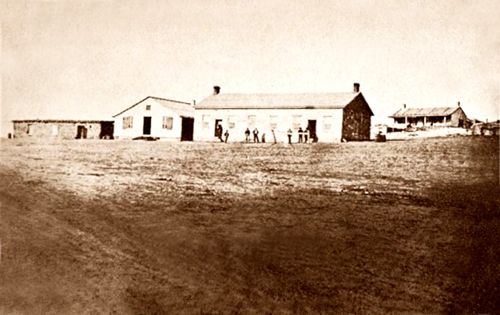
Vintage Fort Dodge, Kansas, 1867
Over time, he called on me at the fort, armed with letters to the commanding officer of Fort Dodge City and instructing said officer to give Father Swineberg all the assistance in his power. His objective point was way down in old Mexico, across the borders of that unknown region, those days, of New Mexico, Arizona, and old Mexico, a distance from Fort Elliott, his starting point, of over one thousand miles. It was a desert, entirely unknown, in those days, without water, wood, or habitations, or civilization of any kind. His trade stock was splendid maps of the region he was to traverse, encased in an oil-cloth covered tin tube.
I, being familiar with the terrible dangers and privations he would have to undergo, from lack of food and water, exposure to the elements both heat and cold, as well as the terrible storms that visited that country, and some big rivers to cross, tried to persuade him to desist.
I told him it was as much as his life was worth — that he must not go. He said he had to go. I asked him why. Shrugging his shoulders, like a Frenchman would, he said: “Because my bishop ordered me.” The commanding officer at Fort Elliott fitted out Father Swineberg and another priest, who was to be his traveling companion, with two fine horses, what grub they could conveniently carry, and blankets. They had no arms of any kind or description except knives; they said they didn’t need any. Remarkable to relate, they made the trip, accomplished their object, and came back safely. Father Swineberg told me that they enjoyed the trip. That once, when they were in one of the greatest straits and lost without food or water, they ran into a very large band of Indians, who received them kindly, and several of the band understood Spanish and some understood French. They stayed with the Indians about a week, preaching alternately in French and Spanish, which many of the Indians seemed to understand and enjoy and appreciate.
Now comes my yellow fever episode, which reminded me of this story. When the great call was made from the South to the North, for aid and nurses to subdue the terrible scourge, Father Swineberg, with twenty-odd other priests, nobly responded, well knowing they were going to their death. Very few ever returned, and Father Swineberg was among the number that went down. His was a noble life.
There was a society known as “The Orients” in Dodge City, with charitable work as its real object and fun as a sideline. A few disparaging remarks, made by a young blood who desired membership, subjected the individual to a “side degree,” upon which lavish hand performed all sorts of excruciating tricks, which were absurd and ridiculous. When it came to ridicule, the old-timer was not sparing in punishment.
The greatest excitement ever caused in Dodge was the advent of an Indian, one of the principal chiefs of the Cheyenne. In the winter of 1872, W. D. Lee, of the firm of Lee & Reynolds, doing a large business at Supply as freighters, government contractors, sutlers, and Indian traders combined, brought this Indian to Dodge City to show him the wonders of the railroad and impress upon him how civilization was advancing.
There happened to be several hunters in town at that time, driven in by a heavy storm and snow. No sooner did the Indian make his appearance on the street than the excitement began. Most of the hunters hated an Indian, and not a few of them had suffered more or less from their depredations.
Among the latter was one Kirk Jordan, a very desperate man, whose sister, brother-in-law, and whole family had been wiped out by the savages, and their home and its contents burned and every vestige of stock stolen. This had happened in the northwest part of the state. Jordan had sworn to kill the first Indian he saw, no matter what the consequences might be. He was a leader and a favorite with the hunters and, together with his companions, being inflated with liquor, had no trouble in getting followers.
We ran the Indian into a drugstore and locked the doors. There was no egress from the rear, but two families occupied houses adjoining the drugstore, and someone quickly tore off one of the upright partition boards that separated the drug tore from the dwellings containing the families, and the Indian squeezed through. The board was quickly and neatly replaced, leaving no trace of its having been removed; so when the crowd of excited hunters burst into the store and could not find the Indian, they were as puzzled a lot as ever lost a trail upon open prairie.
That afternoon I thought things had quieted down, and I saddled one of Lee’s finest horses (Lee had brought up a magnificent team,) and led it around to the back door — of course, the Indian had been previously instructed to mount and make for his tribe as fast as the horse would carry him; but before I rapped at the door I looked around, and from the back of the dance hall, a hundred yards distant, there were fifty buffalo guns leveled at me.
I knew those fellows had nothing against me, but I was afraid some of the guns might go off by accident and wished right there that the ground would sink down deep enough to cover me from the range of their guns. I led the horseback to the stable as quickly and quietly as possible, feeling relieved when inside. I at once despatched a courier to the commander at the fort, requesting that he send up a company of cavalry, but he wouldn’t do it. As soon as it got dark, Lee and I got in his carriage, loaded with buffalo-robes, had the Indian rushed out, robes piled on top of him, and went out of Dodge on the run. Wernet Captain Tupper’s troop of the Sixth United States cavalry about a mile out, coming after the chief. There were no more Indians seen in Dodge except under big escort.
The following rules were posted in one of the Dodge City hotels for the guidance of guests (some say rules were stolen from Mark Twain’s hotel).
HOTEL RULES
These are the rules and regulations of this hotel.
This house will be considered strictly intemperate.
None but the brave deserve the fare.
Persons owing bills for board will be bored for bills.
Boarders who do not wish to pay in advance are requested to advance the pay.
Borders are requested to wait on the colored cook for meals.
Sheets will be nightly changed once in six months, oftener if necessary.
Boarders are expected to pull off their boots if they can conveniently do so.
Beds with or without bedbugs.
All moneys and other valuables are to be left in charge of the proprietor. This is insisted upon, as he will be held responsible for no losses.
And now follows an early day market report:
Dodge City Markets, January 5, 1878.
Flour, per 100 lbs. $ 2.50 @ 4.00
Corn Meal, per 10O lbs. 2.00
Oats, per bu. .45
Corn, per bu. .56
Hides, Buffalo, per lb. .03¾ @ .04¾
Wolf .75 @ 1.25
Coyote .30 @ .5
Skunks .10 @: .50
Chickens, dressed, per lb. .10
Turkeys, per lb. 12½
Potatoes, per bu. .1.40
Apples, dried, per lb. .08 @ .10
Peaches, dried, per lb. 12½ @ 10
Bacon, per lb. 12@
Hams, per lb. .15 @ .17
Lard, per lb. .12 @ .14
Beef, per lb. .08 @ .16
Butter, per lb. .30@ @ .35
Eggs, per doz. .35
Salt, per bbl. 4.50
Coffee, per lb. .25 @ .26
Tea,per lb. .80 @ 1.26
Sugar, per lb. .12 @ .14
Coal Oil, per gal. .50
Coal, per ton 9.00 @ 10.00
The lexicographers of today should credit Dodge City with contributions to our language, as certain significations or meanings of three words, now very much used, can be traced to our early philologists. The words are “stinker,” “stiff,” and “joint.” These words are not considered the sweetest nor most elegant in the language, by our institutions of learning nor in the realms of culture and refinement, yet they are very expressive and are warranted by sufficient use. The word “stinker”, or rather the signification in which it is used when applied to a person in a contemptuous way, originated in this way. In the early days of this country, the buffalo or bison densely populated the plains. The killing of this noble animal for the hide was a great industry, and it was nothing uncommon for the buffalo hunter to get a stand on a herd and kill scores of them in a very short time. Such occurrences were sometimes in winter, and, before the hunters could skin all the animals, the carcasses would freeze and he would be compelled to leave many frozen on the prairies. When the weather moderated and the carcasses thawed, newcomers or “tenderfeet,” as we called them, would skin them for the hides. Natural causes and decay would render such hides very inferior and almost worthless, and, as these thrifty beneficiaries of the prowess of the genuine buffalo hunter were despised by him, the name “stinker” was originated and applied to him, and the word has since supplied the vocabulary of many when their systems were surcharged with contempt and hatred.
The word “stiff,” as applied to people in a contemptuous way, originated in Dodge City. The readers of this book will gather from this record of the early history of Dodge City the fact that the lifeless remains of people were a common sight here, in those days, and veneration and respect for the dead was somewhat stinted, unless some tie of friendship or relationship existed with the departed. As the lifeless body of a human being soon becomes rigid, our philologists substituted the easily spoken word “stiff” for the ghostly word “corpse,” in referring to the dead in which they had no special interest, and, from this, the word received an appropriate application to such people as suggest death or worthlessness, or, in other words, “dead ones.”
A very common signification or meaning of the word “joint” is easily traced to Dodge City, and I here submit my proof. I quote from an edition of the Dodge City Times, dated June 2, 1877:
“Washington, D. C., May 17, ’77
Editor Dodge City Times:
I trust you will not take this, from its postmark outside, as being an appointment to a lucrative official position. Such is not the case. I write to the far West seeking information. I see, at times, in your sprightly paper, the use of the term or terms, ‘go to the joint,’ or ‘gone to the joint,’ etc. Will you please inform me what it means?
Yours, INQUIRER.”
“We are always willing to give the people of Washington City any information they may desire on matters of public interest. In order that the president and his cabinet may get a clear idea of this grave question, we will endeavor to be explicit. Gilmore, on municipal elections, page 77, says, ‘The gang got to the joint in good shape.’ This is the best authority we have. As an instance more easily understood by the average Washingtonian, suppose Hayes and Morton should get on a bender and put their jewelry in soak for booze, then it would be appropriate to say they ‘got to the joint’ by this means.
For further particulars, address, L. McGlue”
I remember well the first child born in Dodge. Early in the morning, a young doctor came into the only drugstore in Dodge, with a look of thorough disgust on his countenance, saying, “My God! I did something last night that I never thought is possible to fall to my lot, and I am so ashamed that I never will again practice in Dodge. I delivered an illegitimate child from a notorious woman, in a house of prostitution.” The druggist and I both laughed at him and told him he must not think of leaving the profession for such a little thing as that; he must keep right on and fortune would sure follow, as it was a great field for his profession, and we knew he was fully capable; and so he did, and has become one of the most prominent, as well as skillful physicians, not only of Dodge City, but the whole state of Kansas. This was in the fall of 1872. Soon after, followed the birth of Claude, son of Dr. T. L. and Sallie McCarty; and close after him, Jesse Rath was born, son of Charles and Carrie Rath, who died in infancy. So Claude McCarty can well claim the distinction of being the first legitimate child born in the town and the eldest native.
By Robert M. Wright, 1913. Compiled & edited by Kathy Weiser/Legends of America, updated November 2021.

Robert M. Wright
Author and Notes: The Beginnings of Dodge City was written by Robert M. Wright in 1913. The article was Chapter seven of his book, Dodge City, The Cowboy Capital and the Great Southwest: In The Days Of The Wild Indian, The Buffalo, The Cowboy, Dance Halls, Gambling Halls, And Bad Men (now in the public domain.) The article is not 100% verbatim, as minor grammatical and spelling corrections have been made.
Wright came west from Maryland at the age of 16, first settling in Missouri. Later he worked as a freighter and became a trader at Fort Dodge. He then settled in Dodge City, where he was known as a farmer, stockman, merchant, and politician. He served as Dodge City’s postmaster, the city’s first mayor, and later represented Ford County in the Legislature for four terms.
Also See:
Dodge City – A Wicked Little Town
Fort Dodge History and Hauntings