
By Ambrose Bierce

A Peddler.
An old man named Daniel Baker, living near Lebanon, Iowa, was suspected by his neighbors of having murdered a peddler who had obtained permission to pass the night at his house.
This was in 1853, when peddling was more common in the Western country than it is now and was attended with considerable danger. The peddler, with his pack, traversed the country by all manner of lonely roads and was compelled to rely upon the country people for hospitality.
This brought him into relationships with strange characters, some of whom were not altogether scrupulous in their methods of making a living, murder being an acceptable means to that end. Occasionally, a peddler with a diminished pack and swollen purse would be traced to the lonely dwelling of some rough character and never could be traced beyond.
This was the case with “old man Baker,” as he was always called. A peddler came to his house, and none went away–that is all that anybody knew.
Seven years later, the Reverend Mr. Cummings, a Baptist minister well known in that part of the country, was driving by Baker’s farm one night. It was not very dark: there was a bit of moon somewhere above the light veil of mist that lay along the earth. Mr. Cummings, who was always cheerful, whistled a tune, which he would occasionally interrupt to speak a word of friendly encouragement to his horse.
As he came to a little bridge across a dry ravine, he saw a man standing on it, clearly outlined against the gray background of a misty forest. The man had something strapped on his back and carried a heavy stick — obviously an itinerant peddler. His attitude suggested abstraction, like that of a sleepwalker. Mr. Cummings reined in his horse when he arrived in front of him, gave him a pleasant salutation, and invited him to a seat in the vehicle — “if you are going my way,” he added. The man raised his head and looked him full in the face, but neither answered nor made any further movement. The minister, with good-natured persistence, repeated his invitation. At this, the man threw his right hand forward from his side and pointed downward as he stood on the extreme edge of the bridge. Mr. Cummings looked past him, over into the ravine, saw nothing unusual, and withdrew his eyes to address the man again. He had disappeared.
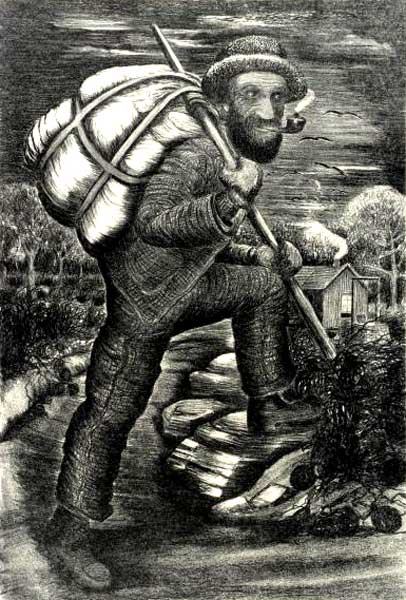
Pack Peddler by Merritt Mauzey.
The horse, which had been uncommonly restless all this time, snorted in terror at the exact moment and started to run away. Before he had regained control of the animal, the minister was at the crest of the hill a hundred yards along. He looked back and saw the figure again, in the same place and with the same attitude as when he first observed it. Then for the first time, he was conscious of a sense of the supernatural and drove home as rapidly as his willing horse would go.
On arriving home, he related his adventure to his family, and early the next morning, accompanied by two neighbors, John White Corwell and Abner Raiser, he returned to the spot. They found the body of old man Baker hanging by the neck from one of the beams of the bridge, immediately beneath the spot where the apparition had stood. A thick coating of dust, slightly dampened by the mist, covered the floor of the bridge, but the only footprints were those of Mr. Cummings’ horse.
In taking down the body, the men disturbed the loose, friable earth of the slope below it, disclosing human bones already nearly uncovered by the action of water and frost. They were identified as the lost peddlers. At the double inquest, the coroner’s jury found that Daniel Baker died by his own hand while suffering from temporary insanity and that some person or persons murdered Samuel Morritz, the identity of whom was unknown to the jury.
By Ambrose Bierce, 1913. Compiled and edited by Kathy Alexander/Legends of America, updated November 2025.
Excerpted from the book Present at a Hanging and Other Ghost Stories, by Ambrose Bierce, 1913, now in the public domain. Ambrose Bierce was the author of several supernatural stories and tales of the Civil War, drawn from his own experience as a Union cartographer and officer. Bierce was a journalist and editor for the San Francisco News-Letter and California Advertiser. In 1913, at the age of 71, Bierce disappeared into revolution-torn Mexico to fight alongside the bandit Pancho Villa. Although a popular theory is that Bierce argued with Villa over military strategy and was subsequently shot, he probably perished in the battle of Ojinaga on January 11, 1914.
Also See: