|
Legends Home
Site
Map
What's New!!

American History
Ghost Towns
Ghostly Legends
Historic People
Native Americans
The Old West
Photo Galleries
Roadside Attractions
Rocky Mtn Store
Route 66
Travel
Destinations
Treasure Tales
Legends Blog
Free E-Newsletter
Facebook Fanpage
Twittering

Contact Us
Please report
broken
links, missing pictures, or
other problems online by
clicking
HERE or send us
an
email. Thanks!
| |
| |
|
Colorado
Forts - Page 3 |
|

|
<<
Previous
1 2 3
Next >> |
|
Fort Pueblo
(1842-1854) - A non-military establishment, this
trading post was also referred to as El Pueblo Fort.
The post was established in 1842 by independent
traders and men who had been working at Bent's
Fort. Situated about sixty miles upstream on
the Arkansas River
from Bent's
Fort, in what is today near the downtown area
of the city of Pueblo, its owners pooled their money
and formed partnerships to operate the post. By
primarily trading with the
Ute
and Apache
Indians
in the area, its owners thrived for more than a
decade. However, after years of serving as a sanctuary
for traders and thousands of dollars of goods being
traded, the post's demise would come at the very hands
of the tribes with whom which they had traded.
Though the
Ute
Indians
had signed a peace treaty in 1849, as more and more settlers
moved into the area, the whites brought with them diseases,
encroached upon the Indians'
land, and depleted the wild game, making hunting difficult.
|

El Pueblo Museum in Pueblo, Colorado
|
|
|
As a result, the angry
Ute Indians,
along with their Jicarilla
Apache allies raided
settlers and villages for food. The troops at
Fort
Massachusetts
were tasked with
stopping the raids, but this would take several years.
On Christmas Eve, in 1854, the
Ute
and Apache,
led by the Ute
Chief Tierra Blanca, attacked the people in the fort in what is
known as the Fort Pueblo Massacre. During a celebration at the
post, the traders let in a group of
Indians
who they thought were friendly. However, the
Indians
attacked, killing 15 men and kidnapping a woman and two boys.
The soldiers at
Fort
Massachusetts
were fortified with troops from Fort Union, New Mexico to
permanently subdue the Indians,
who were eventually forced to cede their lands in the San Luis
Valley.
Shortly after the Fort Pueblo Massacre, the post was abandoned
and other settlers soon built over it.
However, today, the El Pueblo
History Museum sits near the fort’s original site. The museum
includes a replica of the old trading post
as well as an archaeological excavation of the original 1842 El
Pueblo trading post. The museum is located at 301 North Union,
Pueblo,
Colorado, 719-583-0453.
Fort
Sedgwick (1864-1871) - Originally called Camp Rankin, the post was
located opposite the mouth of Lodgepole Creek about one mile
upriver from present-day Julesburg. The camp was founded during
the Indian uprisings in
Colorado
that peaked in the summer of 1864 and was responsible for
protecting settlers, emigrants, and the overland route to
Denver. The town of Julesburg, just to the east, was a stage and
freight station. Early in 1865, the area was being heavily
raided by southern Plains
Indians in revenge for the
Sand Creek Massacre, which had
occurred in November, 1864. On January 7, 1865, a thousand
Cheyenne,
Arapaho,
and
Sioux
warriors attacked the weakly garrisoned post, but when they
failed to take it, they sacked the town of Julesburg.
|
|
|
|
A few
weeks later, on February 18, they again attacked Julesburg and
it's few citizens fled to Fort Sedgwick and watched as their
town pillaged and burned to the ground. The small military force
at Fort Sedgwick was unable to prevent the burning of Julesburg
and the killing 18 defenders.
No
attempt was made to rebuild Julesburg, and it subsequently
occupied three different sites nearby, including that of the
present town. In the meantime, the military post was enlarged
and renamed Fort Sedgwick, in honor of General John Sedgwick,
who was killed during the
Civil War.
For the next several years the troops protected the Overland
Trail and the meadows surrounding the post became a favorite
emigrant campgrounds. During the construction of the Union
Pacific Railroad across western Nebraska in 1867, troops from
the post protected the construction workers from the continual
threat of Indian attack. In May, 1871, the fort was abandoned by
the U.S. Army. Nothing remains of the old fort today, which was
situated along the South Platte River Trail, a 19 mile Colorado
Scenic Byway. The site is designated by a marker, but all that's
left is a field. A stone monument marks the original Julesburg
site. The original flagpole from Fort Sedgwick was moved to
Julesburg and is now in front of the Julesburg library. The town
also features the Julesburg Historical Museum, which interprets
the history of the fort and the area.
Fort St. Vrain's Fort (1837-1848) - Built by
Ceran St. Vrain, and brothers,
William and
Charles Bent in 1837, the fort was a non-military location
that served as a trading post for the
Bent, St. Vrain & Company.
Located
near present-day Platteville,
Colorado, the fort was built much the same as in Bent's
Old Fort in southeastern
Colorado. the
fort was a major trading post on the Platte River until it was abandoned
in 1848. Later, it became
the site of
the first post office and first courthouse for what would become Weld
County, Colorado. After it was abandoned for these purposes, it was
unfortunately allowed to fall into ruins and by 1951 so little was left, the site was leveled. Today,
only a monument remains to mark the site.
Fort Uncompahgre (1828-1844)
- Pronounced "un-come-paw-gray," this non-military trading post
was established in 1828 by Antoine Robidoux near the present-day
city of Delta, Colorado. An influential trader out of Santa Fe,
the post was located about two miles down from the Gunnison and
Uncompahgre Rivers, Robidoux established several trails for
supplying goods to Fort Uncompahgre, including the Mountain
Branch of the Old Spanish Trail and Rouidoux's Cutoff that left
the Santa Fe Trail near Bent's Fort. The trading post was
probably little more than a few log buildings surrounded by a
fence of cottonwood pickets and employed between 15 and 18
Mexican traders.
|
|

Fort Uncompahgre today, photo
courtesy
Malachite’s Big Hole
|
As remote as it was, the trading post was successful for many
years. However, in the summer of 1843, hostilities broke out
between the Ute
tribe and Mexicans of the Santa Fe area. In September of the
following year, all of the Mexican traders at the fort, with the
exception of one, were killed by
Ute
Indians
and their women taken prisoner. Only a single trapper named
Calario Cortez, escaped to tell the tale. Robidoux, who wasn't
present during the attack, never returned and a few years later,
the post was burned by the Ute.
|
|
Today, a replica of Fort Uncompahgre has been rebuilt in Delta,
Colorado.
The living history museum recreates the feeling and the
experience of frontier life in a trading post with interpreters
clothed in period attire. The Fort Uncompahgre History Museum is
located at 204 Gunnison River Drive in Delta,
Colorado.
|
|
Fort Vasquez (1835-1842) - A
fur trading post built by Louis Vasquez and Andrew Sublette in
1835 for the Rocky Mountain Fur Company, it was situated along
the South Platte River. After obtaining a trading license in
St. Louis, Missouri
from William Clark, the Superintendent of Indian Affairs, they
began to trade with the
Cheyenne
and Arapaho Indians
in the area.
Stategically located between Fort
Laramie,
Wyoming
to the north and Bent's
Old Fort, Colorado to the south, along the
Trapper's Trail, the trading post did succeeded for several
years, eventually hiring many of their trapper friends including
Baptiste Charbonneau and Jim Beckwourth. However, when the price
and demand for beaver pelts declined, the adobe trading post was
sold the firm Locke and Randolph in 1840. That firm later went
bankrupt and Louis Vasquez and Andrew Sublette were never able
to collect the entire amount of the sale. In 1842, the post was
abandoned.
|

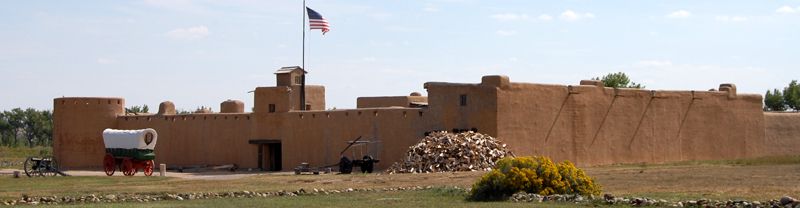
Fort Vasquez has been rebuilt today,
photo courtesy
Blake20CO's
Flicker photostream
|
|
By 1932, only the foundations a few
feet of the exterior walls remained. Two years later, the owners
of the
Fort Vasquez Ranch deeded an acre of
land surrounding the fort to the Weld County. In 1935-36, Work
Progress Administration crews rebuilt the walls from existing
bricks on the location, complete with its guard towers. Today,
it operates as the Fort Vasquez Museum, located at 13412 U. S.
Highway 85 in Platteville, Colorado
©
Kathy Weiser/Legends
of America, updated April, 2010
|
<<
Previous
1 2 3
Next >> |
|
From the Rocky Mountain General Store
Old
West Books -
Legends of America and
the
Rocky Mountain General Store has collected a number of
Old West
books for our frontier enthusiasts. For many of these, we have
only one available. To see this varied collection, click
HERE!
 |
|
| |
|