
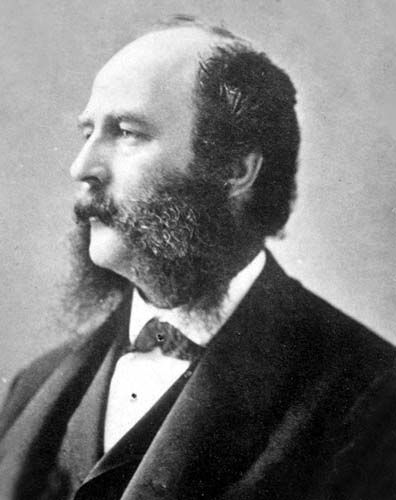
William Coleman.
William Tell Coleman was a shipping magnate, politician, and borax producer. He was born in Cynthiana, Kentucky, on February 29, 1824. His mother died when he was eight, and his father the following year. He then lived with an aunt until he was 16.
He then went to St. Louis, Missouri, where he worked for a lumber company before attending St. Louis University. After completing the four-year legal course, he served as a plantation overseer in Louisiana for a while before working for his former lumber employers, overseeing timber tracts and sawmills in Wisconsin.
During the California Gold Rush, he and his brother joined the flood of people heading westward and became involved in the mercantile business in Sacramento and Placerville, California. Later, his brother went to Oregon, and William settled in San Francisco, where he started the merchandising firm of William T. Coleman & Company, which he built into the largest commission business in the city.
Coleman was a leading figure in both the 1851 and 1856 Vigilante Committees of San Francisco, which attempted to establish law and order in the lawless city. In 1856, he also established a steamship line between New York and San Francisco. The following year, he moved to New York to manage the business.
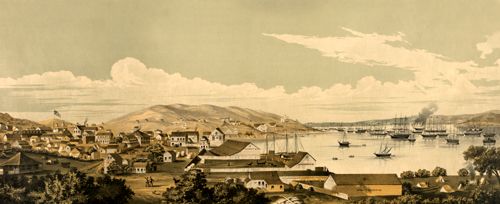
San Francisco, 1849.
In the early 1870s, he returned to California with his family and erected a white Roman villa on Nob Hill in San Francisco, as well as a spacious country home in San Mateo County. In 1877, the Great Railroad Strike started anti-Asian riots in the West. After protestors tried to burn the docks of the Pacific Mail Steamship Company, thought to be the largest importer of Chinese laborers, business owners organized a Committee of Public Safety with Coleman as president. Acting as a supplementary force to the city police, they were armed only with pick handles. Within a few days, the order was restored, and the committee was disbanded.
But his last venture into the borax mining industry, while initially very successful and allowing him to corner the industry, would ultimately ruin him. In the early 1880s, Coleman began to invest heavily in the booming borax mines in Death Valley.
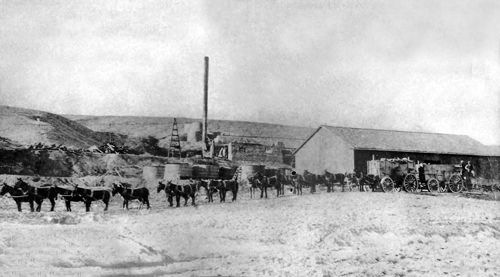
Vintage Harmony Borax Works.
Borax was first discovered in Death Valley in 1881 by Aaron and Rose Winters, whose holdings were immediately bought by Coleman for $20,000. He subsequently formed the Greenland Salt and Borax Mining Company, which, in 1882, began operating as the Harmony Borax Works. That same year, he also discovered hydrous calcium borate in Death Valley. It was named Colemanite for its discoverer.
Coleman also purchased the 40-acre Greenland Ranch (later known as the Furnace Creek Ranch) immediately to the south, making it a supply point for his men and stock. There, he developed a virtual oasis from water that flowed from Furnace Creek.
Getting the finished product to market from the heart of Death Valley was a difficult task, and an efficient method had to be devised. The Harmony operation became famous through the use of large mule teams and double wagons, which hauled borax over the long overland route. The romantic image of the “20 mule team” soon became the symbol of borax in this country.
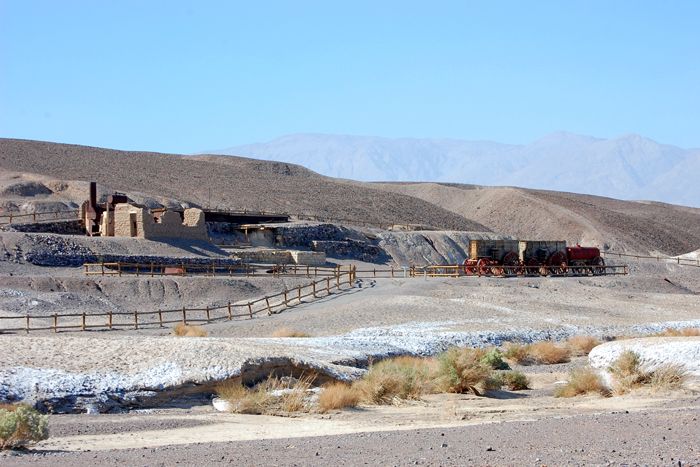
Harmony Borax Works in Death Valley, California, by Dave Alexander.
Coleman continued to buy more and more borax properties in Death Valley, to the point that he cornered the borax market and, in the end, overproduced it, causing the price of borax to fall. At about the same time, in 1887, he became interested in the profitable raisin market and tried to corner it. Ultimately, he suffered a significant financial shortfall, totaling millions of dollars. He first attempted to sell off some of his borax operations to minimize his losses, but was unsuccessful. He was ultimately forced to mortgage them to Francis M. “Borax” Smith and lost them in 1890.
Coleman’s kingdom, which had an estimated annual business of $14 million, totally collapsed. He could only pay off his creditors a year before he died in San Francisco in 1893.
The ruins of Coleman’s Borax Works were placed on the National Register of Historic Places on December 31, 1974. They are part of the National Park Service historical site preservation program in Death Valley National Park.
©Kathy Alexander/Legends of America, updated December 2025.
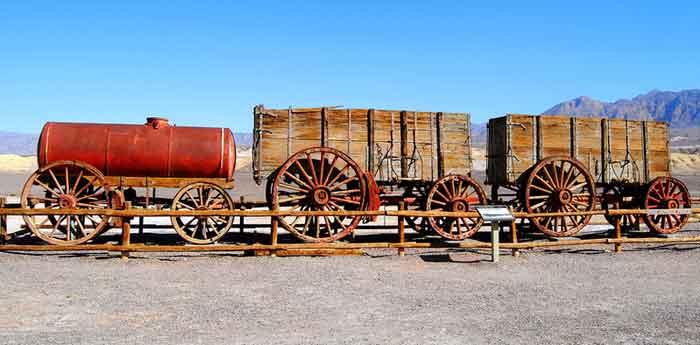
20 Mule Team Wagon, Harmony Borax Works, Death Valley, California, Kathy Alexander.
Also See:
Characters of Early Death Valley
See Sources.