
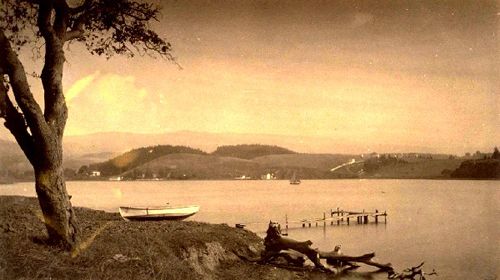
Lake Merritt, California, from Adams Point, 1884.
Alameda County – With a posse on their tails in 1893, two bandits allegedly buried a cache of stolen loot near a brick kiln at Adams Point on Lake Merritt. When the lawmen caught up with the outlaws, one was killed, and the other was immediately arrested. The surviving outlaw later died in prison. The ill-gotten treasure has never been found.
Contra Costa County – Dr. John Marsh, a California pioneer sometimes referred to as California’s first American doctor, was allegedly known to bury his money near his home in the foothills of Mt. Diablo. Marsh was murdered in 1856 while on his way home from Martinez, without ever telling anyone of the exact location of his hidden riches. Today’s treasure tale alleges that Marsh had hidden a cache of some $40,000 gold coins near his home or Marsh Creek that bears his name. Currently, plans are underway to develop the location into a California State Park.

Vallejo Junction, California Mining District.
Another, even larger treasure is said to be buried along the county’s beaches. In 1901, the Selby Smelter at Vallejo Junction was busy refining ores shipped from neighboring mining districts. But, one employee by the name of John Winters was “busy” with a different task — removing gold bars, one at a time, from the vault and burying them on the beach near the water’s edge. Taking an estimated $283,000 in gold, Winters was finally caught, and about $130,000 of the bars were recovered. However, more than $150,000 remained lost.
Humboldt County – In July of 1928, the small post office at Willow Creek was robbed by two outlaws who escaped with some $2,800. According to the story, the bandits buried the loot in one of two places and never returned to retrieve it. The first version of its location tells of the stolen cache buried near the Cedar Flat Bridge that crosses Trinity River about four miles upriver from Burnt Ranch. The second location has the loot hidden at some point up New River Canyon on the first ranch above the mouth of New River.
Another stolen cache, taken by an employee of the San Francisco Mint in 1894, is said to be buried in Humbolt County. The thief was later captured and sent to prison for his crime but refused to reveal the exact location of the loot. The treasure, containing some 290 pounds of gold ingots, is thought to be buried at Shelter Cove near Point Delgado.
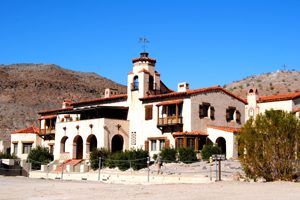
Scotty’s Castle, Death Valley, California, by Kathy Alexander.
Inyo County – Near Scotty’s Castle in Death Valley, some say that a hidden cache of gold coins amounting to as much as $200,000 was buried by Walter Scott. “Scotty,” as he was more familiarly known, was a flamboyant and outrageous character and a known swindler and prospector. Though he did not build or own the castle that bears his name, he was closely associated with the man who did.
Kings County – In 1873, Kingston, California, stopped on the Overland Stage route between Stockton and Visalia, California. In December of 1873, Tiburcio Vasquez and his outlaw band made a bold raid, robbing the entire village and holding 39 men hostage. When an alarm was raised, the bandits dashed to their horses and began to flee. However, in the ensuing melee, three of the outlaws were shot and killed, and the man carrying the stolen loot was wounded.
Unable to reach a horse, the injured bandit escaped on foot and crossed the Kings River. Though the outlaw was pursued, neither he nor the loot could be found. Years later, a skeleton was discovered in the area and was thought to have been the injured bandit, but again the ill-gotten cache remained un-recovered. By the 1890s, Kingston had been abandoned altogether, and it is gone today. The town’s site is now a California Historical Landmark in Kingston Park in Hanford.
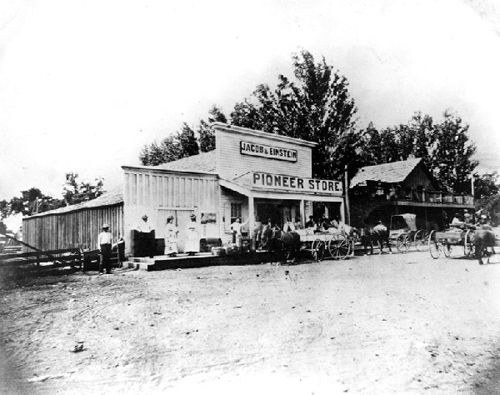
Kingston, California, 1870.
Marin County – Not all lost treasures of California are related to the Gold Rush. During Prohibition’s wild and wooly days, a German whiskey smuggler, Carl Hause, was doing a brisk business. Hause’s operations were located on Point Reyes Peninsula at the edge of Drake’s Inlet just south of Inverness. The whiskey smuggler was said to have buried approximately $500,000 in gold-backed currency somewhere between Inverness and the old Heims Ranch. However, the liquor entrepreneur would not live to retrieve his ill-gotten gains as he was found shot to death in his car. The currency has never been found.
Modoc County – Though Modoc County was never known as a prime mining country, a few treasure tales continue to be told in this region, which is most known for its Indian lore and unparalleled scenic beauty.
In the last years of the 19th century, a sheepherder picked up a heavy rock on the west slope of the South Warner Mountains. Forgetting about it for months, he finally retrieved the stone and took it to an assayer. Imagine his shock when he was told the heavy rock was almost pure gold. He soon found an Alturas banker, who grubstaked him, and the sheepherder returned to the Warner Mountains. However, try though he might, he searched relentlessly and could never find the source of ore again.
Another fairly well-authenticated story tells of an Oregon emigrant who picked up a similar piece of rock in the 1850s in the Devil’s Garden area. Though no mineral deposits of any amount were ever found in the area, the legend of hidden ore persists.
About 60 years ago, a family sought refuge from a snowstorm in the lava beds of northwest Modoc County. While there, they said they found a rich copper vein in a crater of the rugged volcanic formations. Though Mr. Courtright and other prospectors returned to the area to search for the rich ore, it was never found.
During the 1860s, an army scout named Daniel Hoag was stationed at Fort Bidwell. He reportedly found a rich gold ledge while scouting the Warner Mountains in the Fandango Peak area. However, at this time, the area was in the midst of what is referred to as the Modoc Indian War. Hoag was killed in one of the battles before he could return to the site, but the location of the ledge remains lost. Fort Bidwell, used from 1864 to 1892, is located on the Fort Bidwell Indian Reservation, where the officer’s quarters continue to stand near the old post cemetery.
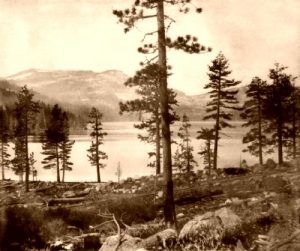
The ill-fated Donner Party were said to have buried their savings near Alder Creek and Donner Lake.
Nevada County – Several tales continue about the Donner Party having buried their money while trapped during that terrible winter in 1846. One story tells that George Donner allegedly buried about $10,000 in gold near Alder Creek northeast of Truckee, California. Though the cache has never been “officially” located, many believe that it was dug up and stolen after Donner’s death. Other party members are also said to have buried their savings in the area. This was supported when, in May 1891, a man named Edward Reynolds found a five-franc silver piece while fishing on the northeast corner of Donner Lake. A few days later, he and a friend returned to the site and found an entire sack of coins. The horde was believed to have been hidden by Elizabeth Graves.
San Luis Obispo County – Numerous caves throughout San Luis Obispo County provided excellent cover for outlaws during California’s Wild West days. Near Avila Beach, a group of bandits was said to have made one of these caves their hiding place, where they hid much of their stolen cache. No additional information is available on the exact location of the cave.
Shasta County – Long ago, when a detachment of soldiers was transporting an Army payroll along the road between Redding and Weaverville, California, they were attacked by Indians. While the battle ranged, one soldier had the foresight to bury the gold and marked it by burying his rifle straight up in the ground. He then joined the rest of the soldiers in the frenzied battle. Severely wounded, he was later rescued and taken to French Gulch, where he told the story of the attack and buried payroll before he died. Though the army began an immediate search, they could not find the rifle or the hidden gold. Many years later, two deer hunters in the vicinity found the rifle and, not knowing the story, removed it and took it with them. Today, French Gulch is a sleepy little village about ten miles east of Lewiston, California.
Tehama County – Peter Lassen was a pioneer and landowner in California long before its Gold Rush days of 1849. Arriving in 1840, he secured a 26,000-acre land grant in 1843. Lassen hoped to develop his land into an empire in the upper Sacramento Valley and established the Rancho Los Bosquejo, or the “ranch of the wooded places,” in 1845. In the following years, Lassen developed a trading post, a new settlement, vineyards, and farms to entice people to what he believed would be his new empire. However, when gold was discovered at Sutter’s Mill in Coloma, his workers and settlers abandoned him for the goldfields. Lassen’s fortunes would rise and fall over the next decade until he was murdered in 1859 while traveling to Virginia City, Nevada, to prospect for silver. Afterward, a legend grew that Lassen had buried thousands of dollars in gold near his home on the Rancho Los Bosquejo. Located at the confluence of Deer Creek and the Sacramento River, he was said to have hidden his gold coins in iron pots surrounding his property. Though Lassen had a lifetime of financial difficulties, the legend continues. The buried cache is thought to be in Deer Creek Canyon near Vina, California, or somewhere along the Lassen Trail, which follows Deer Creek.
About 20 years after Lassen’s death, a miner named Obe Leininger found a gold-flecked ledge of gold in the same area. To find it again, he marked the spot by burying his pick in the trunk of a nearby tree. When he returned, however, he could not find the tree with the pick, though he searched the area diligently. Though he and others who had heard his tale continued to search the area for years afterward, the gold ledge was never found again. The location of the ore was said to be between the mouth of Calf Creek and the Potato Patch campground of the U.S. Forest Service, just beyond Deer Creek.
Trinity County – In 1862, the sheriff of Trinity County was not only responsible for upholding the law but was also tasked with collecting taxes. On one occasion, as he traveled through the area, his saddlebag was filled with about $1,000 in gold coins and $50 gold slugs. As the sheriff and his horse were cautiously crossing a stream, the horse stumbled, and the saddlebag filled with gold was dropped and washed down the creek. Though the lawman made an immediate search of the area, he was unable to find the bag. Soon, the county offered a reward of $250 for the recovery of the saddlebag, but despite diligent search efforts, including damming up the creek, it was never found. In those early days of California, assayers and private mines often minted gold slugs. Today, in addition to their gold value, they have also become major collectible items, and if the treasure were to be found today, some estimate it could be worth as much as a million dollars. The creek was located near Weaverville, California.
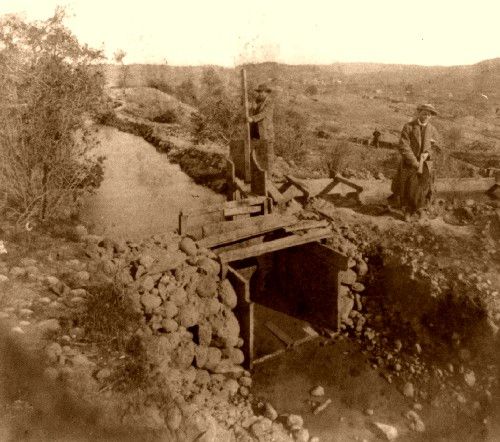
Yuba County Mining, 1866.
Yuba County – During California’s Gold Rush days, a prospector named Bill Snyder was one of the lucky ones. Working a claim along one of the branches of Oregon Creek on a ridge behind Camptonville, he consistently brought out large quantities of gold. Just as the gold was almost exhausted, Snyder became seriously ill, and knowing he needed medical attention, he buried his gold, estimated at $30,000, between 2 large pine trees in the flat area below his cabin. He then left his cabin to seek a doctor. Though the type of illness is unknown, it was very serious, as he was unable to return home for over a year. Imagine his distress when he returned to the site to find his cabin and the two large pine trees gone, replaced by a sawmill that now stood in its place. Only stumps of trees remained, and though he searched diligently in the area, he could never locate his buried gold. He later died in the county home, and to this day, the hidden cache has never been found.
©Kathy Alexander/Legends of America, updated February 2025.
Also See: