
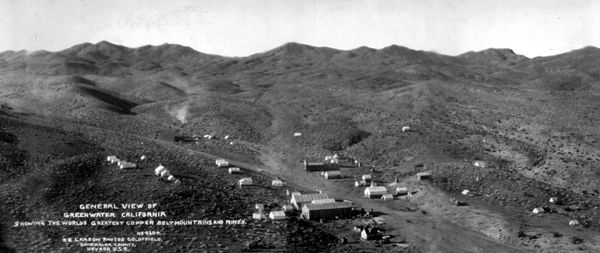
Greenwater Mining District 1906
Greenwater Valley was the site of the most spectacular boom in the history of Death Valley mining. While other districts, such as Bullfrog, Lee–Echo, Panamint, Skidoo, and Leadfield had their booms, which saw rushes into new mining areas and the establishment of new mining camps and towns, Greenwater surpassed all the others in the brilliance of its birth. Within a year and a half from the beginning of the rush to Greenwater, the deserted desert was home to over 2,000 people in four towns, 73 incorporated mining companies, and was the focal point of over 140 million dollars worth of capitalization.
But, it was not only the amazing rush to Greenwater which sets it apart from other booms, for Greenwater also experienced the shortest life ever recorded for a boom camp of its size. Within one year from the boom’s height, all but five of the companies had left the district, and Greenwater was practically deserted. By the end of two more years, everyone had given up, and the Greenwater Valley, the scene of so much bustle and excitement a short time before, was once again completely deserted.
This combination of a tremendous boom, a brief life, and then complete desertion, all within the space of fewer than four years, has made Greenwater a name that is still anathema to the investing public and dear to the hearts of desert folklorists. Few, if any, mining camps in the American west have ever combined such initial excitement with such total disappointment.
The real discovery of Greenwater, as with most throughout the Death Valley area, came about due to the Bullfrog boom, some 65 miles to the north. The great rush to the Bullfrog Hills soon filled up the ground in that vicinity, and late-arriving prospectors were forced to move farther afield. Two such men, Fred Birney and Phil Creasor ambled south down the east side of the Black Mountain Range, and in February 1905, while looking for gold, and instead, uncovered rich surface croppings of an immense copper belt in Greenwater Valley. Birney and Creasor sent samples of their find to Patsy Clark of Spokane, Washington, a well-known copper mining operator, and Clark was sufficiently impressed to buy the claims from the two men in May.
Hearing of Clark’s new holdings, which held amazingly high copper values at the surface, F. August Heinze, the “famous copper king” of Butte, Montana, also visited the new locations and was equally impressed. The rich surface showing was so promising that Heinze and his partners immediately bought 16 copper claims from another pair of early prospectors for the sum of $275,000. Commenting upon the transaction, which brought newspaper attention to the area, the Inyo Independent reported that the “vast copper deposits in the Funeral Range have long been known to prospectors, but their inaccessibility to the markets prevented working.” With the booming camp of Bullfrog to the north and the promise of railroads into the desert regions, the transportation and supply problems would be much less severe, although the Greenwater Valley was still a long way from civilization.
As the news quickly spread that two of copper’s biggest operators had located in Greenwater, a rush ensued. Prospectors and mining men started to flock into the Greenwater area to stake out the close-in ground. As usual, with a new boom, transportation problems exceeded all others, and many prospectors, including one who reported for the Inyo Independent, were reduced to walking from Bullfrog into the new district, a task which took three days. The work was rough since even in September, the thermometer reached 113 degrees in the afternoon, and the reporter-prospector found that he was forced to sit down and rest after building each monument to mark his claims. The heat was not alleviated by the total lack of water in the district, and prospectors who ran out of water were forced to leave their location work and return to Bullfrog, the nearest point of civilization.
By late June 1905, Patsy Clark already had eight men working at his property, and a shaft had been sunk 35 feet into the ground. As the year progressed, other operators entered the scene, including Arthur Kunze, who secured some of the best-looking ground in the area and had five men working it by the end of the year.
As 1906 opened, Kunze, Clark, and Heinze began to have plenty of company, for innumerable other mining promoters, prospectors, and miners were entering the district. Clark established a mining camp near his mine to support his operation, and other small camps sprung up along the valley floor.
As the area’s rush continued, however, it soon became apparent that the lack of an adequate water supply anywhere in the vicinity would be a major problem. “The water proposition is the serious drawback in that section at present and will be a matter of considerable expense,” remarked a Rhyolite stockbroker, “yet the earmarks of the country seem to show that any expense would be justified, judging from the surface indications.”
Those surface indications were so rich that men and money continued to rush into the district, regardless of water and transportation’s serious problems. As the spring progressed, some of Nevada mining’s biggest names joined the boom, and fortunes reaped in Tonopah and Goldfield were reinvested in the promising new district.
“All of the great copper magnates are looking to this section,” reported the Inyo Register in May, “which is destined to become the next great copper district of the world.” That prediction seemed to be borne out by June 1906, as the copper belt was “proven” to be at least seven miles long. Four of the larger mines had, by that time, been incorporated into full-fledged mining companies, and Greenwater seemed assured of a long and lively life.
The rush slowed down somewhat during the hot summer months of 1906. However, the future of the district looked even better when both the Las Vegas & Tonopah and the Tonopah & Tidewater Railroads, which were building into the Bullfrog District, expressed interest in tapping the new copper belt to the south. The local papers declared that the district “will make one of the greatest copper camps in America,” and the continuing rush caused the major national mining journals to take notice of the area. “The weather in Death Valley is the only thing that prevents Greenwater from having one of the biggest booms on record in this country,” wrote the Bullfrog Miner. “But even the midsummer heat of the ‘terrible region’ does not keep prospectors out. Hardly a day passes that Bullfrog prospectors are not seen starting out for Greenwater.” In early July, a stage line was started from Ash Meadows into the new district, and water, which was being hauled in from 15 miles away, was selling for $5 per barrel.
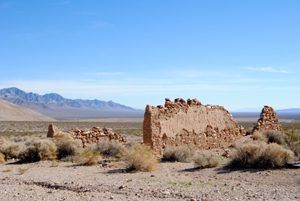
Ruins in Bullfrog, Nevada. Kathy Weiser-Alexander, 2015.
Hundreds of thousands of dollars had changed hands by the end of July, as feverish trading of mines and claims took place. Five mining companies were organized, and the capital stock of four of them reached $5,750,000. “This week auto after auto loaded with prospective investors has gone to Greenwater, and the demand locally for horses and rigs has almost exceeded the supply,” reported the Bullfrog Miner. The rush was causing scarcities in Greenwater, and water rose to $7.50 per barrel, while horse feed was almost as hard to find. But, the rush continued, and as was often the case in new mining booms, and several camps formed in the district spawning the Bullfrog Miner to say: “The townsite epidemic has broken out in a decidedly virulent form. No less than three towns are already planned, and it is a difficult matter to tell which is going to be the commercial center of the district. That there will be a flourishing town in the district goes without saying, but, which and where it will be is a matter of conjecture at this writing.”
As more and more prospectors flooded into the area, concerns began to arise over their welfare. Printed warnings were published in the Rhyolite papers, warning prospectors to bring all the food and water they would need into the district with them since none could be provided there. Water was being hauled from Furnace Creek in Death Valley, but “Teams making the trip to the creek and back, fifty miles, drink about as much as they can deliver, making it almost impossible to get any reserve supply. Unless travelers heed the timely warning, there is liable to be real suffering, and perhaps several deaths.” Several mine owners, who were importing water to meet the demands of mining and to supply their employees, publicly warned prospective visitors that they could no longer afford to sell water to private individuals.
But, despite all these serious problems, there was no denying the allure of the Greenwater District, and the rush continued. On July 29th, a meeting was held to organize the new district to alleviate some of the problems caused by conflicting claims and remove the necessity for prospectors to travel to Independence, California, to record their claims.
By August, the district was beginning to take shape, competing towns had been surveyed and platted, and one of them had established a boarding house. The district population was then estimated at 300, and several stores and a restaurant had opened for business. Kimball Brothers, the staging kings of Rhyolite, announced a new stage line that would make thrice-weekly trips into Greenwater. One traveler counted over 100 freighting wagons heading towards the district in one day, straining their resources to supply the growing demands of the new boom camp. Canned tomatoes were an especially popular item for sale at the crude tent stores since they were cheaper than water, which was now selling for $10 a barrel, and quenched the thirst almost as well.
The new region’s rush had several unique aspects, which the local newspapers were quick to report. Due to the extremely rich surface showings, money was pouring into the district at a tremendous rate before the ground was even broken. As the Rhyolite Herald noted, money seemed to have beat labor to the scene of activity, as the big capitalists were on the ground and buying claims before any work had been done. It is not a poor man’s region,” agreed the Bullfrog Miner, “but one which will require a great deal of money to develop it.”
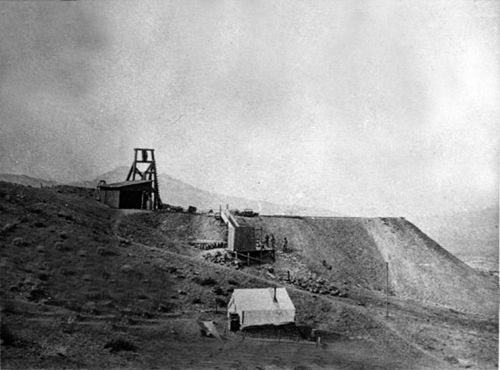
Patsy Clark’s Funeral Creek Copper Mine in its earliest days.
All this business, of course, was good for the Rhyolite area merchants, and the new boom was looked upon favorably. “All Nevada is taking a hand in this rush,” noted the Inyo Independent, “as practically the whole of the United States has been told of its marvelous deposits of copper, which are revelations to geologists and mining men in general. Although the district hardly needed another spur to its boom, it got one anyway on August 10th, when the Greenwater Death Valley Copper Company’s organization was announced. Promoted by Charles Schwab, the steel and mining millionaire whose name was magic to Nevada miners, the new company was incorporated for $3,000,000. Together with Patsy Clark’s Furnace Creek Copper Company, assured “a thorough and complete development of the district.”
By the middle of August, the townsite rivalry was beginning to take shape as two major competitors emerged from the dust. Arthur Kunze was the chief promoter of the first, and his town seemed to have the edge. Alternating between the name of Kunze and Greenwater, Kunze’s townsite was located midway between the mines of the Furnace Creek Copper Company and the Greenwater Death Valley Copper Company — the district’s two largest mines. By mid-August, Kunze’s townsite boasted two stores, a hotel, a restaurant, and several corrals were under construction. The Salsberry Water Company was under contract to Kunze to keep the camp supplied with water, and a petition was sent in for the establishment of a post office.
The Kimball Brothers obligingly routed their stage line to Kunze’s townsite, and the Tonopah Lumber Company, in addition to establishing a lumber yard to supply the hectic construction pace, sent down several 12-horse teams, to be used in hauling supplies from Johnnie Siding of the Tonopah & Tidewater Railroad to the new townsite. The lumber company, also, supplied a 2,500-gallon water tank for the townsite company, and Kunze’s plat of the town, which showed 32 blocks with over 550 lots for sale, was approved by the Inyo County Commissioners on August 13th. Assessing the situation, the Bullfrog Miner predicted that Kunze’s camp seemed to have the inside track over its main rival, the townsite promoted by Harry Ramsey.
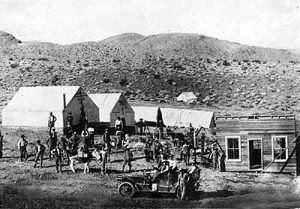
Greenwater, California 1906.
Just to add to the confusion, Ramsey also insisted on calling his townsite Greenwater, although it was commonly called Ramsey and less commonly called Copperfield.
Its location today is hard to pin down since it was variously described as being 1-4 miles east or southeast of Kunze’s camp. Nor did Ramsey help alleviate the confusion when he moved his site around at least once. Nevertheless, Ramsey vigorously promoted his own town and even tore down his iron office building at Rhyolite and moved it to his town-site.
One observer counted $25,000 worth of supplies heading into the Greenwater District in one day as the rush continued. Another counted 200 miners and prospectors in the area, not including those out in the camps’ hills. The Engineering Mining Journal assessing the Greenwater boom noted that the “copper finds there recently have brought about an excitement equal to that at Bullfrog two years ago. Hundreds of people from Tonopah, Goldfield, Lida, Palmetto, and the Bullfrog towns are traveling towards Greenwater in all sorts of conveyances. As high as $200 is being paid to automobile companies for transportation by wealthy operators who are anxious to get in early.”
Getting into Greenwater was not that easy for those who could not afford the $200 to rent an auto. Those who arrived by train via the Johnnie Siding could sometimes hitch a ride on one of the big freight teams traveling between the railhead and Greenwater, but, that trip took from 12-15 hours. The Kimball stage took just as long, for the relatively reasonable rate of $18 per passenger. Still, spaces were limited, and numerous travelers found themselves forced to wait at Johnnie Siding for a day or two before their turn on the stage came.
As August came to an end, the Greenwater District braced itself for the increasing rush which would undoubtedly come with the cooler weather of the fall and winter. Arthur Kunze and Harry Ramsey continued to promote their towns and endeavored to attract the merchants , makingtheir camps the winner. Ramsey formed the Greenwater Townsite Company to promote his camp, and by the end of August, he had a restaurant, two saloons, a hotel, and a store. Kunze, meanwhile, had completed arrangements with several merchants, and the Greenwater Banking Corporation was organized, as well as the Greenwater Mercantile Company, which planned to erect a large general merchandise store. In addition, Kunze’s camp had a lodging house, a store, a saloon, a restaurant, and a number of tents as well as an assay office.
The booming mining business was also good for the labor interests, and by late October, the Greenwater Miners Union was over 100 strong. Meetings were held every Tuesday, and the Greenwater Townsite Company donated two “very fine lots to the union, where they intended to build their union hall. The miners started a fund drive to build and staff a union hospital and proudly proclaimed its motto across the Greenwater Times pages “It is Justice the World Needs! Not Charity!”

Greenwater Valley
In other news, the Times reported that the chief engineer for the Las Vegas & Tonopah Railroad was in town to select the best rail route into the district and that due to public demand for living space, Patsy Clark had agreed to throw open his townsite of Furnace, which had hitherto been reserved for employees of his mine. Then, as was fitting, the Greenwater Times’ first issue closed with a large advertisement for the Greenwater Townsite Company. Greenwater was, according to this ad, “The Greatest Copper City of the Century.”
The payroll at its mines already exceeded that of Beatty, Bullfrog, and Rhyolite combined, and $52,500 in real estate had been sold in Greenwater in September. Still, however, business lots were available at “ground floor prices” to anyone interested.
Less than a week later, the Inyo Independent took its turn at marveling at the wonder of the eastern California desert. Lock at the place, the paper said, where back in July, only one tent was to be seen.
Now Greenwater was a well-laid-out city, with over 1,000 people in the district. At the present rate, the population would be 2,000 before the year was over The Bullfrog Miner, noting the same week that nearly $20,000,000 had been invested in 100 claims in the last six months at Greenwater, agreed that “by far the most sensational jump into prominence of any mining camp added to the map in many years is that of Greenwater… Greenwater is, without doubt, the greatest copper mining territory ever found in the world.” Only the Engineering & Mining Journal, the far away and much staider publication, managed to hold its breath. In a much more realistic appraisal and one which immediately became immensely unpopular in Greenwater, the Journal noted that the “district is too new, however, to permit trustworthy predictions as to its future, and it will take many months before development work can be carried far enough to establish its real value, and make it a factor in copper production. The present indications, however, are promising.”
Although the Engineering & Mining Journal was absolutely correct in stating that it would be many months before anyone began making money by mining copper, that was too cold an assessment for a boomtown. There were much easier and quicker methods of making money in a boomtown, and although all of them were risky, there was not a lack of men who were willing to try. Charles Crismor, for example, was a favorite Horatio Alger-type story much played up by the local papers. Arriving in Rhyolite in January of 1906 with 30¢ in his pocket, he had entered the restaurant business there. With the advent of the Greenwater boom, Crismor had grubstaked two prospectors with left-over food from his dining room, and by November 1st had sold the claims they staked for a $150,000 profit. Such was the way money was made at Greenwater. The promoters who bought those prospects, in turn, incorporated a mining company to find out if there was any ore in the ground and sold stock shares to the investing public, which by now extended from the west to the east coast. The promoters paid themselves salaries out of the stock sales proceeds and used the rest of the funds to look for ore. Only if the ore was found would a profit flow back to the stockholders. In the meantime, as long as the boom lasted and people could be persuaded to invest their money in Greenwater’s mines, everyone on the ground was making money.
As the boom continued and the mineral district spread farther and farther out across the desert, new towns appeared to accommodate those miners who lived too far from Greenwater, Copperfield, or Furnace to walk to work. South Greenwater, for example, was started on the grounds of the Pittsburgh-Greenwater Copper Company, 15 miles south of Greenwater itself, in early November. Later that month, the town of East Greenwater was started to serve the mines in that area, approximately eight miles east. At about the same time, the first gas hoists began to arrive in the district, marking some of the companies’ transition from the exploration to the development stage of mining. Eleven more mining companies were incorporated in November, bringing the total in the district to 41. Many times that number of small mines, locations, and prospects were also being held and worked by individual miners who were awaiting the proper price to sell their locations to mining companies.
And the towns continued to grow. The best information comes from Kunze’s Greenwater since the Greenwater Times naturally boosted its own town over the rival camps. By November 6th, Greenwater had two barbershops, and 20 wooden buildings were in the course of construction. A lawyer had moved to town to take advantage of the lucrative fees involved in the inevitable mining conflicts, Paul Wiesse had started a butcher shop, and two more restaurants were ready to open, bringing the total to five. T. E. Blake opened a shoe repair shop, two more offices full of mining engineers and surveyors opened, and J. C. Collins announced the grand opening of his Undertaker and Scientific Embalmer’s services. So many carpenters were now in camp, serving the building boom’s demands, that they organized themselves as a local branch of the Nevada carpenters union.