
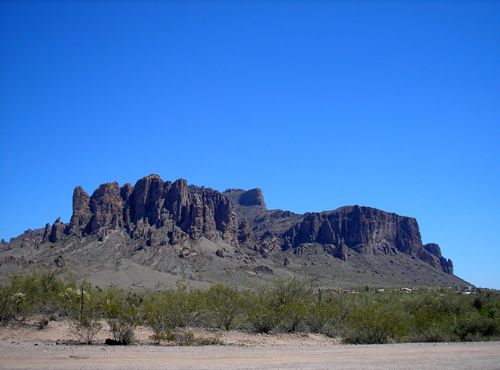
Superstition Mountain, Arizona, by Kathy Alexander.
One of the best treasure tales in the history of the American West is the story of the Lost Dutchman Mine. Shrouded in mystery, the mine is not only allegedly rich in gold but also said to be cursed, leading to a number of strange deaths and people who mysteriously go “missing” when they attempt to locate the old mine.
For more than 120 years, the legend of the Lost Dutchman Mine has been told repeatedly, growing in proportions to the point that some claim the entire legend is nothing but a myth. But for thousands of others, the mine and its legends are extremely real, hidden in the forbidding peaks of the Superstition Mountains.
“Real” or not, the haunting tales endure, continuing to draw prospectors to the Superstition Mountains today, making the story one of the most famous lost treasure tales ever.
East of Phoenix, Arizona, lies the Superstition Mountains, more commonly known to locals as the “Superstitions.” Standing majestically at the forefront of this rough terrain is Superstition Mountain, a 3,000-foot-high monolith, which seemingly stands guard over the rest of its territory.

Francisco Vásquez de Coronado.
Long before gold was found in these rugged cliffs and mesas, the area had been cloaked in mystery. When the Spanish arrived in 1540, the region was inhabited by the Apache, who considered Superstition Mountain sacred ground because it was home to their Thunder God. Led by Francisco Vasquez de Coronado, the conquistadors cared little about the Apache customs or beliefs, wanting only to find the legendary “Seven Golden Cities of Cibola.”
Learning from the Apache that the range did hold gold, the Spaniards were intent on exploring the area. The Apache, however, refused to help them, telling them that if they dared to trespass on the sacred ground, the Thunder God would take revenge upon them, causing tremendous suffering and horrible deaths. The Indians called Superstition Mountain the “Devil’s Playground.”
But the Spaniards were determined and began to explore. Almost immediately, men began to mysteriously vanish, to the point that warnings were given to never stray more than a few feet away from the rest of the group. Still, more men disappeared only to be found dead later, their bodies mutilated and their heads cut off.
In fear, the conquistadors finally fled, refusing to return to the mountain, which they dubbed Monte Superstition. The legends had begun.
A century and a half later, having heard of the rich gold to be found in the Superstitions, Jesuit priest Eusebio Francisco Kino, whose objective was to establish missions and Christianize the Indians, was lured by the tales. In the first decade of the 1700s, he began to explore the region, finding several sources of gold. Though it is not known if he found the fabled Dutchman’s Mine, his forays did produce the coveted shining metal, adding more fuel to the legend of gold in the Superstitions. However, these expeditions further enraged the Apache, who then began to prey on all trespassers.
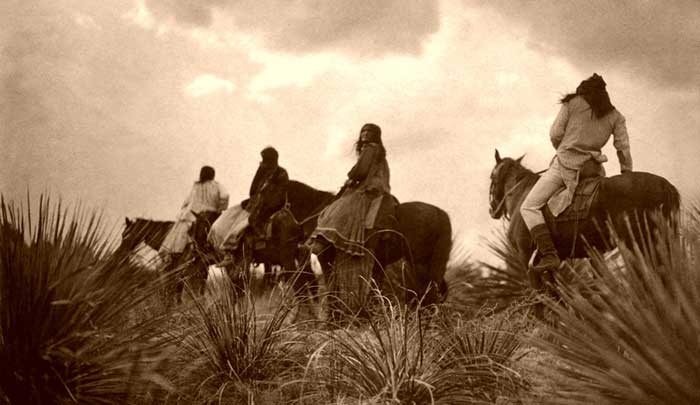
Apache Before the Storm, Edwards S. Curtis, 1906.
In 1748, the Superstitions, as well as some 3,750 square miles of what is now Arizona, were given to Mexican cattle baron, Don Miguel Peralta of Sonora, in a land grant.
The land not only contained a rich gold mine, but also several silver mines. This was the first official recording of the mine’s existence. For the next century, the Peralta family and their laborers would make infrequent forays into Arizona, bringing out loads of ore. Aware of the Apache’s displeasure, they kept these mining trips to a minimum, not wanting to risk the ferocious Apache’s ire.
However, in 1846, four descendants of the original grant, Enrico, Pedro, Ramon, and Manuel Peralta, decided to make another foray into Arizona, risking not only the “curse” but also the wrath of the Apache.
They soon returned to Sonora, laden with gold and planning another trip. The next year, with the Mexican-American War in full swing, Pedro was the only one willing to return to Arizona, determined to extract as much gold as possible before their holdings became part of the United States. In the meantime, the Apache were angry at the intrusion upon their sacred grounds. When the Peralta miners heard that the Apache might attack, they packed up, concealed the entrance to the mine, and with burros and wagons laden with gold, began to make their way back to Mexico in the winter of 1847-1848.
But they wouldn’t make it. The Apache attacked them. The pack mules scattered in all directions, spilling the gold everywhere. For years afterward, prospectors flocked to the area not only in search of the mine but also in search of Mexican gold spilled during the massacre. In the 1850s, two prospectors are said to have come upon three dead burros with intact pack saddles that held some $37,000 in gold.
The Peralta family refrained even more from working the mines for the next 16 years. However, in 1864, Enrico Peralta, leading some 400 men, ventured back into the range. It would be his last. On the northwest slope of the mountain, in an area now referred to as “Massacre Ground,” all but one of the miners were ambushed and killed by the Apache. Never again did the Peralta family return to the mine, and over the years, all maps and knowledge of its location were lost.
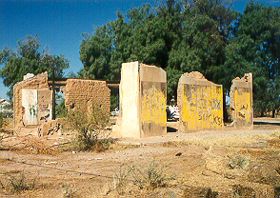
Old Fort McDowell, photo by Tom McCurnin, courtesy Ghosttowns.com
The following person to come across the mine was a man named Dr. Abraham Thorne. In 1865, Thorne was working as an army doctor at Fort McDowell, Arizona. During this time, the Apache had turned their wrath against the Arizona settlers and the U.S. Army. As the soldiers subdued the Indians, a reservation was established near Fort McDowell, where Thorne began to provide his services. Thorne earned the respect of tribal leaders as he cared for the sick and injured, and after curing several Apache of eye disease, he was offered an opportunity to be led to the gold in the Superstitions in 1870. However, Thorne had to agree to be blindfolded for the 20-mile trip. When the doctor agreed, he was taken to a place allegedly near the mine, where a pile of gold ore had been stacked at the base of the canyon wall.
Allowed to remove the blindfold, Thorne found himself in a canyon where a large, unusual rock pinnacle loomed to the south. The Apache let him pick up as much as he could before the doctor was again blindfolded for the return trip. Thorne sold the ore for some $6,000, making him wealthy. However, sometime later, legend tells us that Dr. Thorne decided to try to find the place again. Gathering up a few of his friends, the group amazingly stumbled onto the mine’s location. After filling their saddlebags with as much gold as they could carry, they set out for Phoenix but never lived to enjoy the wealth. They were discovered by the Apache, who killed them before they could escape with the gold.
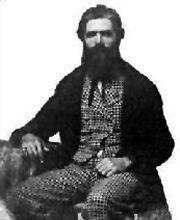
An alleged photo of Jacob Waltz.
In the 1870s, Jacob Waltz (or Walz), who had befriended one of the Peralta heirs, was allegedly told the location of the mine. Waltz, a German immigrant who had relocated to Arizona some years previously, worked as a prospector and owned a homestead on the northern side of Superstition Mountain.
However, before relocating to what is now Pinal County, Arizona, Waltz worked at Henry Wickenburg’s Vulture Gold Mine near Wickenburg, Arizona. While there, he met an Apache girl named Ken-tee, who became his mistress even though Waltz was almost 60 years old. Later, Waltz was suspected of high-grading ore from the Vulture Mine and was dismissed.
It was then that the pair moved toward the Superstition Mountains. Another version of the tale states that Waltz learned of the mine’s location from Ken-tee. In retaliation, the Apache convinced that Ken-tee had betrayed the site of their secret shrine, attacked Waltz and his Indian mistress, seizing Ken-tee and cutting out her tongue. Waltz, however, was able to escape and, before long, was running a saloon in Tortilla Flats.
However, by 1877, he and another man, Jacob Weiser (or Wisner), returned to the Superstitions. Not long after, the miners began paying for supplies in nearby Phoenix with high-grade gold ore, but they never stated where it was coming from or filed a claim.
A few years later, Weiser disappeared without a trace. Speculation was rampant, with some saying Apache killed him and others alleging Waltz killed him.
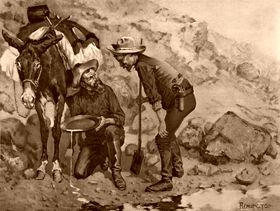
Miners prospecting by Frederic Remington.
For the next ten years, Waltz would often appear in Phoenix with saddlebags filled with some of the richest gold ore many had ever seen before disappearing again into the Superstition Mountains.
People often asked him the obvious questions—where was the gold coming from? Where was the mine? To these, Waltz would give contradictory statements and directions. When people tried to follow him out of town, he would “lose” them in the many clefts and canyons on the peak.
In the Spring of 1891, Waltz’s homestead was caught in a flood, and he was saved from certain death by two brothers named Herman and Reinhardt Petrasch. Having taken on a terrible chill, he was attended to by a woman named Julia Thomas, who tried to nurse him back to health, but Jacob had contracted pneumonia.
He sent friends back to his home to see if they could find the gold that he had kept there. Though the house was gone, searchers later found five sacks of gold worth about $15,000. Delivering it to Jacob, it was placed under his sickbed. Through the summer, he lingered in a wasted condition, giving clues to his caretaker, Julia, and his rescuers, Herman and Reinhardt Petrasch. But his condition was worsening as he suffered a stroke and was paralyzed to the point that he could barely speak.
Undaunted, however, Julia and the Petrasches made an expedition into the Superstitions that summer, trying to find the mine. But after five weeks, the three returned with nothing. Jacob finally died on October 25, 1891. The legend continued to grow, and soon the lost mine was referred to as the “Lost Dutchman,” as many at the time confused the Germans with the Dutch.
Having invested everything she owned into the venture to find the mine, Julia Thomas never attempted to find it again. Herman Petrasch accused his brother, Rhinehart, of not paying attention to Jacob’s bedside clues, and the disagreement led to their never speaking again. Separately, however, they spent much of their lives looking for the lost mine.
The legend of the lost mine and the tales of its curse continued to grow over the years as more and more stories were told, relating mysterious deaths, disappearances, and small gold finds.
In the summer of 1880, two recently discharged soldiers from Fort McDowell showed up in Pinal, Arizona, looking for work at the Silver King Mine. When they showed a bag of gold ore to the Silver King Manager, Aaron Mason, the manager was stunned by how rich the ore was and immediately asked where they had found it. The soldiers replied that the ore had been picked up while crossing Superstition Mountain, where they had also spied an old mine. Mason bought the ore from the men, outfitted them, and entered a partnership with the pair to share in the profits.
The two, sure that they could find the place, then headed towards Weaver’s Needle, but after two weeks, they had not returned. Mason sent out a search party, which found the nude bodies of both men, shot in the head.
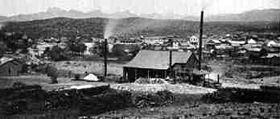
Pinal, Arizona, around 1880.
The next year, a prospector named Joe Dearing, who was working as a part-time bartender in Pinal, heard the stories of the two dead soldiers and began to look for the lost mine. He soon returned to Pinal, saying he had found an old mine, describing it as “the most God-awful rough place you can imagine… a ghostly place.” Dearing continued working as a bartender until he had saved enough money for the excavation. To make even more money, he worked at the Silver King Mine. Just a week later, he was killed in a cave-in without ever disclosing the location to anyone.
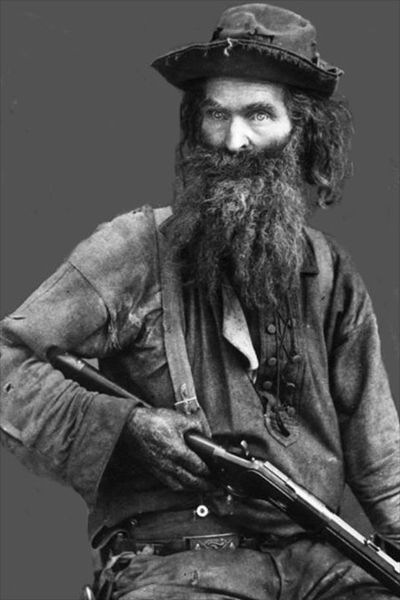
Elisha Marcus Reavis.
Another tale describes an eccentric prospector named Elisha Marcus Reavis, who was better known in the area as the “Madman of the Superstitions” or the “Old Hermit.” One of Arizona’s most interesting characters, Reavis, was college-educated and taught school before he began prospecting during the California Gold Rush. Not having much luck in California, he traveled to Arizona in the 1860s. By 1872, Reavis lived in a high mountain valley near Pinal, where he farmed vegetables and hunted in his isolated mountain retreat. Though he preferred his own company and his large library of books to being with others, he never turned away a visitor to his retreat and often traveled to the mining camps in the area to sell his vegetables. It was not his manner that earned him his eccentric reputation; instead, it was his appearance, high intelligence, and the isolated way he lived. Never shaving or cutting his hair, he seldom bathed, and rumors said he was prone to running naked through the canyons, firing a pistol into the sky. Sure that he was “mad,” even the Apache left him alone. In the Spring of 1896, when Reavis hadn’t been seen, one of his few friends went to check on him. The nearly 70-year-old man was found dead about four miles south of his home on a trail near Roger’s Canyon. His head had been severed from his body and was lying several feet away. Later that year, two easterners set out to find the lost mine. They were never seen again.
Around the turn of the century, two prospectors who went by the names of Silverlock and Malm began to work on the northern edge of Superstition Mountain. Sinking dozens of shafts into the mountainside, they found little gold other than some scarce remains from the Peralta Massacre. In 1910, Malm appeared in Mesa, Arizona, telling everyone that Silverlock had tried to kill him. Lawmen picked up Silverlock, judged him insane, and sent him to an asylum. Malm was later sent to the county poor farm, not doing much better himself. Both died within two years.
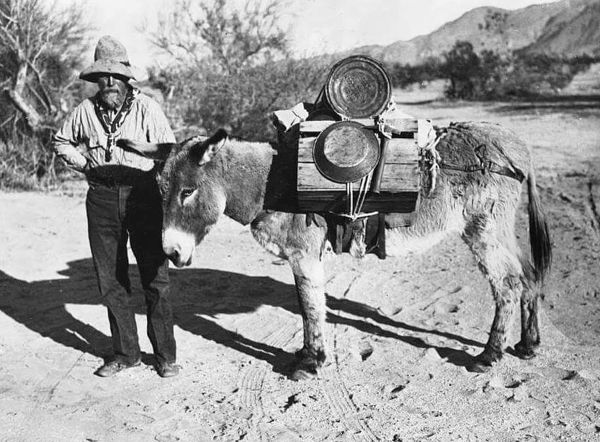
Arizona Prospector.
Also, in 1910, the skeleton of a woman was found in a cave high up on Superstition Mountain. With the body were several gold nuggets. The coroner could tell that the woman’s death was recent, but the gold was never explained.
More than 20 years later, in 1927, a New Jersey man and his sons were hiking the mountain when rocks began to roll down on them from the cliffs above as if someone had pushed the boulders. One of the boys’ legs was crushed. Just a year later, two deer hunters were driven off the mountain when again, rolling boulders appeared to have been pushed toward them by someone or “something” down the mountain.
In June 1931, another event added to the legends of Superstition Mountain when Adolph Ruth, a Washington, D.C., veterinarian and avid treasure-hunting hobbyist, went missing in a wilderness area of the peak.
In his search, Ruth used a map his son had obtained in Mexico several years previously, dating back to the Mexican Revolution (1909-1923), which was later referred to as the Ruth-Peralta map. Ruth was searching for the lost Peralta Mines, especially that of the Lost Dutchman. Arriving in May, Ruth convinced two local cowboys to pack him into the mountains, where they left him to explore a place called Willow Springs in West Boulder Canyon around June 14, 1931.
When nothing had been heard of Ruth for six days, the cowboys’ boss, Tex Barkley, looked for the treasure hunter. Upon arriving at Ruth’s camp, the rancher could tell that no one had been there for at least a day and reported Ruth missing. The family immediately offered a reward, and searchers combed the mountain for the next 45 days, but Ruth was not found.
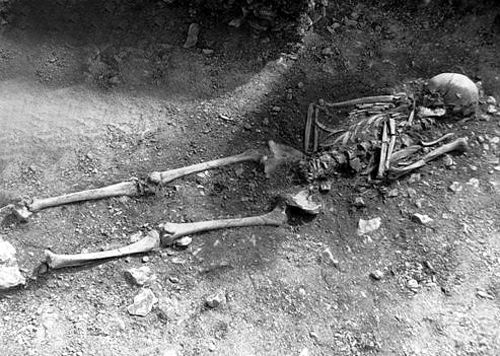
Skeletal remains.
Some months later, in December, an archaeological expedition discovered a skull with two holes in it near the three Red Hills. It turned out to be that of Adolph Ruth. The rest of the treasure hunter’s body would not be found until the following month in a small tributary on the east slope of Black Top Mesa. Ruth’s treasure map was found at his original campsite.
The headlines were sensational – alleging that Ruth had been murdered for his map. However, the original coroner said he could not be positive that the skull had bullet holes. But Adoph’s son, Erwin, was convinced his father had been killed. Though the coroner acceded that foul play “might” have been involved, the original statement was never changed.
Most believed that Ruth died, probably from the extreme desert heat, and wild animals carried his body away in parts. His death remains a mystery; however, it is one more life claimed by the mountain and, perhaps, its curse.
In 1934 the Superstitions claimed Adam Stewart’s life, the unknown cause of death.
Two years later, in December 1936, the mountain claimed another life when hobbyist Roman O’Hal, a broker from New York, died from a fall while searching for the Lost Dutchman.
Yet, another year later, an old prospector named Guy “Hematite” Frink was lucky enough to return from the mountain with several rich gold samples. In November, he was found shot in the stomach on the side of a trail in or near La Barge Canyon. Next to his decomposing body was a small sack of gold ore.
In 1937, a man named Jenkins, his wife, and two children were having a picnic on the mountain. During their outing, Jenkins found a heavy quartz rock that he later learned was rich in gold. However, he had a heart attack before he could return to the spot. His wife could not remember the location of the find.
In 1945, a book about the Lost Dutchman Mine was written by Barry Storm, who claimed to have narrowly escaped from a mysterious sniper. Storm speculated that Adolph Ruth might have been a victim of the same sniper.
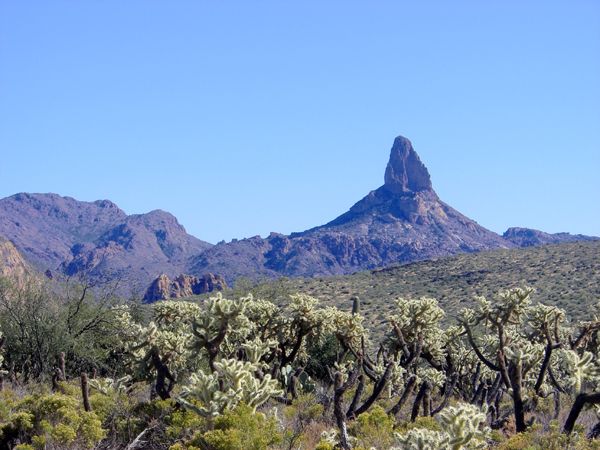
Weaver’s Needle in the Superstition Mountains of Arizona, courtesy Wikipedia.
In June 1947, a prospector named James A. Cravey made a much-publicized trip into the Superstition canyons by helicopter, searching for the Lost Dutchman Mine. The pilot set him down in La Barge Canyon, near Weaver’s Needle. When Cravey failed to hike out as planned, a search was started, and although his camp was found, Cravey was not. The following February, his headless skeleton was found in a canyon a good distance from his camp. It was tied in a blanket, and his skull was found about thirty feet away. The coroner’s jury ruled “no evidence of foul play.”
In 1949, a man named James Kidd disappeared from the Superstitions.
In February 1951, Dr. John Burns, a physician from Oregon, was found shot to death on Superstition Mountain. The “official” ruling was that the death was accidental.
In early 1952, Joseph Kelley of Dayton, Ohio, was also searching for the lost mine. He vanished and was never seen again. His skeleton was discovered near Weaver’s Needle two years later. The shot in his skull was ruled an accidental shooting incident.
That same year, two California boys, who were hiking on Superstition Mountain, also vanished. Unfortunately, nothing was ever found of these two.
In 1955, Charles Massey, who was hunting with a 22, was found shot between the eyes by a heavy-caliber rifle bullet. The coroner ruled it an accidental death resulting from a ricochet.
In January 1956, a man from Brooklyn, New York, reported to police that his brother, Martin Zywotho, who he believed was searching for the Lost Dutchman Mine, had been missing for several weeks. The missing man’s body was found with a bullet hole above his right temple a month later. Although his gun was found under the body, the death was ruled a suicide.
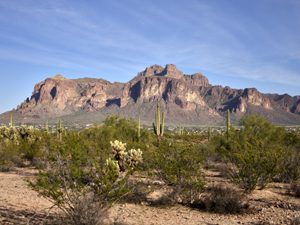
The Superstition Mountains west of Phoenix, Arizona, by Carol Highsmith.
In April of 1958, a deserted campsite was discovered on the northern edge of the mountain. At the campsite were a bloodstained blanket, a Geiger counter, a gun-cleaning kit, but no gun, cooking utensils, and some letters from which the names and addresses had been torn. No trace of the camp’s occupant was ever found.
In 1959, two men named Stanley Hernandez and Benjamin Ferreira thought they had found the “jackpot.” However, they discovered pyrite, often called “Fool’s Gold.” But these two were sure they had found the elusive mine. Whether out of greed or dispute over how they would handle their newfound wealth, Hernandez killed his friend Ferreira.
That same year, Robert St. Marie, who was attempting to drill a hole all the way through Weaver’s Needle, was killed by prospector Edward Piper. Two months later, Piper was found dead. The cause of death was said to have been a “perforated ulcer.”
Two more men hiking in the Superstitions that year became involved in some dispute. Lavern Rowlee was shot by Ralph Thomas, who reported that he had been attacked by Rowlee and shot the other man in self-defense.
In October 1960, a group of hikers found a headless skeleton near the foot of a cliff on Superstition Mountain. Four days later, an investigation determined it belonged to an Austrian student named Franz Harrier.
Five days later, another skeleton was found, identified the next month as William Richard Harvey, a painter from San Francisco, California. The cause of death was unknown.
In January 1961, a family picnicking near the edge of the mountain discovered the body of Hilmer Charles Bohen buried beneath the sand. Bohen was a Utah prospector who had been shot in the back.
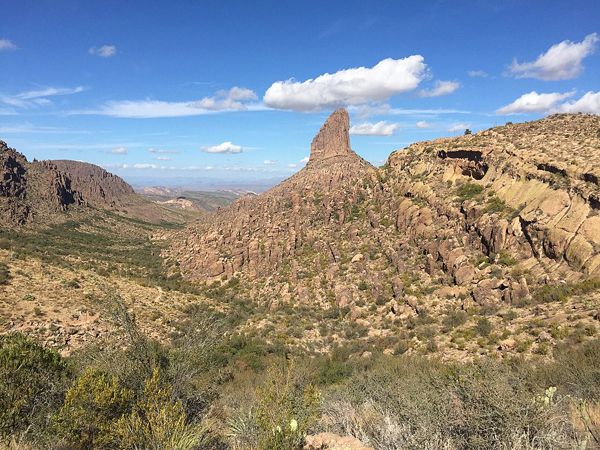
Weaver’s Needle in the Superstition Mountains of Arizona, courtesy Wikipedia.
Two months later, another prospector from Denver, Colorado, named Walter J. Mowry, was found in Needle Canyon. His bullet-ridden body was removed to the coroner’s, who ruled it a suicide.
Five days later, another skeleton was found, later identified as William Richard Harvey, a painter from San Francisco. The cause of death was undetermined.
In the Fall of 1961, police began searching for a prospector named Jay Clapp, who had intermittently worked on Superstition Mountain for a decade and a half. Clapp had been missing since July. After a thorough search, the hunt was called off. Three years later, his headless skeleton was finally discovered.
In 1963, a man named Vance Bacon, also working to tunnel through Weaver’s Needle, fell to his death. Allegedly, there were rifle shots and indications of foul play.
The following year, brothers Richard and Robert Kremis were found dead at the bottom of a high cliff. That same year, an elderly couple was found murdered in an automobile.
In 1970, a seasoned prospector named Al Morrow was killed by a boulder that fell into a tunnel he was digging.
In 1973, Charles Lewing shot Ladislas Guerrero at a mountain campsite. Lewing claimed self-defense.
In 1976, a prospector named Howard Polling was found dead of a gunshot wound. The following year, another man named Dennis Brown was also found dead of a gunshot wound.
In 1978, a man named Manuel Valdez was murdered in the Superstitions.
Two years later, in 1980, the skeleton of a man named Rick Fenning was found.
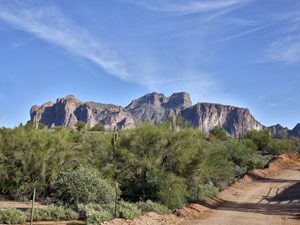
The Superstition Mountains by Carol Highsmith.
In 1984, a prospector named Walt Gassler, who had been searching for the Lost Dutchman for most of his life, was found dead in the Superstitions. In his pack was gold ore, later discovered to be identical to the rich ore Jacob Waltz had found earlier.
Are these many deaths part of the old Apache curse? Does the Lost Dutchman Mine really even exist, or is it nothing more than a “tall tale” perpetuated throughout the years? Scientists say that the Superstition Mountains don’t contain the type of mineral deposits that produce gold. So, if any earlier tales of gold found are true, where did it come from? Some historians believe that any gold found in this rugged terrain was probably hidden there, perhaps even having been the fabled lost Aztec treasure.
There are dozens of variations of the lost mine tale, and almost as many reports of people finding the mine, making it the most found-and-lost mine ever. However, these many variations and tales only add to the intrigue of the “Lost Dutchman,” enticing hundreds of treasure-hunting hobbyists and seasoned prospectors to continue searching for the elusive gold.
The Superstitions are now a federal wilderness area and Arizona State Park, so even if the gold were found, it would have to be surrendered to the government. This does not deter many seekers—the search is too intriguing.
The lost mine is thought to be located somewhere near Weaver’s Needle, the prominent landmark of the Superstition Mountains, even though hundreds of people have diligently searched the area. Jacob Waltz said the mine was a large funnel-shaped pit.
The Superstition range covers approximately 160,000 acres of desolate, rugged terrain, so arid that only a bit of desert vegetation and a few sparse strands of Ponderosa Pine are all that grows.
Be prepared to join the thousands of others who have searched for the lost mine, as conditions can be harsh in this rugged terrain. Temperatures during the day can easily climb to more than 100 degrees and, at higher elevations, drop into the freezing range at night. Searchers should never enter the wilderness area alone, take plenty of water, and pack lightly to avoid overexertion.

The Superstition Mountains can be seen behind these old buildings in nearby Goldfield, Arizona, by Kathy Alexander.
If these many tales of intrigue are not enough, other reports suggest that the area is haunted, most likely by the many who have died there in mysterious deaths.
©Kathy Alexander/Legends of America, updated November 2025.
Also See:
Arizona – The Grand Canyon State
Lost Treasure Across the Country
See Sources.