
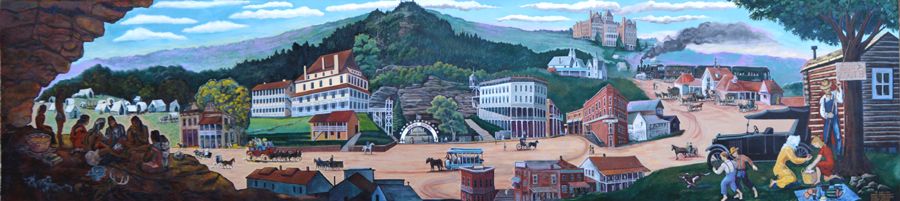
Mural in Eureka Springs, Arkansas, by Louis Freund, photo by Kathy Alexander.
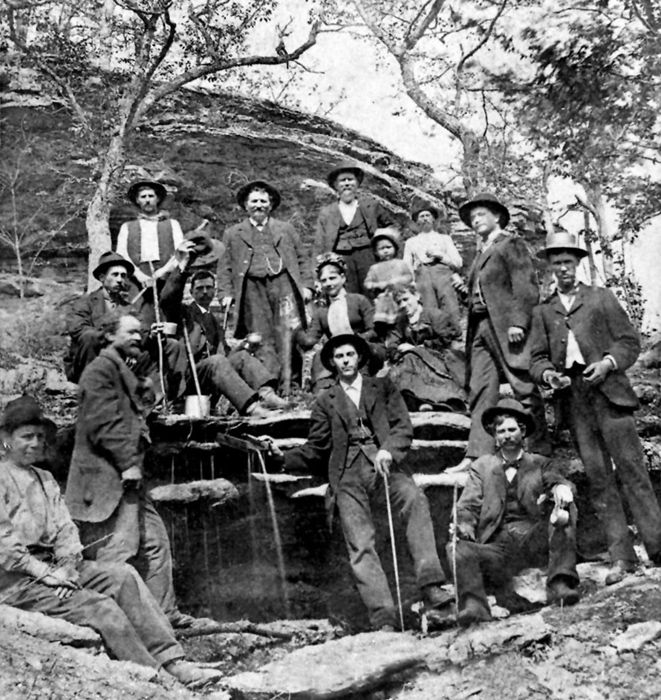
Partaking of the healing waters at Eureka Springs, 1881.
Eureka Springs, Arkansas, nestled in the heart of the Ozark Mountains of Northwest Arkansas, is steeped in history, so much so that the entire city is listed on the National Register of Historic Places. Numerous Victorian-style buildings, cottages, and manors are among the mountainous terrain and winding streets.
Centuries before the beautiful Victorian city of Eureka Springs was born, the area had long been known by the Indians for its healing waters. An old Native American Legend tells of a Sioux Princess who suffered from an eye affliction that had taken her sight. However, when she washed her eyes in the Basin Spring, her eyesight was fully restored.
Before long, the legend spread, and Indians came from far and wide to partake of the healing waters. It soon became a sacred site where war could not be made among the tribes, and only peaceful gatherings were allowed. This was respected among all the Indian bands.
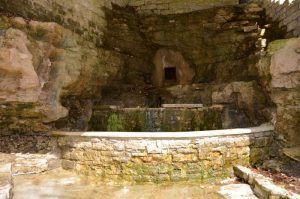
Magnetic Spring in Eureka Springs by Kathy Alexander.
The first white settler to come upon the healing springs was Dr. Alvah Jackson. Having heard the Indian legend, he brought his son to the springs in 1856 to cure an eye ailment. When the Civil War broke out, Jackson established what became known as “Dr. Jackson’s Cave Hospital” to care for the ill and injured. After the war, he established a successful business selling “Dr. Jackson’s Eye Water.”
The springs’ “secrets” remained known only to the locals until early 1879, when Dr. Jackson’s friend and hunting companion, Judge J. B. Saunders of Berryville, visited him. Suffering from a skin disease that caused severe inflammation, the judge was allegedly cured after visiting Basin Spring. Using his influence, the judge began to promote the springs throughout Arkansas.
Word quickly spread that the spring’s miraculous healing waters were said to cure, or at least help, virtually every ailment known at the time, including diabetes, rheumatism, women’s diseases, asthma, paralysis, and more.
Thousands of visitors began to flock to the area almost overnight, and the City of Eureka Springs was officially founded on July 4, 1879. The first cabin was built by Judge Saunders, who utilized it as a summer retreat. Next came a rough board shanty built by O.D. Thornton utilized it not only as a place of residence but also as a general store. By the end of July, there were twelve structures around the springs, along with numerous tents and wagons. By mid-August, the population had grown to about 300, and before long, another general store, a meat market, and a blacksmith shop were built. By the end of the year, the settlement’s population had reached some 10,000 people and supported numerous businesses, including hotels, saloons, bathhouses, livery stables, groceries, and dry goods stores.

Eureka Springs, Arkansas, 1885.
By 1881, the town was declared a “City of the First Class” and had become the fourth largest city in Arkansas. Unlike the development of most cities, where the most desirable locations are on the higher elevations, the choicest lots in the settlement were near the springs. This is where the wealthy population of the burgeoning city built their homes.
The springs also attracted numerous investors, and former Arkansas governor Powell Clayton soon organized the Eureka Springs Improvement Company. These enterprising investors began an era of “gracious living” in Eureka Springs that would last until the turn of the century.
One of the first tasks of the Improvement Company was to bring the railroad to the new city. The closest terminal was located in Pierce City, Missouri, some 55 miles to the northeast. At that time, the many visitors to the city were required to take a nine-hour stage ride from Pierce City to reach the springs. Compelling in their efforts, the railroad was extended to Seligman, Missouri, just 18 miles away, in 1882. The Eureka Springs Railway was chartered in the same year and was opened to travel on February 1, 1883. The steam engine brought with it not only numerous visitors searching for a cure but also several booming commercial enterprises.
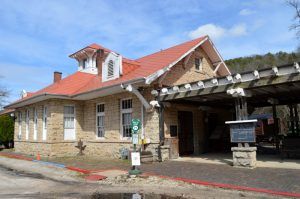
Eureka Springs Train Station by Kathy Alexander.
Eureka Springs quickly became an important commercial center for the area. However, on November 3, 1883, the town suffered an extremely destructive fire that destroyed approximately five acres, including most of the business district. As a result, the Eureka Springs Improvement Company and many of the city’s residents began to replace the older frame structures with new brick-and-stone buildings. The Improvement Company also began to make city improvements that included widening the streets, installing street lights, and establishing water and sewage systems.
In 1884, in partnership with the Frisco Railroad, the Improvement Company began to build the famous Crescent Hotel. Considered America’s most luxurious resort hotel of the time, the majestic inn opened amid fanfare on May 20, 1886. Notables from across the country attended its grand opening, which included a gala ball, complete with a full orchestra, and a banquet dinner for 400 celebrants.
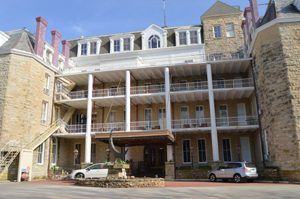
Front of the Crescent Hotel, Eureka Springs, Arkansas. Photo by Kathy Alexander.
Offering large, airy rooms with exquisite furnishings, a dining room that once seated more than 500 people, and outdoor amenities that included a swimming pool, tennis courts, and croquet, among a beautiful landscape of flower gardens, winding boardwalks, and gazebos, the hotel’s luxury was unmatched at the time.
Immediately, the well-to-do of the nation began to flock to the luxurious resort hotel as liveried footmen met them at the Frisco depot before transporting them to the inn. Once there, the guest could enjoy not only the healing waters of the spa but also a stable of 100 sleek-coated horses, tea dances in the afternoon, and elaborate parties every evening with a full in-house orchestra.
The Crescent Hotel changed hands several times over the last century, serving in various capacities and suffering a tragic fire in the 1960s. However, “Grand Lady of the Ozarks,” as the hotel is affectionately called, has been fully restored to her original magnificence and continues to cater to travelers today.
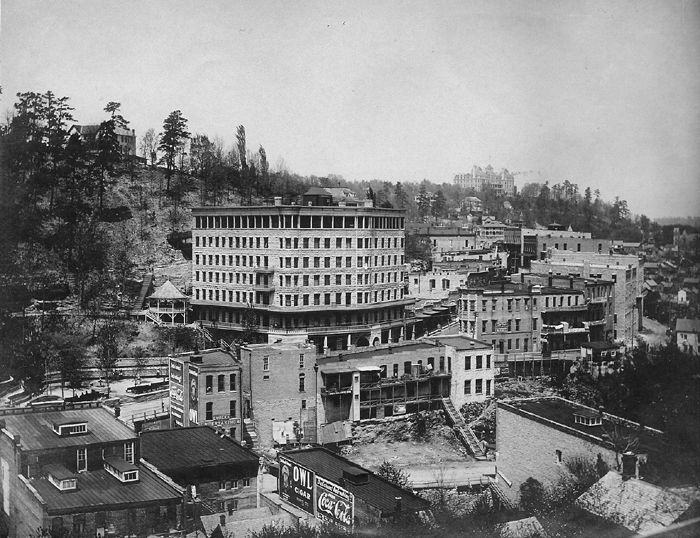
Basin Park area of Eureka Springs, 1909.
By the turn of the century, Eureka Springs reached its peak of prosperity and gradually began a slow decline. As modern medicine continued to improve, the faith in the healing powers of mineral springs began to dwindle. Eureka Springs and numerous other resorts around the country painfully felt the decline as tourists stopped frequenting mineral spas. Another blow was dealt to the city when the St. Louis and North Arkansas Railroad connected Eureka Springs with Harrison, Arkansas, in 1901, immediately decreasing the town’s importance as a commercial center.
The last “important” building of Eureka Springs’ “golden days” held its grand opening on July 1, 1905. The seven-story Basin Park Hotel represented an unusual form of architecture. Built against a mountainside, each of the seven floors is a ground floor on the backside of the hotel. The Basin Park Hotel is still open today.
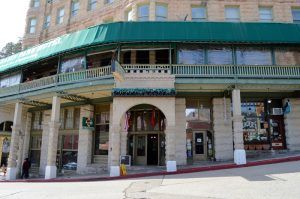
The Basin Park Hotel in Eureka Springs, Arkansas, continues to cater to guests today, by Kathy Alexander.
In 1911, when the railroad transferred its repair workshops to nearby Harrison, it almost spelled a death knell for Eureka Springs. However, the city would survive when the automobile became affordable for the masses. In the 1920s, the National Auto Trails were opened, and U.S. Highway 62, which began in Niagara Falls, New York, and ended in El Paso, Texas, passed right along the edge of Eureka Springs. The Ozark Trail spawned a new roadside culture of service stations, motor courts, diners, and tourist traps. The Auto Trails era ended as interstates replaced the old routes in the 1970s, but much of the vintage architecture of the era can still be seen today.
But again, when the Great Depression hit the nation, Eureka Springs, like other vacation destinations, suffered severely. Unfortunately, during this time, several wooden buildings were torn down so that the materials could be sold or reused for other purposes. However, none of the existing stone and brick buildings were razed. Though many stood abandoned for years, the quality of construction utilized in the buildings would save them for later use.
After the depression, numerous artists and writers began to relocate to the area, and the Works Progress Administration project created the world’s largest hand-cut stone dam at Lake Leatherwood.
After World War II, when travel restrictions were lifted, Americans again began to take vacations, and soon Eureka Springs realized a small boom as a tourist destination. Many of the abandoned buildings once again began to see new life. When the Army Corps of Engineers began work on Beaver Dam in 1960, the recreation facilities and Beaver Lake, coupled with the Pea Ridge Battlefield National Military Park opening, brought yet more visitors to northwest Arkansas.
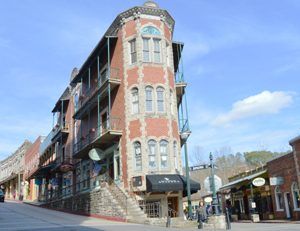
Street scene in Eureka Springs today by Kathy Alexander.
After a lapse of half a century, the city began to experience a second “boom” as motels and service facilities sprang up, abandoned buildings filled with boutiques and specialty shops, and artists and retirees took up permanent residence.
In 1970, the entire city limits of Eureka Springs were designated as a Historic District and listed on the National Register of Historic Places. Covering about two square miles, the district includes almost 500 buildings that contribute to the historical significance of the city, most of which were built of native stone from 1890 to 1910. Eureka Springs was also named one of America’s Twelve Distinctive Destinations in 2001 by the National Trust for Historic Preservation. In 2005, Eureka Springs was upgraded by the National Park Service to National Significance on the National Register of Historic Places.
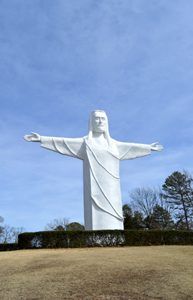
Christ of the Ozarks, erected in 1966, stands over 65 feet tall near Eureka Springs. Photo by Kathy Alexander.
Today, this quaint city of almost 2,500 people is one of the best-preserved 19th-century communities in the nation. Tucked into the Ozark Mountains and encircled by two beautiful lakes, the city provides numerous historic attractions and simple pleasures while still allowing the visitor to shop at more than 100 specialty boutiques, dine at 70 restaurants, and partake in several recreational opportunities.
The Great Passion Play, an outdoor drama depicting the last week of Jesus Christ’s life, is one of the most visited attractions. The event opened in 1868. The site also includes the Christ of the Ozarks, a 67-foot-tall statue, the Holy Land Tour, a tabernacle, a museum, and more.
©Kathy Alexander/Legends of America, updated May 2025.
Also See:
The Haunted Crescent Hotel in Eureka Springs
See Sources.