
By William Worthington Fowler, 1877.
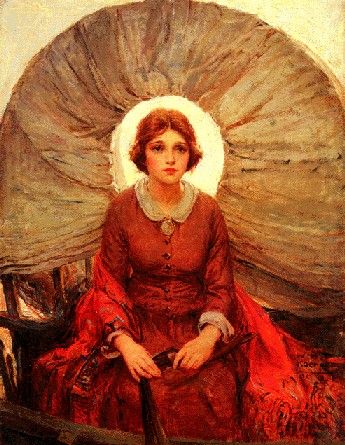
Pioneer Woman.
No portion of our country has been the scene of more romantic and dangerous adventures than that region described under the broad and vague term the “Southwest.” Texas, New Mexico, and Arizona are vast, remote, and varied fields with which danger and hardship, wonder, and mystery are ever associated. The country itself embraces great contrarieties of scenery and topography — theprosperoush farm, the expansive cattle ranch, the broad lonely prairie watered by majestic rivers, the barren desert, the lofty plateau, the secluded mining settlement, and vast mountain ranges furrowed by torrents into black canyons where sands of gold lie heaped in inaccessible, useless riches.
Human society is almost equally diverse. Strange and mysterious tribes, each with different characteristics, live side by side.
Vile mongrel breeds of men multiply to astonish the ethnologist and the moralist. The Comanche and the Apache roam, the most remorseless and bloodthirsty of all the North American aboriginal tribes. Mexican bandits traverse the plains and lurk in the mountain passes, and American outlaws and desperadoes here find refuge from justice.
As the Anglo-Saxon advances westward after fording the Sabine, the Brazos, and the Colorado River of Texas, he is brought face to face with these different races mixed in greater or lesser proportion with the blood of the old Castilian conquerors. Each race is widely alien from and most instinctively antagonistic to the North European people.
Taking into view the immense distances to be traversed, the natural difficulties presented by the face of the country, the remoteness of the region from civilization, and the mixed, unpredictable, and hostile character of the inhabitants, we might naturally expect that its occupation by peaceful settlers,–by those forms of household life in which woman is an essential element–would be indefinitely postponed. But that energy and ardor which mark alike the men and the women of our race have carried the family, that germ of the state, over all obstacles and planted it in the inhospitable soil of the most remote corners of this region. There it will flourish and germinate doubtless till it has uprooted every neighboring and noxious product.
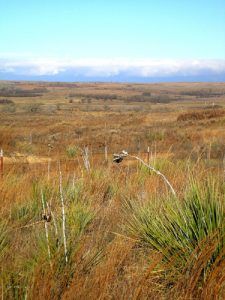
Texas Panhandle Plains by Kathy Alexander.
The northeastern section of this vast country is composed of that stupendous level tract known as the “Llano Estacado” or “Staked Plain.” Stretching hundreds of miles in every direction, this sandy plain, treeless and arid, with only here and there patches of stunted herbage, whitened by the bones of horses and mules and by the more ghastly skeletons of too adventurous travelers, presents an area of desolation scarcely more than paralleled by the great African Desert.
In 1846, after news reached the States that our troops were in peaceful occupation of New Mexico, a party of men and women set out from the upper valley of the Red River of Louisiana to settle in the valley of the Pecos River, in the eastern part of the newly conquered territory. The company consisted of seven people: Mr. and Mrs. Benham and their seven-year-old child, Mr. and Mrs. Braxton, and two sons, 15 and 19 years old.
They made rapid and comfortable progress through the valley of the Red River and, in two weeks, reached the edge of the “Staked Plain,” which they now made preparations to cross, for the difficulties and dangers of the route were not unknown to them.
Disencumbering their pack-mules of useless burdens and supplying themselves with water for two days, they pushed forward on their first stage, which brought them on the evening of the second day to a kind of oasis in this desert where they found wood, water, and grass. From this point, there was a stretch of 90 miles perfectly bare of wood and water and with rare intervals of scanty herbage for the beasts. After this desolate region had been passed, they would have a comparatively easy journey to their destination.
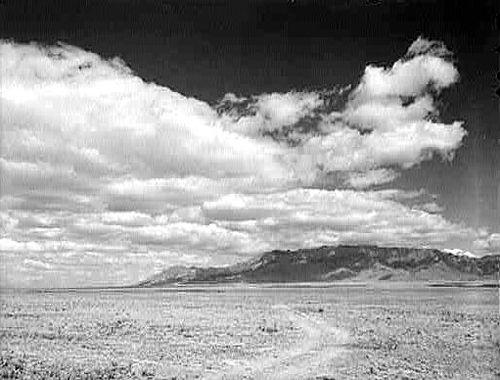
New Mexico Plains
On the evening of the second day of their passage across this arid tract, they had the misfortune to burst their only remaining water cask and to see the thirsty sands drink up in a moment every drop of the precious liquid. They were then forty miles from the nearest water. Their beasts were tired and suffering from thirst. The two men were incapacitated for exertion by slight sun-strokes received that day, and one of the boys had been bitten in the hand by a rattlesnake while taking from its burrow a prairie dog he had shot.
The next day, they pursued their march only with the utmost difficulty; the two men were barely able to sit on their horses, and the boy who had been bitten was faint and nerveless from the effect of the poison. The heat was felt very severely by the party as they dragged themselves slowly across the white expanse of sand, which reflected the rays of the sun with a painful glare into the haggard eyes of the wretched wanderers. Before they had made fifteen miles, or a little more than one-third of the distance that would have to be accomplished before reaching water, the horses and mules gave out. At three o’clock in the afternoon, the party dismounted and stretched themselves on the sand, panting with heat and thirst. The sky above them was like brass, and the soil was coated with a fine alkali deposit which rose in clouds at their slightest motion, filling their nostrils and eyes and increasing the agonies they were suffering.
Their only hope was to be discovered by some passing train of hunters or emigrants. This hope faded away as the sun declined, and nothing but the sky and the long, dreary, dazzling expanse of sand met their eyes.
The painful glare slowly softened, and with sunset came coolness; this was some slight mitigation to their sufferings; sleep, too, promised to bring oblivion; and hope, which a merciful Providence has ordained to cast its halo over the darkest hours, told its flattering tale of possible relief on the morrow.
The air of that desert is transparent as crystal, and the last beams of the sun left on the unclouded azure of the sky a soft glow, through which everything in the western horizon was outlined as if drawn by some magic pencil. Casting their eyes in that direction, the wretched wayfarers saw far away from a dun-colored haze through which small black specks seemed to be moving.
It grew larger and more distinct and approached them slowly over the vast expanse until its true nature was apparent. It was a cloud of dust, like a party of horsemen makes when rapidly over a soil as fine and light as ashes. Was it friend or foe? Was it American cavalry, or was it a band of Mexican guerrillas that was galloping so fiercely over that arid plain?
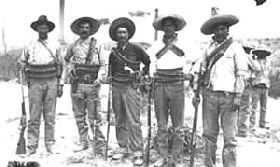
Mexican Bandits.
These torturing doubts were soon solved. Skimming over the ground like swallows, six sunburned men with hair as black as the crow’s wing, gaily dressed and bearing long lances, soon reined in their mustangs within twenty paces of the party and gazed curiously at them. One of the band then rode up and asked in broken English if they were “Americans.” Having thus done reconnaissance and seeing their helplessness, without waiting for a reply, he beckoned to his companions, who approached and demanded the surrender of the party. Under other circumstances, a stout resistance would have been made, but they could do nothing in their present forlorn condition.
Their guns, a part of their money, and whatever the unfortunate families had that pleased the guerrillas, was speedily appropriated, the throats of their horses and mules were cut, Mrs. Braxton and Mrs. Benham were seized, and despite their struggles and shrieks, each of them was placed in front of a swarthy bandit. Then the Mexicans rode away, cursing “Los Americanos” and barbarously leaving them to die of hunger and thirst.
After a four-hour’ gallop, the marauders reached an adobe house on Picosa Creek, a tributary of the Rio Pecos. This was the gang’s headquarters, and here they kept relays of fresh horses, mustangs, fiery and full of speed and bottom. Mrs. Benham and Mrs. Braxton were placed in a room by themselves on the second story, and the door was barricaded so that escape by that avenue was impossible. Still, the windows were only guarded by stout oaken bars, which the women, by their united strength, succeeded in removing. Their captors were in a profound slumber when Mrs. Benham and her companion dropped themselves out of the window and succeeded in reaching the stable without discovery. Here they found six fresh horses ready saddled and bridled, the others on which the bandits had made their raid being loose in the enclosure.
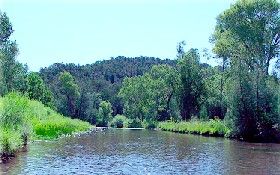
Upper Pecos River.
It was a cruel necessity that impelled our brave heroines to draw their knives across the hamstrings of the tired horses, thus disabling them to prevent pursuit. Then, softly leading out the six fresh mustangs, each of our heroines mounted one of the horses man-fashion and led the others lashed together with lariats, walking the beasts until out of hearing. They then put them to a gallop and, riding all night, came, at sunrise, to the spot where their suffering friends lay stretched on the sand, having abandoned all hope.
After a brief rest, the whole party pushed rapidly forward on their journey, arriving that evening at a place of safety. Two days after, they reached the headwaters of the Pecos. Here, they purchased a large adobe house and an extensive tract suitable for grazing and tillage.
These events occurred early in the autumn. The Mexicans revolted and massacred Governor Bent and his military household during the following winter.

Arroyo Hondo.
On the same day, seven Americans were killed at Arroyo Hondo; a large Mexican force was preparing to march on Santa Fe. It seemed as if the handful of American soldiers would be driven out of the territory for a time. This conspiracy was made known to the authorities by an American girl, who was the wife of one of the Mexican conspirators, and, becoming, through her husband, acquainted with the plan of operations, divulged them to General Price to prevent a more general outbreak. As it was, the American settlers were in great danger.
The solid and spacious house in which the Benhams and Braxtons lived had formerly been used as a stockade and fortification against Indian attack. Its thick walls were pierced with loopholes, and its doors, of double oak planks, were studded with wrought-iron spikes, which made it bullet-proof.
A detachment of United States troops was stationed a short distance from their ranch, and the two families felt reasonably secure despite the disturbed condition of the country. However, the troops were withdrawn after the revolt commenced, leaving the new settlers dependent upon their own resources for protection. Their cattle and horses were driven into the enclosure, and the people of the house kept a sharp lookout against hostile parties of marauders, whether Indian or Mexican.
Early on the morning of January 24th, a mounted party of 12 Mexicans made their appearance in front of the enclosure, which they quickly scaled, and discharged a volley of balls, one of which passed through a loophole, and, entering Mr. Braxton’s eye as he was aiming a rifle at the assailants, laid him dead at the feet of his wife. Mrs. Braxton, with streaming eyes, laid the head of her husband in her lap and watched his expiring throes with agony, such as only a wife and mother can feel when she sees the dear partner of her life and the father of her sons torn in an instant from her embrace. Seeing that her husband was no more, she dried her tears and thought only of vengeance on his murderers.
At the start, the besieged were 12: Mr. and Mrs.Braxton, Mr. and Mrs. Benham and their children, three Irish herders, and a half-breed Mexican and his wife, who were house servants. Mr. Braxton’s death reduced their number to eleven. A few moments later, the Mexican half-breed disappeared but was not missed in the excitement of the defense.
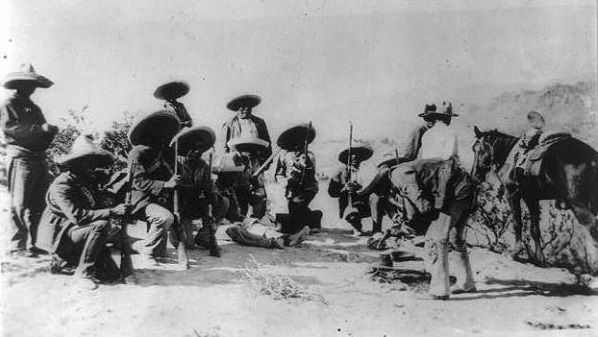
Mexican Bandits.
The besieged returned the fire of their assailants with vigor, two of whom had already bit the dust. The women loaded the guns and passed them to the men, who kept the Mexicans at a respectful distance by the rapidity of their fire. Mrs. Benham was the first to mark the absence of Juan, the Mexican half-breed, and, suspecting treachery, flew to the loft with a hatchet in one hand and a revolver in the other. Her suspicion was correct. Juan opened an upper window and assisted two of the attacking party in ascending, letting down a ladder. They were preparing to assault those below by firing through the cracks in the floor when the intrepid woman dispatched Juan with a shot from her revolver and clove the skull of another Mexican; the third leaped from the window and escaped.
As Mrs. Benham was about to descend from the loft, after drawing up the ladder and closing the window, she was met by the wife of the treacherous half-breed, who aimed a stroke at her breast with a machete or large knife, such as the Mexicans use. She received a flesh wound in the left arm as she dodged the blow, and it was only with the mixed strength of Mrs. Braxton and one of the herders, who had now ascended to the loft, that the enraged Mexican whom Mrs. Benham had made a widow could be mastered and bound.
Three of the attacking party had now been killed, and three others placed “hors de combat.” The remnant was apparently about to retire from the siege when six more swarthy desperadoes, mounted on black mustangs, came galloping up and halted on a hill just out of rifle shot.
Mrs. Braxton and Mrs. Benham, looking through a field glass, immediately recognized them as the band that had taken them captive a few months before.
After a few moments of consultation, one of the band, who appeared only armed with a bow and arrow, advanced towards the house, waving a white flag. Within 30 paces of the door stood a large tree, and behind this, the envoy, bearing the white flag, ensconced himself. Striking a light, he twanged his bow and sent a burning arrow upon the roof of the house, which, being dry as tinder, was ablaze in a moment.
Both women immediately carried water to the roof and extinguished the flames. Another arrow, wrapped in cotton steeped in turpentine, again set the roof on fire. As one of the daring matrons threw a bucket of water upon the blaze, the dastard stepped from behind the tree and sent a pistol ball through her right arm, but at the same moment received two rifle balls in his breast and fell a corpse.
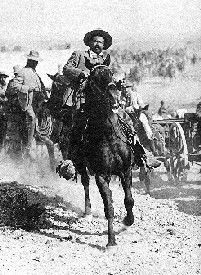
Mexican Attack.
Mrs. Benham, for it, was she who had been struck, was assisted by her husband to the ground floor, where her wound was examined and found to be fortunately not a dangerous one. However, a new peril now struck terror to their hearts; the water was exhausted. The fire began to make headway. Mrs. Braxton, calling loudly for water to extinguish it, and meeting no response, descended to the ground floor, where the defenders were about to give up all hope, and either resign themselves to the flames or by emerging from the house, submit to the massacre at the hands of the now angry foe. As Mrs. Braxton rolled her eyes in search of some substitute for water, they fell on the corpse of her husband. His coat and vest were completely saturated with blood. Only the sad but terrible necessity immediately suggested to her the use to which these garments could be put. Shuddering, she removed them quickly but tenderly from the body, flew to the roof, and succeeded, by these dripping and ghastly tokens of her widowhood, in finally extinguishing the flames.
The attack ceased at nightfall, and the Mexicans withdrew. The United States forces soon quelled the outbreak, and the territory was brought again into a condition of peace and comparative security.
At the close of the war in 1848, Mrs. Braxton married a discharged volunteer named Whitley. Having disposed of the late Mr. Braxton’s interest in the New Mexican ranch, she removed in 1851 with her husband and family to California, where they lived for two years in the Sacramento Valley.
Whitley possessed one of those roving and adventurous spirits that are never happy in repose. When John Crossman informed him, an old comrade, of the discovery of a rich placer which he had made during his march as a United States soldier across the territory of Arizona, at that time known as the Gadsden Purchase, he eagerly formed a partnership with the discoverer, who was no longer in the army and announced to his wife his resolution to settle in Arizona. She endeavored by every argument she could command to dissuade him from this rash step. Still, in vain, and finding all her representations and entreaties of no avail, she consented, though with the utmost reluctance, to accompany him. They accordingly sold their place and took a vessel with their household goods, for San Diego, from which point they purposed to advance across the country three hundred miles to the point where Crossman had located his placer.
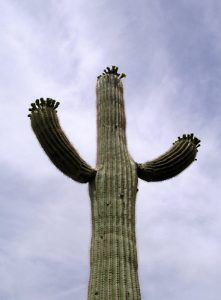
Saguaro Cactus.
The territory of Arizona may be likened to that wild and rugged mountain region in Central Asia, where, according to Persian myth, untold treasures are guarded by the malign legions of Ahriman, the spirit of evil. Two of the great elemental forces have employed their destructive agencies upon the country’s surface until it might serve for an ideal picture of desolation. For countless centuries, the water has seamed and gashed the face of the hills, stripping them of soil and cutting deep gorges and canyons through the rocks. The water then flowed away or disappeared in the sands, and the sun came with its parching heat to complete the work of ruin. Famine and thirst stalk over those arid plains or lurk in the waterless and gloomy canyons; as if to compensate for these evils, the soil of the territory teems with mineral wealth.
Grains of gold glisten in the sandy debris of ancient torrents, and nuggets are wedged in the faces of the precipices. Mountains of silver and copper are waiting for the miner who is bold enough to venture through that desolate region in quest of these metals.
The journey from San Diego was made with pack mules and occupied thirty days, during which nearly every hardship and obstacle in the pioneer’s catalog was encountered. When they reached the spot described by Crossman, they found the place, which lay at the bottom of a deep ravine, had been covered with boulders and thirty feet of sand by the rapid torrents of five rainy seasons. They immediately commenced “prospecting.” Mrs. Braxton had the good fortune to discover a large “pocket,” from which Crossman and her husband took out $30,000 in gold in a few weeks. This contented the adventurers, and being disgusted with the country’s appearance, they decided to go back to California.
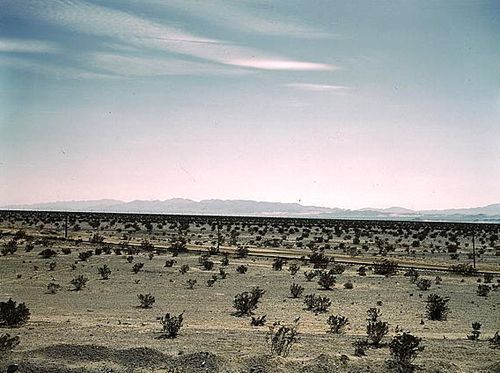
Mojave Desert.
Instead of returning on the same route by which they came, they resolved to cross the Colorado River higher up and in the neighborhood of the Santa Maria. They reached the Colorado River after a toilsome march. While searching for a place to pass over, Crossman lost his footing and fell 60 feet down a precipice, surviving only long enough to bequeath his share of the treasure to his partner. Here, too, they had the misfortune to lose one of their four pack-mules, which strayed away. Pressing on in a northwesterly direction, they passed through a series of deep valleys and gorges where the only water they could find was brackish and bitter and reached the edge of the California desert.
Meanwhile, they had lost another mule that had been dashed to pieces by falling down a canyon. Mr. Whitley’s strength becoming exhausted, his wife gave up to him the beast she had been riding and pursued her way on foot, driving before her the other mule, which bore the gold-dust with their scanty supply of food and their only remaining cooking utensils.
Their tents and camp furniture having been lost, they had suffered much from the chilly nights in the mountains, and after they had entered the desert, from the rays of the sun. Before they could reach the Mohave River, Mr. Whitley became insane from thirst and hunger, and nothing but constant watchfulness on the part of his wife could prevent him from doing injury to himself. Once, while she was gathering cactus leaves to wet his lips with the moisture they contained, he bit his arm and sucked the blood. Upon reaching the river, he drank immoderately of the water and in an hour expired, regaining his consciousness before death and blessing his devoted wife with his last breath. Ten days later, the brave woman had succeeded in reaching Techichipa in such a wasted condition that she looked like a specter risen from the grave. Here, by careful nursing, she was at length restored to health. The gold dust, which had cost so dearly, was found after a long search beneath the carcass of the mule, twenty miles from Techichipa.
The extraordinary exploits of Mrs. Braxton can only be explained by supposing her to be naturally endowed with a larger share of nerve and hardihood than usually falls to the lot of her sex. Some influence, too, must be ascribed to the peculiarly wild and free life that prevails in the southwest. Living so much of the time in the open air in a climate peculiarly luxuriant and yet bracing, and environed with dangers in manifold guise, all the latent heroism in woman’s nature is brought out to view, her muscular and nervous tissues are hardened, and her moral endurance by constant training in the school of hardship and danger rests upon a strong and healthy physique. Upon this theory, we may also explain the following incident related to another border woman of the southwest.
Beyond the extreme outer line of settlements in western Texas, near the headwaters of the Colorado River, and in one of the remotest and most sequestered sections of that sparsely populated district, there lived in 1867, an enterprising pioneer by the name of Babb, whose besetting propensity and ambition consisted in pushing his fortunes a little farther toward the setting sun than any of his neighbors, the nearest of whom, at the time specified, was some 15 miles in his rear.
The borderer’s household consisted of his wife, three small children, and a female friend named Mrs. L., who, having previously lost her husband, was spending the summer with the family. She was a veritable type of vigorous, self-reliant border woman who encountered danger or the vicissitudes of weather without quailing.
Born and nurtured upon the remotest frontier, she inherited a robust constitution, and her active life in the exhilarating prairie air served to develop and mature a healthy womanly physique. From an early age, she had been a fearless rider, and her life on the frontier had habituated her to the constant use of the horse until she felt almost more at home in the saddle than in a chair.
Upon one bright and lovely morning in June 1867, the adventurous borderer before mentioned set out from his home with some cattle for a distant market, leaving his family in possession of the ranch, without any male protectors from Indian marauders.
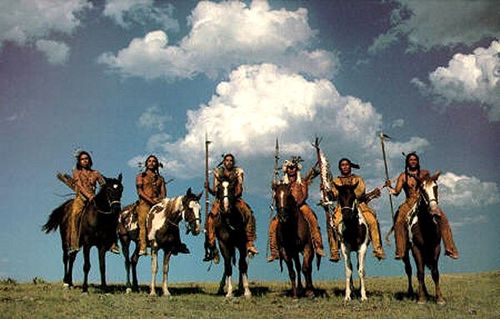
Indians on Horses.
However, they did not entertain any serious apprehensions of molestation in his absence, as no hostile Indians had made their appearance in that locality. Everything passed on quietly for several days until one morning. While the women were busily occupied with their domestic affairs in the house, the two oldest children, who were playing outside, called to their mother and informed her that some mounted men were approaching from the prairie. On looking out, she perceived, to her astonishment, that they were Indians coming upon the gallop and already very near the house. This gave her no time to make arrangements for defense. Still, she screamed to the children to run in for their lives, as she desired to bar the door, being conscious of the fact that the prairie warriors seldom attack a house that is closed, fearing, doubtless, that it may be occupied by armed men, who might give them an unwelcome reception.
However, the children did not obey their mother’s command, believing the strangers to be white men, and the door was left open. As soon as the alarm was given, Mrs. L. sprang up a ladder into the loft and concealed herself so that she could see all that passed beneath through cracks in the floor.
In the meantime, the Indians came up, seized and bound the two children outdoors, and, entering the house, rushed toward the young child, which the terror-stricken mother struggled frantically to rescue from their clutches; but they were too much for her, and tearing the infant from her arms, they dashed it upon the floor; then seizing her by the hair, they wrenched back her head and cut her throat from ear to ear, putting her to death instantaneously.
Mrs. L., who was anxiously watching their proceedings from the loft, witnessed the fiendish tragedy and uttered an involuntary shriek of horror, which disclosed her hiding-place to the barbarians. They instantly vaulted up the ladder, overpowered and tied her. Dragging her rudely down, they placed her, with the two elder children, upon horses, and hurriedly set off to the north, leaving the infant child unharmed, and clasping the murdered corpse of its mangled parent.
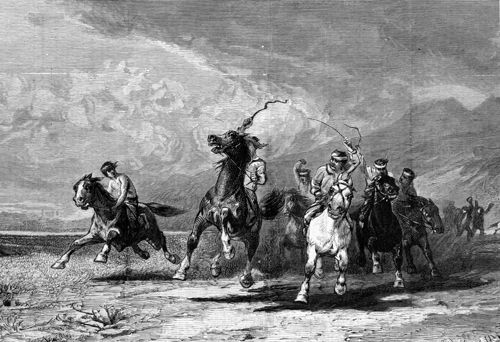
Indians on horses.
Following their usual practice, they traveled as rapidly as their horses could carry them for several consecutive days and nights, only making occasional short halts to graze and rest their animals and get a little sleep themselves, so that the unfortunate captives necessarily suffered indescribable tortures from harsh treatment, fatigue, and want of sleep and food. Yet the Indians forced them to continue on day after day, and night after night, for many, many weary miles toward the “Staked Plain,” crossing en route the Brazos, Wachita, Red, Canadian, and Arkansas Rivers, several of which were at swimming stages.
The warriors guarded their captives very closely until they had gone so far from the settlements that they imagined it impossible for them to make their escape and find their way home when they relaxed their vigilance slightly. They were permitted to walk about a little within short limits from the bivouacs. Still, they were given to understand by unmistakable pantomime that death would be the certain penalty of the first attempt to escape.
Despite this, Mrs. L., who possessed a firmness of purpose truly heroic, resolved to seize the first favorable opportunity to get away. With this resolution in view, she carefully observed the relative speed and powers of endurance of the different horses in the party and noted how they were grazed, guarded, and caught. Upon a dark night, after a long, fatiguing day’s ride, and while the Indians were sleeping soundly, she noiselessly and cautiously crawled away from the bed of her young companions, who were also buried in profound slumber, and going to the pasture-ground of the horses, selected the best, leaped upon his back à la garçon, with only a lariat around his neck, and without saddle or bridle, quietly started at a slow walk in the direction of the north star, believing that this course would lead her to the nearest white habitations. As soon as she had gone out of hearing from the bivouac, without detection or pursuit, she accelerated the speed of the horse into a trot, then to a gallop, and urged him rapidly forward during the entire night.
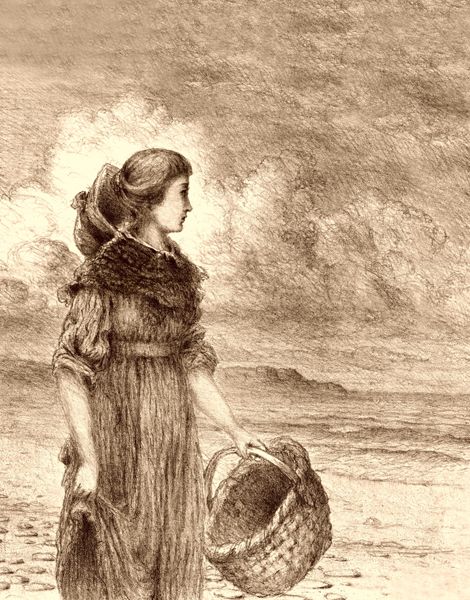
Woman on the Prairie by George E. Niles, 1887.
At the dawn of day on the following morning, she rose upon the crest of an eminence overlooking a vast area of bald prairie country, where, for the first time since leaving the Indians, she halted, and, turning round, tremblingly cast a rapid glance to the rear, expecting to see the savage blood-hounds upon her track; but, to her great relief, not a single indication of a living object could be discerned within the extended scope of her vision. She breathed more freely now, but still did not feel safe from pursuit. The total absence of all knowledge of her whereabouts in the vast expanse of dreary prairie around her, with the uncertainty of ever again looking upon a friendly face, caused her to realize most vividly her weakness and entire dependence upon the Almighty. She raised her thoughts to Heaven in earnest supplication.
The majesty and sublimity of the stupendous works of the great Author and Creator of the Universe, when contrasted with the insignificance of the powers and achievements of a vivified atom of earth modeled into human form, are probably under no circumstances more strikingly exhibited and felt than when one becomes bewildered and lost in the almost limitless amplitude of our great North American “pampas,” where not a single foot-mark or other trace of man’s presence or action can be discovered, and where the solitary wanderer is startled at the sound even of his own voice.
The sensation of loneliness and despair resulting from the appalling consciousness of being really lost, with the realization of the fact that but two or three of the innumerable different points of direction embraced within the circle of the horizon will serve to extricate the bewildered victim from the awful doom of death by starvation, and in entire ignorance as to which of these particular directions should be followed, without a single road, trail, tree, bush, or other landmark to guide or direct–the effects upon the imagination of this formidable array of disheartening circumstances can be fully appreciated only by those who have been personally subjected to their influence.
A faint perception of the intensity of the mental torture experienced by these unfortunate victims may, however, be conjectured from the fact that their senses at such junctures become so wholly absorbed and overpowered by the cheerless prospect before them that they often wander about in a state of temporary lunacy, without the power of exercising the slightest volition of the reasoning faculties.
The steadfast spirit of the heroine of this narrative did not, however, succumb in the least to the imminent perils of the situation in which she found herself. Her purposes were carried out with a determination as resolute and unflinching as those of the Israelites in their long pilgrimage through the wilderness and without the guidance of pillars of fire and cloud.
The aid of the sun and the broad leaves of the pilot plant by day, with the light of Polaris by night, enabled her to pursue her undeviating course to the north with as much accuracy as if the magnetic needle had guided her.
She continued to urge forward the generous steed she bestrode, who, in obedience to the will of his rider, coursed swiftly on hour after hour during the greater part of the day, without the least apparent labor or exhaustion.
It was a contest for life and liberty that she had undertaken, a struggle in which she resolved to triumph or perish in the effort: and still, the brave-hearted woman pressed on, until at length her horse began to show signs of exhaustion, and as the shadows of evening began to appear, he became so much tired that it was difficult to coax or force him into a trot, and the poor woman began to entertain serious apprehensions that he might soon give out altogether and leave her on foot.
At this time, she was herself so much wearied and in want of sleep that she would have given all she possessed to have been allowed to dismount and rest; but, unfortunately for her, those piratical quadrupeds of the plains, the wolves, advised by their carnivorous instincts that she and her exhausted horse might soon fall an easy sacrifice to their voracious appetites, followed upon her track, and came howling in great numbers about her, so that she dared not set her feet upon the ground, fearing they would devour her. Her only alternative was to continue urging the poor beast to struggle forward during the dark and gloomy hours of the long night until, at length, she became so exhausted that it was only with the utmost effort of her iron will that she kept her balance upon the horse.
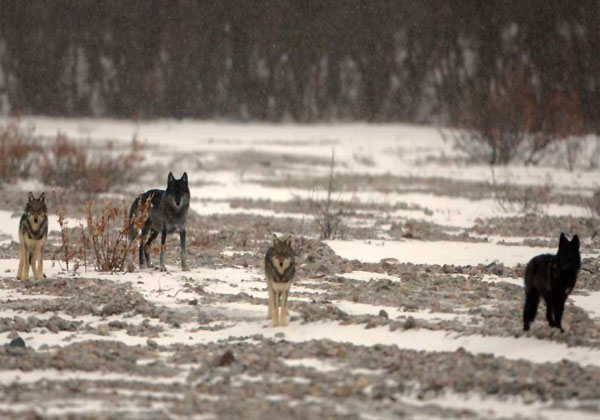
Wolves.
Meanwhile, the ravenous pack of wolves, becoming more and more emboldened and impatient as the speed of her horse relaxed, approached nearer and nearer, until, with their eyes flashing fire, they snapped savagely at the heels of the terrified horse. At the same time, they kept up their hideous concert like the howlings of 10,000 fiends from the infernal regions.
Every element in her nature was at this fearful juncture taxed to its greatest tension and urged her to concentrate the force of all her remaining energies in urging and coaxing forward the wearied horse until, finally, he was barely able to reel and stagger along at a slow walk. When she was about to give up in despair, expecting every instant that the animal would drop down dead under her, the welcome light of day dawned on the eastern horizon. It imparted a more cheerful and encouraging influence over her, and, on looking around, to her great joy, there were no wolves in sight.
She now, for the first time in about 36 hours, dismounted and knew that sleep would soon overpower her, and the horse, if not secured, might escape or wander away. There being no tree or other object to which he could be fastened, she, with great presence of mind, tied one end of the long lariat to his neck and, with the other end around her waist, dropped down upon the ground in a deep sleep. At the same time, the hungry horse eagerly cropped the herbage around her.
She was unconscious of the duration of her slumber, but it must have been very protracted to compensate the demands of nature for the exhaustion induced by her prodigious ride. Her sleep was sweet, and she dreamed of happiness and home, losing all consciousness of her actual situation until she was suddenly startled and aroused by the pattering sound of horses’ feet beating the earth on every side.
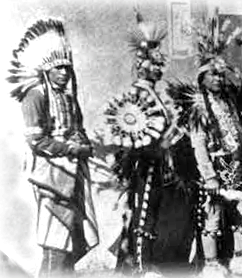
Kiowa Indians.
Springing to her feet in the greatest possible alarm, she found herself surrounded by a large band of hostile Indians, who commenced dancing around, flouting their war clubs in terrible proximity to her head, while giving utterance to the most diabolical shouts of triumph.
Her exceedingly weak and debilitated condition at this time, resulting from prolonged abstinence from food and unprecedented mental and physical trials, had wrought upon her nervous system to such an extent that she imagined the moment of her death had arrived and fainted.
The Indians then approached and, after she revived, placed her again upon a horse and rode away with her to their camp, which, fortunately, was not far distant. They then turned their prisoner over to the Indian women, who gave her food and put her to bed, but it was several days before she was sufficiently recovered to walk about the camp.
She learned that her last captors belonged to “Lone Wolf’s” band of Kiowa. Although these Indians treated her with more kindness than the Comanche had done, yet she did not for an instant entertain the thought that they would ever voluntarily release her from bondage; neither had she the remotest conception of her present locality, or the direction or distance to any white settlement; but she had no idea of remaining a slave for life, and resolved to make her escape the first practicable moment that offered.
During the time she remained with these Indians, a party of men went away to the north and was absent for six days. On their return, they brought with them some ears of green corn. She knew the prairie tribes never planted a seed of any description and was, therefore, confident the party had visited a white settlement and that it was not over three days’ journey distant. This was encouraging intelligence for her, and she anxiously bided her time to depart.
Late one night, after all had become quiet throughout the camp. Everything seemed promising for the consummation of her purposes, she stole carefully away from her bed, crept softly out to the herd of horses, and after having caught and saddled one, was in the act of mounting, when several dogs rushed out after her, and by their barking, created such a disturbance among the Indians that she was forced, for the time, to forego her designs and crawl hastily back to her lodge.
On a subsequent occasion, however, fortune favored her. She secured an excellent horse and rode away in the direction from which she had seen the Indians returning to camp with the green corn. Under the guidance of the sun and stars, she was able to pursue a direct bearing. After three consecutive days of rapid riding, anxiety, fatigue, and hunger, she arrived at the border of a large river, flowing directly across her track. The stream was swollen to the top of its banks; the water coursed like a torrent through its channel, and she feared her horse might not be able to stem the powerful current; but after surmounting the numerous perils and hardships she had already encountered, the dauntless woman was not to be turned aside from her inflexible purpose by this formidable obstacle. She instantly dashed into the foaming torrent, forced her horse through the stream, and landed safely upon the opposite bank.
After giving her horse a few moments’ rest, she again set forward. She had ridden but a short distance when, to her inexpressible astonishment and delight, she struck a broad and well-beaten wagon road, the first and only evidence or trace of civilization she had seen since leaving her home in Texas.
Up to this joyful moment, the indomitable inflexibility of purpose of our heroine had not faltered for an instant, neither had she suffered the slightest despondency, given the terrible array of disheartening circumstances that had continually confronted her, but when she realized the hopeful prospect before her of a speedy escape from the reach of her barbarous captors, and a reasonable certainty of an early reunion with people of her sympathizing race, the feminine elements of her nature preponderated, her stoical fortitude yielded to the delightful anticipation. Her joy was intensified and confirmed by seeing, at this moment, a long train of wagons approaching over the distant prairie.
The spectacle overwhelmed her with ecstasy, and she wept tears of joy while offering up heartfelt thanks to the Almighty for delivering her from a bondage more dreadful than death.
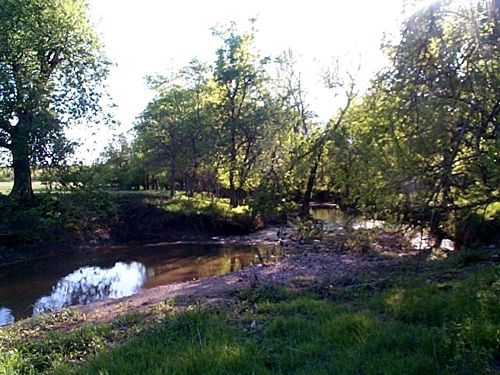
Big Turkey Creek.
She then proceeded until she met the wagons in charge of Mr. Robert Bent, whom she entreated to give her food instantly, as she was in a state bordering absolute starvation. He kindly complied with her request, and after the cravings of her appetite had been appeased, he desired to gratify his curiosity, which had been not a little excited at the unusual exhibition of a beautiful white woman appearing alone in that wild country, riding upon an Indian saddle, with no covering on her head save her long natural hair, which was hanging loosely and disorderly about her shoulders.
Accordingly, he inquired of her where she lived, to which she replied, “In Texas .” Mr. Bent gave an incredulous shake of his head at this response, remarking at the same time that he thought she must be mistaken, as Texas happened to be situated some five or 600 miles distant. She reiterated her statements and briefly described the leading incidents that led to her capture and escape to him. However, he was inclined to doubt, believing that she might be insane.
He informed her that the river she had just crossed was the Arkansas River and that she was then on the old Santa Fe road, about 15 miles west of Big Turkey Creek, where she would find the most remote frontier house. Then, after thanking him for his kindness, she bade him adieu and started away on a walk toward the settlements while he continued his journey in the opposite direction. However, he still followed the exit of the remarkable apparition with his eyes until she was several hundred yards distant when he observed her throw one of her feet over the horse’s back, ‘a la femme sauvage, and casting a graceful kiss toward him with her hand, she set off on a gallop and soon disappeared over the crest of the prairies.
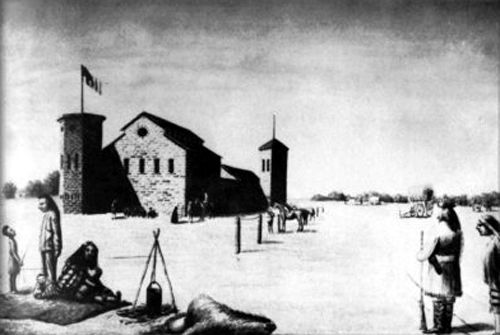
Fort Zarah, Kansas.
On the arrival of Mr. Bent at Fort Zarah, Kansas, he called upon the Indian agent. He reported the circumstance of meeting Mrs. L., and, by a singular coincidence, it so happened that the agent was at that very time holding a council with the chiefs of the identical band of Indians from whom she had last escaped. They had just given a complete history of the entire affair, which seemed so improbable to the agent that he was not disposed to credit it until he received its confirmation through Mr. Bent. He at once dispatched a man to follow the woman and conduct her to Council Grove, Kansas, where she was kindly received and remained for some time. Hoping through the efforts of the agents to gain intelligence of the two children she had left with the Comanche, she desired to take them back to their father in Texas, but gained no tidings for a long while. The two captive children were afterward ransomed and sent home to their father.
It will readily be seen, by a reference to the map of the country over which Mrs. L. passed, that the distance from the place of her capture to the point where she struck the Arkansas River could not have been short of about 500 miles, and the greater part of this immense expanse of desert plain she traversed alone, without seeing a single civilized human habitation.
It may well be questioned whether any woman, ancient or modern, ever performed such a remarkable equestrian feat, and the story itself would be almost incredible were we not in possession of so many well-authenticated instances of the hardihood and powers of endurance shown by women on the frontiers of our country.
By William Worthington Fowler, 1877. Compiled and edited by Kathy Alexander/Legends of America, updated May 2025.
About the Author: William Worthington Fowler, initially published in 1877, wrote a book entitled Woman On The American Frontier: A Valuable and Authentic History. The article above is excerpted from this excellent work, which is now in the public domain. The text that appears here is not verbatim and has been edited in length, punctuation, and verbiage for the modern reader.
Also See: