
By Andy Adams in 1906
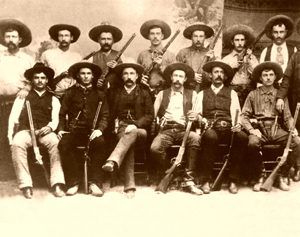
Texas Rangers Company D 1887 in Realitos, Texas. The caption on the original photo identifies the men as follows: Back Row from left Jim King, Baz Outlaw, Riley Barton, Charles H. Fusselman, James W. “Tink” Durbin, Ernest Rogers, Charles Barton, Walter Jones (Cut out of this version of the photo). Sitting Bob Bell, Cal Aten, Capt. Frank Jones, Walter Durbin, Jim Robinson, Frank Schmidt.
No State in the Union was ever called upon to meet and deal with the criminal element, as was Texas. She was a border territory upon her admission to the sisterhood of states. An area equal to four ordinary states and a climate that permitted outdoor life year-round made it a desirable rendezvous for criminals. The sparsely settled condition of the country, with immigration remaining light until the seventies, was an essential factor.
With a common impulse, the fugitives from justice of the older states turned toward this empire of isolation. Europe contributed its quota, particularly from the south, bringing the Mafia and vendetta with them. Once, it was the mystery of the criminal Western world. The crime catalog was fully represented, from the man who came not to build a church to the one who had taken human life.
Humorous writers tell us that it was a breach of good manners to ask a man his name, or what state he was from, or to examine the brand on his horse very particularly. It can be safely said that much truth is mingled with humor. Some of these fugitives from justice became good citizens, but the majority, sooner or later, returned to their former callings.
Along with this criminal immigration came the sturdy settler, the man intent on building a home and establishing a fireside. Usually following lines of longitude, he came from other Southern States. He also brought with him the fortitude of the pioneer who reclaims the wilderness and meets any emergency that confronts him. Meeting and dealing with this criminal element as a matter of necessity soon became an important consideration. His only team of horses was frequently stolen. His cattle ran off their range, their earmarks altered, and their brands changed. Frequently, it was a band of neighbors, together in a posse, who followed and brought the marauders to bay. It was an unlucky moment for a horse thief when he was caught possessing another man’s horse. The impromptu court of emergency had no sentiment regarding the passing sentence of death. It was a question of guilt, and when that was established, Judge Lynch passed the sentence.
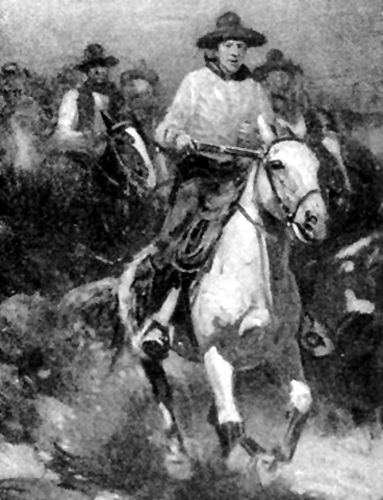
Posse.
As the state advanced, the authorities enlisted small companies of men called Rangers. The citizens’ posse soon gave way to this organized service. The companies, few in number at first, were gradually increased until the state had over a dozen companies in the field. These companies numbered between ten and 60 men. It can be said with no discredit to the state that there were never half enough companies of men for the work before them.
There was a frontier of over 2,000 miles west of the south and west to be guarded. A fair specimen of the large things in that state was a shoestring congressional district over 1,100 miles long. To the Ranger, then, is due all credit for guarding this western frontier against the Indians and for making life and the possession of property possible. On the south was to be met the bandit, the smuggler, and every grade of criminal known to the code.
A generation had come and gone before the Ranger’s work was pretty done. The emergency demanded brave men. They were ready. Not necessarily born to the soil, as a boy, the guardian of the frontier was an expert in the use of firearms and, in the saddle, a tireless rider. As trailers, many of them were equal to hounds. They were artists using that arbiter of the frontier, the six-shooter. As a class, never before or since have their equals in using that arm come forward to question this statement.
While familiar with firearms, the average criminal was as badly handicapped as a woman would be against a man. The Ranger had no equal. The emergency that produced him no longer exists; he will never have a successor. Any attempt to copy the original would be a hopeless imitation. He was shot at a short range more often than he received his monthly wage. He admired the criminal who would fight and despised one who would demand surrender. He would nurse back to life a dead-game man whom his own shot had brought to earth and give a coward a chance to run any time if he desired.
He was compelled to lead an open life and often descended to the level of a criminal. He had few elements in his makeup and a single purpose, but he executed that one purpose — to rid the state of crime — with a vengeance. He was poorly paid for the service rendered. Frequently, there was no appropriation to pay him; then, he lived by rewards and the friendship of ranchmen.
 The Ranger always had a fresh horse at his command — no one thought of refusing him this. Rustproof, rugged, and tireless, he protected the state’s life and property. The emergency had produced the man.
“Here, take my glass and throw down on that grove of timber yonder, and notice if there is any sign of animal life to be seen,” said Sergeant “Smoky” C—-, addressing “Ramrod,” a private in Company X of the Texas Rangers. The sergeant and the four men had been out on special duty, and now we had halted after an all-night ride looking for shade and water, — the latter especially. We had two prisoners who were horse thieves, some extra saddle stock, and three pack mules.
It was an hour after sun-up. We had just come out of the foothills, where the Brazos has its source, and before us lay the plains, dusty and arid. This grove of green timber held out a hope that within it might be found what we wanted. Eyesight is as variable as men’s, but Ramrod’s was known to be reliable for five miles with the naked eye and ten with the aid of a good glass. He dismounted at the sergeant’s request and focused the glass on this oasis and, after sweeping the field for a minute or so, remarked languidly, “There must be water there. I can see a band of antelope grazing out from the grove. Hold your mules! Something is raising a dust over to the south. Good! It’s cattle coming to the water.”
While he was covering the field with his glass, two of the boys were threatening eternal punishment of the pack mules, which showed an energetic determination to lie down and dislodge their packs by rolling.
“Cut your observations short as possible there, Ramrod, or there will be re-packing to do. Mula, you hybrid son of your father, don’t you dare to lie down!”
But Ramrod’s observations were cut short at the sight of the cattle, and we pushed out for the grove, about seven miles distant. As we rode this short hour’s ride, numerous small bands of antelope were startled and, in turn, stood and gazed at us in bewilderment.
“I’m not tasty,” said Sergeant Smoky, “but I would give the preference this morning to a breakfast of a well-roasted side of ribs of a nice yearling venison over the salt hoss that the Lone Star State furnishes this service. Have we no hunters with us?”
“Let me try,” begged a little man we called “Cushion-foot.” What his real name was, none of us knew. The books, of course, would show some name, and then you were entitled to a guess. He was as quiet as a mouse, as reliable as he was quiet, and as noiseless in his movements as a snake. One of the boys went with him, making quite a detour from our course but always remaining in sight. About two miles from the grove, we saw a small band of five or six antelope, which soon took fright and ran to the nearest elevation. Here, they made a stand about half a mile distant. We signaled to our hunters, who soon spotted them and dismounted. We could see Cushion sneaking through the short grass like a coyote, “Conajo” leading the horses, well hidden between them. We held the antelopes’ attention by circling and flagging them. Several times, Cushion lay flat, and we thought he would risk a long shot. Then he would crawl forward like a cat, but finally came to his knees. We saw the little puff, the band squatted, jumping to one side far enough to show one of their number down and struggling in the throes of death.
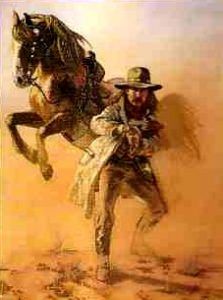
Painting of a Texas Ranger by Hermon Adams.
“Good long shot, little man,” said the sergeant, “and you may have the choice of cuts so that I get a rib.”
We saw Conajo mount and ride up on a gallop, but we held our course for the grove. We were busy making camp when the two rode in with a fine two-year-old buck across the pommel of Cushion’s saddle. They had only disemboweled him, but Conajo had the heart as a trophy of the shot’s accuracy, though Cushion hadn’t a word to say. It was a splendid heart shot. Conajo took it over and showed it to the two Mexican prisoners. It was an object lesson to them. One said to the other, “Es un buen tirador.”
We put the prisoners to roasting the ribs and making themselves useful. One man guarded them at work while all the others attended to the hobbling and other camp duties.
It proved to be a delightful camp. We aimed to stay until sunset, the days being sultry and hot. Our appetites were equal to the breakfast, and it was a good one.
“To do justice to an occasion like this,” said Smoky as he squatted down with about four ribs in his hand, “a man by rights ought to have at least three fingers of good liquor under his belt. But then we can’t have all the luxuries of life in the far West; sure to be something lacking.”
“I never hear a man hanker for liquor,” said Conajo, as he poured out a tin cup of coffee, “but I think of an incident my father used to tell us boys at home. He was the sheriff in Kentucky before we moved to Texas. Was the sheriff in the same county for twelve years? Counties are very irregular back in the old States. Some look like Mexican brands.
One of the rankest, rabid political admirers my father had lived away on a spur of this county. He lived about 30 miles from the county seat. Didn’t come to town over twice a year, but he always stopped, generally overnight, at our house. My father wouldn’t have it any other way. Talk about thieves being chummy; why these two we have here couldn’t hold a candle to that man and my father. I can see them parting just as distinctly as it was yesterday. He would always abuse my father for not coming to see him. ‘Sam,’ he would say, — my father’s name was Sam, — ‘Sam, why on earth is it that you never come to see me? I’ve heard of you within ten miles of my plantation, and you have never shown your face to us once. Do you think we can’t entertain you? Why, Sam, I’ve known you since you weren’t big enough to lead a hound dog. I’ve known you since you weren’t knee to a grasshopper.’
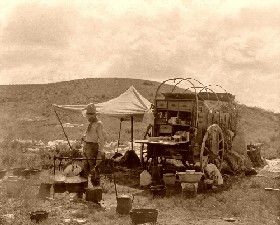
Cookie at the Chuckwagon.
“‘Let me have a word,’ my father would put in, for he was very mild in speaking; ‘let me have a word, Joe. I hope you don’t think for a moment that I wouldn’t like to visit you, now, do you?’
“‘No, I don’t think so, Sam, but you don’t come. That’s why I’m complaining. You have never come in ten years you’ve been sheriff, and you know that we have voted for you to a man, in our neck of the woods.’ My father felt this last remark, though I think he never realized its gravity before, but he took him by one hand and, laying the other on his shoulder, said, ‘Joe, if I have slighted you in the past, I’m glad you have called my attention to it. Now, let me tell you the first time my business takes me within ten miles of your place, I’ll make it a point to reach your house and stay all night, and longer if I can.’
“‘That’s all I ask, Sam,’ was his only reply. Now I’ve learned lots of the ways of the world since then. I’ve seen people pleasant to each other, and behind their backs, the tune changed. But I want to say to you fellows that those two old boys were not throwing off on each other–not a little bit.
They meant every word and meant it sincerely. It was months afterward, and father had been gone for a week, when he came home. He told us about his visit to Joe Evans. It was wintertime, and mother and we boys sat around the old fireplace in the evening. ‘I never saw him so embarrassed before in my life,’ said father.
‘I did ride out of my way, but I was glad of the chance. Men like Joe Evans are getting scarce.’ He nodded to us boys. ‘It was nearly dark when I rode up to his gate. He recognized me and came down to the gate to meet me. “Howdy, Sam,” was all he said. There was a troubled expression on his face, though he looked well enough, but he couldn’t simply look me in the face. Just kept his eye on the ground. He motioned for a ni**er boy and said to him, “Take his horse.” He started up the path when I stopped him. “Look here, Joe,” I said to him. “Now, if there’s anything wrong, anything likely to happen in the family, I can just as well drop back on the pike and stay all night with some of the neighbors. You know I’m acquainted all around here.” He turned in the path, and there was the most painful look in his face I ever saw as he spoke: “Hell, no, Sam, there’s nothing wrong. We’ve got plenty to eat, plenty of beds, no end of horse-feed, but by G—-, Sam, there isn’t a drop of whiskey on the place!”‘
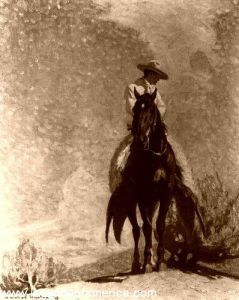
Range Rider.
“You see, it was hoss and cabello, and Joe seemed to think the hoss on him was an unpardonable offense. Salt? You’ll find it in an empty one-spoon baking-powder can over there. In those panniers that belong to that big sorrel mule. Look at Mexico over there burying his fangs in the venison, will you?”
Ramrod was on guard, but he was so hungry himself that he was good enough to let the prisoners eat at the same time, although he kept them at a respectable distance. He was old in the service and had gotten his name under a baptism of fire. He was watching a pass once for smugglers at a point called Emigrant Gap. This was long before he joined the present company. At length, the man he was waiting for came along. Ramrod went after him at close quarters, but the fellow was game and drew his gun. When the smoke cleared away, Ramrod had brought down his horse and winged his man right and left. The smuggler was not far behind on the shoot, for Ramrod’s coat and hat showed he was calling for him. The captain was joshing the prisoner about his poor shooting when Ramrod brought him into camp, and they were dressing when they couldn’t find him. He’s built like a ramrod.”
After breakfast, we smoked and yarned. It would be two-hour guards for the day, keeping an eye on the prisoners and stock; only one man was required, so we would all get plenty of sleep. Conajo had the first guard after breakfast. “I remember once,” said Sergeant Smoky, as he crushed a pipe of twist with the heel of his hand, “we were camped out on the ‘Sunset’ railway. I was a corporal at the time. One day, our captain received a message to send a man up West on that line to take charge of a murderer.
The result was that I was sent by the first train to this point. When I arrived, I found that an Irishman had killed a Chinaman. It was on the railroad, at a bridge construction camp, that the fracas took place. There were about 100 employees at the camp, and they ran their own boarding tent. They had a Chinese cook at this camp, and many Chinese were employed at common labor on the road.
Some cavalryman, it was thought, in passing up and down from Fort Stockton to points on the river, had lost his saber, and one of this bridge gang had found it. When it was brought into camp, no one would have the old corn cutter; but this Irishman took a shine to it, having once been a soldier himself. The result was that it was presented to him. He ground it up like a machete and took great pride in giving exhibitions with it. He was an old man now, the storekeeper for the iron supplies, a kind of trusty job. The old saber renewed his youth to a certain extent, for he used it in self-defense shortly afterward.
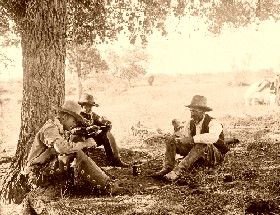
Cowboys Taking a Break.
This Erin-go-bragh — his name was McKay, I think, was in the habit now and then of stealing a pie from the cook and taking it into his own tent and eating it there. The Chink kept missing his pies and got a helper to spy out the offender. The result was that they caught the old man red-handed. The Chink armed himself with the biggest butcher knife he had and went on the warpath. He found the old fellow sitting contentedly in his storeroom, eating the pie. The old man had his eyes on the cook and saw the knife just in time to jump behind some kegs of nuts and bolts. The Chink followed him with murder in his eye, and as the old man ran out of the tent, he picked up the old saber. Once clear of the tent, he turned and faced him, made only one pass, and cut his head off as though he were beheading a chicken.
They hadn’t yet buried the Chinaman when I got there. I’m willing to testify that it was an artistic job. They turned the old man over to me, and I took him down to the next station, where an old alcalde lived, — Roy Bean by name. This old judge was known as ‘Law west of the Pecos,’ as he generally construed the law to suit his opinion of the offense. He wasn’t even strong on testimony. He was a ranchman then, so when I presented my prisoner, he only said, ‘Killed a Chinese, did he? Well, I ain’t got time to try the case today. Cattle are suffering from a lack of water, and three windmills are out of repair. Bring him back in the morning.’ I took the old man back to the hotel, and we had a jolly good time together that day. I never put a string on him, only locked the door, but we slept together. The next morning, I took him before the alcalde. Bean held court in an outhouse, the prisoner seated on a bale of flint hides. Bean was not only the judge but also the prosecutor and counsel for the defense. ‘Killed a Chinaman, did you?’

Judge.
“‘I did, yer Honor,’ was the prisoner’s reply.
“I suggested to the court that the prisoner be informed of his rights, that he need not plead guilty unless he so desired.
“‘That makes no difference here,’ said the court.’ Gentlemen, I’m busy this morning. I’ve got to raise the piping out of a 200-foot well today — something’s the matter with the valve at the bottom. I’ll glance over the law a moment.’
“He rummaged over a book or two for a few moments and then said,’ Here, I reckon this is near enough. I find in the revised statute before me, in the killing of a n***er, the offending party was fined five dollars. A Chinaman ought to be half as good as a black man. Stand up and receive your sentence. What’s your name?’
“‘Jerry McKay, your Honor.’
“Just then, the court noticed one of the vaqueros belonging to the ranch standing in the door, hat in hand, and he called to him in Spanish, ‘Have my horse ready, I’ll be through here just in a minute.’
“‘McKay,’ said the court as he gave him a withering look, ‘I’ll fine you two dollars and a half and costs. Officer, take charge of the prisoner until it’s paid!’ It took about ten dollars to cover everything, which I paid, McKay returning it when he reached his camp. Whoever named that alcalde’ Law west of the Pecos’ knew his man.”
“I’ll bet a twist of dog,” said Ramrod, “that prisoner with the black whiskers spoke English. Did you notice him paying strict attention to Smoky’s little talk? He reminds me of a fellow who crouched behind his horse at the fight we had on the head of the Arroyo Colorado and plugged me in the shoulder. What, you never heard of it? That’s so, Cushion hasn’t been with us for a few months. Well, it was in ’82, down on the river, about fifty miles northwest of Brownsville. Word came in one day that a big band of horse thieves was sweeping the country of every horse they could gather. There were a number of the old Cortina gang known to still be on the rustle. When this report came, it found eleven men in camp. We lost little time saddling up, taking only five days’ rations with us, for they were certain to re-cross the river before then in case we failed to intercept them. Every Mexican in the country was terrorized. All they could tell us was that there were plenty of ladrones and lots of horses, ‘muchos’ being the qualifying word as to the number of either.
“It was night before we came to their trail, and to our surprise, they were heading inland, to the North, and must have had a contract to supply the Mexican army with cavalry horses. They were sweeping the country, taking nothing but gentle stock. These they bucked in strings and led. That made easy trailing, as each string left a distinct trail. The moon was splendid that night, and we trailed as easily as though it had been day. We didn’t halt all night long on either trail, pegging along at a steady gait that would carry us inland some distance before morning. Our scouts aroused every ranch within miles that we passed on the way, only to have reports exaggerated as usual. One thing we did learn that night was that a white man led the robbers. He was described in the superlatives that the Spanish language possesses abundantly; everything from the horse he rode to the solid braid on his sombrero was described in the same strain. But that kind of prize was the kind we were looking for.
“On the head of the Arroyo Colorado, there is a broken country interspersed with glades and large openings. We felt very sure that the robbers would make camp somewhere in that country. When day broke, the freshness of the trail surprised and pleased us; they couldn’t be far away. Before an hour passed, we noticed a smoke cloud hanging low in the morning air about a mile ahead. We dismounted and securely tied our horses and pack stock.
Every man took all the cartridges he could use and was itching to use them. We left the trail and, to conceal ourselves, took to the brush or dry arroyos for protection against alarming the quarry. They were a quarter of a mile off when we first sighted them. We began to think the reports were right, for there seemed no end of horses and at least twenty-five men. By dropping back, we could gain one of those dry arroyos, which would bring us within 100 yards of their camp. A young fellow by the name of Rusou, a crack shot, was acting captain in the absence of our officers. As we backed into the arroyo, he said to us, ‘If there’s a white man there, leave him to me.’ We were all satisfied that he would be adequately cared for in Rusou’s hands, and silence gave consent.
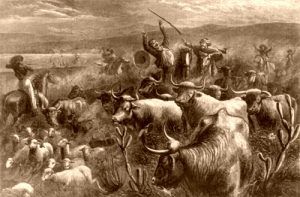
Cattle Rustlers,
“Opposite the camp, we wormed out of the arroyo like a skirmish line, hugging the ground for the one remaining little knoll between the robbers and ourselves. I was within a few feet of Rusou as we sighted the camp about seventy-five yards distant. We were trying to make out a man that was asleep, at least he had his hat over his face, lying on a blanket with his head in a saddle. We concluded he was a white man if there was one. Our survey of their camp was cut short by two shots fired at us by two pickets of theirs posted to our left about one hundred yards. No one was hit, but the sleeping man jumped to his feet with a six-shooter in each hand. I heard Rusou say to himself, ‘You’re too late, my friend.’ His carbine spoke, and the fellow fell forward, firing both guns into the ground at his feet as he went down.
“Then the stuff was off, and she opened up in earnest. They fought all right. I was on my knee pumping lead for dear life, and as I threw my carbine down to refill the magazine, a bullet struck it in the heel of the magazine with sufficient force to knock me backward. I thought I was hit for an instant, but it passed in a moment. When I tried to work the lever, I saw that my carbine was ruined. I called the boys to notice a fellow with black whiskers who was shooting from behind his horse. He would shoot over and under alternately. I thought he was shooting at me. I threw down my carbine and drew my six-shooter. Just then, I got a plug in the shoulder, and things got dizzy and dark. It caught me an inch above the nipple, ranging upward, — shooting from under, you see. But some of the boys must have noticed him, for he decorated the scene badly when it was over. I was unconscious for a few minutes, and when I came around, the fight had ended.
“During the few brief moments that I was knocked out, our boys had closed in on them and mixed it with them at short range. The thieves took to such horses as they could lay their hands on, and one fellow went no farther. A six-shooter halted him at fifty yards. The boys rounded up over a hundred horses, each one with a fiber grass halter on, besides killing over twenty wounded ones to put them out of their misery.
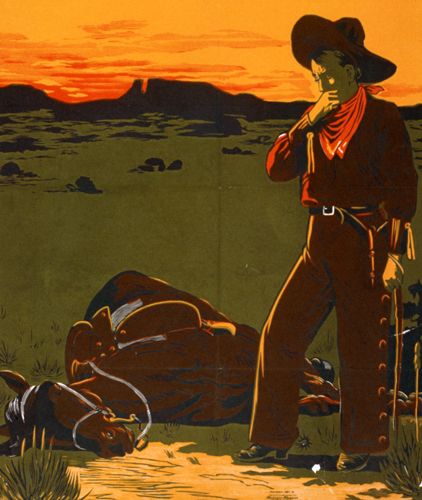
Lost horse.
“It was a nasty fight. Two of our own boys were killed, and three were wounded. But then you ought to have seen the other fellows; we took no prisoners that day. Nine men lay dead. Horses were dead and dying all around, and the wounded ones were crying in agony.
“This white man proved to be a typical dandy, a queer leader for such a gang. He was dressed in buckskin throughout, while his sombrero was as fine as money could buy.
You can know it was a fine one, for it was sold for company prize money and brought $350. He had nearly $4,000 on his person and in his saddle. A belt that we found on him had $1,100 in bills and $600 in good old yellow gold. The silver in the saddle was mixed, Mexican and American, about equally.
“He had as fine a gold watch in his pocket as you ever saw, while his firearms and saddle were beauties. He was a dandy all right and a fine-looking man, over six feet tall, with a swarthy complexion and hair like a raven’s wing. He was too nice a man for the company he was in. We looked over the ‘Black Book’ afterward for any description of him. At that time, there were over 4,000 criminals and outlaws described in it, but none that fit him. For this reason, we supposed that he must live far in the interior of Mexico.
“Our saddle stock was brought up, and our wounded were bandaged as best they could be. My wound was the worst, so they decided to send me back. One of the boys went with me, and we rode 50 miles before we got medical attention. While in the hospital, I got my divvy of the prize money, something over four hundred dollars.”
When Ramrod had finished his narrative, he was compelled to submit to cross-examination at the hands of Cushion-foot, for he delighted in a skirmish. All his questions being satisfactorily answered, Cushion-foot drew up his saddle alongside where Ramrod lay stretched on a blanket and seated himself. This was a signal to the rest of us that he had a story, so we drew near, for he spoke so low that you must be near to hear him. His years on the frontier were rich in experience, though he seldom referred to them.
Addressing himself to Ramrod, he began: “You might live amongst these border Mexicans all your life and think you knew them, but every day you live, you’ll see new features about them. You can’t calculate them with any certainty. What they ought to do by any system of reasoning, they never do. They will steal an article and then give it away. You’ve heard the expression ‘robbing Peter to pay Paul.’ Well, my brother played the role of Paul once himself. It was out in Arizona at a place called Las Palomas. He was a stripling of a boy but could palaver Spanish in a manner that would make a Mexican ashamed of his ancestry. He was about 18 at this time and was working in a store. One morning, as he stepped outside the store where he slept, he noticed quite a commotion around the customs house. He noticed the town was full of strangers as he crossed toward the crowd. He was suddenly halted and searched by a group of strange men. Fortunately, he had no arms on him, and his ability to talk to them, together with his boyish looks, ingratiated him in their favor, and they made him their prisoner. Just at that moment, an alcalde rode up to the group about him and was ordered to halt. He saw at a glance they were revolutionists and, whirling his mount, attempted to escape when one of them shot him from his horse. The young fellow then saw what he was into.
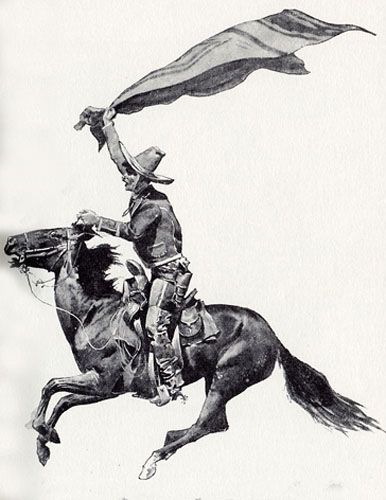
Mexican Vaquero, Frederic Remington.
“They called themselves Timochis. They belonged in Mexico, and a year or so earlier, they refused to pay the taxes the Mexican government levied on them and rebelled. Their own government sent soldiers after them, resulting in about eight hundred soldiers being killed when they dispersed into small bands, one of which was paying Las Palomas a social call that morning. Along the Rio Grande, it is only a short step at best from revolution to robbery, and either calling has its variations.
“Well, they took my brother with them to act as a spokesman in looting the town. The customs house was a desired prize, and when my brother interpreted their desires to the collector, he consented to open the safe, as life had charms for him, even in Arizona. Uncle Sam’s strong box yielded over a thousand dobes. They turned their attention to the few small stores in the town, looting them of money and goods as they went.
There was quite a large store kept by a Frenchman, who refused to open when he realized that the Timochi was honoring the town with his presence. They put the boy in the front and ordered him to call on the Frenchman to open up. He said afterward that he put in a word for himself, telling him not to do any shooting through the door. After some persuasion, the store was opened and proved to be quite a prize. Then they turned their attention to the store where the boy worked. He unlocked it and waved them in. He went into the cellar, brought up half a dozen bottles of imported French Cognac, and invited the chief bandit and his followers to be good enough to join him. In the meantime, they had piled up on the counters whatever they wanted. They made no money demand on him; the chief asked him to set a price on the things they were taking. He made a hasty inventory of the goods and gave the chief the figures, about one hundred and ten dollars. The chief opened a sack they had taken from the custom house and paid the bill with a flourish.
“The chief then said he had a favor to ask: that my brother should cheer for the revolutionists, to identify him as a friend. That was easy, so he mounted the counter and gave three cheers of ‘Viva los Timochis!’ He got down off the counter, took the bandit by the arm, and led him to the rear, where, with glasses in the air, they drank to ‘Viva los Timochis!’ again. Then the chief and his men withdrew and re-crossed the river. It was the best day’s trade he had had in a long time. Now, here comes the native. While the boy did everything from compulsion and policy, the native element looked upon him with suspicion. Knowing that this suspicion existed, the store owners advised him to leave, and he did.”
The two prisoners were sleeping soundly. Sleep comes easily to tired men, and soon all but the solitary guard were wrapped in sleep to fight anew in rangers’ dreams scatheless battles!
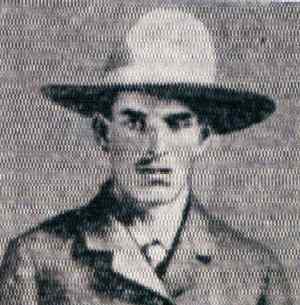
Sam Bass.
There was no lack of pathetic shade in the redemption of this State from crime and lawlessness. In the village burying ground of Round Rock, Texas, is a simple headstone devoid of any lettering save the name “Sam Bass.” His long career of crime and lawlessness would fill a good-sized volume. He met his death at the hands of the Texas Rangers. Years afterward, a woman, with all the delicacy of her sex and knowing the odium attached to his career, came to this town from her home in the North and sought out his grave. As only a woman can, when some strong tie of affection binds, this woman went to work to mark the last resting place of the wayward man. Concealing her identity, she performed these sacred rites, clothing her relation to the criminal in mystery. The village people would not have withheld their services in well-meant friendship, but she shrank from them, being a stranger.
A year passed, and she came again. This time, she brought the stone that marks his last resting place. The chivalry of these generous people was aroused in admiration of a woman who would defy the calumny attached to an outlaw. While she would have shrunken from kindness, had she been permitted, such devotion could not go unchallenged. So she disclosed her identity.
She was his sister.
Bass was Northern born, and this sister was the wife of a respectable practicing physician in Indiana. Womanlike, her love for a wayward brother followed him beyond his disgraceful end. With her own hands, she performed an act with few equals as a testimony of love and affection for her own.
For years afterward, she came annually, her timidity having worn away after the generous reception accorded her by a hospitable people.
By Andy Adams, 1906. Compiled and edited by Kathy Alexander/Legends of America, updated November 2025.
About the Author: Rangering was written by Andy Adams in 1906 and included in his book Cattle Brands: A Collection of Western Camp-Fire Stories. As it appears here, the story has been edited.
Also See:
Texas Rangers – Order Out of Chaos