
By David Saville Muzzey, 1920
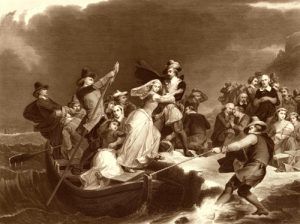
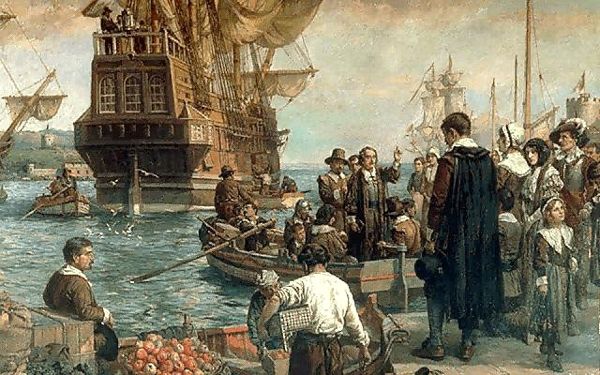
Landing of the Pilgrims on Plymouth, by Peter Frederick RockRothermel, 1869.
While the “Old Dominion” was being established at Jamestown, Virginia, a very different history took place in the northern regions granted to the Ferdinando Plymouth Company. This company sent out a colony in the same year that the London Company settled Jamestown in 1607, but one winter in the little fort at the mouth of the Kennebec River on the ice-bound coast of Maine was enough to send the frozen settlers back to England. Sir Ferdinando Gorges, the governor of Plymouth, was the driving force behind the company. Despite his losses in the expedition of 1607-1608, he showed a determination worthy of Sir Walter Raleigh. In 1614, Gorges sent Captain John Smith, who had earlier played a significant role in founding Jamestown, to explore the coast of “northern Virginia,” as the Plymouth grant was known. Smith created a map of the coast from Cape Cod to Nova Scotia, naming the land “New England.” On the map of America that he created, he first included familiar names such as Cambridge, the Charles River, Plymouth, and Cape Ann. In 1620, Gorges persuaded the king to make a new grant of this territory to several nobles and gentlemen about the court, designated as the Council for New England.
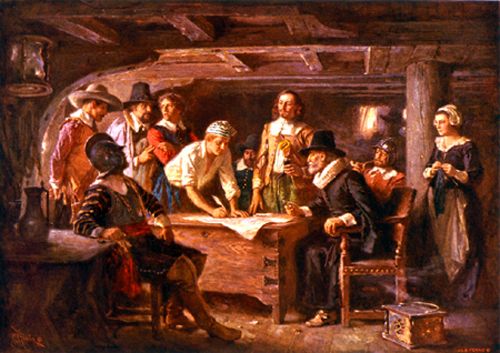
Mayflower Compact, by Jean Leon Gerome Ferris, 1932
A few weeks after the formation of this new company, a group of 100 men and women, later known as the “Pilgrims,” landed the little vessel of Mayflower at Plymouth. The Council did not send them to New England or by the London Company. Their objective was neither to explore the country for gold nor to find a northwest passage to the Indies. Instead, they came of their own free will to found homes in the wilderness, where they might worship God according to their conscience. These “Independents” had separated from the Church of England because it retained in its worship many features, such as vestments, altars, and ceremonies, which seemed to them “idolatrous” as the Roman Catholic rites, which England had rejected.
During this time, religion was an affair of the state, not just a matter of private choice. Rulers enforced uniformity in creed and worship, believing it necessary to preserve their authority. For men who were too brave to conceal their convictions and too honest to modify them at the command of the sovereign, only three courses were open: to submit to persecution and martyrdom, to rise in armed resistance, or to retire to a place beyond the reach of the king’s arm.
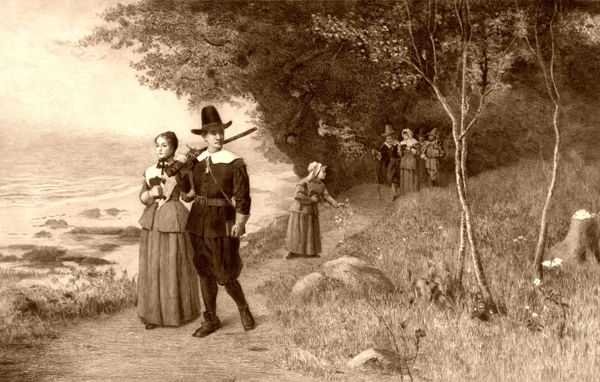
Pilgrims holding Bibles.
Many of these separatist congregations took refuge in Holland in 1608, but were not content to be absorbed into the Dutch nation and have their children forget the customs and speech of England. Determined to migrate to the new land of America, they got permission from the London Company to settle in, but their pilot brought them to the shores of Cape Cod, where they landed on December 21, 1620.
Although they had neither a right to the soil nor the power to establish a government, before the Pilgrims landed, they gathered in the cabin of the Mayflower and pledged themselves to form a government and obey it. It was the first instance of complete self-government in the nation’s history. The assembly, which met at Jamestown the year before they landed, was called together by orders from the Virginia Company in England.
The first winter of 1620-1621 was difficult for the immigrants. Yet, when the Mayflower returned to England in the spring, not one of the colonists went with her. Their home was in America.
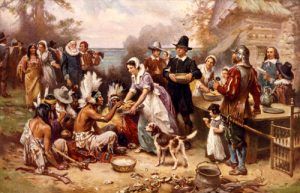
The first Thanksgiving with the Pilgrims. 1921 painting by Jean Leon Gerome Ferris.
They had come to conquer the wilderness or die, and their determination was expressed in the brave words of one of their leaders: “It is not with us as with men whom small things can discourage.” The little colony grew slowly and was never granted a charter by the king. Consequently, its government, which was carried on by the democratic institution of the town meeting, was never legal in the eyes of the English court. However, because of its small size and quiet demeanor, the colony of Plymouth was allowed to continue undisturbed by the Stuarts.
Politically, the little colony was of slight importance, but its moral and religious influence on New England was significant. The Pilgrims demonstrated that industry and courage could overcome even the inhospitable soil and climate of the Massachusetts shore, and that unflinching devotion to an ideal could make the wilderness their home.
It took its part bravely in defending the New England settlements against the Indians and saw half its towns destroyed in King Phillip’s War in 1675. Years later, in 1691, Plymouth would be annexed to the powerful neighboring colony of Massachusetts Bay.
While the settlement at Plymouth was slowly growing, several attempts were made by Gorges and other members of the Massachusetts Council for New England to plant colonies in the New World. About 50 scattered settlements were established by March 1629 around the shores and on Boston Harbor islands.
Massachusetts Bay Colonists
In 1628, a company of Puritan gentlemen secured a land grant from the council. It began with the largest and most critical English settlements in America — the colony of Massachusetts Bay. The following year, they obtained a royal charter from King Charles I, constituting them as a political body governed by a governor, a deputy governor, and eighteen “assistants,” all of whom were elected by the company members.
However, King Charles I, coming more and more under the influence of men who thought the only ecclesiastical reform needed was the extermination of independent opinions of all sorts, and the lamblike submission of Church, courts, and parliaments to the royal will, made little distinction in his despotic mind between Separatists and Puritans. He was as glad to have the latter out of England as his father had been to get rid of the former, and he granted the Massachusetts charter less as a favor than as a sentence of exile. He little dreamed that he was laying the foundations of a practically independent state in his distant domain of America.
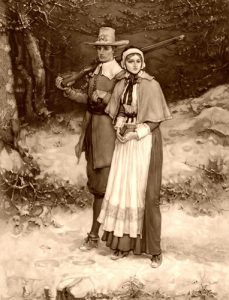
Puritans. By George Henry Boughton, 1884
In 1629, King Charles I angrily dismissed his Parliament and entered on his eleven-year course of despotism. At that time, several leading members of the Massachusetts Company decided to emigrate to America themselves and take their charter with them. In 1630, they sent 17 ships to Massachusetts with nearly 1,000 colonists.
John Endicott established the company’s first settlers at Salem in 1628. Still, when the main body of emigrants arrived with John Winthrop two years later, the colony was relocated to a narrow neck of land a few miles to the south, known to the Indians as Shawmut. The spot was rechristened Boston, after the Puritan fishing village in the east of England, where John Cotton was the pastor. Winthrop and Cotton were the leading spirits of the colony in its first twenty years: the former, a cultivated gentleman from the south of England, serving almost continually as governor; the latter, a scholar and preacher of great power, acting as director of the Massachusetts conscience. The Puritans, like the Separatists, protested against what they called “the idolatrous remnants of papacy” in the English Church, but, unlike the Separatists, they believed in reforming the Church from within rather than leaving its communion.
Massachusetts Bay Colony.
The objective of the Massachusetts Puritans was to establish a colony in which they could enjoy worship purified of what they called “the idolatrous remnants of popery” in the English Church. They did not, however, open a refuge for freedom of worship. Others might live in the colony so long as they did not resist the authorities, molest the ministers, or bring discredit to the Puritan system of worship and government. However, they had to contribute to the support of the Church and submit to its controlling oversight of both public and private life. Soon, the Colony of Massachusetts Bay became the nucleus of America’s largest and most important English settlements.
Between 1630 and 1640, the growing tyranny of King Charles and the persecutions of the zealous Archbishop Laud of Canterbury drove another 25,000 refugees to the new colony. “God sifted a nation,” wrote a Massachusetts governor a half-century later, “in order that he might send choice grain to this wilderness. Archbishop Laud called the Puritans whom he drove into exile “swine which rooted out God’s vineyard.”
The king, absorbed in his quarrel with Parliament, probably knew nothing about the removal of the charter from England until, in 1634, the persecuting zeal of Archbishop Laud of Canterbury against the Puritans moved him to demand its surrender. The English representatives of the company politely informed the king that the charter was in America, well out of reach of the king’s officers. The American colony politely declined to send the charter back to England. Before the king could use force to recover the charter, a war with his Scottish subjects overtook him. Thus, the Massachusetts Company escaped the fate that had overtaken the London Company’s colony of Virginia ten years earlier.
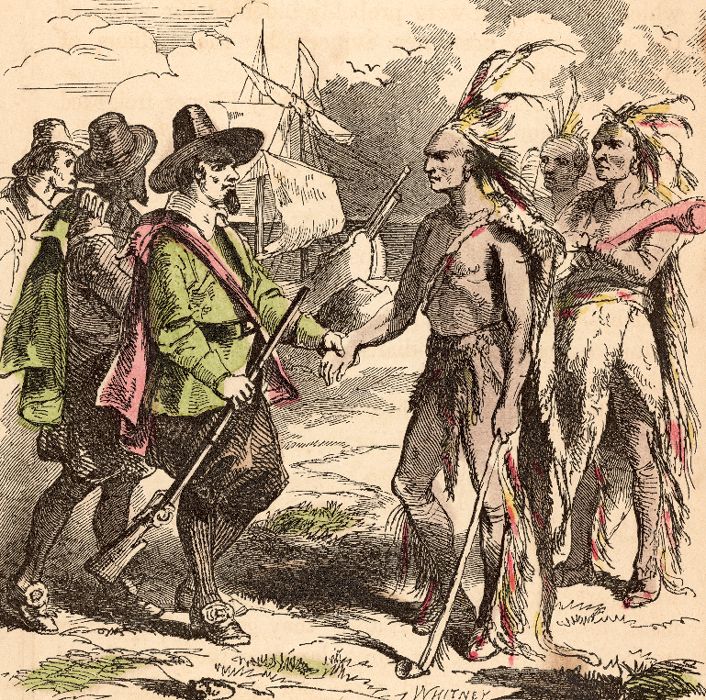
Early Colonists and Native Americans.
The significant emigration to Massachusetts led to several critical political outcomes. It relieved the colony of the immediate fear of Indian attacks; it enabled the authorities to quickly drive out various companies of settlers established by the agents of Gorges and other claimants to Massachusetts lands under the grants of the Council for New England. Ultimately, it led to the establishment of a representative form of government.
In 1634, the towns demanded the privilege of sending their own elected representatives to help make the laws. The more liberal spirits of the colony protested against the narrowing of the representatives to the “freemen” alone. Still, the Puritan leaders were firm in their determination to exclude from the government all suspected of heresy in belief or laxity in morals. “A democracy is no fit government either for Church or the commonwealth,” declared Cotton, and even the tolerant John Winthrop defended the exclusive Puritan system.
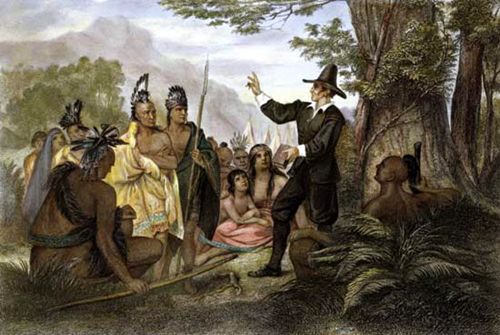
It was natural that this “Puritan aristocracy,” which seemed so harsh to many colonists, should lead to voluntary and enforced exile from the territory governed under the Massachusetts charter. Roger Williams, the pastor of the church in Salem, taught doctrines very unacceptable to the Puritan governors of the colony. He said that the land on which they had settled belonged to the Indians, despite the king’s charter, that the state had no control over a man’s conscience, and that to make a man take the oath of citizenship was to encourage lying and hypocrisy. As a result, the civil authorities drove Williams from the colony in 1636. Making his difficult way southward in midwinter through the forests, from one Indian tribe to another, he arrived at the head of Narragansett Bay, where he purchased a tract of land from the Indians and began a settlement which he called, in recognition of God’s guidance, “Providence.”
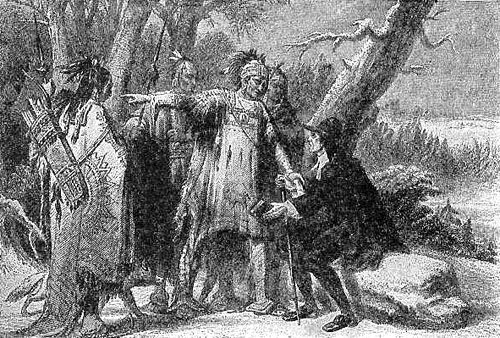
Narragansett Indians Receiving Roger Williams.
Other dissenters from Massachusetts followed, and soon four towns were established on the mainland about Narragansett Bay and what would later become the State of Rhode Island. In 1643, Roger Williams secured recognition for his colony from the English Parliament, which had driven King Charles from London the year before. The little colonies of Rhode Island and Providence were remarkable for two things: democracy and religious freedom. Election by ballots was introduced, and the government was “held by free and voluntary consent of all the free inhabitants.” Here, all men might “walk as their conscience persuaded them, everyone in the name of his God.”
The scornful orthodox brethren in Massachusetts called Rhode Island’s population “the Lord’s debris.” At the same time, the facetious said, “if a man had lost his religion, he would be sure to find it in some Rhode Island village.”
Massachusetts further showed her spite against the dissenting settlers by refusing to admit Rhode Island into the confederation of New England colonies, which was formed in 1643 for protection against the Indians. It would not be until the colony received a royal charter from King Charles II in 1663, which recognized its boundaries and its self-elected government, that it was securely established. For his heroic devotion to principles of freedom, far in advance of his age, Roger Williams deserves to be honored as one of the noblest figures in our colonial history.
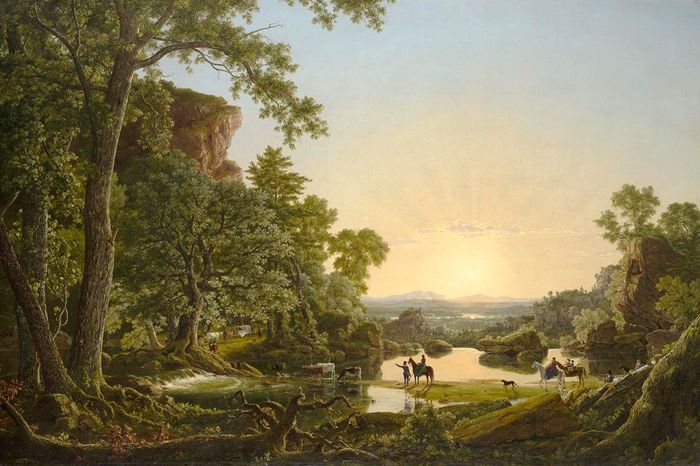
Thomas Hooker and settlers journeying through the wilderness by Frederic E. Church, 1846.
The same year Massachusetts drove Roger Williams out of her jurisdiction, the magistrates permitted the citizens of Cambridge, Dorchester, Watertown, and other places to transport themselves and their estates into what would become the State of Connecticut. These emigrants were partly attracted by the glowing reports of the fertility of the Connecticut Valley and partly repelled by the extreme rigor of the Massachusetts “aristocracy of righteousness,” which made an honest expression of opinion impossible.
Led by their pastor, Thomas Hooker, they tramped across the wilderness between the Charles and the Connecticut Rivers, driving their cattle before them and carrying their household goods in wagons —the first heralds of that mighty westward movement that was to continue through two centuries to the Pacific Ocean. The Connecticut emigrants founded the towns of Hartford, Windsor, and Wethersfield.
In 1639, they adopted their “Fundamental Orders,” — the first constitution drawn up in America and the first in modern history composed by the free founders of a state. They did not require a man to be a church member to vote, and their clergymen exercised far less influence over political life than those of the mother colony. However, they had trouble with Massachusetts, which still claimed them under her jurisdiction, and with the Dutch, who had spread from the Hudson River to the Connecticut River. Still, the colonists of the river towns were strong enough to defend their land and government.
After the extermination of the dangerous Pequot Indians in 1637, the colony enjoyed peace and prosperity. In 1662 it was granted a charter by King Charles II, which extended its territory westward to the South Sea (the Pacific Ocean.)
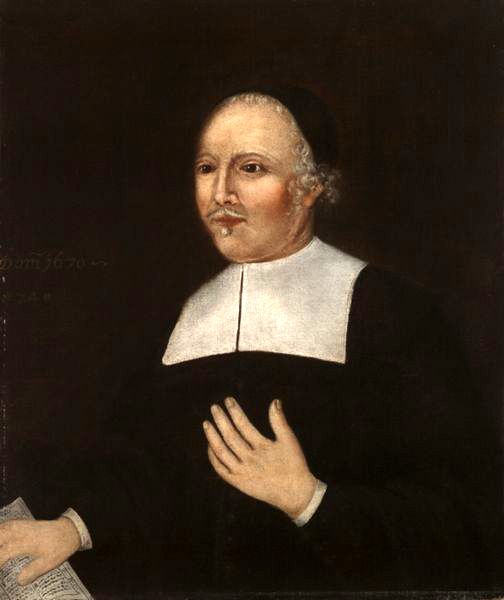
John Davenport.
John Davenport, a stern Puritan, founded a third seceding colony from Massachusetts when he led his congregation from Boston to the shores of Long Island Sound and established the settlement of New Haven in 1638. The colony, which soon expanded into several towns, was even more strictly Puritan than the Massachusetts Bay Colony.
The founders aimed to combine worldly prosperity with their piety by establishing New Haven as a thriving commercial port. However, the proximity of the unrivaled harbor of New York rendered any such hope in vain from the beginning. Instead of becoming an independent commercial colony, New Haven and its sister towns found themselves, to their dismay, included within the limits of Connecticut by the royal charter of 1662. They protested valiantly against the consolidation but were ultimately forced to yield. Thus, the New Haven colony ceased to exist in 1665.
The radiation from Massachusetts of colonies to the south and west went through a contrary process of absorption by Massachusetts of settlements to the north and east. Ferdinando Gorges was the father of these settlements and a deadly enemy of the Massachusetts Bay Colony. As a courtier, he opposed the reforming party in Parliament, and as a staunch member of the Church of England, he detested the entire Puritan movement.
He secured a royal charter in 1639, making him the proprietor of the territory that would later become Maine. He labored to have strong anti-Puritan settlers emigrate to his province and New Hampshire, the neighboring province of his fellow courtier and churchman, John Mason. By the charter of 1629, Massachusetts, whose territory extended from three miles north of the Merrimac River to three miles south of the Charles River, laid claim to these settlements. She annexed the New Hampshire towns in 1641-1643 and, after a long quarrel over the Maine towns, finally bought the claims of Gorges’s heirs for £1250 in 1677. King Charles II was incensed at the transaction. In 1679, he separated New Hampshire from Massachusetts and appointed a royal governor, but Maine remained part of the Bay Colony and then the Bay State until 1820.
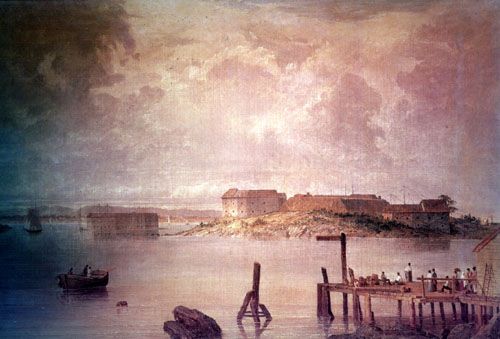
Forts Scammel and Gorges, Maine. By Seth Eastman, 1870.
The domination of Massachusetts over the other New England colonies was complete, at least until Connecticut and Rhode Island received their charters. She far surpassed them all in men and wealth. The New England Confederation, formed in 1643 by Massachusetts, Plymouth, Connecticut, and New Haven, primarily for defense against the Indians and the Dutch, was theoretically a league of four equal states, each with two members and an equal voice in the governing council. However, the opposition of Massachusetts prevented Rhode Island from joining the Confederation. In the question of declaring war on the Dutch colony of New Netherland in 1653, the two Massachusetts councilors vetoed the unanimous vote of the other six.
The second half of the seventeenth century exhibited the character of the colony in its most uncompromising and unlovely aspects. The large-minded, courteous Winthrop died in 1649 and was succeeded in the governorship by a harsh and intolerant Puritan “saint” named John Endicott.

An artist’s depiction of Mary Johnson, the first recorded confession of witchcraft in Connecticut.
Faithfulness to Puritan ideals reached a point of fanatic cruelty. Witch hunts began in Connecticut in 1647. Quakers were hanged in 1660 on Boston Common for the crime of testifying to the “inner light,” or special divine revelation. Again, in 1692, 19 people, primarily women, were hanged in Salem Village for witchcraft, or secret alliance with Satan, on the most unfair evidence of excited children and hysterical women.
On its political side, the increasing power of Massachusetts’s magistrates aroused the king’s angry suspicions. The colony banished Episcopalians, coined its own currency, omitted the king’s name in its legal documents, and defied the king’s laws to regulate its trade. When he sent commissioners in 1664 to investigate these conditions, they were insulted by a constable in a Boston tavern. Their chairman wrote back, “Our time is lost upon men puffed up with the spirit of independence.” Edward Randolph, sent over a few years later as a collector of revenues, complained that “the king’s letters are of no more account in Massachusetts than an old number of the London Gazette.” Finally, King Charles II, provoked beyond patience, had the Massachusetts charter annulled in his court in 1684, and the colony became a royal province.
But, before the great Puritan colony entered its checkered career of the 18th century under royal governors, it bore a conspicuous part in overthrowing the tyranny that the last Stuart King, James II, made unendurable for freeborn Englishmen. In 1686, James united New York, New Jersey, and New England into one great province, which should have been a solid bulwark against the danger of French and Indian invasion from the north. The King also felt that his governor should rule absolutely, unhampered by colonial charters or assemblies. He sent over Sir Edmund Andros as governor of this vast province extending from Delaware Bay to Nova Scotia. Andros was a faithful servant and an upright man, but a harsh, narrow, unbending governor who determined that the instructions of his royal master should be carried out to the letter. He attempted to seize the charters of Connecticut and Rhode Island but was baffled by the local patriots in both colonies. Exasperated by resistance, Andros made his hand doubly heavy upon Massachusetts. He dismissed the assembly, abolished the colonial courts, dispensed justice himself, charged exorbitant fees, established strict press censorship, introduced Episcopal worship in Boston, denied the colonists fair and speedy trials, and levied a land tax on them without their consent.
The patience of the colony was about exhausted when the welcome news arrived in April 1689 that King James II had been driven from the English throne. The inhabitants of Boston immediately responded by a popular rising against James’s odious servant. Andros tried, like his master, to flee from the vengeance of the people he had so grievously provoked, but he was seized and imprisoned and later sent back to England. The town meeting of Boston assumed control of the government, appointed a Committee of Safety, and sent envoys to London to learn the will of the new king, William of Orange. Thus the “Glorious Revolution” of 1689 in Massachusetts was indeed a part of the English Revolution of 1688 and a foreshadowing of the greater Revolution that would begin 86 years later by the descendants of the men who expelled Andros.
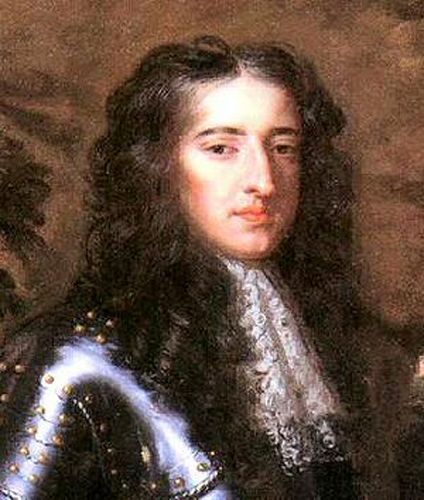
King William III.
King William III granted a new charter to the Massachusetts Bay Colony in 1691. Connecticut and Rhode Island quietly resumed government under their old charters, retaining them as state constitutions well into the nineteenth century.
The new Massachusetts charter provided for the union of Plymouth and Maine with the Bay Colony under a royal governor. It broke down the old Puritan regime by guaranteeing freedom of worship to all Protestant sects and making the possession of property, instead of membership in the church, the basis of political rights. Under this charter, the Massachusetts colony lived until the American Revolution.
By David S. Muzzey, 1920. Compiled and edited by Kathy Alexander/Legends of America, updated July 2025.
Also See:
About the Article: This article was, for the most part, written by David Saville Muzzey and included in a chapter of his book, “An American History,” published in 1920 by Ginn and Co. However, the original content has been heavily edited, truncated in parts, and additional information added.