
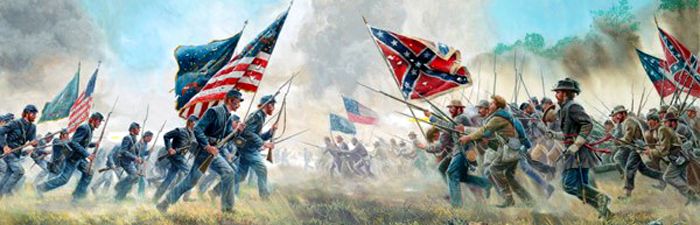
“With a rebel yell,” painting by Mort Kunstler.
“…but one of them would make war rather than let the nation survive, and the other would accept war rather than let it perish, and the war came.”
— Abraham Lincoln, 2nd Inaugural Address, March 4, 1865
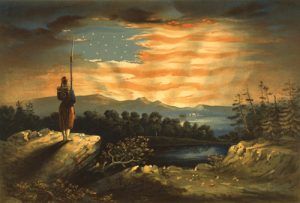
Our heaven-born banner painted by William Bauly, 1861.
America’s progression toward the Civil War over the issue of slavery dates back over 200 years before the final conflict. Here is a timeline of notable events.
1619 – English settlers in Virginia purchase 20 African indentured servants from a Dutch ship. Not slaves, the Africans would ultimately earn their freedom after working for a certain number of years. However, it was not long after that that any Africans arriving in America were treated as slaves — bought and sold into a lifetime of slavery, along with any of their offspring.
1641 – The Massachusetts Bay Colony legalizes slavery.
1660 – Virginia legalized slavery.
1663 – Maryland became the first colony to enact laws recognizing slavery for life. Under prior English law, slaves who converted to Christianity were granted freedom.
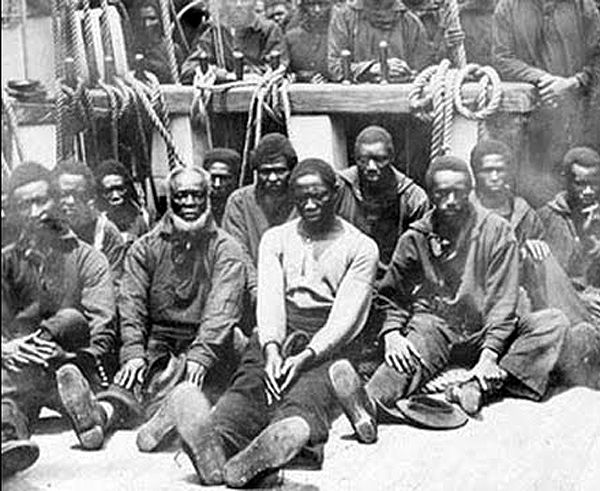
Slaves.
1667 – Virginia passed a law that allowed for slaves who converted to Christianity to become free.
1688 – In February, the first organized protest against slavery in the New World was drafted by a group of Quakers in Germantown, Pennsylvania. Known as the Germantown Protest, it argued that Christians should do as they would want to be done to them and that slavery was essentially theft, as if you were buying something stolen. They also stated that adultery is wrong, yet slave traders/owners forced adultery on men and women by breaking up marriages when they resold husbands and wives to different owners.
1739 – In September, in the town of Stono, South Carolina, a band of slaves started an insurrection. Previous runaway slaves had made their way to Florida, where they had been given freedom and land by the Spanish, who had issued a proclamation stating that any slave who deserted to Florida would be given freedom.
1775 – The Pennsylvania Abolition Society is organized to protect the rights of blacks unlawfully held as slaves.

Writing the Declaration of Independence, by Jean Ferris.
1776 – In July, the 13 colonies declared independence from England by adopting The Declaration of Independence. Primarily written by Thomas Jefferson, the document declares that “all men are created equal,” despite the fact that Jefferson and many of the document’s signers were slaveholders.
1777 – Vermont, an American colony and not yet a state, is the first government entity to abolish slavery.
1780 – Pennsylvania became the first state to abolish slavery, with the law calling for gradual abolition.
1783 – Massachusetts abolished slavery and granted voting rights to blacks and Native Americans.
1787 – At the 1787 Constitutional Convention in Philadelphia, delegates debated whether Congress should halt the importation of slaves. South Carolina and Georgia delegates threatened that their states would not join the new Union being planned, and won concessions that the slave trade could not be restricted for 20 years.
Congress passed the Three-Fifths Clause, stating that each slave was to be counted as three-fifths of a person for determining representation in Congress. This clause dramatically strengthened the power of slave states in the House of Representatives.
Our Glorious Banner.
1787 – In July, Congress passes the Northwest Ordinance, preventing slavery from existing in the new federal territories.
1790 – The first national census shows that of the nearly 4 million people in the United States, 18% are slaves. Maine, Massachusetts, and Vermont have no slaves, while 43% of the population in South Carolina, 39% in Virginia, and 35% in Georgia are slaves.
1791 – Vermont became the 14th state and entered the Union as a free state.
1792 – In June, Kentucky became the 15th state and entered the Union as a slave state.
“Whenever I hear anyone arguing for slavery, I feel a strong impulse to see it tried on him personally.” — Abraham Lincoln
1793 – In February, Congress passed the first Fugitive Slave Act, which allowed for the recovery of runaway slaves, authorized the arrest and/or seizure of fugitives, and created a fine of $500 for any person who aids a fugitive.
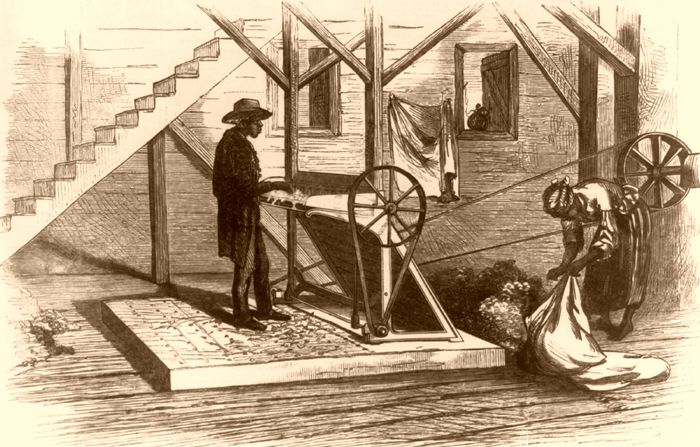
Cotton Gin, 1871.
1794 – In March, Eli Whitney received a patent for inventing the cotton gin, which dramatically increased the production of cleaned cotton, making cotton a profitable crop and increasing the demand for and value of slaves.
1796 (June) – Tennessee became the 16th state and entered the Union as a slave state.
1800 – The results of the 1800 census show a total population of just over five million, 17% of whom are slaves. Slaves are virtually non-existent in northern states, as high as 42% in South Carolina and 39% in Virginia.
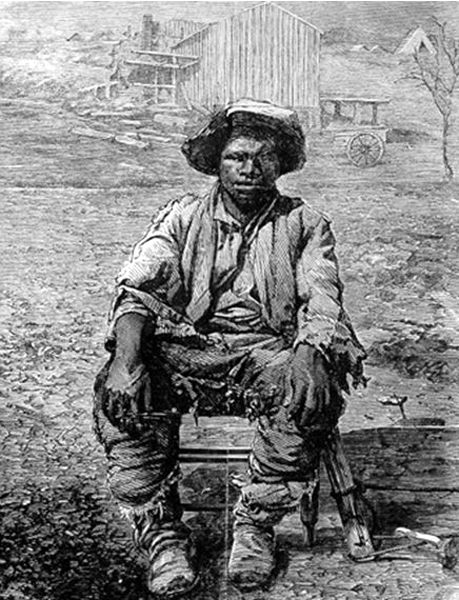
Gabriel Prosser.
1800 – In August, a slave named Gabriel Prosser led a group of armed slaves in rebellion. His plan involved seizing Capitol Square in Richmond, Virginia, and taking Governor James Monroe as a hostage in order to bargain with city authorities for freedom. Ultimately, Gabriel, along with many followers, was captured and executed.
1803 – In March, Ohio became the 17th state and entered the Union as a free state based on the terms of the Northwest Ordinance.
1804 – New Jersey’s state legislature announces a gradual emancipation act.
1807 – In March, Congress passed a law banning the importation of new slaves into the United States, effective January 1, 1808.
1810 – The results of the 1810 census show a U.S. population of nearly 7 million, with 17% of the population being slaves. Slaves are virtually non-existent in northern states and as high as 47% in South Carolina and 42% in Georgia.
1812 – In December, Louisiana became the 18th state and entered the Union as a slave state.
1816 – In December, Indiana became the 19th state and entered the Union as a free state.
1817 – In December, Mississippi became the 20th state and entered the Union as a slave state.
1818 – In December, Illinois became the 21st state and entered the Union as a free state.
1819 – In December, Alabama became the 22nd state and entered the Union as a slave state.
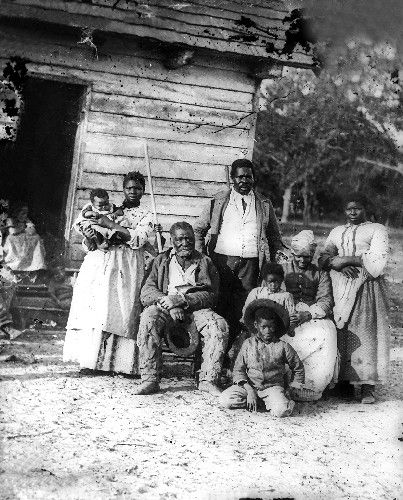
Slave family in South Carolina, 1862.
1820 – The results of the 1820 census show that the total population was slightly more than 10 million, with 15% being slaves, although they were virtually non-existent in the northern states. However, in the South, it is as high as 51% in South Carolina and 45% in Louisiana.
1820 – In March, the Missouri Compromise was negotiated, allowing Maine to be admitted to the Union as a free state and Missouri to be admitted as a slave state in 1821. This act will maintain a balance between free and slave states. The compromise established the 36-degree, 30′ parallel of latitude as a dividing line between free and slave areas of the territories.
1827 – The state of New York abolishes slavery.
1828 – Congress again raises tariffs with the Tariff of Abominations. Designed to support American industry, they successfully benefited the northern industrial economy but damaged the southern agricultural economy.
“The fact is that civilization requires slaves. Human slavery is wrong, insecure, and demoralizing. On mechanical slavery, on the slavery of the machine, the future of the world depends.“
— Oscar Wilde
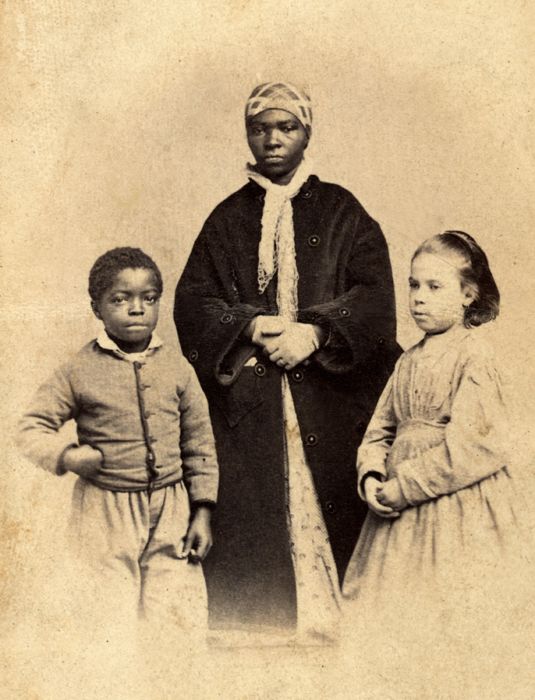
New Orleans, Louisiana Slaves by M.H. Kimball, 1863.
1830 – The results of the 1830 census show a total population of almost 12.8 million, of which 16% are slaves. Slaves are virtually non-existent in northern states and as high as 54% in South Carolina and 51% in Louisiana.
1831 – In January, William Lloyd Garrison published the first issue of the abolitionist journal The Liberator.
1831 – In August, Nat Turner led a rebellion in Southampton County, Virginia, where over 60 whites were killed. Turner was on the run for nearly two months but was eventually caught and hanged.
1832 – The Tariff Act of 1832 reduced duties; however, the South remained dissatisfied and threatened secession. South Carolina’s legislature organized an army and declared the tariffs null and void.
1833 – The Compromise Tariff Act, passed to reduce tariffs gradually, averted a confrontation over tariffs.
1834 – Slavery was abolished throughout the British Empire.
1835 – In June, Arkansas became the 25th state, entering as a slave state.
1836 – In May, the House passed a resolution that automatically tabled or postponed action on all petitions relating to slavery without hearing them. Stricter versions of this gag rule are passed in succeeding Congresses.
1837 – In January, Michigan became the 26th state, entering as a free state.
In November 1837, Abolitionist publisher Elijah P. Lovejoy was murdered in Alton, Illinois, and his printing press was thrown in the river. He had been calling for an end to slavery.
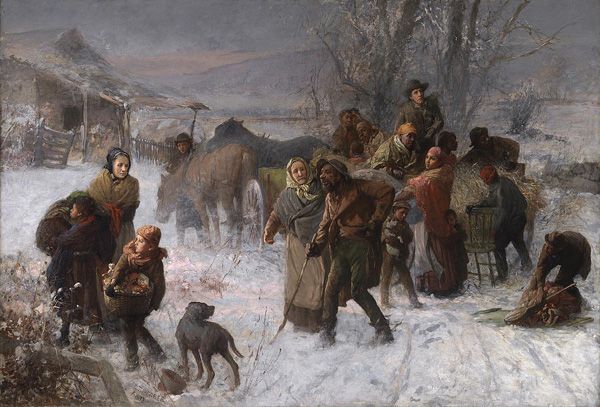
Underground Railroad by Charles T. Webber.
1838 – Led by black abolitionist Robert Purvis, the Underground Railroad was formally organized.
1840 – The results of the 1840 census show a total population of nearly 17 million, of which 15% are slaves. Slaves are virtually non-existent in northern states, and as high as 55% in South Carolina and 52% in Mississippi.
1845 – In March, Florida becomes the 27th state, and in December, Texas becomes the 28th state. Both entered as slave states.
1846 – In December, Iowa becomes the 29th state, entering as a free state.
1848 – In May, Wisconsin becomes the 30th state, entering as a free state.
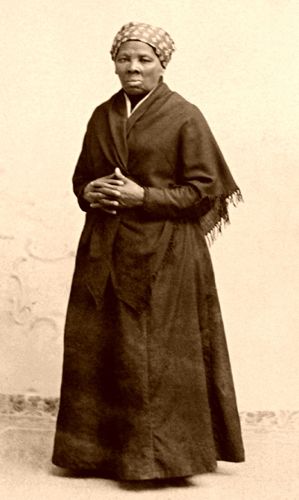
Harriet Tubman.
1849 – Harriet Tubman escapes from slavery in Maryland. Afterward, she travels to the South 19 times, bringing out more than 300 slaves on the Underground Railroad.
“I had reasoned this out in my mind; there was one of two things I had a right to, liberty or death; if I could not have one, I would have the other.” — Harriet Tubman
1850 – The results of the 1850 census show a total population of 23 million, of which 14% are slaves. Slaves were virtually non-existent in northern states, as high as 58% in South Carolina and 51% in Mississippi.
1850 – In September, Congress implemented several measures to form the Compromise of 1850. The measures included California joining the Union as a free state, the territories of New Mexico and Utah were organized with no restrictions on slavery, slave trading being abolished in the District of Columbia effective January 1851, and the Fugitive Slave Act of 1793 was modified and strengthened to allow slaveholders to retrieve slaves in northern states and free territories. California became the 31st state and entered the Union as a free state.
1851 – In January, slave trading is abolished in the District of Columbia.

Uncle Tom’s Cabin by Harriet Beecher Stowe.
1852 – Harriet Beecher Stowe publishes Uncle Tom’s Cabin to respond to the pro-slavery movement.
1854 – The Kansas-Nebraska Act passes Congress, overturning the Missouri Compromise and opening the Northern territory to slavery. Both sides begin to send settlers into the areas to influence them.
1855 – As Kansas prepared for elections, thousands of Border Ruffians from Missouri entered the territory to influence the election. This begins the Bloody Kansas period with duplicate constitutional conventions, separate elections, and constant violent attacks.
1856 – In May, Massachusetts Senator Charles Sumner delivers a speech attacking supporters of slavery in the Senate. He singles out Senator Andrew Butler of South Carolina in his speech. Two days later, South Carolina Representative Preston Brooks, Butler’s nephew, attacks Sumner on the Senate floor and beats him with a cane. The House did not expel or censure Brooks for the attack; Sumner took three years to recover.
1857 – Congress passed the Tariff of 1857, lowering rates to the lowest level since 1812. This is very unpopular in the North, but it is praised in the South.
1857 – In March, the Dred Scott Decision, the Supreme Court ruled in Scott v. Sandford that blacks were not U.S. citizens, and slaveholders had the right to take existing slaves into free areas of the county.
1858 – Minnesota becomes the 32nd state, entering as a free state.
1859 – Oregon becomes the 33rd state, entering as a free state.
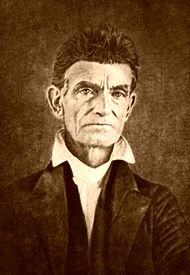
John Brown, 1850s.
1859 – In October, in an attempt to amass arms for a slave insurrection, John Brown attacked the federal armory and arsenal at Harpers Ferry, West Virginia. Robert E. Lee, then a Federal Army regular, leads the troops and captures Brown.
In December, John Brown and two of the black members of his band are hanged for murder and treason at Charles Town, Virginia.
“In thinking of America, I sometimes find myself admiring her bright blue sky, her grand old woods, her fertile fields, her beautiful rivers, her mighty lakes, and star-crowned mountains. But my rapture is soon checked when I remember that all is cursed with the infernal spirit of slave-holding and wrong; When I remember that with the waters of her noblest rivers, the tears of my brethren are borne to the ocean, disregarded and forgotten; That her most fertile fields drink daily of the warm blood of my outraged sisters, I am filled with unutterable loathing. ”
– Frederick Douglass, American Abolitionist and former slave
1860 – The results of the 1860 census show a total population of just over 31 million, of which 13% are enslaved. Slaves equal 2% of the population in the Northern Aligned States and 39% in the Southern Aligned States.
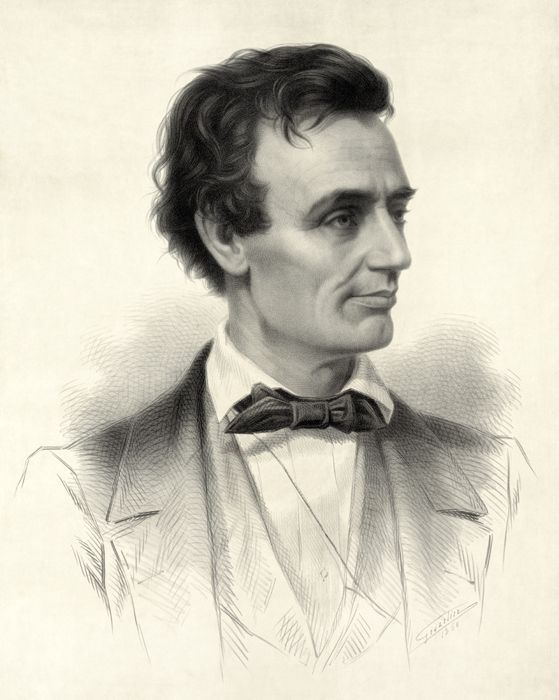
Presidential Candidate Abraham Lincoln by Thomas Hicks, 1860.
1860 – In November, Abraham Lincoln, who had declared, “Government cannot endure permanently half slave, half free…” was elected president. The first Republican ever elected, he received 40% of the popular vote and won 59% of the Electoral votes. He was not even on the ballot in the Deep South.
Due to Lincoln’s election in December, a special convention of the South Carolina legislature voted to secede from the Union. In their secession, they stated: “We affirm that these ends for which this Government was instituted have been defeated, and the Government itself has been made destructive of them by the action of the non-slaveholding States. Those states have assumed the right of deciding upon the propriety of our domestic institutions and have denied the rights of property established in fifteen of the States and recognized by the Constitution; they have denounced as sinful the institution of slavery; they have permitted open establishment among them of societies, whose avowed object is to disturb the peace and to remove the property of the citizens of other States. They have encouraged and assisted thousands of our slaves to leave their homes, and emissaries, books, and pictures have incited those who remain to servile insurrection.”
On December 26, 1860, U.S. Major General Robert Anderson moved his troops from Fort Moultrie in Charleston, South Carolina, to Fort Sumter.
1861– On January 9, an unarmed merchant ship, Star of the West, arrives in Charleston Harbor with troops and supplies to reinforce Fort Sumter. The ship is fired upon and retreats. That same month, Mississippi, Florida, Alabama, Georgia, and Louisiana seceded from the Union.
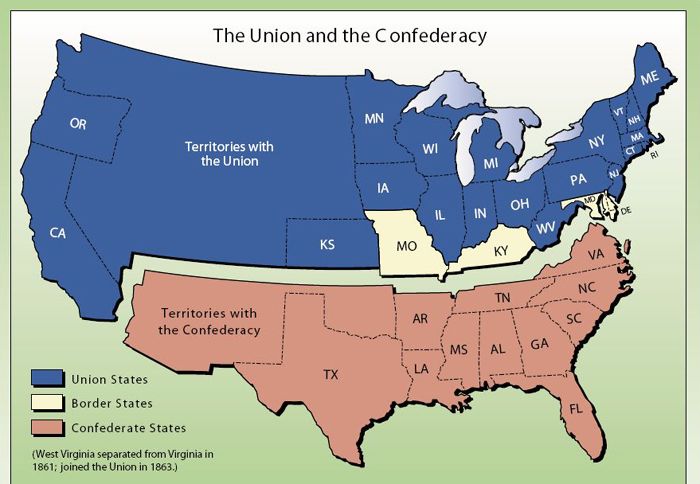
Union and Confederacy.
On January 16, the Senate refused to consider the Crittenden Compromise, one of several failed attempts to ease tension between the North and South. The compromise contained six proposals for constitutional amendments and four proposals for Congressional resolution, including the re-application of the north/south boundary from the Missouri Compromise, which stated that the federal government could not interfere with slavery where it already existed and could not interfere with the recovery of slaves from any part of the Union.
On January 29, 1861, Kansas became the 34th state, entering the Union as a free state.
February 1, 1861 – The Texas Legislature secedes from the Union.
February 8, 1861 – A provisional Constitution of the Confederacy was adopted in Montgomery, Alabama.
February 9, 1861 – The Confederate States of America was formed with Jefferson Davis, a West Point graduate and former U.S. Army officer, as president.
February 11, 1861 – President-elect Abraham Lincoln leaves Springfield, Illinois, on his trip to Washington, D.C., arriving on Saturday, February 23.
February 18, 1861 – Jefferson Davis is inaugurated as President of the Confederacy.
March 4, 1861 – Abraham Lincoln was inaugurated as the 16th President of the United States of America.
March 6, 1861 – The Confederate Congress authorizes an army of volunteers.
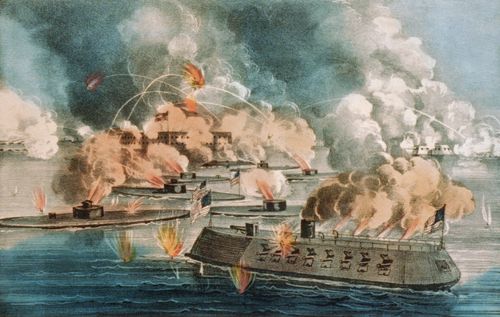
The great fight at Fort Sumter, South Carolina, April 7, 1863, by Courier & Ives.
April 12, 1861 – At 4:30 a.m. Confederates under General Pierre Beauregard open fire with 50 cannons upon Fort Sumter in Charleston, South Carolina, and the Civil War begins.
April 13, 1861 – U.S. Major-General Anderson surrenders Fort Sumter, South Carolina.
April 15, 1861 – In Washington D.C., President Abraham Lincoln issues a proclamation announcing an “insurrection” and called for 75,000 troops to be raised from the militia from the Union States. Robert E. Lee, son of a Revolutionary War hero and a 25-year distinguished veteran of the United States Army and former Superintendent of West Point is offered command of the Union Army. Lee declines.
“They do not know what they say. If it came to a conflict of arms, the war would last at least four years. Northern politicians will not appreciate the determination and pluck of the South, and Southern politicians do not appreciate the numbers, resources, and patient perseverance of the North. Both sides forget that we are all Americans. I foresee that our country will pass through a terrible ordeal, a necessary expiation, perhaps, for our national sins.”
— Robert E. Lee
April 17, 1861 – Virginia secedes from the Union.
April 19, 1861 – President Abraham Lincoln issues a Proclamation of Blockade against Southern ports. For the duration of the war, the blockade severely limited the rural South’s ability to stay well-supplied in its conflict against the industrialized North.
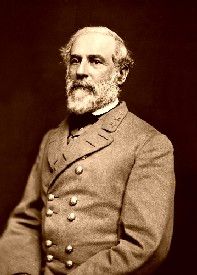
Robert E. Lee.
April 20, 1861 – Robert E. Lee resigned his commission in the United States Army. “I cannot raise my hand against my birthplace, my home, my children.” Robert E. Lee then goes to Richmond, Virginia, and accepts the command of Virginia’s military and naval forces.
May 6, 1861 – Arkansas seceded from the Union.
May 20, 1861 – North Carolina seceded from the Union.
May 24, 1861 – Union troops cross the Potomac River from Washington and capture Alexandria, Virginia, and its vicinity. A local innkeeper killed Colonel Elmer E. Ellsworth, who was the first officer to die in the war. He becomes a martyr for the North.
May 29, 1861 – Richmond, Virginia, became the capital of the Confederacy.
June 1861 – Four Slave States Stay in the Union. Despite their acceptance of slavery, Delaware, Kentucky, Maryland, and Missouri did not join the Confederacy. Although divided in their loyalties, political maneuvering and Union military pressure kept these states from seceding. Because residents of the western counties of Virginia did not wish to secede along with the rest of the state, West Virginia was created.
June 8, 1861 – Tennessee seceded from the Union.
July 1861 – Suddenly aware of the threat of a protracted war and the army’s need for organization and training, Lincoln replaces General McDowell with General George B. McClellan. To blockade the coast of the Confederacy effectively, the federal navy had to be improved. By July, the effort at improvement had made a difference, and an effective blockade had begun. The South responded with Union vessels.
“A nation of well-informed men who have been taught to know and prize the rights God has given them cannot be enslaved. It is in the region of ignorance that tyranny begins.”
— Benjamin Franklin
July 4, 1861 – Lincoln, in a speech to Congress, states the war is…” a People’s contest…a struggle for maintaining in the world, that form, and substance of government, whose leading object is, to elevate the condition of men…” Congress authorized a call for 500,000 men.
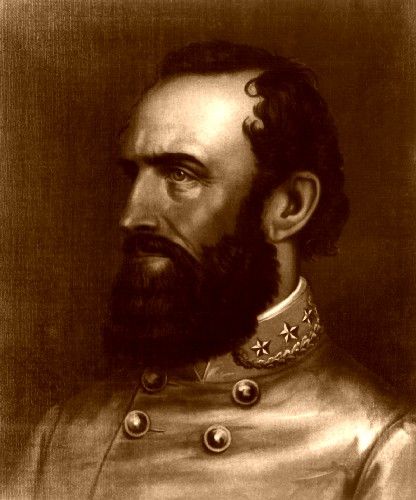
Stonewall Jackson.
July 21, 1861 – The Union Army under General Irvin McDowell suffers a defeat at Bull Run, some 25 miles southwest of Washington. Confederate General Thomas J. Jackson earned the nickname “Stonewall” as his brigade resisted Union attacks. When Union troops were forced to retreat to Washington, President Lincoln realized that the war would be prolonged. “It’s damned bad,” he comments.
July 27, 1861 – President Abraham Lincoln appointed General George B. McClellan as Commander of the Department of the Potomac, replacing General Irvin McDowell.
September 11, 1861 – President Abraham Lincoln revokes General John CFrémont’s’s unauthorized military proclamation of emancipation in Missouri. Later, President Lincoln relieved GeneraFrémontnt of his command and replaced him with General David Hunter.
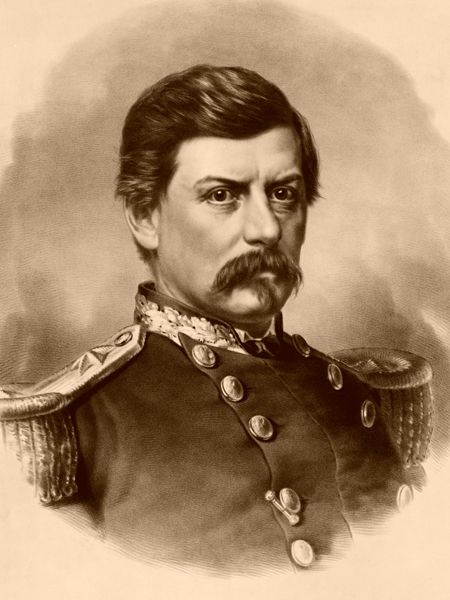
Major General George B. McClellan.
November 1, 1861 – President Abraham Lincoln appoints 34-year-old General George B. McClellan as General-in-Chief of all Union forces after the resignation of the aged Winfield Scott. Lincoln tells McClellan, “…the supreme command of the Army will entail a vast labor upon you.” McClellan responds, “I can do it all.”
November 1861 – Julia Ward Howe, inspired by a review of General McClellan’s army in the Virginia countryside near Washington, D.C., composes the lyrics to “The Battle Hymn of the Republic.” It was published in the Atlantic Monthly in February 1862.
“In your hands, my dissatisfied fellow-countrymen, and not in mine, is the momentous issue of civil war. The Government will not assail you. You can have no conflict without being the aggressors yourself. You have no oath registered in heaven to destroy the Government, while I shall have the most solemn one to preserve, protect, and defend it.” — President Abraham Lincoln
November 7, 1861 – Captain Samuel F. Dupont’s warships silenced Confederate guns in Fort Walker and Fort Beauregard. This victory enabled General Thomas W. Sherman’s troops to occupy first Port Royal and then all the famous Sea Islands of South Carolina.
November 8, 1861 – The Union navy seizes Confederate commissioners to Great Britain and France — James A. Mason and John Slidell — from the British steamer Trent, inflaming tensions between the United States and Great Britain. This marks the beginning of an international diplomatic crisis for President Lincoln. England, the leading world power, demanded their release and threatened war. Lincoln eventually gives in and orders their release in December. “One war at a time,” Lincoln remarks.
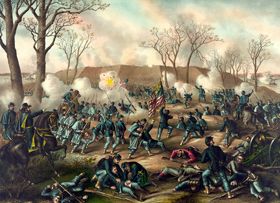
Battle of Fort Donelson, Tennessee, by Kurz and Allison, 1887.
January 31, 1862 – President Lincoln issued General War Order No. 1, authorizing the Union to launch a unified, aggressive action against the Confederacy. General McClellan ignored the order.
February 6, 1862 – General Ulysses S. Grant captures Fort Henry, Tennessee. Ten days later, he accepts the “unconditional and immediate surrender” of Fort Donelson. These victories opened up the state of Tennessee for Union advancement and earned Grant the nickname “Unconditional Surrender” Grant.
February 20, 1862 – President Abraham Lincoln is struck with grief as his beloved eleven-year-old son, Willie, dies from fever, probably caused by polluted drinking water in the White House.
March 8, 1862 – President Abraham Lincoln, impatient with General McClellan’s inactivity, issued an order reorganizing the Army of Virginia and relieving McClellan of supreme command. McClellan was given command of the Army of the Potomac and ordered to attack Richmond.
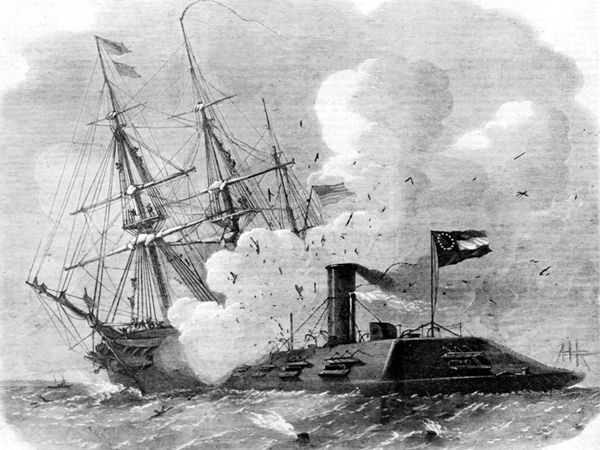
Confederate Ironclad Steamer, the Merrimac.
March 8-9, 1862 – The Confederate Ironclad Merrimac sank two wooden Union ships and then battled the Union Ironclad Monitor to a draw. Naval warfare is thus changed forever, making wooden ships obsolete.
The Peninsular Campaign begins as McClellan’s Army of the Potomac advances from Washington down the Potomac River and the Chesapeake Bay to the peninsula south of the Confederate Capitol of Richmond, Virginia, then begins an advance toward Richmond. President Abraham Lincoln temporarily relieved McClellan as general-in-chief and took direct command of the Union Armies.
April 4, 1862 – On the peninsula southeast of Richmond, General McClellan leads the Army of the Potomac toward Yorktown, Virginia, beginning the Peninsular Campaign.
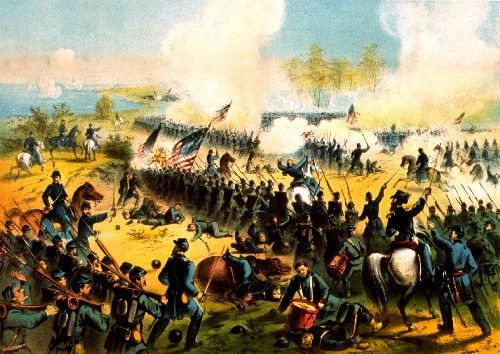
Battle of Shiloh, Tennessee, by J.H. Bufford.
April 6-7, 1862 – Confederates launch a surprise attack on General Ulysses S. Grant’s unprepared troops at Shiloh, Tennessee. By the end of the day, the federal troops were almost defeated. Yet, during the night, reinforcements arrived, and by the next morning, the Union commanded the field. When the Confederate forces retreated, the exhausted federal forces did not pursue them. Casualties were heavy — 13,000 out of 63,000 Union soldiers died, and 11,000 of 40,000 Confederate troops were killed. President Abraham Lincoln is then pressured to relieve Grant, but resists. “I can’t spare this man; he fights,” Lincoln says.
April 10-11, 1862 – General Quincy A. Gillmore battered Fort Pulaski, the imposing masonry structure near the mouth of the Savannah River, into submission in less than two days.
April 16, 1862 – Conscription is adopted in the Confederacy.
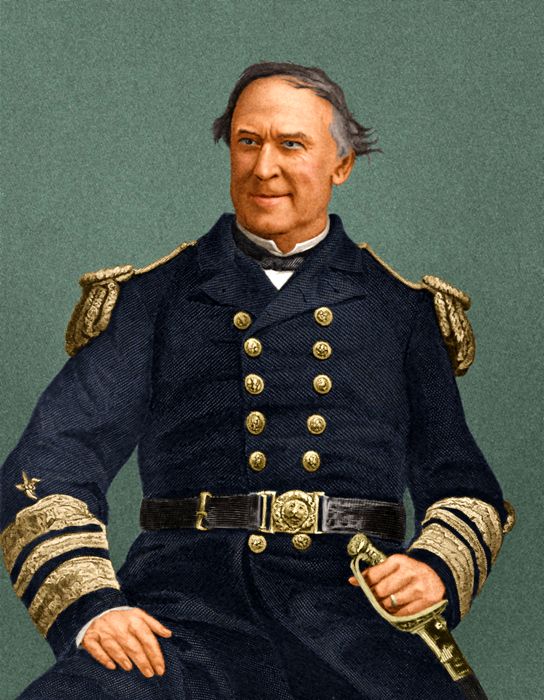
David Farragut.
April 24-25, 1862 – 17 Union ships, under the command of Flag Officer David Farragut, move up the Mississippi River, then take New Orleans, the South’s greatest seaport. Later in the war, sailing through a Rebel minefield, Farragut utters the famous phrase, “Damn the torpedoes, full speed ahead!”
May 8, 1862 – Stonewall Jackson’s Shenandoah Valley campaign begins successfully with a victory at the Battle of McDowell in Virginia.
May 31, 1862 – In the Battle of Seven Pines, General Joseph E. Johnston’s Army attacks McClellan’s troops in front of Richmond and nearly defeats them. Last-minute reinforcements saved the Union from a severe defeat. Robert E. Lee takes over command of the Confederate army from the wounded Joseph E. Johnston.
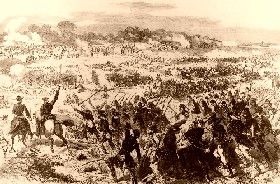
Battle of Malvern Hill, Virginia, in the Civil War.
June 25-July 1, 1862 – Union and Confederate forces fought a series of battles known as the Seven Days Battles: Mechanicsville (June 26-27), Gaines’s Mill (June 27), Savage’s Station (June 29), Frayser’s Farm (June 30), and Malvern Hill (July 1). Results to both sides were heavy, and McClellan then withdrew back toward Washington. On July 2, the Confederates withdrew to Richmond, ending the Peninsular Campaign.
July 11, 1862 – After four months as his own General-in-Chief, President Lincoln hands over the task to General Henry W. “Old Brains” Halleck.
August 20, 1862 – Horace Greeley of the New York Tribune publishes The Prayer of Twenty Millions, a plea for Lincoln to liberate slaves in the Union.
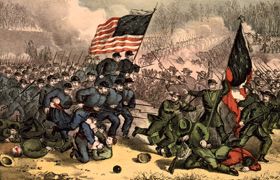
Second Battle of Bull Run, by Currier & Ives.
August 29-30, 1862 – Union General John Pope suffered defeat at the Second Battle of Bull Run in northern Virginia. 75,000 Federals lost to 55,000 Confederates under General Stonewall Jackson and General James Longstreet. Once again, the Union Army retreats to Washington, and President Lincoln then relieves Pope. General Fitz-John Porter was also held responsible for the defeat because he failed to commit his troops to battle quickly. He was forced out of the army by 1863.
September 4-9, 1862 – General Robert E. Lee invaded the North with 50,000 Confederates and headed for Harpers Ferry, located 50 miles northwest of Washington. The Union Army, 90,000 strong, under the command of McClellan, pursues Lee.
September 15, 1862 – Union General McClellan defeated Confederate General Lee at South Mountain and Crampton’s Gap in September, but did not move quickly enough to save Harper’s Ferry, which fell to Confederate General “Stonewall” Jackson, along with a significant number of men and a large body of supplies.
September 17, 1862 – Confederate forces under General Lee were caught by General McClellan near Sharpsburg, Maryland. This battle proved to be the bloodiest day of the war; 2,108 Union soldiers were killed and 9,549 wounded — 2,700 Confederates were killed and 9,029 wounded. The battle had no clear winner, but McClellan was considered the victor because General Lee withdrew to Virginia. The battle convinced the British and French, who were contemplating official recognition of the Confederacy, to hold off on action.
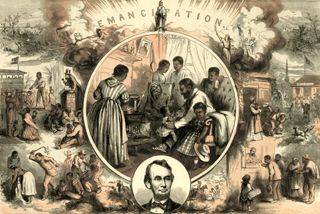
Emancipation.
September 22, 1862 – President Lincoln issued the Preliminary Emancipation Proclamation, which would free all slaves in areas rebelling against the United States, effective January 1, 1863.
November 7, 1862 – President Lincoln replaces McClellan with General Ambrose E. Burnside as the new Commander of the Army of the Potomac. Lincoln had grown impatient with McClellan’s slowness to follow up on the success at Antietam, even telling him, “If you don’t want to use the army, I should like to borrow it for a while.”
December 13, 1862 – The Army of the Potomac under General Burnside suffers a costly defeat at Fredericksburg in Virginia with a loss of 12,653 men after 14 frontal assaults on well-entrenched Rebels on Marye’s Heights. “We might as well have tried to take hell,” a Union soldier remarks. Confederate losses are 5,309. “It is well that war is so terrible – we should grow too fond of it,” states Lee during the fighting.
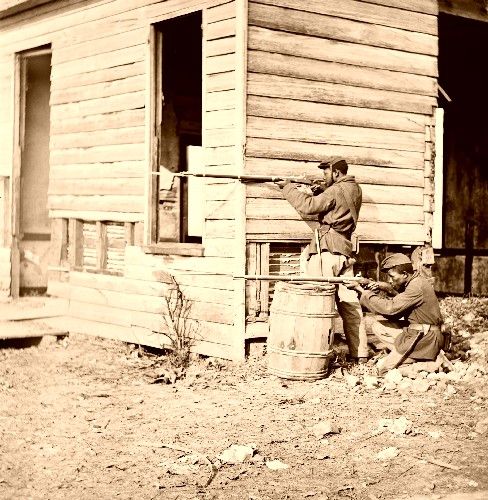
African American soldiers in the Civil War.
January 1, 1863 – President Abraham Lincoln issued the final Emancipation Proclamation, freeing all slaves in territories held by Confederates, and emphasized the enlistment of black soldiers in the Union Army. The war to preserve the Union became a revolutionary struggle to abolish slavery.
January 25, 1863 – President Abraham Lincoln appoints General Joseph “Fighting Joe” Hooker as Commander of the Army of the Potomac, replacing Burnside.
January 29, 1863: General Ulysses S. Grant is placed in command of the Army of the West and ordered to capture Vicksburg.
March 3, 1863 – The U.S. Congress enacts a draft affecting male citizens aged 20 to 45, but also exempts those who pay $300 or provide a substitute. “The blood of a poor man is as precious as that of the wealthy,” poor Northerners complain.
April 7, 1863 – In a test of ironclad vessels against land fortifications, Union Admiral Samuel F. Du Pont’s fleet fails to penetrate the harbor defenses of Charleston.
April 27, 1863 – Union General Hooker crossed the Rappahannock River to attack General Lee’s forces. Lee split his army, attacking a surprised Union army in three places and almost completely defeating them. Hooker withdrew across the Rappahannock River, giving the South a victory, but it was the Confederates’ most costly victory in terms of casualties.
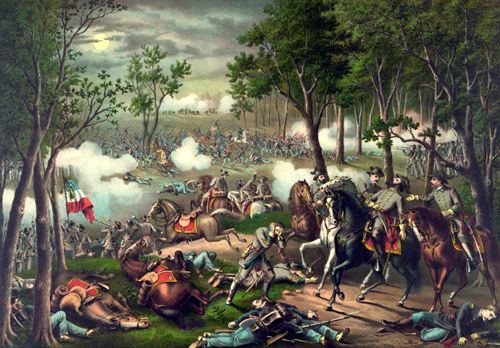
Battle of Chancellorsville, Virginia, by Kurz and Allison.
May 1-4, 1863 – The Union Army under General Hooker is decisively defeated by General Robert E. Lee’s much smaller forces at the Battle of Chancellorsville in Virginia as a result of Lee’s brilliant and daring tactics. His own soldiers mortally wounded Confederate General Stonewall Jackson. Hooker retreats. Union losses are 17,000 killed, wounded, and missing out of 130,000. The Confederates, 13,000 out of 60,000.
May 10, 1863 – The South suffers a massive blow as Stonewall Jackson dies from his wounds, his last words, “Let us cross over the river and rest under the shade of the trees.” “I have lost my right arm,” Lee laments.
May 22, 1863 – Union General Ulysses S. Grant won several victories around Vicksburg, Mississippi, the fortified city essential to the Union’s plans to regain control of the Mississippi River. On May 22, Grant began a siege of the city. After six weeks, Confederate General John Pemberton surrendered, giving up the city and 30,000 men. The capture of Port Hudson, Louisiana, shortly thereafter placed the entire Mississippi River in Union hands. The Confederacy was split into two.
June 3, 1863 – General Lee, with 75,000 Confederates, launches his second invasion of the North, heading into Pennsylvania in a campaign that will soon lead to Gettysburg.
June 9, 1863 – Confederate cavalry under Jeb Stuart clashed with the Union mounts of Alfred Pleasonton in an all-day battle at Brandy Station, Virginia. Some 18,000 troopers — approximately 9,000 on either side– participated, making this the largest cavalry battle on American soil. In the end, Stuart will hold the field. Yet this battle signals the rise and future domination of Union cavalry in the Eastern Theater.
June 20, 1863 – West Virginia became the 35th state and officially joined the Union.
June 28, 1863 – President Abraham Lincoln appointed General George G. Meade as commander of the Army of the Potomac, replacing Hooker. Meade is the 5th man to command the Army in less than a year.
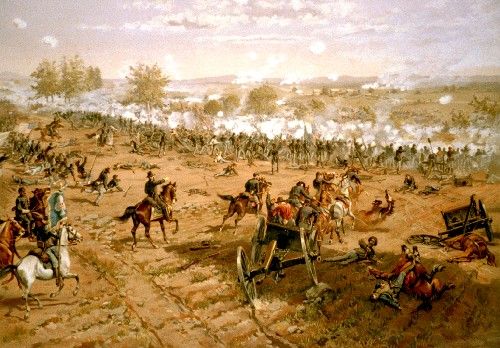
Battle of Gettysburg, Pennsylvania.
July 1-3, 1863 – The Battle of Gettysburg is fought in Pennsylvania. General George G. Meade compromises his victory by allowing Lee to retreat South across the Potomac.
July 4, 1863 – Vicksburg, Mississippi, the last Confederate stronghold on the Mississippi River, surrenders to General Ulysses S. Grant and the Army of the West after a six-week siege. With the Union now in control of the Mississippi River, the Confederacy was effectively split in two, cut off from its Western allies.
July 13-16, 1863 – Anti-draft riots in New York City include arson and the murder of blacks by poor immigrant whites. At least 120 persons, including children, were killed, and $2 million in damage was caused until Union soldiers returning from Gettysburg restored order.
July 18, 1863 – “Negro troops” of the 54th Massachusetts Infantry Regiment under Colonel Robert G. Shaw assault fortified Rebels at Fort Wagner, South Carolina. Colonel Shaw and half of the 600 men in the regiment are killed.
Did You Know?
- Sickness accounted for a full one-third of all casualties in the Civil War.
- The 12th Connecticut Regiment entered the war with a complement of 1,000 men. Before it entered its first engagement, sickness had reduced its strength to 600 able-bodied soldiers.
- General Robert E. Lee, commander of the Confederate forces, traveled with a pet hen that laid one egg under his cot every morning.
- Approximately 130,000 freed slaves became Union soldiers during the war.
- Of the 364,000 on the Union side who lost their lives, a third were killed or died of wounds, and two-thirds died of disease.
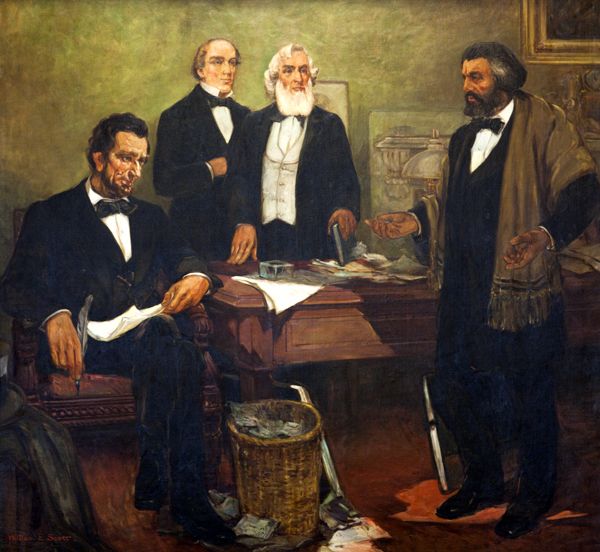
Frederick Douglass appealed to President Lincoln and his cabinet to enlist African Americans in the military.
August 10, 1863 – President Abraham Lincoln meets with abolitionist Frederick Douglass, who pushes for full equality for Union ‘Negro troops.’
August 21, 1863 – At Lawrence, Kansas, pro-Confederate William C. Quantrill and 450 pro-slavery followers raid the town and butcher 182 boys and men.
September 19-20, 1863 – A decisive Confederate victory by General Braxton Bragg’s Army of Tennessee at Chickamauga leaves General William S. Rosecrans’ Union Army of the Cumberland trapped in Chattanooga, Tennessee, under Confederate siege.
Confederates under General Braxton Bragg win a decisive victory at Chickamauga, Georgia. Union General George H. Thomas wins the nickname “Rock of Chickamauga” for his stubborn defense of his position.
October 16, 1863 – President Abraham Lincoln appoints General Ulysses S. Grant to command all operations in the Western Theater.
November 19, 1863: President Abraham Lincoln delivered his two-minute Gettysburg Address at a ceremony dedicating the Battlefield as a National Cemetery.
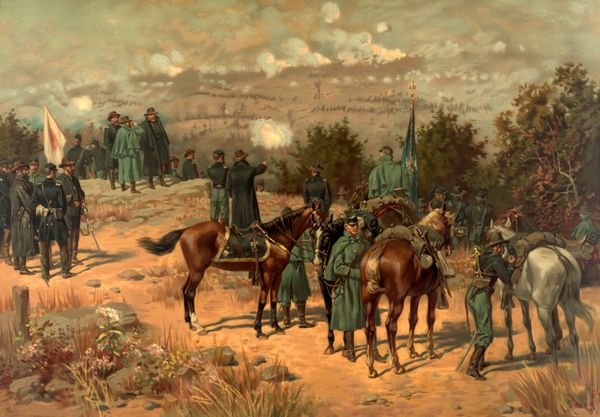
Battle of Chattanooga, L. Prang and Co, 1880.
November 23-25, 1863 – The Rebel siege of Chattanooga, Tennessee, ends as Union forces under General Ulysses S. Grant defeat the siege army of General Braxton Bragg. During the battle, one of the most dramatic moments of the war occurs. Yelling “Chickamauga! Chickamauga!” Union troops avenged their defeat at Chickamauga by storming up the face of Missionary Ridge without orders and sweeping the Rebels from what had been thought to be an impregnable position. “My God, come and see ’em run!” a Union soldier cries.
March 9, 1864 – President Abraham Lincoln appointed General Ulysses S. Grant to command all of the armies of the United States. General William T. Sherman succeeds Grant as commander in the West.
May 4, 1864—The beginning of a massive, coordinated campaign involving all the Union Armies. In Virginia, General Ulysses S. Grant, with an Army of 120,000, begins advancing toward Richmond to engage Lee’s Army of Northern Virginia, now numbering 64,000. This marks the beginning of a war of attrition that will include major battles at the Wilderness (May 5-6), Spotsylvania (May 8-12), and Cold Harbor (June 1-3).
In the west, General William Sherman, with 100,000 men, began an advance toward Atlanta to engage Joseph E. Johnston’s 60,000-strong Army of Tennessee.
May 5–6, 1864 – The Battle of the Wilderness in Virginia is the first of a bloody series of month-long engagements between General Ulysses S. Grant and Lee.
May 10–12, 1864 – Battles at Spotsylvania Court House and Yellow Tavern impede General Ulysses S. Grant’s drive for Richmond. Confederate cavalry commander Jeb Stuart is killed at Yellow Tavern on May 11.

Battle of Cold Harbor, Virginia.
June 1-3, 1864 – A costly mistake by General Ulysses S. Grant resulted in 7,000 Union casualties in 20 minutes during an offensive against fortified Rebels at Cold Harbor in Virginia. Grant lost over 7,000 men in 20 minutes. Although Lee suffered fewer casualties, his army never recovered from Grant’s continual attacks. This was Lee’s last clear victory of the war. Grant prepares for a ten-month siege of Petersburg.
June 15, 1864 – Union forces miss an opportunity to capture Petersburg and cut off the Confederate rail lines. As a result, a nine-month siege of Petersburg begins with General Ulysses S. Grant’s forces surrounding Robert E. Lee and his men.
June 19, 1864 – The USS Kearsarge sinks the CSS Alabama off Cherbourg, France, where the Confederate raider was bound for refitting.
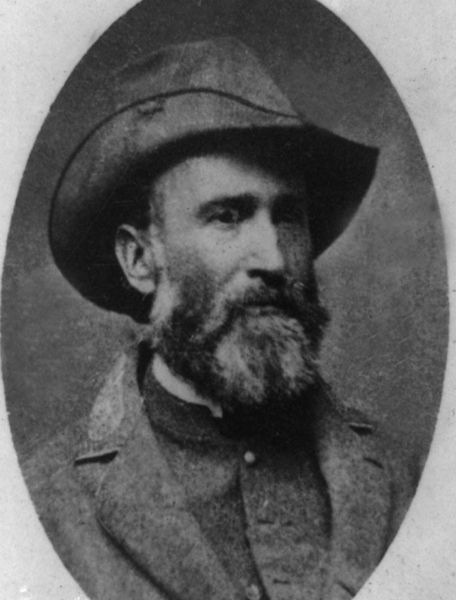
Jubal A. Early.
July 1864 – Confederate General Jubal Early led his forces into Maryland to relieve the pressure on Lee’s army. Early got within five miles of Washington, D.C., but on July 13, he was driven back to Virginia.
July 11-12, 1864 – Confederate forces under Jubal Early probe and fire upon the northern defenses of Washington, D.C., throwing the Capital into a state of high alert.
June 28, 1864 – President Abraham Lincoln signed a bill repealing the Fugitive Slave Laws.
July 20, 1864 – At Atlanta, Sherman’s forces battle the Rebels now under General John B.Hood, who replaced Johnston.
August 5, 1864 – Union Admiral David G. Farragut wins the Battle of Mobile Bay.
August 29, 1864 – Democrats nominate George B. McClellan for president to run against Republican incumbent Abraham Lincoln.
Battle of Atlanta, July 22, 1864, by Kurz & Allison,1888.
September 2, 1864 – Sherman’s Army captured Atlanta. “Atlanta is ours and fairly won,” Sherman telegraphs President Abraham Lincoln. The victory greatly helps Abraham Lincoln’s bid for re-election.
October 19, 1864 – A decisive Union victory by Cavalry General Philip H. Sheridan in the Shenandoah Valley over Jubal Early’s troops.
November 8, 1864 – After three and a half months of incessant maneuvering and much hard fighting, Sherman forced Hood to abandon Atlanta, the munitions center of the Confederacy. Sherman remained there, resting his war-worn men and accumulating supplies, for nearly two-and-a-half months. During the occupation, George N. Barnard, the official photographer of the Chief Engineer’s Office, created the most comprehensive documentary record of the war in the West. Much of what he photographed was destroyed in the fire that spread from the military facilities blown up upon Sherman’s departure.
General William T. Sherman’s March to the Sea.
Abraham Lincoln was re-elected president, defeating Democrat George B. McClellan. Lincoln carried all but three states with 55 percent of the popular vote and 212 of 233 electoral votes. “I earnestly believe that the consequences of this day’s work will be to the lasting advantage, if not the very salvation, of the country,” Lincoln told supporters.
November 15, 1864 – After destroying Atlanta’s warehouses and railroad facilities, Sherman, with 62,000 men, began a March to the Sea. President Abraham Lincoln approved the idea after consulting with General Ulysses S. Grant. “I can make Georgia howl!” Sherman boasts.
November 16, 1864 – Sherman leaves Atlanta and begins his “march to the sea,” attempting to demoralize the South and hasten surrender.
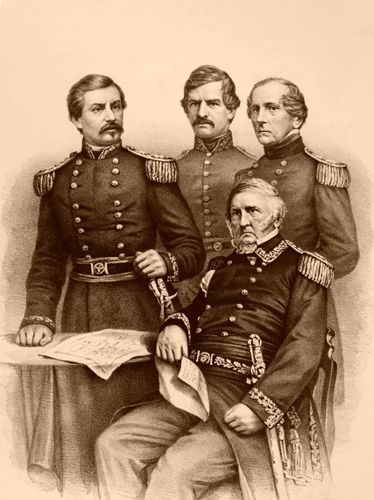
Union Generals Winfield Scott, George McClellan, Nathaniel Banks, and John Wool, by B.B. Russell, 1861.
December 15-16, 1864 – Hood’s Rebel Army of 23,000 is crushed at Nashville, Tennessee, by 55,000 Federals, including African American troops under General George H. Thomas. The Confederate Army of Tennessee ceases as an effective fighting force.
Did You Know?
- More than three million men fought in the war.
- Two percent of the population — more than 620,000 — died in it.
- The chance of surviving a wound in Civil War days was 7 to 1.
- The first organized ambulance corps was used in the Peninsular campaign and Antietam.
- President Abraham Lincoln did not believe that whites and blacks could live together in peace. He had planned to relocate the entire black population of the United States to Central America.
December 21, 1864 – Sherman reaches Savannah, Georgia, leaving behind a 300-mile path of destruction 60 miles wide from Atlanta. Sherman then telegraphs Lincoln, offering him Savannah as a Christmas present.
January 31, 1865 – The U.S. Congress approved the Thirteenth Amendment to the United States Constitution to abolish slavery. The amendment is then submitted to the states for ratification.
February 3, 1865 – A peace conference took place as President Lincoln met with Confederate Vice President Alexander Stephens at Hampton Roads, Virginia, but the meeting ultimately failed, and the war would continue.
Only General Robert E. Lee’s Army at Petersburg and Johnston’s forces in North Carolina remain to fight for the South against Northern forces, now numbering 280,000 men.
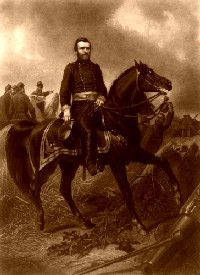
Ulysses S. Grant in the Civil War, By Schussele, 1866.
March 4, 1865 – Inauguration ceremonies occur for President Abraham Lincoln in Washington. “With malice toward none; with charity for all…let us strive on to finish the work we are in…to do all which may achieve and cherish a just, and a lasting peace, among ourselves, and with all nations,” Lincoln says.
March 25, 1865 – General Robert E. Lee launched the last major offensive when he attacked General Ulysses S. Grant’s forces near Petersburg, but was defeated. He attempted to attack again on April 1, but was defeated once more. On April 2, Lee evacuated Richmond, the Confederate capital, and headed west to join with other forces.
April 2, 1865 – General Ulysses S. Grant’s forces begin a general advance and break through Lee’s lines at Petersburg. Confederate General Ambrose P. Hill is killed. Lee evacuates Petersburg. The Confederate Capital, Richmond, is evacuated. Fires and looting break out. The next day, Union troops enter and raise the Stars and Stripes.
April 4, 1865 – President Abraham Lincoln tours Richmond, where he enters the Confederate White House. With “a serious, dreamy expression,” he sits at Jefferson Davis’ desk for a moment.
April 9, 1865 – General Robert E. Lee surrenders his Confederate Army to General Ulysses S. Grant at the village of Appomattox Court House in Virginia. Grant allows Rebel officers to keep their sidearms and permits soldiers to keep horses and mules. Lee tells his troops: “After four years of arduous service marked by unsurpassed courage and fortitude, the Army of Northern Virginia has been compelled to yield to overwhelming numbers and resources.”
“No man can put a chain about the ankle of his fellow man without at last finding the other end fastened about his own neck.”
– Frederick Douglass, American Abolitionist and former slave
April 10, 1865 – Celebrations break out in Washington, D.C.
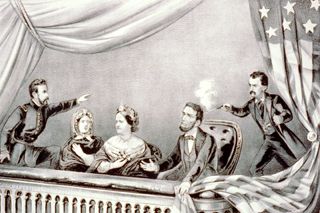
The Assassination of President Lincoln, by Currier and Ives, 1865.
April 14, 1865 – The Stars and Stripes is ceremoniously raised over Fort Sumter, South Carolina. That night, Lincoln and his wife, Mary, saw the play “Our American Cousin” at Ford’s Theater. At 10:13 p.m., during the play’s third act, John Wilkes Booth shoots President Abraham Lincoln in the head. Doctors attend to President Lincoln in the theater and then move him to a house across the street. He never regains consciousness.
April 15, 1865 – President Abraham Lincoln dies at 7:22 a.m. Vice President Andrew Johnson assumes the presidency.
April 18, 1865 – Confederate General Joseph E. Johnston surrenders to Sherman near Durham, North Carolina.
April 26, 1865 – John Wilkes Booth is shot and killed in a tobacco barn in Virginia.
May 4, 1865 – President Abraham Lincoln was laid to rest in Oak Ridge Cemetery outside Springfield, Illinois.
May 1865 – The remaining Confederate forces surrender. The Nation is reunited as the Civil War comes to an end. Over 620,000 Americans died in the war, with disease killing twice as many as those lost in battle. Fifty thousand survivors return home as amputees.
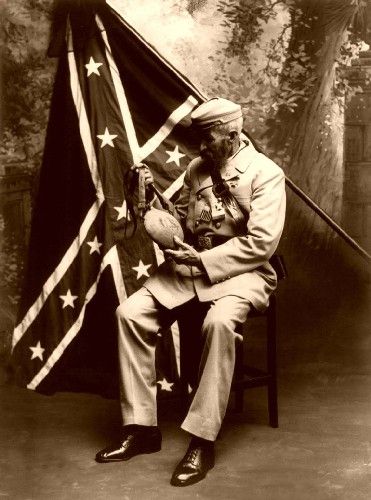
Conquered Banner of the Confederacy.
November 10, 1865 – Captain Henry Wirz, the notorious superintendent of the Confederate prison at Andersonville, Georgia, was tried by a military commission presided over by General Lew Wallace from August 23 to October 24, 1865. He was hanged in the yard of the Old Capitol Prison on November 10.
December 6, 1865 – The 13th Amendment to the United States Constitution, which abolished slavery, was passed by the United States Congress on January 31, 1865.
Compiled by Kathy Alexander/Legends of America, updated October 2025.
Also See:
Slavery – Cause and Catalyst of the Civil War
See Sources.