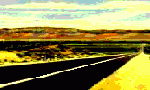
It is a nine-foot-wide road between Miami and Afton, Oklahoma. Kathy Alexander.
Though all eight states along historic Route 66 take pride in their piece of the pavement, Oklahoma seems to do it best. Perhaps that is as it should be, given that the Mother Road was born in Oklahoma when Cyrus Avery of Tulsa conceived the idea of linking Chicago to Los Angeles. Moreover, Oklahoma has more miles of the original highway than any other state; it was the first to install historical markers along the old route, the first to have a state-sponsored Route 66 museum, and ironically, the first to lose part of the original road when I-44 barreled through, dealing a deathblow to many service businesses between Tulsa and Oklahoma City.
In addition to the many signs promoting the Mother Road, you will see dozens of billboards proudly showcasing the state’s Native American heritage. Just a little more than a century ago, the state was the last haven for numerous Indian tribes before this land, too, was taken from them during the 1890s Oklahoma land rush.
We see those Oklahoma people vividly when we think of early Route 66. Most of the 200,000 people fled from Oklahoma, escaping the towering black clouds of the Dust Bowl. Headed west in overheated old trucks topped with tattered mattresses, they migrated along the Mother Road to California, seeking to make a better life.
Oklahoma is also home to the National Highway 66 Association, which promotes the Mother Road across all eight states, and the International Route 66 Festival is held annually each June in Tulsa.
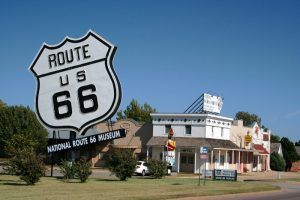
National Route 66 Museum, Elk City, Oklahoma, by the Federal Highway Administration.
This road, which evolved from the early wagon trails of the 1800s, cuts a diagonal path through the rolling hills of northeast Oklahoma to the state’s center before heading westward to the Texas Line. Along the way, the Mother Road provides an abundance of vintage buildings, roadside attractions, and friendly people who are more than ready to share their experiences of the old Mother Road.
Though Route 66 is closely aligned with I-44 and I-40 across the state, you can travel almost the entire path on the vintage highway, jogging over and under the interstates. Most of the old Route 66 is designated as a state highway from the Kansas State Line to El Reno.
As you begin your journey, you will first come to the small town of Quapaw, which displays several lovely murals on its buildings and is home to the Spooklight, a dancing ball of light seen on a bluff called Devil’s Promenade. Then, through man-made mountains of chat, left over from the profitable lead and zinc mining era to nearby Commerce, the hometown of Mickey Mantle.
Soon, you will come to Miami, the first town established in Indian Territory, where you will see the beautiful Coleman Theatre, built in 1929. Just outside Miami is the last section of the original nine-foot-wide “Ribbon Road,” listed as an Oklahoma National Historic Landmark. This remarkable piece of vintage pavement zigzags 13 miles between Miami and Afton.
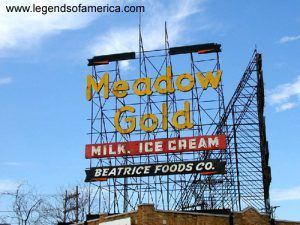
This picture of the Meadow Gold Sign in Tulsa, Oklahoma, was taken on June 13, 2004, just three days before it was taken down. It was later moved down the street and is part of a city park. Photo by David Alexander.
When you reach Afton, this small town provides a vintage peek at what Route 66 must have been like long ago when you spy the remains of Rest Haven Motel and the restored Afton Station. In Vinita, satisfy your hunger at Clanton’s Café, operated by generations of the same family. Vinita starts you on a trail through several small towns, including White Oak, Chelsea, and Foyil, where an excellent side trip presents itself to Ed Galloway’s Totem Pole Park, four miles east of town. Here, you can see the world’s largest concrete totem pole, built over eleven years from 1937 to 1948, along with a wide array of other folk art sculptures.
Continue through Claremore, the hometown of Will Rogers, on your way to Catoosa, where the old Blue Whale attraction is a must-see. Once a stand-alone town outside of Tulsa, Catoosa is now but a suburb of the quickly growing “Tulsey Town.” Tulsa provides many views of the old Mother Road with vintage motels dotting 10th and 11th streets and art deco buildings downtown.
Beyond Tulsa, Route 66 provides another stretch of small towns, including Sapulpa, home of the original Rock Creek Bridge, Kellyville, and Bristow, where you can chow down on a delicious pork rib dinner plate at Russ’ Ribs.
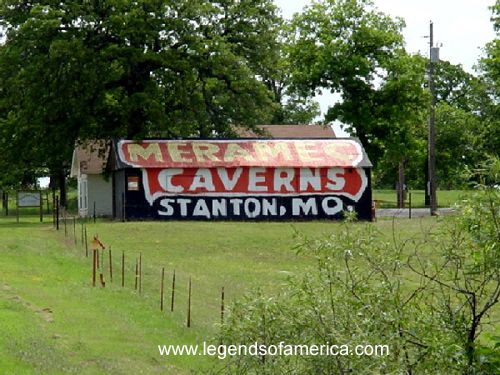
Meramec Caverns just west of Chandler, Oklahoma, by Kathy Alexander.
Nearby, Depew offers a view of several vintage buildings in its tiny downtown district before entering Stroud, home to an old Route 66 icon, the Rock Cafe. Soon, you will pass through Davenport before rolling into Chandler, the town of the last old-west gunfight that took the life of lawman Bill Tilghman. You can also see the old Lincoln Motel, established in 1939, and a restored Phillips 66 cottage-style station. An old Meramec Caverns barn is west of town, the last on Oklahoma’s Mother Road.
The towns of Warwick, Wellston, and Luther provide several vintage peeks at old stations and tourist camps before entering Arcadia, the city of the Round Barn. Built in 1898, the Arcadia Round Barn is the most photographed sight on Mother Road.
At Edmond, the suburbs of Oklahoma City begin. Not long ago, the Mother Road passed by the oil rigs of Oklahoma’s state capital. As you head out of the city, several old motels and restaurants appear.
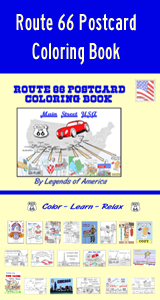
Route 66 Postcard Coloring Book, available at Legends’ General Store.
The path soon finds you riding atop the Overholser Steel Truss Bridge in Bethany before entering Yukon, Garth Brooks’ hometown. At El Reno, you will cross the old Chisholm Trail before entering more small towns – Calumet, Geary, and Bridgeport, now an official ghost town.
Nearby Hydro is home to Lucille Hamons Station, built in 1927. Lucille was called the Mother of the Mother Road, having run the station and store for 59 years until her death.
Soon, you will pass through Weatherford on your way to Clinton, where the first state-operated Route 66 Museum is located. It was also here that Elvis Presley once stayed at the Trade Winds Courtyard Inn.
Next, the ghost town of Foss comes into view before heading west through Canute on your way to Elk City, which offers another great Route 66 Museum at the Old Town Museum complex. The Beckham County Courthouse appeared in the movie The Grapes of Wrath near Sayre.
I-40 killed two more Route 66 towns, those of Hext and Texola, on either side of Erick, Roger Miller’s hometown.
Traveling the Mother Road through Oklahoma provides an array of restaurants, architectural styles, historic buildings, and ruins through its quaint small towns and metro cities. Enjoy its open stretches, winding roads, and many parks and lakes before heading onto the staked plains of Texas.
©Kathy Alexander/Legends of America, updated November 2025.
See Sources.